Restoration of Ellis Class IV Fracture with Fiber Post
Department Of Conservative Dentistry & Endodontics K. D. Dental College & Hospital, Mathura
ABSTRACT
Restoring teeth following root canal therapy can present challenges particularly when significant amounts of tooth structure have been lost. The use of metal or non-metal posts and cores has been used to support restoration. More and more endodontically treated teeth are being restored using fiber reinforced composite posts (fiber posts), primarily because they are safer, more easily removed, aesthetic, conserve tooth structure, and provide improved fracture resistance to these compromised teeth. Fiber posts are (optimally) placed using a bonding agent, followed by resin cement (preferably dual cure) and a composite for the core build-up. Brief exposure of light-cure energy from the occlusal aspect will initiate the cement catalysts. While polymerization will continue below the surface for a few minutes, the clinician can go directly to the placement of the core without waiting. This leaves clinicians with an opportunity to facilitate better care, expand our options, respect the tooth structure, and save us time, through the important concepts and benefits that follow.
INTRODUCTION
Restoration of the endodontically treated tooth is very important as it has impact on the long-term prognosis of tooth. The root canal treated tooth is mostly associated with the loss of coronal and radicular tooth structure from preexisting restorations, restorative failures, trauma, dental caries, and endodontic access preparation. When a huge amount of the clinical crown has been lost due to damage, it is often impossible to achieve the sufficient anchorage of a restoration in the remaining dentin. This hard tissue tooth structure leads to decreased occlusal load carrying capacity of the root canal treated tooth. Therefore, posts are essentially indicated for the root canal treated teeth to prevent fracture of the remaining tooth structure and to prevent tooth loss.1
Traditionally, prefabricated posts were made with metal, which are at times visible through the structure of ETT especially in the anterior region.2 Metallic materials have much higher moduli of elasticity than that of the supporting dentin, this mismatch in the moduli could lead to stress concentrating in the cement lute, leading to its failure. This has led to a search for a plastic-based material that has a modulus closer to that of dentin.3
In 1990 Duret et al. described a non-metallic material for the fabrication of posts based on the carbon-fibre reinforcement principle. Laboratory-based studies have shown that these posts have a high tensile strength4 and modulus of elasticity, similar to dentine.5
Currently available fibre-based posts are essentially composite materials. They are composed of fibres of carbon or silica surrounded by a matrix of polymer resin, usually an epoxy resin.6
The article highlights a case report of the effective management of endodontically treated with fibrepost, followed by all ceramic crown.
CASE REPORT
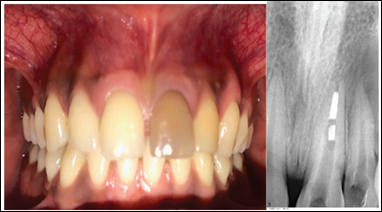
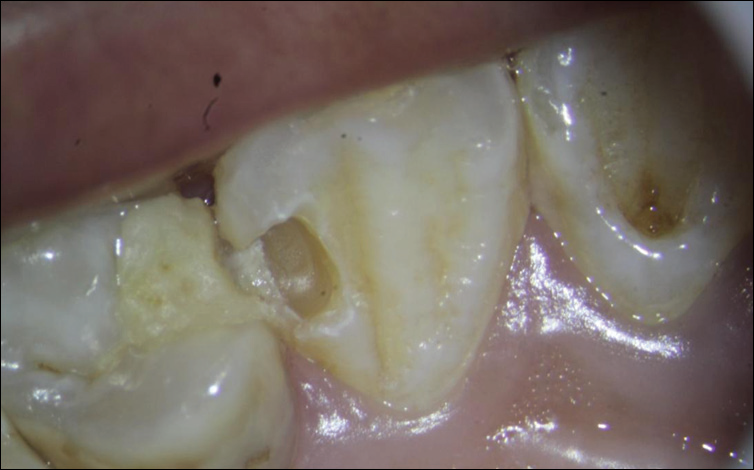
A 26 year old male patient reported to our department with the chief complaint of broken teeth in upper front region of mouth since 3 months. Patient gave history of trauma 3 months back. Electric pulp testing revealed Elli’s class IV fracture in relation to 22. Radiographic finding showed presence of periapical radiolucency in relation to 22 (Fig.1). Medical history was non contributary. Based on patients demand fibrepost followed by all ceramic crown was indicated.
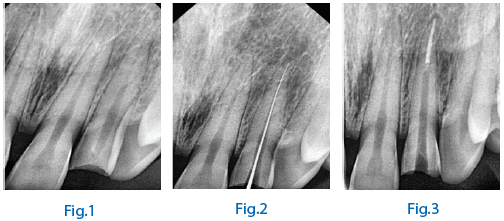
Access opening was done in relation to 22. Working length was determined with no. 10 k file (Dentsply) (Fig. 2). BMP was done till 55 no. K file with copious irrigation with 3%NaOCl and 17% EDTA. Caoh was given as an intracanal medicament and patient was recalled after one week. Sectional obturation was done followed by post space preparation till No. 3 peeso reamer (Mani)(Fig. 3).
Post space was etched with 37% phosphoric acid for 15 seconds and then rinsed. Bonding agent was applied in the canal for 10 seconds and air dried (Fig.4&5).

Fig.4
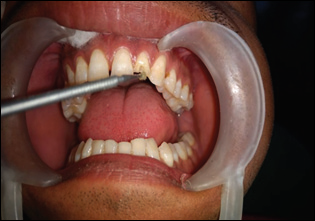
Fig.5
Bonding agent was applied on fibrepost. Dual core cement (DMG Luxacore Z) was placed inside the canal along with fibrepost and cured for 15 seconds (Fig. 6&7).
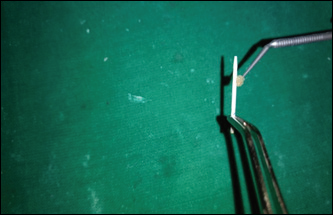
Fig.6

Fig.7
Composite build was done, followed by all ceramic crown cutting in relation to 22 (Fig. 8&9).
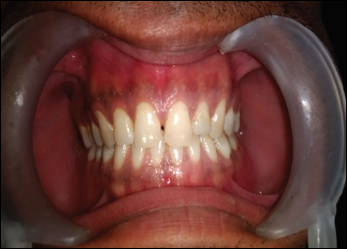
Fig.8

Fig.9
Putty impression was taken and after 2 days crown cementation was done (Fig. 10& 11).

Fig.10

Fig.11
DISCUSSION
A various post and core systems have been investigated till date for the restoration of the root canal treated tooth. In fact, post failure and prosthetic failure have been cited as the most common cause of failure in endodontically treated teeth.
Traditionally, prefabricated posts were made with the metal, which sometimes visible through the structure of endodontically treated teeth commonly in the anterior region. Carbon fiber post is among the many prefabricated fiber post and core systems which were introduced to reduce the failure rate of post-retained restored teeth. In addition, quartz and glass fiber posts embedded in a filled resin matrix have been developed to fulfill esthetic requirement.1
Fiber post itself is a new advancement in the field of dentistry. The unfavorable transmission of stress from post to tooth structure resulting from the high modulus of elasticity of the metal post leading to frequent decementation or even fracture of the tooth can be attributed for failure of the metal post system. This led to decreasing preference of metal post and rising popularity of fiber posts.6
The few clinical trials that have been published, suggest, at least in the short term, reasonable success for fibre-based post restorations. The authors feel however that before these posts are adopted fully in the clinical practice, high quality randomised controlled prospective clinical trials are necessary, investigating the success of fibre-based post restorations.7 Various other treatment options can also be taken into consideration like luminex post, Edelweiss post and core and Richmond crown.
REFERENCES
- Roshan Uthappa, Deepika Mod, Pranav Kharod. Comparative evaluation of the metal post and fiber post in the restoration of the endodontically treated teeth. Journal of dental research and review 2015.
- El-Ela OA, Atta OA, El-Mowafy O. Fracture resistance of anterior teeth restored with a novel nonmetallic post. J Can Dent Assoc 2008;74:441.
- Preethi G, Kala M. Clinical evaluation of carbon fiber reinforced carbon endodontic post, glass fiber reinforced post with cast post and core: A one year comparative clinical study. J Conserv Dent 2008;11:162-7
- King PA, Setchell DJ. An in vitro evaluation of a prototype CFRC prefabricated post developed for the restoration of pulpless teeth. J Oral Rehabil 1990; 17: 599– 609.
- Asmussen E, Peutzfeldt A, Heitmann T. Stiffness, elastic limit, and strength of newer types of endodontic posts. J Dent 1999; 27: 275– 278.
- Aashwini Lamichhane1, Chun Xu1,2, Fu-qiang Zhang. Dental fiber-post resin base material: a review
- G. Bateman, D. N. J. Ricketts and W. P. Saunders.Fibre-based post systems: a Review
Disclaimer from Guident
The views and opinions expressed in articles published in Guident are solely those of the authors and do not necessarily reflect the views of the editors, the editorial board or the publisher, Ivory India. Guident does not endorse any product, technique or treatment described. Clinical content is intended for qualified dental and medical professionals and is not a substitute for individual clinical judgement. Guident, its editors and the publisher accept no liability for any consequence arising from the use of information published in the journal.
How to cite this article
Dr. Jaya Srivastava, Dr. Ajay Nagpal, Dr. Rohit Paul. Restoration of Ellis Class IV Fracture with Fiber Post. Guident. 2019 Jan;12(2). Available from: https://guident.in/articles/endodontics/restoration-of-ellis-class-iv-fracture-with-fiber-post.html