Chemo Mechanical Caries Removal- Exploring Minimal Invasive Dentistry
Director, Upskill Dental Academy Mumbai, India
INTRODUCTION
The invention and application of engine driven or rotary instruments in operative treatment of carious lesions has resulted in removal of considerable tooth structure. Since GV Black in 1893, proposed the 'Principle for prevention, the techniques used in caries removal has undergone a lot of development. He had initially proposed that the removal of sound tooth structure at sites that would otherwise encourage stagnation of plaque (like occlusal fissure, approximal contacts, etc.) would help minimize caries onset and progression. However, with the introduction of adhesive materials for restorations, and the advent of minimal cavity design this principle has been challenged and is now considered being too destructive to the tooth structure during caries removal.
The management of cavitated carious lesions focuses on arresting or controlling and including restoring existing lesions through minimal invasive restorative treatments, including repairing rather than replacing old restorations.
For existing carious lesions different lesion stages and activities might require different management, all of which should aim toward
- control of the disease process
- preservation of dental hard tissue
- avoidance of initiating the cycle of restoration
- preservation of the tooth as long as possible
The decision of how to manage with what technique becomes most important.
For example, non cavitated lesions can be managed by removal of biofilms, remineralisation or by sealants for occlusal surfaces.
But for proximal surfaces other methods or sealing or by resin infiltration. Non cleansable cavitated lesions which are considered active require restorative options.
Removal of carious tissue requires us to
- always preserve non demineralised tissue
- place the peripheral margin of the restoration always onto sound dentine and enamel
Certain factors which satisfy both operator and the patient must be fulfilled by the ideal cutting instruments which include:
- Ease and comfort of use
- Ability to Identify, discriminate & remove the involved tissue
- Requiring minimal pressure and at the same time being painless and silent
- Being able to generate the minimal amount of vibration or heat during use
- Excavators, handpieces and burs
- It is a known fact that the rotary bur is in universal use. Having said this there are problems that need to be overcome. There are a few factors which are potentially responsible for the pain and discomfort which is associated with cavity preparation which include,
- Sensitivity - Pressure sensation on the tooth
- Bone conducted noise & vibration
- High pitched noise of air turbine hand piece
- High temperature build up
AIR POLISHING
- This is a process of adding tricalcium phosphate (to improve the flow) to water soluble particles of sodium bicarbonate and applying this mix to the tooth surface using air pressure coupled with a concentric water jet which is the contrasting difference between this technique and air abrasion. The interesting fact that the abrasive is water-soluble ensures that it does not escape from the operating field. But as this is non selective, its overzealous use could easily remove a considerable amount of tooth structure especially in the cervical margin.
ULTRASONIC INSTRUMENTATION:
- The possibility of using an ultrasonic instrument for cutting tooth tissue was indicated the studies by Nielsen et at in the 1950's. A magnetostrictive instrument with a 25KHz oscillating frequency was developed for this purpose which was used in conjunction with a thick aluminium oxide and water slurry. The kinetic energy of the water molecules was transferred to the tooth surface via the abrasive through high speed oscillations of the tip. However the results were inconclusive due to erratic and unpredictable performance of the instrument.
SONO-ABRASION:
- It is the use of high frequency, sonic, air-scalers with modified abrasive tips. Favorable results from laboratory studies using sono-abrasion to remove softened, carious dentine have indicated possible use for this technique in the future.1
CHEMO MECHANICAL CARIES REMOVAL SYSTEM:
- Chemo mechanical caries removal is an excellent method for minimally invasive caries excavation, and the removal agents are either sodium hypochlorite (NaOCl)- or enzyme-based. The chemical-mechanical removal agents appeared in 1972 and are characterized by the ability to dissolve organic matter from the action of chemicals on carious dentin, resulting in the dissolution of the softened tissue.
MECHANISM OF ACTION
- Proteolysis to remove the infected
- Collagen tissue in decayed tooth structure
- Less dissolution of active principle by oral fluids
- Greater anti bacterial & anti fungal potency
- With an increased antiseptic effect2
CASE REPORT
A 32 year old female patient reported to clinic .she complained of sensitivity to cold in maxillary left anterior region.upon clinical examination a debonded composite restoration was found on tooth 23 ,which upon probing completely dislodged from the distall proximal aspect, it showed presence of secondary caries.a radiograph was taken to estimate the extent of carious damage.the radiograph revealed sufficient dentin around the pulp chamber.
Management
a decision was taken to remove old fractured restoration .atraumatically remove secondary caries using chemo mechanical caries removal agent.replace with a direct composite restoration.
TOOTH NO 23
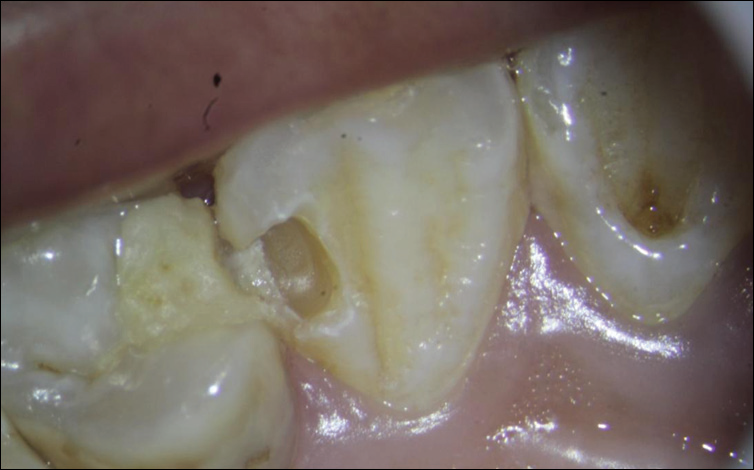
SECONDARY CARIES ON DISTAL PROXIMAL WALL
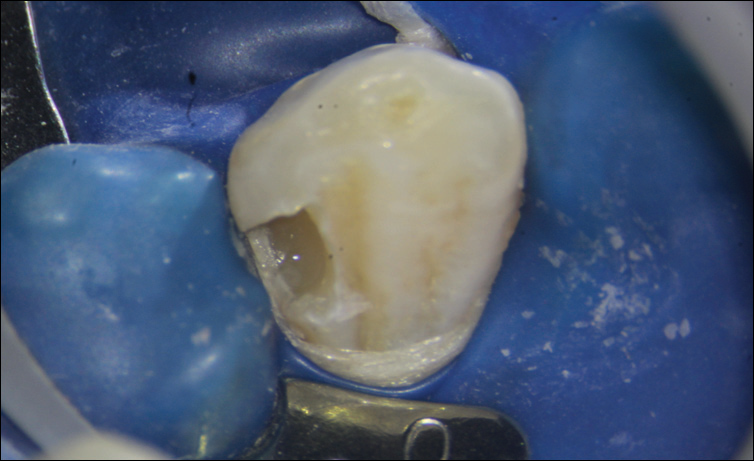
RUBBER DAM ISOLATION
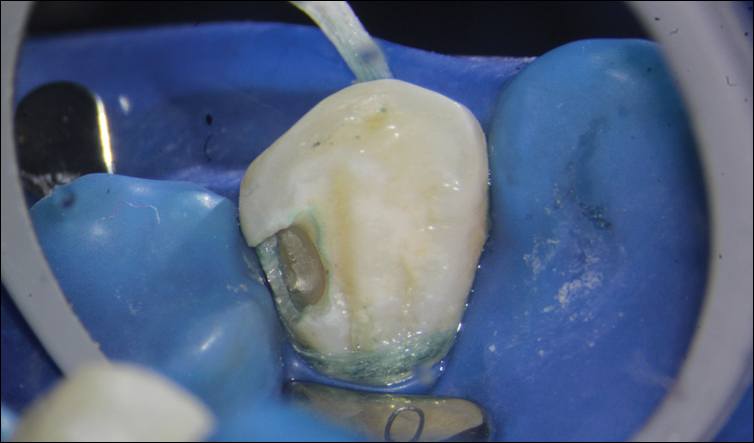
APPLICATION OF CARIES DISCLOSING AGENT

BRIX3000 APPLIED FOR 3 MINUTES
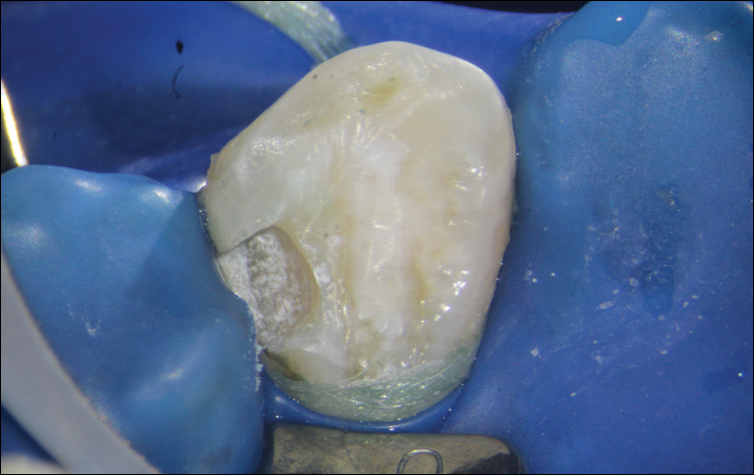
CARIES EXCAVATED WITH A SPOON EXCAVATOR
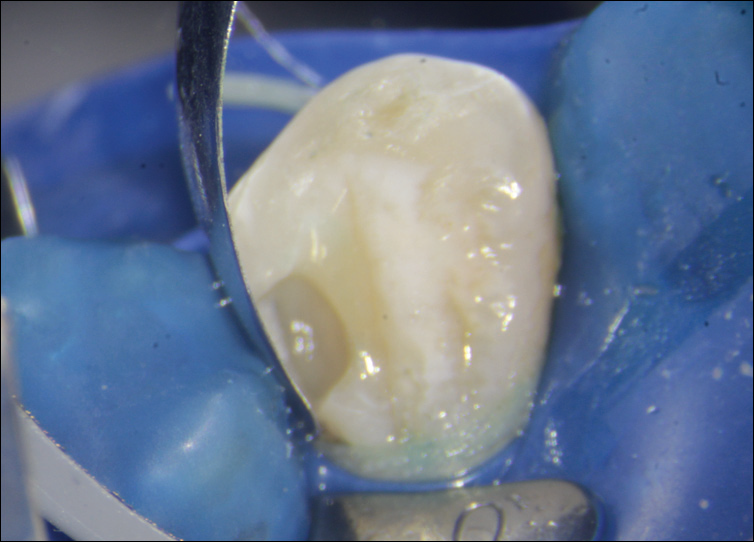
RESTORATIVE PHASE-APPLICATION OF MATRIX BAND & RETAINER
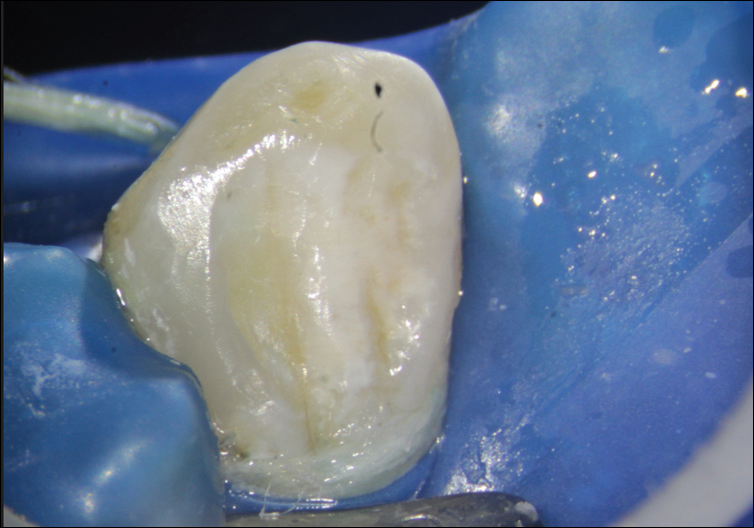
COMPLETED RESTORATION
DISCUSSION
Management of dental caries conservatively is a delicate balance achieved with proper use of techniques along with use of magnification to evaluate the carious tooth .Application of chemo mechanical caries removing agent along with the aid of magnification is one of the simplified, effective and accomplished techniques for the same. This method of caries removal exhibits high patient comfort level, precise control, atraumatic and extremely useful in anxious, disabled and also in pediatric patients.3
REFERENCES
- 1Chemomechanical Caries Removal: A Review & Study of an Indigen- ously Developed Agent (Carie Care™ Gel) In Children .Journal of International Oral Health.July- August 2013; 5(4):36-42 [ 36 ]
REVIEW ARTICLE
Care™ Gel) In Children. J Int Oral Health 2013; 5(4):36-42.
Karthik Venkataraghavan, Anil Kush, C S Lakshminarayana, Latha Diwakar, Puja Ravikumar, Shankargouda Patil, Sandhya Karthik
2. Klissia Romero Felizardoa ; Nayara Priscila de Alvarenga Barradasa ; Gabriella Fernanda Guedesa ; Fernanda da Conceição Antônio Ferreirab ; Murilo Baena LopesbUse of BRIX-3000 Enzymatic Gel in Mechanical Chemical Removal of Caries: Clinical Case Report,J Health Sci 2018;20(2):87-93
3. H Hamama,C Yiu,M Burrow,Current Update of Chemo Mechanical Caries Removal Methods ,Australian Dental Journal 2014:59;446-456
Disclaimer from Guident
The views and opinions expressed in articles published in Guident are solely those of the authors and do not necessarily reflect the views of the editors, the editorial board or the publisher, Ivory India. Guident does not endorse any product, technique or treatment described. Clinical content is intended for qualified dental and medical professionals and is not a substitute for individual clinical judgement. Guident, its editors and the publisher accept no liability for any consequence arising from the use of information published in the journal.
How to cite this article
Dr. Pavana Kamath. Chemo Mechanical Caries Removal- Exploring Minimal Invasive Dentistry. Guident. 2019 Feb;12(3). Available from: https://guident.in/articles/endodontics/chemo-mechanical-caries-removal-exploring-minimal-invasive-dentistry.html