
One Day Denture Camps - the Jewel in the Crown
Department of Prosthodontics A.B. Shetty Memorial Institute of Dental Sciences, Nitte University, Deralakatte, Mangalore, India
Abstract
One Day Denture Camp is a unique community programme of the Department of Prosthodontics, A.B. Shetty Memorial Institute of Dental Sciences, A Constituent College of Nitte University, Mangalore. It is the first of its kind in India, to deliver oral and dental care for the masses at their doorsteps, free of cost, for the rural and semi urban population under institutionalized approach. This article gives an overview of treatment procedures and management of single day complete denture camps.
Keywords: Complete dentures, Community programme, Denture camps, One day Dentures.
INTRODUCTION
Prior to the advent of modern medicine and technology, loss of life could occur from what may seem, today, as trivial injuries and diseases. Advances in medicine have made higher average life expectancy possible.
Thus the proportion of older people continues to grow worldwide, especially in developing countries. Approximately 600 million people are aged 60 years and above, and this number by 2050, it will be 2 billion, 80% living in developing countries.1 The loss of few or all natural teeth with the passage of time, severely handicaps the elderly.
The stomatognathic system comprises of the temperomandibular joint, the muscles of mastication and the oral cavity. These three components work together as a well-oiled machine to enable basic functions of mastication, speech, and deglutition. The loss of teeth handicaps this system and the basic functions cannot be executed with ease.Many studies have been conducted in the past to understand and cater the problems of tooth loss. These studies have concluded such subjects, having less confidence, restricting social activities, and interpersonal relationships.2
Epidemiological studies also show that persons of low social class or income and individuals with little or no education are more likely to be edentulous than persons of high social class and high levels of income and education and this in turn points to the population in the rural and semi urban areas of India. The stomatognathic system can be restored and the subject can be successfully rehabilitated with the complete denture prosthesis.
PHILOSOPHY &CONCEPT:
Life is a struggle for the elderly, from performing simple daily routines to coping with their health issues. Complete denture prosthesis requires at least 5 to 6 clinical appointments for its fabrication and follow up. An elderly person has to brave many difficulties in travelling from distant rural and semi urban areas to the dental office.
How to provide complete denture prosthesis to the public in a way that condenses the appointments without compromising on the quality of treatment?
The concept of One Day Denture Camp was the brainchild of Prof (Dr.) N. Sridhar Shetty, Founder Dean of A.B.Shetty Memorial Institute of Dental Sciences.Way back in 1987, he was seized with an idea that lit the way for a new beginning. An idea, which could provide a simple solution catering to the needs of both, the rural and Semi urban population. This idea took shape in 1990 at Uppinangadi and forged ahead to mark the beginning of the 46 one day denture camps over a span of over 23 years, from 1990 till present.
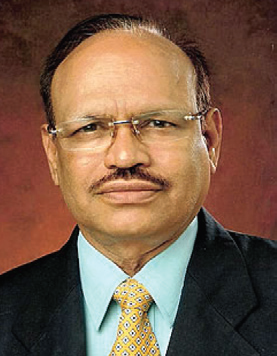
Prof. (Dr.) N. Sridhar Shetty Founder Dean, ABSMIDS
The One Day denture camp was the only logical solution that emerges from this discussion. A group of trained and dedicated doctors from a teaching hospital take up the cause as their moral obligation and duty. They travel to the rural area and the treatment is carried out scientifically and the fit and insertion of the prosthesis is done on the same day. The number of professionals, the heavy duty machinery and the technical help can all be mustered only by a teaching institution and hospital. At the end of one day, the patients are rehabilitated without the undue exertion.
PROCEDURE
The undertaking of a large venture, such as a one day denture camp, free of cost for patients, requires adequate equipments, instruments and man power. The publicity and the venue are arranged in association with other supporting organizations such as Rotary clubs or NGOs.
The venue should have basic amenities such as chairs for patients, clean water, provision for separate areas for lab and clinical work, sufficient light and ventilation, conveyance and food for the patients and the working team.The institution provides for the trained doctors, the heavy duty machinery and other equipment and dental instruments, and the technician support. The material expenses and financial concerns are borne by the institution as a charity.
Thus, the institution along with the coordination skills of an organization, can undertake a venture such as a one day denture camps. The camps can be organized to treat minimum of thirty patients and a maximum of hundred patients or more. About fifty patients can be easily managed with adequate manpower at a One day denture camp. The Department of Prosthodontics, A.B.Shetty Memorial Institute of Dental Sciences has successfully treated up to 175 patients and fit and insertion of complete dentures done in a single day at Chintamani, in the year 1994.
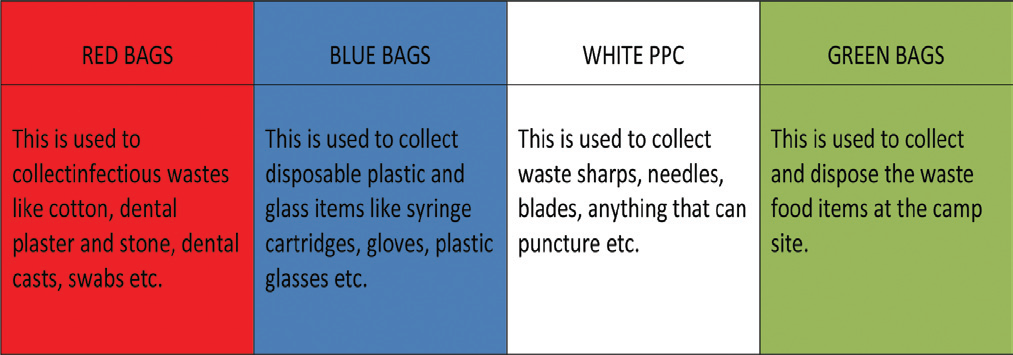
In this day and age, where environmental awareness and hospital waste management is of paramount importance, the one day denture camp also has to comply by the standards of infection control and hygiene protocol. Disposable latex gloves, mouth masks and a doctor’s coat or an apron forms the first line of hygiene and infection control. Spittoons for patients and waste baskets for both clinical and ordinary waste are maintained.
Waste generated is encoded according to its contents and disposed scientifically3.
The institution provides the basic dental materials required for the work at the camp. This includes modeling wax sheets, acrylic resins of both heat and cold cure, dental plaster and dental stone, cold mould seal, acrylic teeth, green stick compound, putty elastomers and the impression materials like Alginate, Zinc oxide euginol impression paste and light body addition silicone.
Heavy duty equipment such as trimmers, lathes, polishing stones, finishing buffs and bench presses are also brought by institution in considerable numbers. Gas cylinders and the required number of Bunsen burners along with the pipe line connections are taken along.
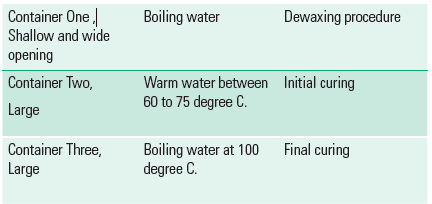
Since it is not feasible to transport an entire dental chair or an acryliser, alternative arrangements are made. An ordinary chair can be used along with backboard to give back and head rest for the patients. Three large vessels can cater to the laboratory needs fulfilled by the acryliser. Each fulfills the following purpose:-
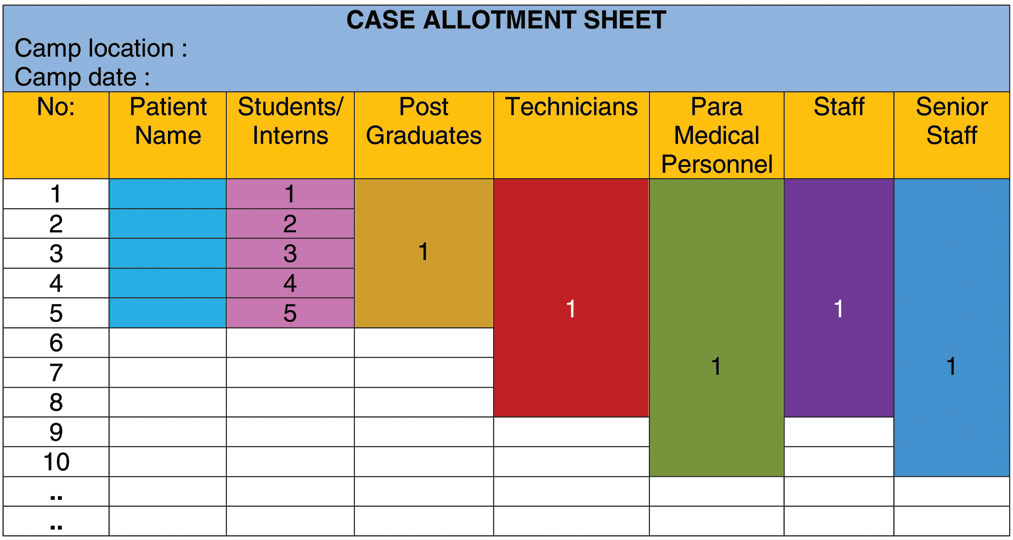
The team of Dental surgeons, technicians and students are tabulated against the number of expected patients at the camp and the schedule is put up well beforehand. Each patient is allotted to one student / intern. Five such patients and students are aided by a post graduate student. For eight patients, one dental technician is allotted and one staff to monitor these cases. For ten patients, one paramedical staff is allotted. Finally one senior staff supervises ten cases. The same format follows depending on the number of patients at the camp. This kind of allotment facilitates better exposure for students and post graduates to fulfill their academic requirements as well.
CLINICAL WORK
PATIENT COUNSELLING:
The doctors have a conversation with the patients making a note of their dental history such as period of edentulousness and the cause for the same, any relevant medical conditions and most importantly the expectations of the patient. The advantages and the limitations of the prosthesis are explained to the patient at the onset to avoid unrealistic expectations by the patient. Informed consent is obtained as a part of treatment protocol.TRAY SELECTION:
Primary stock trays are selected for each, the maxillary and mandibular arch, after preliminary examination of the patient’s oral cavity. The trays are beaded with wax to avoid any sharp edges. The posterior part of the tray is reinforced with modeling wax to cover the Posterior palatal seal area in case of maxillary tray and in case of mandibular tray, proper extension is done to record lateral throat area and to cover the retro molar pad area.Time is of essence while undertaking a project such as a one day denture camp. In a one day denture camp, we have to complete those procedures that require at least 5 clinical appointments, within a single day. Hence management of time is crucial. In accordance to this, the clinical procedures on the maxillary edentulous arch are carried out first, so that the lab procedures for the same are also completed first. The sequence of clinical procedures is explained. (Figure 1.)
PRIMARY IMPRESSION:
Primary impression of the maxillary arch is made with Alginate and sent to the laboratory area to be poured with dental stone. In the meantime, the primary impression of the mandibular arch is made.In the lab area, the primary cast of the maxillary arch is ready. The primary impression for the mandibular arch is poured with dental stone. Wax spacer is adapted and special tray is fabricated on the maxillary cast with self-cure acrylic resin. This is placed in warm water for ten minutes to avoid warpage. Once the primary cast for the mandibular arch sets, the special tray fabrication is carried out.
SECONDARY IMPRESSION:
The special tray for the maxillary arch is checked in the patient’s mouth and overextensions, if any, are trimmed and smoothened. Border moulding is done using low fusing compound such as green stick compound. The tissues (checks and lips) are displaced within physiological limits in order to allow the maximum extension to the denture bearing area without impinging on the oral tissues while in function.The wax spacer is removed and the secondary impression is made with zinc oxide euginol or light body addition silicone. This impression to be poured is given to the laboratory section area. In the meantime, the border molding and secondary impression procedures are carried out for the mandibular arch.
The master cast is obtained from the secondary impression and a temporary denture base is fabricated by using self-cure acrylic resin. An occlusal rim is made out of modeling wax and it follows the shape of the residual ridge of the patient. The same laboratory procedures are carried out on the mandibular master cast.
JAW RELATION:
The jaw relation procedure for the maxillary arch starts with adjustment of occlusal rims for facial fullness, anterior and posterior planes, amount of visibility, the facial midline and canine lines, and smile line is checked, corrected and recorded. Similarly, the adjustments in relation to the mandibular arch are carried out. Here the occlusal plane and visibility is checked with the corner of the mouth. The vertical dimension is determined and adequate freeway space is given by using Niswonger’s technique or phonetic technique4. Finally, the patient is guided into centric relation and the occlusal rims are sealed in this position. Teeth are selected according to various criteria andshape of the face, gender and complexion of the patient.The master casts along with the occlusal rims are mounted on a mean value articulator. Characterized teeth arrangements are done.
Following this, a ten minute hiatus is given for working lunch.
TRY IN:
sOnce the teeth arrangement is completed and waxing and carving is done, it is tried in the patient’s mouth. Once again, facial fullness, midline and occlusal plane is inspected and corrections if necessary are made. Phonetics and esthetics is assessed and patient’s satisfaction and approval is considered before proceeding to processing.FLASKING AND CURING :
The waxed-up denture is flasked. Dewaxing is carried out carefully and once the flasks cool down, separating media is applied and heat cure acrylic resin is packed into the mold space. Bench curing is done for around 30 minutes and subsequently, the flasks are placed into the vessel containing warm water of 60 to 70 degree C.for initial cure5. Thirty minutes later, the flasks are transferred to the next container with boiling water at 100 degree C. for curing for more than one hour. Once the curing cycle is over, the flasks are allowed to cool outside and further 30 minutes in water.
The complete denture prosthesis is retrieved from the flasks and trimmed, smoothened, finished and polished.
COMPLETE DENTURE PROSTHESIS FIT AND INSERTION:
The prosthesis is inserted into the patient’s mouth and necessary corrections are made to suit the comfort of the patient. Occlusal adjustments and selective grinding by using articulating paper are carried out if necessary.POST INSERTION INSTRUCTIONS:
The patient is instructed to wear the complete denture prosthesis only during daytime and to place it in a container with water while not in use. They are told that the food cannot be incised using the anterior teeth and it has to be masticated using the posterior teeth of the prosthesis. They are asked to report to any one of the 15 rural satellite centers of the institution after 48 hours for initial follow up, and if there is any pain, complications, ulcers etc., then after 7 days for recall and check up and then subsequently for long term follow up.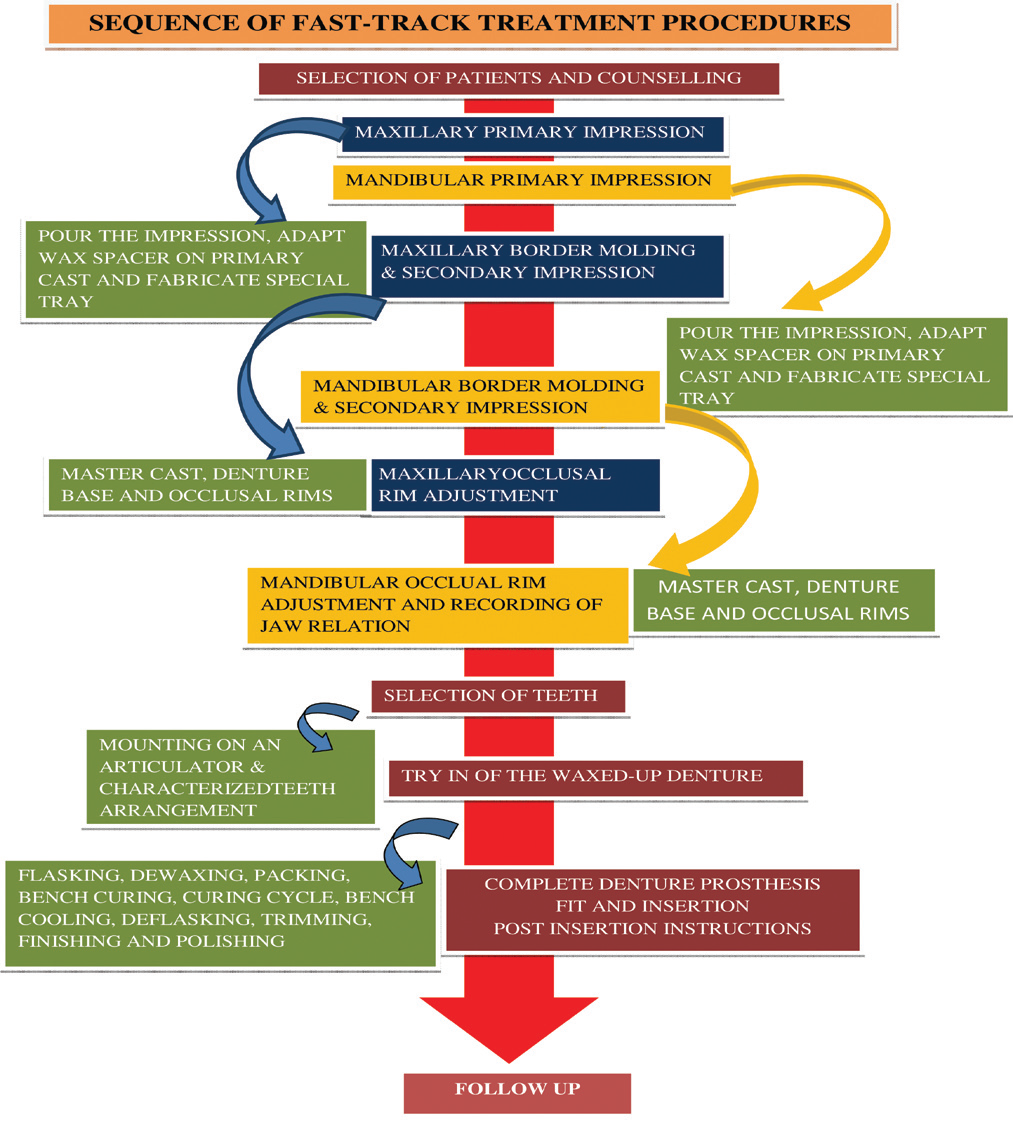
Fig 1: Sequence of procedures
STATISTICS
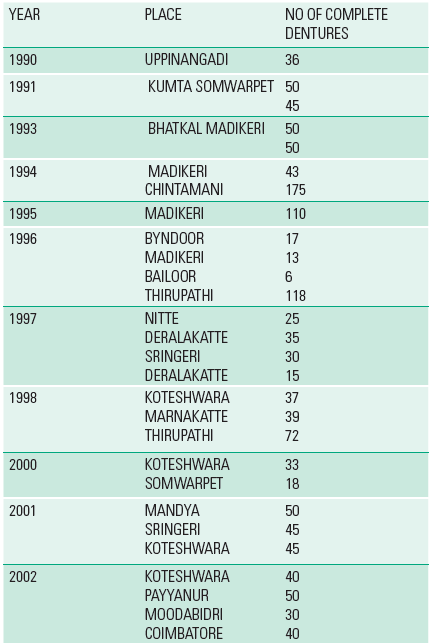
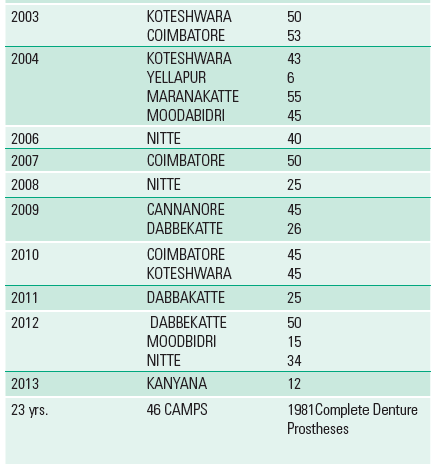
These camps have been conducted by the Department of Prosthodontics, A.B. Shetty Memorial Institute of Dental Sciences over a span of 23 years, from 1990 till present. A total of 46 camps have been conducted so far and the fit and insertion of one thousand nine hundred and eighty one complete denture prostheses have been done. The following list has been compiled from the archives of Department of Prosthodontics, A.B.Shetty Memorial Institute of Dental Sciences:
DISCUSSION
While fabricating complete denture prosthesis a minimum of 5 clinical appointments is required, while in a One day denture camp the same prosthesis is given in a matter of hours. Questions arise as to the efficacy of the aforementioned system. Is this treatment valid? Does the speed affect the accuracy or quality of the end product? Is the treatment based on scientific principles of denture fabrication? Those who view this treatment skeptically can dispel their doubts.
One Day Denture Camp is a unique community programme of the Department of Prosthodontics, A B Shetty Memorial Institute of Dental Sciences, A Constituent College of Nitte University, Mangalore. It is the first of its kind in India, to deliver oral and dental care for the masses at their doorsteps, free of cost, for the rural and semi urban population under institutionalized approach.
The one day Denture camp follows precision and scientific concepts for fabricating the complete denture prosthesis.
The two step impression making procedure is followed. Primary impressions are made with a mucostatic material i.e. Alginate, so as to record the denture bearing tissues in the resting state without any compression and to obtain the primary cast which represents the denture bearing areas in a relaxed state. On the primary cast, the areas which can take stress are marked as well as the areas which cannot take up the load i.e. relieving areas are also identified.
While fabricating special tray, the thickness of the spacers are varied accordingly. The areas which can take up the load, the spacer thickness is minimized and the areas which cannot take up the load, the thickness of the spacer is increased and relief is given. Thus selective pressure is achieved in secondary impression which represents the fitting surface of the final denture. The secondary impression follows the selective pressure technique6 expounded by Carl Boucher, where the stress bearing areas are in contact with the tray and the relief areas are selectively given respite. Thus we get an impression that is functional yet does not stress the relief areas. The posterior palatal seal area recorded with green stick compound and impression material, which is further arbitrarily scored in the master cast, in the shape of a cupid bow (depending on the compressibility assessed in the patient’s mouth) helps to compensate the curing shrinkage and to obtain a good peripheral seal.
No clinical steps are eliminated and at every stage the prosthesis is tried in the patient’s mouth. Phonetics, function and esthetics are all taken into account without compromising on quality of the prosthesis or promptness of the treatment carried out.
CONCLUSION
The one day denture camp opens new avenues, bringing an amicable solution to the conflict between patient’s concerns and treatment protocols. It is possible to rehabilitate the patient without compromising on scientific basis of prosthetic treatment. Such a venture requires a team effort including the skills of both, the clinician and the dental technician, materials and machinery furnished by an institution, the organization skills of an NGO and the team work effort by the professionals.
REFERENCES
- United Nations Population Division. World Population Prospects: The 2002 Revision, New York, NY, USA: United Nations; 2003.
- D. M. Davis, J. Fiske, B. Scott, and D. R. Radford. The emotional effects of tooth loss: apreliminary quantitative study, British Dental Journal, vol. 188, no. 9, 2000, page 503-506.
- Prasad D K, Hegde C, Shetty M. Sterilisation, infection control and hospital management in prosthodontics. Guident, vol 4, issue 5, 2011;16-20 .
- Zarb-Bolender. Prosthodontic treatment for edentulous patients, complete dentures and implant supported prostheses. 12th Ed., Elsevier, page 278-279.
- Anusavice K.J. Phillips’ Science of Dental Materials, 11th Ed, Elsevier, 2004,page 733.
- Bernard Levin. Impressions in complete dentures. Quintessence publishing Co, 1984, page 28-29.
Disclaimer from Guident
The views and opinions expressed in articles published in Guident are solely those of the authors and do not necessarily reflect the views of the editors, the editorial board or the publisher, Ivory India. Guident does not endorse any product, technique or treatment described. Clinical content is intended for qualified dental and medical professionals and is not a substitute for individual clinical judgement. Guident, its editors and the publisher accept no liability for any consequence arising from the use of information published in the journal.
How to cite this article
Dr. Krishna Prasad, Dr. Anupama Prasad, Dr. Archana Ashok S.. One Day Denture Camps - the Jewel in the Crown. Guident. 2013 Oct;6(12). Available from: https://guident.in/articles/prosthodontics/one-day-denture-camps-the-jewel-in-the-crown.html

