Host Modulation for Management of Periodontal Diseases
Department of Periodontology, Department of Periodontology, Department of Conservative and Endodontics, Z A Dental College, Aligarh Muslim University, Aligarh
ABSTRACT
Earlier periodontal diseases were thought to occur as a result of bacterial infection. With the changing concepts in the pathogenesis of periodontal diseases, it was seen that host responses played a vital role. Hence, newer strategies were needed which could alter the pathway of pathogenesis. The use of modulating agents particularly antiproteases, anti inflammatory drugs and bone sparing agents have an effective role as an adjunctive therapy in the management of widespread periodontal diseases
Key word: Host modulation, Periodontal diseas, anti-inflammatory drugs
INTRODUCTION
Periodontal diseases are caused primarily by the presence of microbial infection. Not all microbial infection leads to periodontal disease. It has been observed that only susceptible host develop periodontal disease. So it is the host reaction to microbial infection that mediates tissue destruction. This host response can be influenced by environmental factors and genetic factors. So with this knowledge, it is necessary to consider therapeutic approaches that modulate the host response in the management of periodontal diseases. Hence, host modulation means modifying or modulating destructive or damaging aspects of the inflammatory host response that develops in the periodontal tissues as a result of the chronic challenge presented by the subgingival bacterial plaque.1
Three potential approaches to host modulation have been considered:
- Inhibition of matrix metalloproteinases(MMPs) with antiproteases
- Blocking production of proinflammatory cytokines and prostaglandins with anti-inflammatory drugs and
- Inhibiting activation of osteoclasts with bone sparing agents
ANTIPROTEASES
Tetracyclines are the major group of antiproteases used in the treatment of periodontitis. Therapeutic administration of tetracycline over long period may provoke certain adverse effects such as gastrointestinal disturbances and emergence of antimicrobial resistance. To overcome these effects, a series of tetracycline derivatives known as chemically modified tetracyclines (CMTs) have been synthesized that are devoid of antimicrobial activity but retain the associated anti inflammatory activities.10 CMTs are potent inhibitor of matrix metalloproteinase. Among the tetracycline group, at present subantimicrobial dose doxycycline remains the only systemic host response modulator specifically indicated as an adjunctive treatment for periodontitis.Subantimicrobial dose doxycycline is approved by the US Food and Drug Administration, the UK Medicines and Healthcare products Regulatory Agency, and by similar agencies in other countriesthroughout the world, and was introduced under the trade name Periostat_ (CollaGenex Pharmaceuticals Inc., Newtown, PA). It is a 20-mg dose of doxycycline hyclate that is taken twice daily for periods of 3–9 months as an adjunct to root surface instrumentation in the treatment of periodontitis. Doxycycline like other members of tetracycline family has the potential to downregulate MMPs
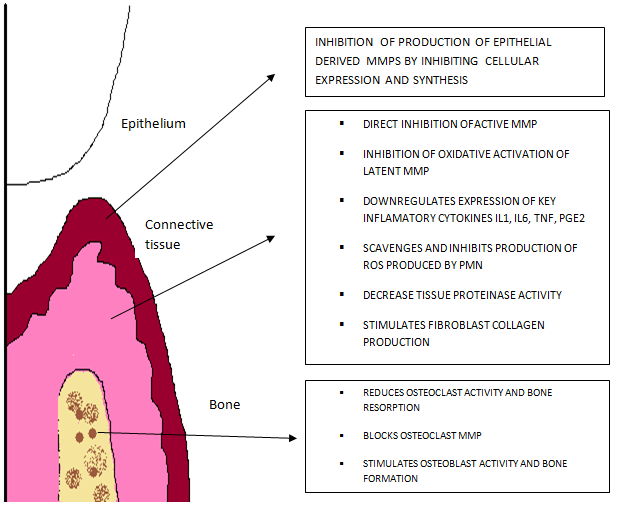
FIG Effect of subantimicrobial dose of doxycycline on epithelium, connective tissue and bone
(family of zinc depending enzymes capable of degrading a variety of extracellular matrix molecules, particularly collagen).[2] MMPs play a key role in the tissue destruction observed in periodontal disease and are secreted by the majority of cell types in the periodontium, including macrophages, neutrophils, fibroblasts, keratinocytes, endothelial cells and osteoclasts. In healthy tissues, MMPs are produced primarily by fibroblasts (MMP-1 or collagenase-1) and are concerned with the maintenance of the periodontal connective tissues. Tissue inhibitors of metalloproteinases are produced by fibroblasts, macrophages, keratinocytes and endothelial cells.3 The rationale for using doxycycline at subantimicrobial doses as a host response modulator is that it inhibits the activity of MMPs by a variety of synergistic mechanisms independent of any antibiotic properties.
Doxycycline was also confirmed as being a more effective inhibitor of MMPs than either minocycline or tetracycline; doxycycline has a much lower inhibitory concentration (IC50 = 15 lM) than minocycline (IC50 = 190 lM) or tetracycline (IC50 = 350 lM), indicating that a much lower dose of doxycycline is necessary to reduce a given collagenase level by 50%compared with minocycline or tetracycline.[4] Furthermore, doxycycline has also been found to be more effective in blocking neutrophil collagenase activity (MMP-8) than fibroblast collagenase activity (MMP-1),5 suggesting that doxycycline can provide a safe method of reducing pathologically elevated collagenase levels without interfering with normal connective tissue turnover.
A concern expressed by many colleagues initially was that the prolonged use of doxycycline, even at a dose of 20 mg twice daily, may lead to the development of antibiotic resistance. However, no evidence for antibiotic resistance has been identified in any of the studies that have investigated this issue to date. This has been confirmed in several randomized studies in which subgingival plaque samples were collected from patients prior to and after 9–27 months of subantimicrobial dose doxycycline therapy or placebo.[6] Regarding safety data, the plasma concentration of doxycycline following a subantimicrobial dose (20 mg) is low, with pharmacokinetic studies revealing peak concentrations of 0.7–0.8 µg ⁄ ml and steady- state concentrations of approximately 0.4 µg ⁄ ml,[7] which are well below the concentrations of 3– 4 µg ⁄ ml that can be expected following antibiotic doses of 100–200 mg of doxycycline.[8] Thus, unwanted effects are less likely to occur as a result of treatment with subantimicrobial doses, compared with antibiotic doses, of doxycycline.
ANTIINFLAMMATORY DRUGS
The inflammatory mediators particularly the arachidonic acid metabolites like prostaglandins and others are associated with the bone resorptive activities in conditions such as chronic periodontitis. Reducing their levels through the use of antinflammatory drugs results in reduction of bone resorptive processes. Hence anti inflammatory agents like NSAIDs have utility in suppressing the release and synthesis of arachidonic acid metabolites by inhibiting the cycloxygenase pathway directly. Indomethacin, an NSAID in a ligature induced canine model was used to demonstrate the inhibition of periodontal disease progression.[11] Studies have shown that systemic indomethacin, naproxen and flurbiprofen when given daily for upto three months, significantly slowed the rate of alveolar bone loss compared to patients treated with placebo.[1] But the use of NSAIDs are limited because of the associated adverse effects like gastrointestinal disturbances.
BONE SPARING AGENTS
Bisphosphonates are a class of agents used to treat osteoporosis and malignant bone metastases. Bisphosphonates act exclusively on bone when administered at physiological doses because of specific affinity to bone. They deposit both in newly formed bone and in proximity to the osteoclasts. Bisphosphonates act on bone by either decreasing osteoclast activity or decreasing osteoclast numbers itself.[9] Bisphosphonates are stable analogues of pyrophosphate which are not metabolized easily and have the capability of localizing to bone and inhibiting osteoclastic function. Bisphosphonates bind avidly to exposed bone mineral around resorbing osteoclasts, resulting in very high levels of bisphosphonates in the resorption lacunae. High concentrations are maintained within the bone for longer periods and thereby are of use in chronic periodontits. A major drawback of long term use of bisphosphonates is the high chances of development of osteonecrosis of jaw. Hence, their use in treatment of chronic periodontits is limited.
CONCLUSION
The host modulation appears to be an impetus for impressive clinical responses to non-surgical therapy. There is little information available on many host modulating therapies related to periodontitis and scarce data on the application of the host modulation therapy. This is an area where further development could revolutionalize the present protocol in the management of periodontal diseases.
REFRENCES
- Philip M. Preshaw Host response modulation in Periodontics Perio2000. 2008; 48:92–110
- Birkedal-Hansen H. Role of matrix metalloproteinases in human periodontal diseases. J Periodontol. 1993; 64: 474–484.
- Birkedal-Hansen H, Moore WG, Bodden MK, Windsor LJ, Birkedal-Hansen B, DeCarlo A, Engler JA. Matrix metalloproteinases: a review. Crit Rev Oral Biol Med. 1993;4:197–250
- Burns FR, Stack MS, Gray RD, Paterson CA. Inhibition of purified collagenase from alkali-burned rabbit corneas. Invest Ophthalmol Vis Sci. 1989; 30: 1569–1575.
- Golub LM, Sorsa T, Lee HM, Ciancio S, Sorbi D, Ramamurthy NS, Gruber B, Salo T, Konttinen YT. Doxycycline inhibits neutrophil (PMN)-type matrix metalloproteinases in human adult periodontitis gingiva. J Clin Periodontol 1995; 22: 100–109
- Thomas JG, Metheny RJ, Karakiozis JM, Wetzel JM, Crout RJ. Long-term sub-antimicrobial doxycycline (Periostat) as adjunctive management in adult periodontitis: effects on subgingival bacterial population dynamics. Adv Dent Res. 1998; 12: 32–39.
- Caton JG. Evaluation of Periostat for patient management. Compend Contin Educ Dent. 1999; 20: 451–456.
- Walker C, Thomas J, Nango S, Lennon J, Wetzel J, Powala C. Long-term treatment with subantimicrobial dose doxycycline exerts no antibacterial effect on the subgingival microflora associated with adult periodontitis. J Periodontol 2000; 71: 1465–1471
- Cheng A, Mavrokokki A, Carter G, Stein B, Fazzalari NL, Wilson DF, Goss AN The dental implications of bisphosphonates and bone disease Aust Dent J. 2005; 50(2):4-13
- Golub LM, Lee HM, Ryan ME, Giannobile WV, Payne J, Sorsa T. Tetracyclines inhibit connective tissue breakdown by multiple nonantimicrobialmechanisms. Adv Dent Res 1998;12:12-26
- Nyman S, Schroeder HE, Lindhe J. Suppression of inflammation and bone resorption by indomethacin during experimental periodontitis in dogs. J Periodontol 1979; 50:450-61
Disclaimer from Guident
The views and opinions expressed in articles published in Guident are solely those of the authors and do not necessarily reflect the views of the editors, the editorial board or the publisher, Ivory India. Guident does not endorse any product, technique or treatment described. Clinical content is intended for qualified dental and medical professionals and is not a substitute for individual clinical judgement. Guident, its editors and the publisher accept no liability for any consequence arising from the use of information published in the journal.
How to cite this article
Dr. Afaf Zia, Dr. Afshan Bey, Dr. Syed Mukhtar-Un-Nisar Andrabi. Host Modulation for Management of Periodontal Diseases. Guident. 2014 May;7(6). Available from: https://guident.in/articles/periodontics/host-modulation-for-management-of-periodontal-diseases.html