Ketorolac Tromethamine in Clinical Post Operative Pain Management in Dentistry
Department of Periodontology and Implantology Mahatma Gandhi Dental College & Hospital, Jaipur
INTRODUCTION
A number of dental procedures cause acute post procedural pain , making effective pain management for all patients an essential component of dental practice. Achieving adequate and safe pain relief may be more challenging in some patient populations, such as those with substance abuse or chronic pain disorders. However, pain following certain dental procedures can be anticipated, which provides dentists an opportunity to thoughtfully plan and optimize the management of acute pain.1
Factors contributing to the occurrence of postoperative dental pain are complex, but many are related to the inflammatory process that is initiated by surgical trauma.2 Injury to the tissues during surgical procedure results in the release of chemical mediators of inflammation.[2] Some of these mediators (histamine, prostaglandins, acetylcholine and bradykinin) evoke pain and cause hyperalgesia, which is characterized by decreased pain threshold and increased sensitivity to suprathreshold stimuli. The prostaglandins have been demonstrated to act, at least in part, by the latter mechanism.2
Since the introduction of acetylsalicylic acid in the nineteenth century, Non Steroidal Anti-Inflammatory Drugs (NSAIDs) have become widely used in the treatment of osteoarthritis, rheumatoid arthritis and ankylosing spondylitis for their pain-relieving and anti-inflammatory properties. Given the large and growing numbers of patients affected by the above diseases, NSAID use by both prescription and over-the-counter, is now very common. Although the efficacy of newer NSAIDs is well-established, their widespread use has prompted concerns over safety, particularly gastrointestinal (GI). The mechanism of action of NSAIDs involves the inhibition of cyclooxygenase (COX), a key enzyme in the inflammation cascade.3
CYCLOOXYGENASE EXISTS AS TWO ISOENZYMES3
• COX-1: a constitutive enzyme responsible for the formation of prostacyclin and protective and repair functions in the gastric mucosa.3
• COX-2: an inducible enzyme responsible for the generation of inflammatory mediators in response to inflammatory stimuli. [3]
The two isoforms of the enzyme have quite different biological properties and functions. Inhibition of COX-1 is responsible for the potentially serious adverse effects of the NSAIDs. NSAIDs have varying degrees of specificity for the two isoforms of cyclooxygenase but in recent years there has been a concerted effort to develop COX-2 specific agents in an attempt to avoid the GI tolerability problems that can be manifest during long-term use of NSAIDs. [3]
With a large number of drugs available commercially for pain management, this review article is aimed at highlighting the potential analgesic and anti-inflammatory properties of Ketorolac Tromethamine over the other drugs , in short term management of moderate to severe pain.
A search of the literature was conducted by using the Pubmed search engine and Google Scholar. Articles were selected for inclusion on the basis of relevance and significance to the topic. This article provides the current status about the newer forms of this drug and their clinical efficacy in detail.
Historical background
Ketorolac Tromethamine was discovered in 1989 by Syntex Corp. It was approved by FDA on 30th November, 1989 as the first injectable NSAID. The tablet form of ketorolac was approved by FDA in 1991. The ophthalmic (i.e., eye-drop) form was approved by FDA on 9 November 1992 and was introduced by Allergan under license from Syntex. An intranasal formulation of ketorolac tromethamine was approved by FDA on 14 May 2010 and introduced as a Nasal Spray by Daiichi Sankyo for short-term management of moderate to moderately severe pain requiring analgesia at the opioid level.
CLINICAL PHARMACOLOGY
Ketorolac is a Non Steroidal Anti-Inflammatory Drug and is a non selective COX inhibitor. It is a pyrrolo pyrrole derivative (Fig 1). Ketorolac is a potent analgesic and has moderate anti-inflammatory and antipyretic activity.4 The chemical structure of ketorolac is related to indomethacin , rather than the ibuprofen class of anti-inflammatory agents.4 In post operative pain it has equalled the efficacy of morphine, but does not interact with opioid receptors and is free of opioid side effects.5 This is the first NSAID for which the sole indication is for the treatment of pain, and not for treatment of rheumatoid arthritis and osteoarthritis.4
Ketorolac blocks the pathway for prostaglandin synthesis by inhibiting the cyclooxygenase enzyme that metabolizes arachadonic acid and blocks pain by a peripheral mechanism.5
After oral administration ketorolac tromethamine dissociates to pure ketorolac molecule in the bloodstream. Ketorolac is absorbed completely after oral and intramuscular administration. Onset of analgesia after administration of 10 mg of oral dosage occurs in 20 – 30 minutes. Peak absorption into the bloodstream occurs in 1 hour and peak analgesia occurs in 3 hours.4
It highly binds to plasma protein and 60% is excreted unchanged in urine. Major metabolic pathway is glucuronidation i.e.. liver enzymes metabolize the drug by conjugation with glucuronic acid , to produce inactive products, which are excreted in urine by renal mechanisms.5 It is lipophilic, hence
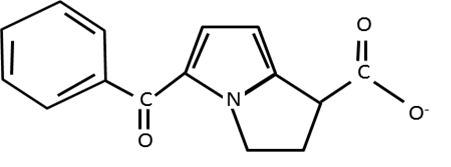
Fig 1: Chemical structure of Ketorolac tromethamine
[(+/-)-5(benzoyl)-2,3-dihydro-1N-pyrrolizine-1-carboxylic acid tris hydroxymethylaminomethane salt]
it crosses the lipid bilayer cell membrane. The plasma T1/2 is 4-5 hours. Those patients who are 70 years of age or older eliminate the drug at a slower rate (half life: 6-7 hours) and may require dose reductions.[4]
USES OF KETOROLAC TROMETHAMINE
It provides symptomatic relief from moderate to severe postoperative pain associated with dental procedures like gingival soft tissue grafting, flap surgery, extractions, biopsy. It is also used for relief from pain of abdominal, gynaecologic, orthopaedic, urologic, ophthalmic origin and cancer pain. It is to be used for short duration of 3-5 days, due to it COX-1 mediated side effects.2
ADVERSE EFFECTS
The risk of serious gastrointestinal (GI) toxicity and inhibition of platelet function has limited its use.10 The major adverse reactions of Ketorolac tromethamine are the damaging effects on gastric mucosa resulting in erosions, ulcers and gastrointestinal bleeding. Ketorolac tromethamine induces gastric damage by a dual insult mechanism. Ketorolac tromethamine is an acidic substance that can damage the GIT even in the absence of hydrochloric acid by changing the permeability of cell membranes allowing

a back diffusion of hydrogen ions. This weak acid remains unionized in the stomach, but the resulting lipophilic nature of Ketorolac tromethamine allows an accumulation in gastric mucosal cells. Once inside these cells, the higher pH of the intracellular environment causes Ketorolac tromethamine to dissociate and become trapped in the cells. The permeability of the mucosal cell membrane is thus altered, and the accumulation of hydrogen ions causes mucosal cell damage. This gastric damage is a result of the primary insult of acidic substances. The inhibition of prostaglandin biosynthesis in the GIT prevents the prostaglandins from exerting their protective mechanism on gastric mucosa and thus Ketorolac tromethamine induces gastric damage through this secondary insult mechanism.11 When Ketorolac is given by the nasal route, adverse effects may include nasal discomfort, rhinalgia, increased lacrimation, irritation in throat, rashes, rhinitis.7
On administration of ketorolac by parenteral route the reported incidence rates of adverse events in the central nervous system and gastrointestinal tract were 23% and 13% respectively.12 Other, less common side effects include pain at the injection site, renal impairment, elevated hepatocellular enzyme levels, prolonged bleeding, purpura, edema, fever and exacerbation of asthma.12
CLINICAL EFFICACY
The rational for prophylactic NSAIDs administration is that, the presence of the drug in the tissues at the time of surgery results in blocking of both synthesis and direct effects of prostaglandins, and thereby limiting postoperative pain and other components of surgically induced inflammation. Studies on clinical efficacy of NSAID premedication, however, seem to suggest that postsurgical pain control is strictly related to many factors, such as patient selection, nature of medication, and drug regimen.13.
Oral Ketorolac is completely absorbed, with a mean peak plasma concentration occurring an average of 44 min after a single 10-mg dose.14 Ketorolac is strongly (99%) protein bound, with the degree of binding apparently independent of the plasma concentration of the drug.15 For this reason, an oral loading approximately twice the maintenance dose is administered to minimize the analgesic delay due to ketorolac's two-compartmental characteristics.
Plasma half-life is 4 to 6 hours in the normal adult, and analgesia may be maintained for 6 to 8 hours.2 Since the maximum concentration of prostaglandins in actively injured tissues occurs simultaneously with the peak intensity of postoperative pain, 3 to 4 hours after injury,16 the pharmacokinetic properties of ketorolac may have allowed for achieving therapeutic blood levels of the drug which would blunt the biochemical processes leading to pain. Although preoperative ketorolac treatment significantly reduces pain intensity on the day of surgery, the results of a single-dose, parallel-group, double blind study showed that 20 mg ketorolac administered immediately before periodontal surgery was effective for alleviating the early postoperative painful sequelae. However, ketorolac premedication did not either affect delayed pain levels, nor postoperative analgesic use . No disadvantages were noted related to this method of administration.2 In a study patients who underwent periodontal surgery were given preoperative ketorolac treatment , they experienced low to moderate postoperative pain, even when osseous reduction was involved.17 There is evidence that pain levels following periodontal surgery are greatest within the immediate 11 hours postoperative period and reach about 25 to 40% after Ketorolac administration.18
Gastrointestinal intolerance and adverse CNS manifestations are among the most common side effects seen in NSAID’s therapy. A major concern when taking any NSAID is the subsequent effect on platelet aggregation. In a previously reported study where 82% of 115 patients treated with single oral dose of ketorolac had registered no complaints such as gastrointestinal intolerance and adverse CNS manifestations during the postoperative observation period.14
Parenteral ketorolac offers an alternative for patients who cannot take medication orally. It does not provide therapeutic blood concentrations more rapidly than the oral form of the drug. Pharmacokinetic studies involving both young and elderly volunteers have demonstrated that the two forms of ketorolac have similar rates and extents of absorption.12 Furthermore, there is no clinical evidence to support a faster onset of pain relief with the parenteral product, if one assumes that prostaglandin inhibition is the step that limits the absorption rate, a faster effect would not be expected.12 The clinical trials that were conducted to examine all aspects of parenteral ketorolac established that, IM ketorolac was an effective NSAID analgesic with a suitable risk/benefit profile for the treatment of acute pain states such as renal colic, posttraumatic musculoskeletal pain.7 Dose-ranging studies conducted during these trials established that IM doses of 15 mg to 30 mg of ketorolac every 6 to 8 hours were safe and effective for short-term (up to 5 days) analgesic use. Clinical experience with IM ketorolac confirmed the safety and efficacy of IM ketorolac as an effective alternative to opioids.7
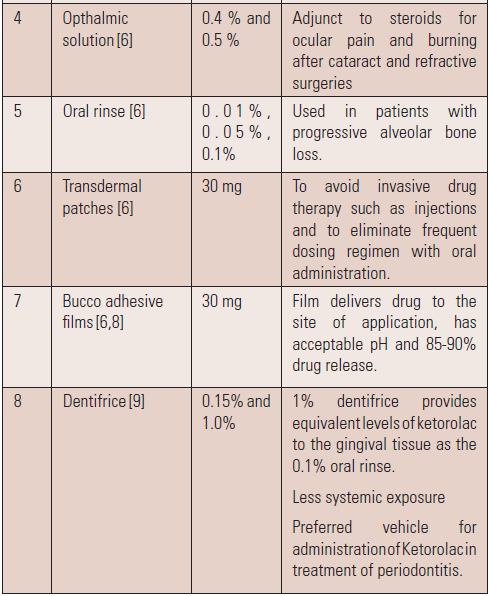
Ketorolac is a potent inhibitor of prostaglandin biosynthesis . PGE2 concentration in GCF was significantly reduced 1 hour after the use of 0.01% , 0.05% or 0.1% KT oral rinse.19 In a study, patients suffering from chronic periodontitis were treated with 0.1% Ketorolac Tromethamine oral rinse twice daily for 6 months resulted in reduction of PGE2 in GCF.20 In another study, the authors reported that topically used ketorolac as oral rinse (0.1%) was clinically effective in treatment of periodontitis. The authors measured the ketorolac concentration in the oral cavity, namely in the gingival crevicular fluid and reported a maximum concentration of about 4.2 mg/ml for the drug after application of 0.1% KT oral rinse for 30 seconds.21
CONCLUSION
Ketorolac (KT) is currently administered orally in the form of tablets or as intramuscular injections in multiple divided doses for short term management of post-operative pain. Tablets given orally have few adverse effects such as GI erosions and ulcers, inhibition of platelet function, renal effects. Concept of administration of drug through ophthalmic solution, intranasal solution, dentifrices and mouthrinses have been tested, and found to result in lower incidence of side effects. The newer methods of its administration like microspheres and delayed release tablets, are still in the phase of development. It is highly recommended to make all the formulations of this drug commercially available in an order to provide more specific form of administration and also decrease the occurrence of adverse effects.
REFERENCES
- Elliot VH, Williams TK, Michael GO, George AK, Nathaniel PK, Stephanie G et al. Prescribing recommendations for the treatment of acute pain in dentistry. Compendium 2013;3:22-30.
- Trombelli L, Schineaglia GP, Zangari F, Seapoli C, Catura G. Effect of pretreatment with ketorolac tromethamine on post-operative pain following periodontat surgery. J Clin Periodontol 1996;23:128-32.
- Erik Legrand. Aceclofenac in the management of inflammatory pain. Expert Opin. Pharmacother 2004;5:1347-1357.
- Tripathi KD. Nonsteroidal Antiinflammatory Drugs and Antipyretic Analgesics. In: Tripathi KD , editor. Essentials of Pharmacology for Dentistry, 1st ed. New Delhi: Jaypee Brothers Medical Publishers; 2005. p. 315-30.
- Reddan RJ. Ketorolac tromethamine: an oral/injectable nonsteroidal anti-inflammatory for postoperative pain control. J Oral Maxillofac Surg 1992;50:1310–13.
- Al-Hezaimi K, Al-Askar M, Selamhe Z, Fu JH, Alsarra IA, Wang HL. Evaluation of Novel adhesive film containing ketorolac for post surgery pain control: a safety and efficacy study. J Periodontol 2011;82:963-68.
- Mark BS, David B. Sprix® (ketorolac tromethamine) nasal spray 15.75 mg per spray: a novel nonopioid alternative for managing moderate to moderately severe dental pain. Compendium 2012;33:2-10.
- Alsarra IA, Alanazi FK, Mahrous GM, Abdel Rahman AA, Al Hezaimi KA. Clinical evaluation of novel buccoadhesive film containing ketorolac in dental and post-oral surgery pain management. Pharmazie 2007;62:773–78.
- Kelm GR, Buchanan W, Meredith MP, Offenbacher S, Mankodi SM, Dobrozsi DJ et al. Evaluation of ketorolac concentrations in plasma and gingival crevicular fluid following topical treatment with oral rinses and dentifrices. J Pharm Sci 1996;85: 842–47.
- Olmedo MV, Galvez R, Vallecillo M . Double blind parallel comparison of multiple doses of Ketorolac, ketoprofen and placebo administrated orally to patients with postoperative dental pain. Pain 2001;90:135–41.
- Maliekal J, Elboim CM . Gastrointestinal complications associated with intramuscular ketorolac tromethamine therapy in the elderly. Ann Pharmacother 1995;29:698–701.
- Robert E. Ariano, Sheryl A. Zelenitsky. Ketorolac (Toradol): a marketing phenomenon. Can Med Assoc J 1993;148:1686-88.
- Jackson DL, Moore PA, Horgreaves KM. Preoperative nonsteroidal anti-infiammatory medication for the prevention of postoperative dental pain. J Am Dent Assoc 1989;119:641-47.
- Johansson S, Josefsson G, Malstam J, Lindstrand A, Stettstroem A. Analgesic efficacy and safety comparison of Ketorolac tromethamine and Doleron for the alleviation of orthopaedic post-operative pain. J Int Med Res 1989;17: 324-332.
- Dipalma JR. Ketorolac: an injectable NSAID. Clinical Pharmacology 1991;43: 207-11.
- Ferreira SH. Peripheral analgesia: Mechanism of the analgesic action of aspirin like drugs and opiate-antagonists. Br J Clin Pharmacol 1980;10:237-42.
- Checchi L, Trombelli L. Postoperative pain and discomfort with and without periodontal dressing in conjunction with 0.2% chlorhexidine mouthwash after apically positioned flap procedure. J Periodontol 1993;64:1238-42.
- Jorkjend L, Skoglund AA. Effect of non-eugenol and eugenol-containing periodontal dressing on the incidence and severity of pain after periodontal soft tissue surgery. J Clin Periodontol 1990;17: 341-44.
- Doyle MJ, Buchanan W, Kelm GR, Meredith MP, Nelson SL, Charles TT et al. Inhibition of PGE2 with ketorolac rinses. J Dent Res 1994;73:125
- Cavanaugh PF Jr, Meredith MP, Buchanan W, Doyle MJ, Reddy MS, Jeffcoat MK. Coordinate production of PGE2 and IL-1 beta in the gingival crevicular fluid of adults with periodontitis: its relationship to alveolar bone loss and disruption by twice daily treatment with ketorolac tromethamine oral rinse. J Periodontal Res 1998;33:75-82.
- Kelm GR, Burchanan W, Meredith MP, Offenbacher S, Mankodi SM, Dobrozsi DJ et al. Evaluation of ketorolac concentrations in plasma and gingival cervicular fluid following topical treatment with oral rinses and dentifrices. J Pharm Sci 1996;58: 842–47.
Disclaimer from Guident
The views and opinions expressed in articles published in Guident are solely those of the authors and do not necessarily reflect the views of the editors, the editorial board or the publisher, Ivory India. Guident does not endorse any product, technique or treatment described. Clinical content is intended for qualified dental and medical professionals and is not a substitute for individual clinical judgement. Guident, its editors and the publisher accept no liability for any consequence arising from the use of information published in the journal.
How to cite this article
Dr. Aditi Gupta, Dr. Devaraj C.G.. Ketorolac Tromethamine in Clinical Post Operative Pain Management in Dentistry. Guident. 2014 Apr;7(5). Available from: https://guident.in/articles/periodontics/ketorolac-tromethamine-in-clinical-post-operative-pain-management-in-dentistry.html