Search for the Problem of Infection Implant-Abutment Connection.laboratory Researches Are Running with Alpha Dent Implants
A member of Ukraine Association of Implantologists since 2009. Author of 28 scientific articles, 2 monographs, 9 patents, 12 rat. Proposals, Assistant of the Children Surgical Dentistry Department of Lugansk State Medical University
INTRODUCTION
During a chewing load on the abutment a negative pressure within the space between the implant and abutment occurs. At this moment through nonhermetic gap liquid bone and microorganisms are coming. At subsequent impacts chewing load on the tooth this content comes outside from micro space and shatters environmental implant tissue. As a result various complications are develope. (picture 4) The most frequent are: inflammation of soft tissue and periimplantitis. Periimplantitis is an inflammatory process by where there is a loss of connection between the implant and the bone because of tissues infection that adjacent to the implant. In protracted nature of the process even rejection of implant is possible.Today implantation became available recovery method for patients who have dentition defects. Implantation is the most physiologic and functionally effective method. However, there is a problem of developing complications. Most often (up to 3 % of cases) complications develop during implant installation procedure with internal hex diameter 2.4 mm. In these models connection implant-abutment is less sealed unlike implants with cone connection.
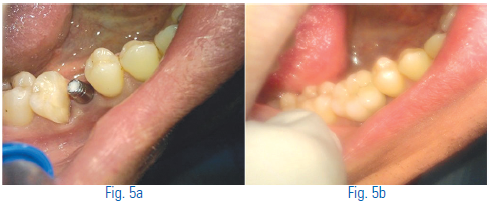
The main task of the Implantologist is to leave sterile contact surfaces and microspace between the implant and abutments and also prevent the growth of microflora in the micro space of implant in the future. To solve this problem we propose to use a method of abutment silver-plating. The purpose of this research is to prove the fact that silver has bacteriostatic and bactericidal action. (picture 5) The use of silver-platined implants in implant practice avoids complications during implantation. A number of experiments was conducted to confirm the feasibility and effectiveness of this method.
IMATERIALS AND METHODS OF THE EXPERIMENT
For our research we used implants and abutments of Alpha Dent Implants system, because in our opinion they are the leaders of price and quality relation among manufacturers. We silvered abutment fragment with chemicals.(picture 1) Items were placed in a specially developed solution consisting of silver nitrate , potassium hexacyanoferrate , potassium chloride , potassium carbonate , distilled water. In this solution low fat fragments of abutments were inserted and for more effect we agitated silvering solution every 3-6 hours. Details were kept in the solution for 2 days under special circumstances. Under aseptic conditions we seeded suspension of

Fig. 1a

Fig. 1b
distilled water and soft plaque (picture 2) at a prepared and poured into Petri dishes medium ( meat-peptone broth , sodium chloride , agar -agar, lactose) . (picture 3) Petri dishes divided before into 2

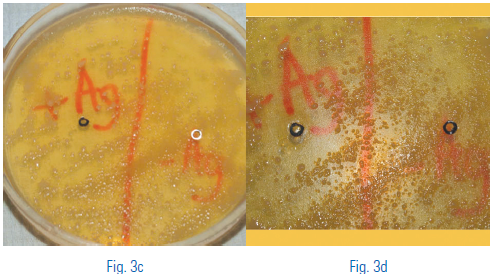
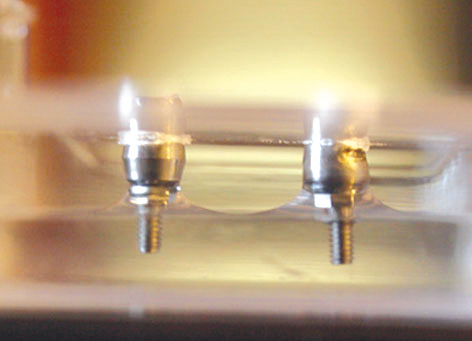
Fig. 3e
parts: one half placed a sterile piece of silvered abutment on the second - sterile nonsilvered.
Tested material was placed in a thermostat and kept it for 5 days at 37C. After extraction cups found intensive growth of colonies of yellow - white color uniformly over the entire Petri dish except silvered space around the abutment. Zone absence of bacterial growth is 1-1.5 cm The next issue that we face is the question of the pigmentation of the gum around the set silvered abutment. Everyone knows that silver oxide used in dentistry, intensely stained with hard and soft tissues of the mouth. For the prevention of this complication we offer only silvering switchings platform, hexagon and the abutment screw. For clinical confirmation of this fact we conducted experiments on rats. Next experience allowed to demonstrate the action of silver ions in vivo. For the operation two rats were used. First anesthetized rat on the left hind limb, we placed a sterile screw - plated plug and took a wound. On the right a screw plated too, but before it is wetted slurry of soft plaque and distilled water. The second rat was carried out similar manipulation with nonsilvered screws on the left - a sterile, right - infected by microorganisms, respectively. After 2 weeks we estimated a result. In an area with an infected nonsilvered screw swollen were observed limbs, flushing with suppuration and rejection, evidence of active inflammation process. In an area with a sterile screw nonsilvered observed weak swelling without signs of suppuration. In the area infected with silvered screw there is no inflammation, pigmentation the surrounding tissue is also observed. Our experiments demonstrate the effectiveness and usefulness of the implant -abutment silvering. This method allows you to maintain microspace aseptic implant - abutment to reduce the likelihood of complications. However, it has many positive properties: bacteriostatic and bactericidal action (picture 5) is not pigmented oral mucosa; getting with active transport into cells of the mucosa, enhances the metabolism; is a very affordable method. Based on the foregoing we can safely assume that the proposed method can help our patients to extend the lifetime of the implant which is in its turn makes implantologists happy.
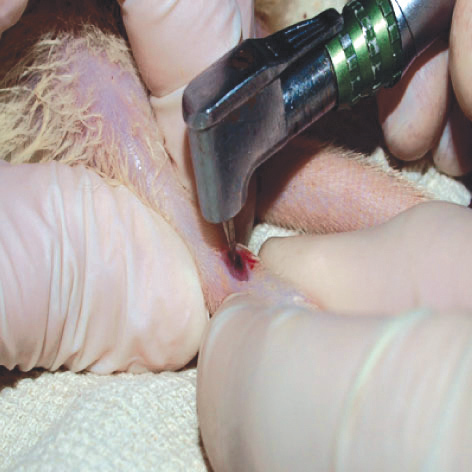
Fig. 4a
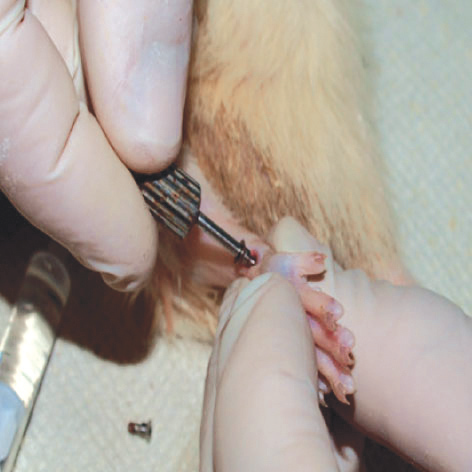
Fig. 4b
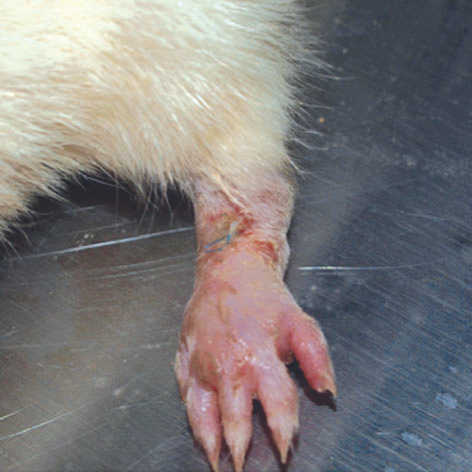
Fig. 4c
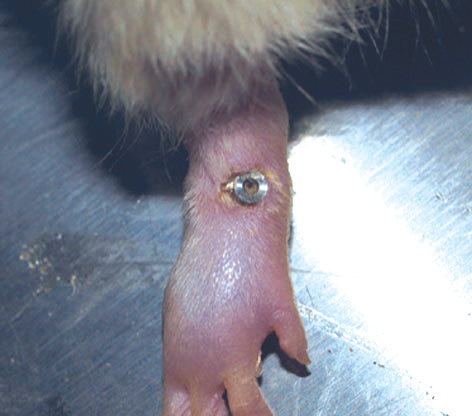
Fig. 4d

Fig. 4e
Disclaimer from Guident
The views and opinions expressed in articles published in Guident are solely those of the authors and do not necessarily reflect the views of the editors, the editorial board or the publisher, Ivory India. Guident does not endorse any product, technique or treatment described. Clinical content is intended for qualified dental and medical professionals and is not a substitute for individual clinical judgement. Guident, its editors and the publisher accept no liability for any consequence arising from the use of information published in the journal.
How to cite this article
Dr. Shublaze GK. Search for the Problem of Infection Implant-Abutment Connection.laboratory Researches Are Running with Alpha Dent Implants. Guident. 2014 Apr;7(5). Available from: https://guident.in/articles/research/search-for-the-problem-of-infection-implant-abutment-connection-laboratory-researches-are-running-with-alpha.html