Antibiotic Usage: A Survey Among Prescribing Habits of Members of Indian Endodontic Society, Davangere Branch
ABSTRACT
What distinguish us from quacks? Does a medical representative influence our antibiotic prescribing habits? As dentists we commonly prescribe antibiotics and analgesics. How often are we aware why we prescribe a particular antibiotic or painkiller? How much are we contributing to the problem of antibiotic resistance? The answer is ‘NO’. There are about 100,000 brands of drugs are sold in the country. Drug companies dictate what a doctor will prescribe, and for how long. But is this a rationale for prescription?
As dentists, we have a professional responsibility for emergency dental care. When it is clinically indicated, it is definitely of therapeutic benefit to the patient. But systemic antibiotics should be used with caution because of the possibility of toxicity, side effects, the development of resistant strains of microbes, and allergic reactions. Thus the purpose of this study was to investigate the antibiotic prescribing habits of members of the Indian Endodontic Society (IES) Davangere branch, Karnataka.
Keywords: antibiotics, antibiotic resistance
Odontogenic infections and, especially, endodontic infections are poly-microbial involving a combination of gram-positive, gram-negative, facultative anaerobes and strict anaerobic bacteria. As dentists we commonly prescribe antibiotics and analgesics for these conditions. How often are we aware why we prescribe a particular antibiotic or painkiller? How much are we contributing to the problem of antibiotic resistance? Have we ever asked our self whether our children be able to fight their infections in the future with so many resistant bacteria around?1
There are 15,000 registered pharmaceutical manufacturers in India, producing medicines worth Rs. 20,000 million yearly. This industry employs about 3 million people in research, production, distribution and marketing, and yet only 22% of the Indian population have access to modern medicines. By some estimate, about 100,000 brands of drugs are sold in the country; large number of drugs in Indian market is either irrational or harmful. Pharmaceutical companies dictate what a doctor will prescribe, and for how long.
The first antibiotic, penicillin, was discovered by Alexander Fleming in 1928. Florey, in 1940, introduced the use of antibiotics to clinical practice. Since then, antibiotics have been used extensively in dentistry. However, although many bacterial species were initially found to be sensitive to different types of antibiotics, there has been a gradual and sustained emergence of resistant strains2.
In different parts of the world, several studies have been done to analyze the use of antibiotics in the treatment of endodontic infections. The purpose of this study was to investigate the antibiotic prescribing habits of members of the Indian Endodontic Society (IES) Davangere branch, Karnataka.

MATERIALS & METHODS
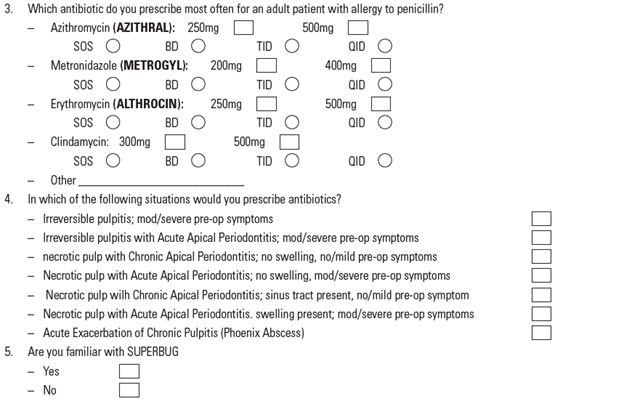
A 2-page questionnaire was sent to the members of the IES Davangere branch, Karnataka .The data were analyzed by descriptive statistics. Groups were compared by using a chi-square test of independence.Few was mailed by post, and few were given and collected personally.Questions was based on those asked in previous studies.
RESULTS
Of the 200 surveys mailed, 150 surveys were returned. The overall response rate was 31.1%. The demographics of the respondents are described. Male respondents accounted for 58% and females 42 of the total (Table1). Sixty-seven percent of the respondents were less than 35 years old, and 12% were more than 45 years old (Table 2). The mean age of the respondents was 33.4 ± 8.2 years of age. The most frequent academic degree was of post graduate students (65%). Only 31% of the respondents were MDS (Table 3). In relation with the percentage of time assigned to endodontic practice, the majority of respondents were in a part-time practice, and only 18% declared themselves to be in full-time endodontic practice. However, 45% of the respondents dedicated more than half of their dental practice to endodontics (Table 4). The average duration of antibiotic therapy was 3.4± 6 days (Diagram 2 and Table 6). The standard deviation in this response indicated that the majority of the respondents prescribe antibiotics for between 6 and 8 days. Most of the responders (81%) chose amoxicillin in patients with no medical allergies, alone (79%) or associated with clavulanic acid (2 %). Ciprofloxacin and tinidazole were prescribed as the first-choice antibiotic by 17 % (Diagram 1 and Table 5). The first drug of choice for patients with an allergy to penicillin was erythromycin 250 mg (65%) followed by azithromycin (35%) (Table 7). Table 8 lists the percentage of respondents who prescribed antibiotics for various pulpal and periapical diagnoses. For cases of irreversible pulpits with moderate/severe symptoms and irreversible pulpitis with acute apical periodontitis and moderate/severe symptoms, 19% and 68% of respondents, respectively, prescribed antibiotics. In cases of a necrotic pulp, chronic apical periodontitis, no swelling, and no other symptoms, antibiotics prescribed nil in %. In the scenario of necrotic pulp, acute apical periodontitis, and moderate/severe symptoms but no swelling, 32 % prescribed antibiotics. For a case of necrotic pulp and chronic apical periodontitis that was asymptomatic but with a sinus tract, 1% prescribed antibiotics. In the case of a necrotic pulp, acute apical periodontitis, swelling, and other moderate/severe symptoms, 66% of respondents prescribed antibiotics whereas in acute exacerbation of chronic pulpitis 57 % respondents prescribed antibiotics. When asked about familiarity with super bug 58 % doctors were unaware whereas 42% were familiar (Table 9). There were no significant differences between respondents in relation with age, sex, academic degree, region, or time dedicated to endodontics (p > 0.05).
DISCUSSION
The population sampled in this study was practicing endodontists, and it should be noted that no attempt was made to survey practicing endodontists who were not members of the IES. The overall response rate of 75% can be considered to be an acceptable rate of return for surveys.
Questions were designed to collect a variety of information relative to the types of antibiotics used and the prescribing habits of endodontists as determined by age, sex, academic degree, area of the country, and percentage of time assigned to endodontics in their whole private dental practice. In relation with antibiotic therapy, an infection must be persistent or systemic to justify the need for antibiotics (ie, fever, swelling, lymphadenopathy, trismus, or malaise in a healthy patient). Antibiotics are also more likely to be needed in an immunocompromised patient or
a patient in poor health. The decision to prescribe antibiotics should not be influenced by patient demand, expectation of referring dentists, or because it is the day before a weekend or holiday.
The proper dose and duration of an antibiotic is enough when there is sufficient evidence that the patient host defenses have gained control of the infection. An antibiotic loading dose should he used whenever the half-life of the antibiotic is longer than 3 hours or whenever a delay of 12 hours or more is unacceptable to achieve therapeutic blood levels Endodontic infections have a rapid onset and short duration 2 to 7 days. The average length of antibiotic prescriptions in this study falls within a range of 2 to 5 days. A 6- to 7-day course would probably be appropriate for most endodontic infections. Penicillin is a narrow spectrum antibiotic for infections caused by aerobic gram-positive bacteria. Amoxicillin – The most preferred antibiotic for patient who was not allergic to penicillin by 81 % respondents is susceptible to degradation by β lactamase producing bacteria [1]. It is given with Clavulanic acid to increase its spectrum against staphylococcal bacteria is one of the antibiotics recommended for the treatment of odontogenic infections. Penicillin is not well absorbed from the intestinal tract, 70% of an oral dose is wasted. On the contrary, in the United States, amoxicillin is prescribed only by 27.5% of members of the AAE, who selected mainly penicillin VK as the first choice antibiotic (68.5%) Thus, penicillin VK is the principal antibiotic prescribed by dentists in the United States. In our study, other antibiotics prescribed were metronidazole, azithromycin and clindamycin (0 %). In the study of Yingling et al, clindamycin was the second prescribed antibiotic for non– penicillin-allergic patients (45.26%). Clindamycin is a broader-spectrum antibiotic than penicillin but is still narrow in its specificity toward oral pathogens. It is bacteriostatic or bactericidal, depending on drug concentration, infection site, and microorganism. It is 90% absorbed from the gastrointestinal tract in the oral form and has peak serum concentration within 60 minutes [1]. The recommended dose for adults is 150 to 450 mg four times a day for orofacial infections. Considering that clindamycin has a low but serious risk of pseudomembranous colitis, is broader spectrum, and is 2 to 3 times more costly than amoxicillin, it seems to be logical to prefer amoxicillin, as the results of this survey indicated, because amoxicillin is effective with less risk, less cost, and less contribution to antimicrobial resistance. Nevertheless, if an infection were found to be resistant to amoxicillin, with or without the adjunct of metronidazole, one could change to clindamycin. The first drug of choice for patients with an allergy to penicillins was erythromycin (65%). In the United States, the study of Whitten et al reported a 21.6% for clindamycin as the first-choice antibiotic, but a posterior study performed by Yingling et al found a percentage (57.03%) similar to that reported in the present study. Other antibiotics prescribed for patients with an allergy to penicillins were metronidazole, clindamycin, and azithromicyn. Erythromycin, a macrolide, has a similar spectrum of activity to that of penicillin2. Azithromycin is semisynthetic derivative of erythromycin that has been modified to create a broader spectrum of antibacterial activity and improved tissue penetration. Metronidazole, prescribed in India as Flagyl is an antibiotic that is very effective against obligate anaerobes but not against facultative anaerobic bacteria. If amoxicillin is not effective after 2 to 3 days of use, then metronidazole has been recommended as a supplemental medication. Metronidazole has excellent activity against anaerobes but no activity against aerobes and therefore requires to be used in conjunction with other agents (antimicrobial combination) for chemotherapy of oral infections3.
Various endodontics conditions where antibiotics were prescribed were associated with various pulpal and periapical diagnoses. Because a medical history could not be provided and specific details of the symptoms could not be included in every question, interpretation of this data must be considered in light of these limitations4,5. The first category was for irreversible pulpitis with moderate/severe symptoms, and the second category was for the same with an acute apical periodontitis component. Combined, 87% of the respondents prescribed antibiotics for these cases. These pulps are still vital. There is no infection or signs of systemic involvement. Antibiotics are not indicated in either situation. The third situation was necrotic pulp, chronic apical periodontitis, no swelling, and no or mild symptoms. Again, in a healthy patient, there is no indication for antibiotic use, and treatment should be limited to nonsurgical root canal therapy. In this survey, 0% responders prescribed antibiotics. The fourth category was necrotic pulp, acute apical periodontitis, no swelling, and moderate/severe symptoms8,9. The proper treatment for this case is debridement of the root canal space and analgesics. This survey’s result was 32%, which fits in the same range as previous studies. This again is over usage of antibiotics. Interestingly, 1% still prescribed antibiotics for asymptomatic cases of necrotic pulp, chronic apical periodontitis, and cases with sinus tracts (the fifth scenario).Indicated treatment should consist of nonsurgical root canal therapy with analgesics if needed for pain but no antibiotics. If the patient was medically compromised and the sinus tract did not close within a few weeks or the patient experienced a flare up with systemic involvement, then antibiotics would be indicated. The next situation described a case of a necrotic pulp, acute apical periodontitis (abscess), swelling, and moderate to severe symptoms of an infection where 66 % responders prescribed antibiotics. The last situation i.e. phoenix abscess 57 % responders overwhelmly prescribed antibiotics4.
Antibiotic resistance is a form of drug resistance whereby some (or, less commonly, all) sub-populations of a microorganism, usually a bacterial species, are able to survive after exposure to one or more antibiotics; pathogens resistant to multiple antibiotics are considered multidrug resistant (MDR) or, more colloquially, superbugs. Super bugs or miracle drugs maintain the balance of power5.
Certain antibiotic classes are highly associated with colonisation with "superbugs" compared to other antibiotic classes. A superbug, also called multi resistant, is a bacterium that carries several resistance genes. The bacteria are equipped with a gene which produces an enzyme that disables antibiotics. The enzyme is Klebsiella pneumoniae carbapenamase, or KPC disables carbapenam antibiotics, last-ditch treatments for infections that don't respond to other drugs6,7.
The interesting point in this survey is that, with regards to irreversible pulpitis, necrotic pulps with no systemic involvement, and sinus tracts, the members of the IES are overprescribing.
Nonsurgical root canal therapy without antibiotics is usually adequate to treat cases of irreversible pulpitis, acute and chronic apical periodontitis, draining sinus tracts, and localized swellings. The pulpal circulation is compromised in these cases, and systemic antibiotics will not reach therapeutic concentrations in the pulp. Removing the source of the infection by performing nonsurgical root canal therapy will usually allow healing of any periradicular lesion or inflammation to occur. Analgesics are indicated for pulpitis pain and pain from periapical inflammation and not antibiotics10.
CONCLUSION
Antibiotic therapy is an art and a science. There are so many confounding variables, such as suspected pathogen, ability to establish drainage, pharmacokinetic properties of the drug, mechanism of action of the antibiotic, virulence of the infection, the current health status of the host, and host defense mechanisms, that it is not possible to make antibiotic therapy into a mechanistic technologic science. The most important decision for the dental practitioner to make is not which antibiotic to use but whether to use one at all11,12.
All endodontists must take into account that, when the decision is made to use an antibiotic, it is important to adhere to the following basic principles of antibiotic dosing13:
- use high doses for short durations,
- use an oral antibiotic loading dose,
- achieve blood levels of the antibiotic at two to eight times the minimum inhibitory concentration,
- use frequent dosing intervals, and
- Determine the duration of therapy by remission of the disease.
However, it is important that not only the dental profession but also the general public understand the importance of restricting the use of antibiotics to those true cases of severe infection that require them . The use of antibiotics for minor infections, or in some cases in patients without infections, could be a major contributor to antimicrobial resistance.
REFERENCES
- Rodriguez. Antibiotic use by members of Spanish endodontic society. J Endod 2009;35: 1198–1203.
- Pallasch TJ. How to use antibiotics effectively. J Cal Dent Assoc 1993; 21: 46-50.
- Montgomery EH, Kroegcr DC. Use of antibiotics in dental practice. Dent Clin North Am 1984; 28: 433-53.
- Kuriyama T, Williams DV, Yanagisawa M, et al. Antimicrobial susceptibility of 800 anaerobic isolates from patients with denloalvcolar infection to 13 oral antibiotics. Oral Microbiol Immunol 2007; 22: 285-8.
- Stein GP, Schooley S, Tyrrell Kl,, el al. Human serum activity of lebthromyrin, azithromycin and amoxicilbn/clavulanate against common aerobic and anaerobic respiratory pathogens. Inl J Antimicrob Agents 2007; 29: 39-43.
- Whilten BH, Gardiner DL, Jcannsonne BG, et al. Current trends in endodontic treatment: report of a national survey. J Am Dent Assoc 1996; 127:1333-41.
- Essentials of pharmacology by KD Tripathi.
- Montgomery EH, Kroegcr DC. Use of antibiotics in dental practice. Dent Clin North Am 1984; 28: 433-53.
- Jaimes EC. Toncocinamides and the incidence of antibiotic-associated colitis. Clin Ther 1991; 13: 270-80.
- Bahal N, Nahata MC. The new macrolide antibiotics: azithromycin, clarithromycin, dirithromycin, and roxithromycin. Ann Pharmacother 1992;26: 46-55.
- American Association of Endodontists. Prescription for the future. Responsible use of antibiotics in endodontic therapy. 1999.
- Yingling NM, Byrne BE, Hartwell GR. Antibiotic use by members of the American Association of Endodontists in the year 2000: report of a national survey. J Endod 2002 ;28;396-404
- Lewis MA Why we must reduce dental prescription of antibiotics: European Union Antibiotic Awareness Day, Br Dent J 2008;205:537-8
Disclaimer from Guident
The views and opinions expressed in articles published in Guident are solely those of the authors and do not necessarily reflect the views of the editors, the editorial board or the publisher, Ivory India. Guident does not endorse any product, technique or treatment described. Clinical content is intended for qualified dental and medical professionals and is not a substitute for individual clinical judgement. Guident, its editors and the publisher accept no liability for any consequence arising from the use of information published in the journal.
How to cite this article
Dr. Subhra Dey, Dr. Vinisha Pandey. Antibiotic Usage: A Survey Among Prescribing Habits of Members of Indian Endodontic Society, Davangere Branch. Guident. 2014 May;7(6). Available from: https://guident.in/articles/research/antibiotic-usage-a-survey-among-prescribing-habits-of-members-of-indian-endodontic-society-davangere-branch.html