Treatment of an Open Bite Case with Tongue Crib
Department of Orthodontics and Dentofacial Orthopedics, Manipal College of Dental Sciences, Manipal university, Manipal India.
Abstract:
This case report demonstrates treatment of a patient with dental open bite class 1 malocclusion with the help of tongue crib.
Key Words: Open bite, Pre-adjusted edgewise.
INTRODUCTION
Open bite malocclusion is a difficult malocclusion to treat. The treatment for dental open bite malocclusion orthodontically is dentoalveolar changes and modification of oral habits. Skeletal open bite treatment requires adjunct surgical intervention. However, to avoid relapse abnormal tongue posture should be corrected. Tongue crib or palatal cribs have been used to treat tongue thrust associated with open bite malocclusion. This case report shows correction of dental open bite malocclusion with tongue crib appliance1,2.
CASE-REPORT
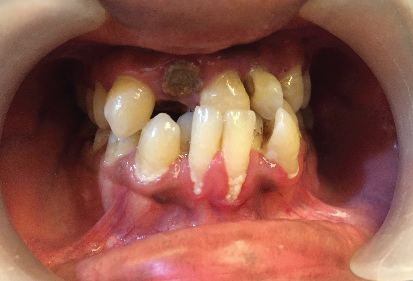
An 18-year-old patient presented with a Class I malocclusion with spacing between upper and lower teeth. The patient had an anterior open bite. Extra oral examination revealed convex profile and straight divergence. Intraoral examination revealed class 1 molar and canine relation, generalized spacing between the teeth, curve of spee of 1 mm, lower midline deviated to the right by 2 mm. Patient also had a tongue thrusting habit (figure 1).
Treatment Objectives
- Improvement in facial profile
- Maintaining Class I molar and canine relation
- Establish normal overjet and overbite
- Correction of lower midline.
Treatment plan
- Fixed appliance therapy using Pre-adjusted edgewise mechanics with Tongue crib appliance.
Treatment progress
Treatment started with the placement of 0.022Ë preadjusted edgewise brackets and molar tubes (MBT Victory series, 3M, UNITEK, Monrovia, CA, USA).
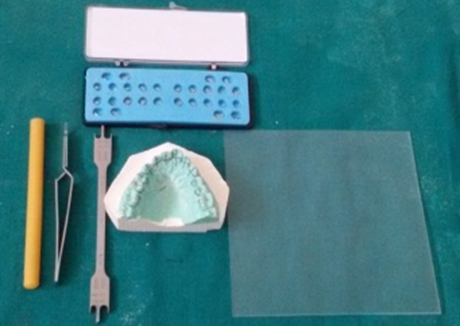
Leveling and alignment was then done with 0.016Ë NiTi archwire (d-tech, Wagholi, Pune, India) and well-coordinated 0.018Ë stainless steel (S.S.) arch wires (A.J. Wilcock Premium Plus Australian arch wire, Whittlesea, Victoria, Australia). The patient was then given a tongue crib appliance (figure 2) to intercept the tongue thrusting habit. Since the patient was an adult, she was given a removable tongue crib and was also advised to perform tongue exercises like elastic swallow. The open bite slowly improved and an ideal overjet and overbite could be achieved. 0.019x0.025” stainless steel wire (Truforce, Ortho Technology, Inc., Tampa, USA) was then placed in the upper and lower arch. Lower spaces were consolidated using elastic chain and upper spaces were closed with a boot loop 0.019x0.025” S.S. wire (figure 3). After space closure upper continuous 0.018” stainless steel (S.S.) arch wire was placed. No box elastics were used during the course of treatment. The patient was asked to maintain the appliance for next 3 months to check for the stability of treatment.
RESULTS
Treatment time was 1 year 5 months. End of treatment, a proper overjet and overbite was established with coincident midlines and a favorable profile change (figure 4).

Figure 1: Pretreatment photographs

Figure 2: Removable tongue crib appliance

Figure 3: Space closure

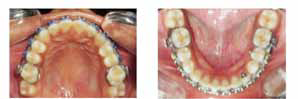
Figure 4: Open bite correction achieved
DISCUSSION
Previous study3 on open bite correction shows that use of spur increases the post treatment stability. Justus et al1 proposed a form function association, suggesting that spurs cause a change in function that cause a change in form. The sequence of events is shown as-
Spurs of the crib à encourage tongue to achieve better posture à new neuromuscular pattern establishedà allows incisor eruption à correction of open bite.
The author also suggested that tongue crib appliance be in place for next 6 months after the orthodontic treatment is over to reduce relapse.
In this case, end of treatment, sufficient overbite was achieved and after the orthodontic treatment, a removable tongue crib appliance was given as retainer.
CONCLUSION
Tongue crib appliance can help in successful closure of dental open bite malocclusion.
REFERENCES
- Roberto Justus. Correction of Anterior Bite with Spurs: Long-Term Stability. World J Orthod 2001;2:219–31.
- Siddharth Mehta, Anjali Mehta, Surendra Lodha. Orthodontic treatment of an open bite case. Guident 2015;8(7):34-5.
- Huang GJ, Justus R, Kennedy DB, Kokich VG. Stability of anterior open bite treated with crib therapy. Angle Orthod 1990;60:17–26.
Disclaimer from Guident
The views and opinions expressed in articles published in Guident are solely those of the authors and do not necessarily reflect the views of the editors, the editorial board or the publisher, Ivory India. Guident does not endorse any product, technique or treatment described. Clinical content is intended for qualified dental and medical professionals and is not a substitute for individual clinical judgement. Guident, its editors and the publisher accept no liability for any consequence arising from the use of information published in the journal.
How to cite this article
Dr.Siddharth Mehta, Dr.Anjali Mehta, Dr.Surendra Lodha. Treatment of an Open Bite Case with Tongue Crib. Guident. 2016 Aug;9(9). Available from: https://guident.in/articles/orthodontics/treatment-of-an-open-bite-case-with-tongue-crib.html