Utilization of an Fixed Appliance Approach for Rapid Correction of Anterior Cross Bite
Hattarki (Senior Lecturer) Department of Orthodontics, Maratha Mandal, s NHG Institute of Dental Science, Belgaum, Karnatka, India
Abstract
Anterior crossbite is the term used to describe an abnormal labiolingual relationship between one or more maxillary and mandibular incisor teeth. Different techniques have been used to correct anterior crossbite. This paper describes the use of a simple fixed appliance for the management of anterior crossbite. The procedure used was a simple and effective method for treating anterior dental crossbite without extraction
Keywords
Anterior; malocclusions, fixed appliance, non extraction
INTRODUCTION
Anterior crossbite is defined as a malocclusion resulting from the lingual positioning of the maxillary anterior teeth in relationship to the mandibular anterior teeth.1 Dental crossbite involves localized tipping of a tooth or teeth and does not involve basal bone.2 Anterior dental crossbite requires early and immediate treatment.
A variety of factors have been reported to cause anterior dental crossbite, including a lingual eruption path of the maxillary anterior incisors; trauma to the primary incisor resulting in lingual displacement of the permanent tooth germ; supernumerary anterior teeth; an over-retained necrotic or pulpless deciduous tooth or root; odontomas; crowding in the incisor region; inadequate arch length; and a habit of biting the upper lip.3–9
There are various treatment modalities used for the correction of anterior dental cross bite. These include tongue blade therapy, reverse stainless steel crowns, removable Hawley retainer with anterior Z-springs and bonded resin composite slopes10,Bruckl appliance and Clear Aligner11
This report presents a method of treating a case of anterior crossbite of dental origin.
CASE PRESENTATION AND EXAMINATION
A 27 year old male patient, presented with Class II malocclusion and anterior crossbite of upper and lower all incisors. His chief complaint was unaesthetic facial appearance, and a missing upper central incisor. Patient had visited a dentist before of the same where he was advised to undergo orthodontic treatment but he was not willing to undergo orthodontic treatment and wanted some immediate short term treatment.[fig1]
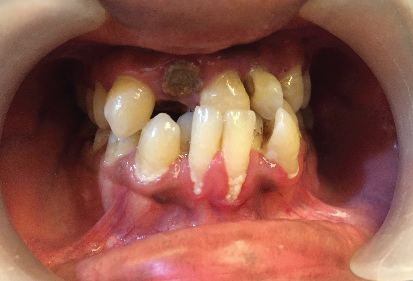
Figure 1a : Intra oral photograph showing anterior cross bite

The following treatment options were discussed with the patient:
1. Extraction of tooth11 root piece , orthodontic correction of upper and lower anteriors, placement of an implant and crown for tooth11.
2. Extraction of tooth11 root piece, intentional root canal treatment for 21 and giving an metal free ceramic bridge(fixed partial denture) from 13 to 23 and without extraction of the lingually placed32 and 42 ,metal free ceramic bridge(fixed partial denture) with a pontic in region of 32 .
The patient reported to the clinic after 2days and was willing to undergo the 2nd option given.
TREATMENT
The following procedures were executed at subsequent appointments based on the clinical findings. The first appointment, non traumatic extraction of 11 root piece and badly carious 22 was done and the extraction site was allowed to heal for one week. In the next appointment intentional root canal treatment was done with 21 on the day of suture removal.
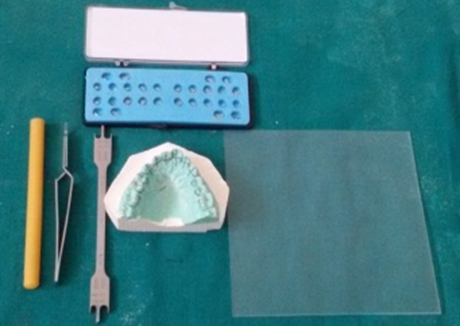
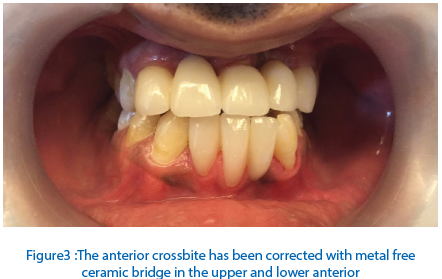
The 2nd appointment was scheduled a week later where in the abutment teeth 12,21,23 and 31 ,41 were prepared. The incisal margin of 21 were over cut to correct the over jet and the lower lateral incisors were not extracted and were kept as it is. Final impressions were made with addition elastomer impression material. The dental technician was given the illustration of the bridge to be made based on the clinical needs. The frame work wax up was done on the cast an additional pontic was asked to attached in 32 region as the space was wide enough to accommodate an additional teeth (fig2). after the approval of wax up, a metal frame work was made and try in was done in the patient's mouth to check the fit of margins as well as the over jet. In the final appointment the fixed partial denture was cemented in with glass ionomer cement after occlusal correction(fig 3).

DISCUSSION
Orthodontic treatment to correct the position of teeth would have been the best option but because of its duration and cost. the patient refused this option .
The main advantages of a fixed denture included the possibility of correcting the anterior crossbite more quickly and less expensively than would have been the case with orthodontic therapy11-13
The treatment done in this patient has been supported by authors, such as Ning,14 where in his 27 cases of anterior crossbite that were corrected with fixed partial denture .there was, no clinical, functional or esthetic problems identified during follow-up after 3 years.
When faced with various esthetic challenges. the optical properties of available ceramic systems enable the clinician to make appropriate choices
CONCLUSIONS
This method represents a safe, quick, easy and esthetically acceptable alternative for the correction of anterior dental crossbite. The procedure is low-cost, involves no discomfort, and it can be completed in only a few visits to the clinic. The success of treatment with a fixed partial denture depends on the diagnosis, treatment planning by the dentist and the patient’s concerns. Appropriate evaluation of the patient, prosthetic design and tooth preparation, as well as good oral hygiene, are all required for success.
REFERENCES
- Tsai HH. Components of anterior crossbite in the primary dentition. ASDC J Dent Child. 2001;68:27–32.[PubMed]
- Marrison JT. Fundamentals of Pediatric Dentistry. 3rd ed. London: Quintessence Publishing Co; 1995. p. 355.
- Olsen CB. Anterior crossbite correction in uncooperative or disabled children. Case reports. Aust Dent J.1996;41:304–309. [PubMed]
- 4. Major P, Glover K. Treatment of anterior cross-bites in the early mixed dentition. J Can Dent Assoc.1992;58:574–575. [PubMed]
- 5. Heikinheimo K, Salmi K, Myllarniemi S. Long-term evaluation of orthodontic diagnosis make at ages of 7 and 10 years. Eur J Orthod. 1987;9:151–159. [PubMed]
- 6. Hannuksela A, Vaananen A. Predisposing factors for malocclusion in 7-year-old children with special reference to atopic diseases. Am J Orthod Dentofacial Orthop. 1987;92:299–303. [PubMed]
- 7. Hannuksela A, Laurin A, Lehmus V, Kauri R. Treatment of cross-bite in the early mixed dentition. Pron Finn Dent Soc. 1988;84:175–182. [PubMed]
- 8. Estreia F, Almerich J, Gascon F. Interceptive correction of anterior crossbite. J Clin Pediatr Dent.1991;15:157–159. [PubMed]
- Valentine F, Howitt JW. Implications of early anterior crossbite correction. J Dent Child. 1970;37:420–427.[PubMed]
- S. Bayrak and E. S. Tunc, “Treatment of anterior dentalcrossbite using bonded resin-composite slopes: case reports,”European Journal of Dentistry, vol. 2, pp. 303–307, 2008. 10) Irena Jirgensone, Andra Liepa, Andris Abeltins Anterior crossbite correction in primary and mixed dentition with removable inclined plane (Bruckl appliance) Stomatologija, Baltic Dental and Maxillofacial Journal, 2008, Vol. 10, No. 4 140-144.
- Bartsch A, Witt E, Sahm G, Schneider S. Correlates of objective patient compliance with removable appliance wear. Am J Orthod Dentofacial Orthop 1993; 104(4):378–86.
- Doll GM, Zentner A, Klages U, Sergl HG. Relationship between patient discomfort, appliance acceptance and compliance in orthodontic therapy. J Orofac Orthop 2000; 61(6):398–413.
- Sergl HG, Klages U, Zentner A. Pain and discomfort during orthodontic treatment: causative factors and effects on compliance.Am J Orthod Dentofacial Orthop 1998; 114(6):684–91.
- Ning JH. Correcting anterior individual crossbite using PFM crowns with porcelain veneer. 6th Annual Scientific Meeting of the IADR Chinese Division; 2005 Oct 24–25; Shanghai, China.
Disclaimer from Guident
The views and opinions expressed in articles published in Guident are solely those of the authors and do not necessarily reflect the views of the editors, the editorial board or the publisher, Ivory India. Guident does not endorse any product, technique or treatment described. Clinical content is intended for qualified dental and medical professionals and is not a substitute for individual clinical judgement. Guident, its editors and the publisher accept no liability for any consequence arising from the use of information published in the journal.
How to cite this article
Dr. Sanjeevini .A. Utilization of an Fixed Appliance Approach for Rapid Correction of Anterior Cross Bite. Guident. 2016 Jun;9(7). Available from: https://guident.in/articles/orthodontics/utilization-of-an-fixed-appliance-approach-for-rapid-correction-of-anterior-cross-bite.html