Skeletal Class III Correction Using Rme and Facemask Therapy
Mcqueen Mendonce (Reader) Dr. Krishna Nayak US (Principal and Dean) Department Of Orthodontics, A B Shettty Memorial Institute of Dental Science, Mangalore
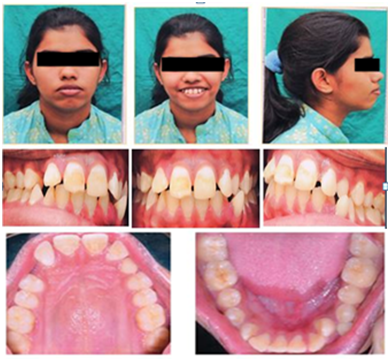
A female patient aged 17 years reported with the chief complaint of forwardly placed lower jaw and highly placed upper front teeth.. Extra-oral examination revealed a concave facial profile,anterior facial divergence with Class III relation of the apical bases.The Maxilla appeared to be retrusive while the Mandible was in line in relation to the Cranial base.
Pretreatment Extraoral Photographs
Pretreatment Intraoral Photographs
Intra-oral examination revealed a constricted V shaped upper arch with crowding and highly placed canines and an average symmetrical U shaped mandibular arch with lower anterior crowding.The Overjet and Overbite were -4mm and -3mm respectively.The molars were in Angles Class III relation and the canines were in end on relationship bilaterally.The upper dental midline was shifted to the left by1.5mm.
The Cephalometric values indicated a retrusive maxilla (SNA=74degrees),normal mandible (SNB=80degree) ,and a Frankfurt Mandibular plane angle of 28 degrees.
It was diagnosed to be a case of Skeletal Class III with constricted maxillary arch resulting in posterior crossbite ,anterior open bite along with Angles Class III Molar and end on Canine relationship.
The Treatment Objectives were correction of the bilateral dental crossbite and crowding in the upper arch,bringing down the highly placed canines into the arch, correction of anterior open bite and obtaining optimum overjet and overbite,correction and maintainance of Class I Molar and Canine Relation and achieving a pleasing facial profile and soft tissue balance.
The Treatment was planned for an initial orthopedic appliance phase with Rapid Maxillary expansion and Facemask therapy followed by fixed orthodontic therapy using MBT mechanics in 022 slot and finishing and detailing.
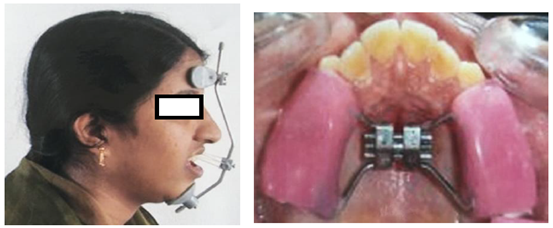
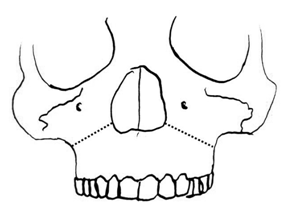
Orthopedic Appliance Therapy with Rapid Maxillary Expander and Facemask
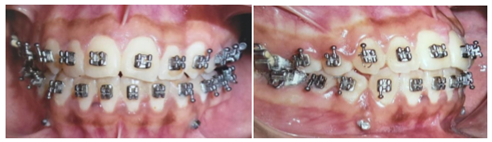
Midtreatment Intraoral Photographs
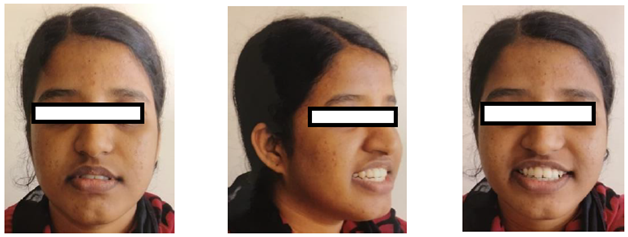
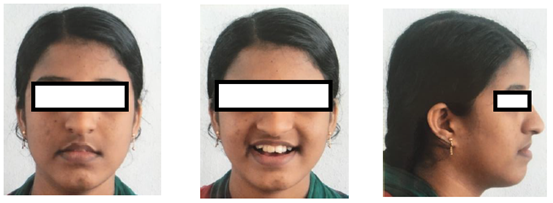
Post treatment Extraoral Photographs

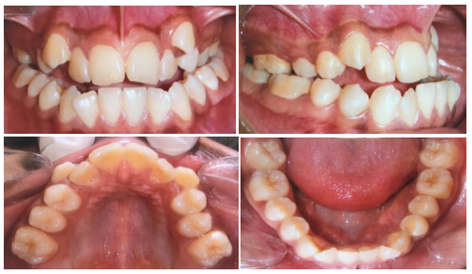
Post treatment Retention Intraoral Photographs
Disclaimer from Guident
The views and opinions expressed in articles published in Guident are solely those of the authors and do not necessarily reflect the views of the editors, the editorial board or the publisher, Ivory India. Guident does not endorse any product, technique or treatment described. Clinical content is intended for qualified dental and medical professionals and is not a substitute for individual clinical judgement. Guident, its editors and the publisher accept no liability for any consequence arising from the use of information published in the journal.
How to cite this article
Dr.Upasak Mukherjee Dr. Skeletal Class III Correction Using Rme and Facemask Therapy. Guident. 2017 Dec;11(1). Available from: https://guident.in/articles/orthodontics/skeletal-class-iii-correction-using-rme-and-facemask-therapy.html