
Polyetheretherketone(PEEK): An Innovation in Dentistry
Manesh Lahori (Principal & HOD) K.D Department of Prosthodontics, K.D Dental College & Hospital, Mathura, India
INTRODUCTION
Metal-free restorations are becoming increasingly important in dentistry due to factors such as the increased aesthetic demands of the patient, legislation in some countries and possible material incompatibility. These days, it seems more
patients want to avoid incorporation of a metallic material in the mouth and clinicians are following this trend too. Ceramic materials ideally meet the aesthetic requirements but also may have material or technical disadvantages in some cases.
Polyether ether ketone (PEEK) high-performance polymer has been used in industry for many years and has also proven successful in many areas of medicine.
PEEK is characterised by excellent mechanical and chemical properties. In medicine, it has long been used for the preparation of different kinds of implants. Artificial cranial plates, components of finger and knee joints or intervertebral bodies (spine implants) are just a few examples of the versatile use of the material in the area of long-term implantation. For several years, PEEK has also increasingly been applied in dentistry. Due to its combination of superior
biocompatibility and ideal mechanical properties, the material is particularly attractive for dental restorations and it is ideal for CAD/CAM framework fabrication in prosthetic dentistry.
The monomer unit of etheretherketone monomer polymerizes via step-growth dialkylation reaction of bis-phenolates to form polyetheretherketone.
Metal in comparison has several disadvantages when used in medical and / or dental applications:
- higher stiffness compared with bone
- possible release of metal ions (Galvanic element) can cause artefacts in CT and MRI Scans
In comparison to traditional materials previously used, PEEK has an abundance of advantages. It has a high strength to weight ratio, it has elastic properties similar to human bone,it has a zero corrosion rate,has extremely low water absorption and is radiolucent. Certain manufacturers can supply “filler free” material making it an ultra high purity material so this is the type ideal for dental use. Also in the past ten years, there has been no indications of allergic reactions to the material.
Historically, most polymer-based partial denture frameworks tend to need bulk to attain a certain strength and can often be brittle or too flexible. Metal frameworks are often time consuming to produce or require expensive equipment such as Selective Laser Melting machinery when digitally manufactured. This is not so with PEEK as it exhibits a perfect balance of the properties desirable to frameworks and can be milled very easily.
One major advantage of a CAD/CAM fabricated framework is that the mechanical properties of the PEEK material are not adversely affected by the milling process. Bridge frameworks milled from a high-grade, industrially manufactured block undergo no physical changes during the fabrication process and posses the same material/technical properties.
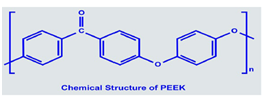
Uses for PEEK in dental technology –
- It include
- Implant fixture,Abutments,healing caps
- Fixed prosthetic frameworks
- Removable partial denture frameworks including precision attachments.
Advantages of PEEK-
The advantages to the patient when using a PEEK partial denture framework are many.
- Strong and lightweight for improved patient comfort;
- Digital design matches the patient’s individual anatomy;
- Metal-free denture framework is a taste neutral (no metal taste);
- It has no thermal or electrical conductivity;
- X-ray and scanner friendly;
- Non-allergenic.
- Shock absorbent during chewing;
- High resistance to abrasion and decay.
- Furthermore,recent publications reported that PEEK is a suitable material for double crown systems . Finally, a gold alloy with its ductility already affects good results in combination with ZrO2. Therefore, a new concept could be the combination of these two biocompatible materials, i.e., ZrO2 and PEEK in order to produce metal-free FDPs such as telescopic crowns.
PEEK AS COMMERCIAL PRODUCT
A wide range of PEEK modifications and composites are commercially available, e.g., PEEK-Classix, PEEK-Optima, Endolign and Motis. They differ in their physical properties, which makes them suitable for different applications. Other forms, so-called PEEK bioactive composites, contain beta-tricalcium phosphate and hydroxyapatite. Research in this field is also concerned with the surface finish of this polymer thermoplastic and involves macroporous titanium and hydroxyapatite layers, or treatment with laser for an exactly defined surface structure. The clinical applications of PEEK and its composites include, in addition to components for spinal surgery, osteosynthesis plates, screws, intramedullary nails or external fixators, which are implants still at the stage of prototypes. Mid-term studies involving hundreds of patients have shown that, for instance, the VerSys Epoch Fullcoat Hip System (Zimmer) has a markedly lower stress-shielding effect. Carbon fibre-reinforced (CFR-PEEK) composites are used to make articulating components for total hip replacement. Their convenient properties allow for production of much thinner liners and an enlargement of the femoral head diameter, thus reducing the wear of joint implants. CFR-PEEK composites are particularly effective for hip resurfacing in which the Mitch PCR (Stryker) acetabular component has been used with good results. The MOTIS polymer acetabular cup (Invibio Ltd.) is another example. Further PEEK applications include the construction of finger-joint prostheses (Mathys AG), suture anchors (Stryker) and various kinds of augmentations (Medin). Based on the information obtained, the authors suggest further use for CFR-PEEK composites, such as the construction of articulating liners for total shoulder joint replacement, particularly in reverse shoulder arthroplasty.
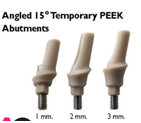
PEEK optima-In 1999 the first ever advanced implantable thermoplastic material was developed by Invibio Biomaterial Solutions: PEEK Optima. PEEK Optima is currently used in dentistry for temporary Abutments, healing caps, telescopic attachments precision attachments and Implant-supported superstructures With CAD-CAM technology PEEK “blanks” can be used to mill frameworks for dentures or bridges within minutes.
BIOHPP
Another Variant of PEEK is BioHPP developed by Bredent GmbH. BioHPP stands for Bio High Performance Polymer and has been developed especially for dental applications.The modification of the material consists of an addition of a special ceramic filler with a grain size between 0.3 to 0.5 μm. According to the manufacturer the small grain size results in a constant homogeneity. Also the small filler size leads to extremely good polishing properties.
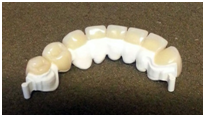
In contrary to PEEK Optima this material can also be vacuum pressed in combination with the conventional lost wax technique.
Implants are osseointegrated without the formation of a periodontal ligament compared with a natural tooth. Conventional materials such as metal and zirconium have very little elasticity which can lead to fractures of the porcelain or TMJ problems. Allergies and corrosion are also disadvantages of these materials.
Therefore it is the cushion effect of PEEK which makes it a desirable material for implant bridges and crowns
JUVORA-One notable dental brand of PEEK is JUVORA. Their ultra high purity “filler free” type of PEEK is unique in the market place and has been used in 4 million medical device implants, Juvora is a true unfilled pure form of PEEK.
.
Denture framework are conventionally made from Chrome-Cobalt. BioHPP or Juvora can be a viable alternative to Chrome-Cobalt as it is lighter, does not cause any galvanic elements (corrosion) when in contact with other metals in the mouth. Especially the option of milling the material (Juvora) would be a major advantage.
The major beneficial property for orthopedics implant application remains its lower Young’s (elastic) modulus (3– 4 GPa) being close to human bone .
The titanium and its alloys have elastic modulus significantly higher than bone and resulting in severe stress-shielding and failure . The modulus of carbon-reinforced PEEK(18Gpa) is also comparable to those of cortical bone and dentin so the polymer could exhibit lesser stress shielding when compared to titanium which used as an implant material .
Moreover, tensile properties of PEEK are also analogous to those of bone, enamel and dentin , making it a suitable restorative material as far as the mechanical properties are concerned.
|
Material |
Tensile strength (MPa) |
Young’s modulus(GPa) |
|
PEEK |
80 |
3-4 |
|
CFR-PEEK |
120 |
18 |
|
Cortical bone |
104-121 |
14 |
|
PMMA |
48-76 |
3-5 |
|
Dentin |
104 |
15 |
|
Enamel |
47.5 |
40-83 |
|
Titanium |
954-976 |
102-110 |
Tensile strength and elastic moduli of PEEK,CFR-PEEK,and mineralized human tissues.
In contrast to titanium, PEEK has very limited inherent osteoconductive properties . Hence, a considerable amount of research has been conducted to improve the bioactivity of PEEK implants . There are a number of methods that have been proposed to improve the bioactivity of PEEK including coating PEEK with synthetic osteoconductive hydroxyl apatite , increasing its surface roughness and chemical modifications and incorporating bioactive particles .
PEEK has white color and excellent mechanical properties, hence it has been proposed for other prosthodontic applications such as fixed prostheses and removable prostheses.
The effects of surface modification of PEEK have been investigated for bonding with different luting agents and extracted teeth .
Moreover, PEEK can also be used an esthetic orthodontic wire. Compared to other polymers, such as polyether sulfone (PES) and polyvinylidene difluoride (PVDF), PEEK orthodontic wires are able to deliver higher orthodontic forces but at a cross section of that similar to metallic wires such as cobalt– chromium (Co–Cr), titanium–molybdenum (Ti–Mo) and nickel– titanium (Ni–Ti) .
Due to these unique physical and mechanical properties, PEEK is a promising material for dental applications. The aim of this review is to summarize the outcome of research conducted on the material for prosthodontic applications.
PEEK as an implant material
According to Wolff’s Law, the bone remodels according to the load that has been applied to it. Stress shielding is the reduction in volume of the bone around an implant due to the shielding of normal loads by the implant. Finite-element analysis (FEA) of carbon-fiber reinforced PEEK (CFR-PEEK) implants suggested that they could induce lesser stress shielding than titanium.
However, since PEEK dental implants have not been used widely clinically, it is unknown if there is a difference between the bone resorption around PEEK and titanium implants in human subjects.
Unmodified PEEK is inherently hydrophobic in nature, with a water-contact angle of 80–90 and bioinert . Indeed, studies have shown that there is no significant effect of unmodified PEEK on the proliferation rate of cells in vitro.
On the contrary, some studies have observed an increased protein turnover in cells in contact with conventional- and CFR-PEEK . Animal studies have suggested that PEEK can survive for up to 3 years while inducing non-remarkable localized inflammation .
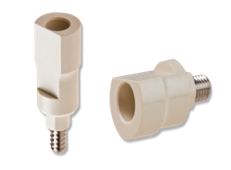
Nevertheless, quite a few studies suggested that there is no significant difference between the osseointegration of PEEK and conventional implant materials such as zirconia and titanium .
Conversely, recent proteomic studies have indicated that PEEK inhibits mRNA processing that may lead to a decreased cellular proliferation rate on the surface and cytotoxic effects may be produced in the long-term]. Nonetheless, the same proteomic studies have found no difference between the bioinertness of PEEK, zirconia and titanium .
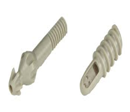
In order to improve the mechanical and biological properties, a number of modifications have been attempted in PEEK materials.
NANO-STRUCTURED PEEK SURFACES
The beneficial role of nanomaterials is well known for dental applications .
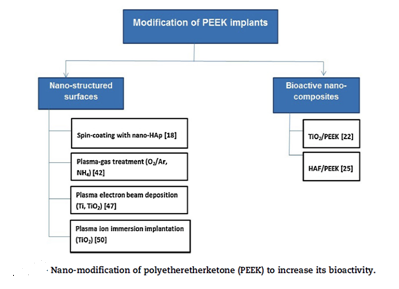
In recent years, PEEK has also been modified at the nano-level in order to improve its bioactivity and osseoconductive properties. Conventionally, PEEK has been coated using bioactive materials such as osseoconductive calcium hydroxyapatite (HAp) or titanium by means of plasma-spraying .
In this process, particles are sprayed onto the surface of an implant through a plasma torch. The plasma melts the particles to deposit on the implant surface and producing a rough surface layer.
Although spraying of a bioactive layer may be suitable for larger implants, the coating produced is not suitable for the relatively smaller dental implants. This is because the highly rough (Ra 7 mm) and very thick apatite layer that may get delaminated leading to implant failures .
Another disadvantage of using plasma-spray to coat PEEK with HAp are the high temperatures involved in the process. High temperatures could damage PEEK structure due to its relatively low melting temperature (ca. 340 8C).
Furthermore, the low bond strength (2.8 MPa) of plasma-sprayed HAp coatings on CFR-PEEK has been suggested to result from the evaporation of carbon fibers from the surface of the implant due to the high temperatures during the coating process .
There has been a lot of focus on nanoscale coating of PEEK with bioactive apatite and production of bioactive PEEK nanocomposites .
Osteogenic implant coatings are used to modify the surface properties of dental implants. Bioactive surface coatings can improve the interaction with bony tissues and results in better osseointegration of implant materials .
Spin-coating is another method for coating a thin layer of nanoscale calcium hydroxyapatite on PEEK surface . In this process apatite dissolved in organic solvents is slowly dropped onto the surface of an implant rotating at high speeds .
Upon heat-treatment a thin layer of HAp is formed on the implants. Animal studies have shown that spin-coated PEEK implants have higher bone-implant contact (BIC) when compared to uncoated PEEK. However, no significant differences in removal torque could be observed .
CFR-PEEK hip stems were plasma-sprayed (17 nm-thick coating) using TiO2 and hydroxyapatite via plasma spraying and dipping in a-Tricalcium phosphate (a-TCP). reported excellent biocompatibility and mechanical properties for hip implant applications without the release ot any metallic ions.
In addition, cementless fixation was attained even for load-bearing applications while using HA-coated CFR/PEEK implants . These finding have suggested a strong potential of coated PEEK materials for dental implant applications.
However, no clinical trials investigating coated PEEK dental implants in humans have been conducted so far and required to assess their biocompatibility prior to clinical application.
A PEEK implant coated with a titanium/BMP-2 coating could be an attractive aspect and a great potential for PEEK oral implantology applications.
However, e-beam coated implants have not been tested in vivo so their clinical prospects are still not very clear. This process is known as plasma immersion ion implantation (PIII) .
Although, PEEK coated with TiO2 using PIII has shown partial activity against Staphylococcus aureus and Eschrechia coli, its antimicrobial effects against periodontal pathogens is yet to be determined .
Similarly in case of apatite-coated PEEK implants, no human trials investigating the use of e-beam coated PEEK
Nano-structured PEEK surfaces produced by etching with sulfuric acid (sulfonation) and rinsing with distilled water have been observed to induce an accelerated osseointegration compared to the unmodified PEEK in vitro and in vivo .
Therefore, these implants cannot be employed into clinical applications until sufficient data validating their safety and longevity has been recorded in literature.
surface. This effect can be minimized by rinsing the implants with acetone to remove the residual sulfuric acid . More recent experiments have focused on using strong alkalis to introduce functional groups (OH groups) on PEEK surface which can induce formation of a biomimetic apatite layer when immersed in simulated biomimetic fluid (SBF) .
However, conventional biomimetic coatings can take up to 48 h to be produced. Nonetheless, microwave-assisted biomimetic coating can produce an apatite layer on PEEK in as quickly as 4 min . Still, no studies have attempted to investigate the bond-strength of this apatite layer. Bioactive PEEK nano-composites
In order to increase the bioactivity, bioactive inorganic particles have been incorporated to PEEK using melt-blending and compression molding techniques .
However, incorporating bioactive HAp particles in the size range of 2–4 mm has a negative impact on the mechanical properties of PEEK . This can be overcome using nano-sized particles instead of larger particles . Implants made of PEEK nano-composites have a number of advantages such as increased bioactivity, better mechanical properties,anti-microbial properties against Streptococcus mutans, a common oral pathogen, in addition to improving osseointegration in vivo .
Furthermore, animal studies have exhibited that nano-TiO2/PEEK implants have a higher bioactivity compared to pure PEEK.
The PEEK nano-composites can enable researchers to synthesize biomaterials with variable combinations of mechanical properties required for any particular application. For example, besides being used as implants, these bioactive nano-composites could be used as indirect intracoronal or extracoronal restorations. These restorations can have an additional advantage of being anti-bacterial as reported by Wang et al. However, more studies are needed in order to ascertain the usage and manipulation of the composites before these composites can be used as restorative materials.
PEEK IMPLANT ABUTMENTS
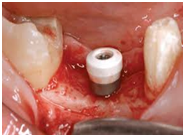
Considering adequate biocompatibility, implant healing abutments can be constructed using PEEK. A randomized, controlled clinical trial (RCT) conducted by Koutouzis et al. suggested that there is no significant difference in the bone resorption and soft tissue inflammation around PEEK and titanium abutments. Furthermore, the oral microbial flora attachment to PEEK abutments is comparable to those made of titanium, zirconia and polymethylmethacrylate. A close match of elastic moduli of bone and PEEK surface reduces the stress shielding effects and encourage bone remodeling. Hence, PEEK could prove to be a viable alternative to titanium in constructing implant abutments.
PEEK AS A REMOVABLE PROSTHESIS MATERIAL
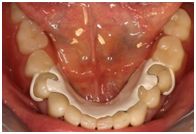
Tannous et al. has suggested that denture clasps made of PEEK have lower retentive forces compared to cobalt–chromium (Co–Cr) clasps . However, since the study was conducted on metal crowns in vitro, it is not known how effective the esthetic PEEK clasps would be in retaining dentures in the clinical setting. Another application of PEEK is the construction of a removable obturator. Nevertheless, more studies are needed to evaluate the efficacy of PEEK obturators compared to conventional acrylic prostheses. However, owing to the superior mechanical and biological properties of PEEK, it will not be surprising if dentures constructed from the polymer are routinely constructed in near future.
PEEK CROWNS
A variety of procedures have been suggested to condition the surface of PEEK in order to facilitate its bonding with resin composite crowns. Even though air abrasion with and without silica coating creates a more wettable surface , etching with sulphuric acid creates a rough and chemically altered surface which enables it to bond more effectively with hydrophobic resin composites (shear bond strength: 19.0 3.4 MPa). It has been observed that etching with sulfuric acid for 60–90 s can exhibit shear bond strength to resin composite cements as high as 15.3 7.2 MPa after being stored in water for 28 days at 37 C . Etching with piranha acid and using a bonding agent have been shown to produce tensile bond strength to composite resin as high as 23.4 9.9 MPa in aged PEEK specimens. No significant differences were observed in the tensile bond strength of PEEK crowns and dentin abutments using air abrasion and sulfuric acid etching techniques. PEEK can be used under resin composite as a coping material. Because the mechanical properties of PEEK are similar to those of dentin and enamel, PEEK could have an advantage over alloy and ceramic restorations.
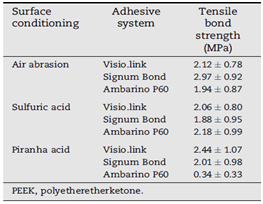
Tensile bond strength of PEEK to dental tissues using various surface conditioning and adhesive systems.
PEEK CAD-CAM MILLED FIXED PARTIAL DENTURES
CAD-CAM designed composites and polymethylmethacrylate (PMMA) fixed dentures have superior mechanical properties compared to conventional fixed dentures. PEEK is another material that can be used as an alternative to PMMA for CAD-CAM restorations. Three-unit PEEK fixed partial denture manufactured via CAD-CAM has been suggested to have a higher fracture resistance than pressed granular- or pellet shaped PEEK dentures . The fracture resistance of the CADCAM milled PEEK fixed dentures is much higher than those of lithium disilicate glass-ceramic (950N), alumina (851N) , zirconia. Despite of significantly low elastic moduli and hardness, abrasive resistance of PEEK is competitive with metallic alloys .It is still unknown if PEEK crowns can function efficiently in harmony with dentin and enamel. Considering good abrasion resistance, mechanical attributes and aforementioned adequate bonding to composites and teeth, a PEEK fixed partial denture would be expected to have a satisfactory survival rate.
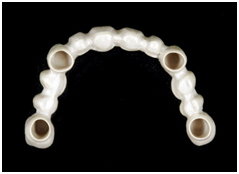
Porous polyether ether ketone: A candidate for hard tissue implant materials.
A porous polyether ether ketone (p-PEEK) was fabricated by firstly preparing titanium/PEEK composite (Ti/PEEK) (die casting) and then removing titanium wire (acid etching). The pores in p-PEEK can provide channels for bone cells ingrowth and body fluid transmission. The pore size and porosity of p-PEEK can be tailored by adjusting the diameter and volume fraction of titanium wire that was used in the preparation process. This porous PEEK is expected to be a candidate for hard tissue implant materials.
SOME STUDIES RELATED TO PEEK
The use of a modified poly ether-ether ketone material as an alternative material for the fabrication of resin-bonded fixed dental prosthesis (RBFDP) framework. This new material can be used for patients allergic to metals, maintaining the same high esthetic demand of ceramics, presenting light weightness and a flexibility similar to bone as a distinct advantage over ceramic materials. .
Some studies were done to investigate the bone response to threaded polyetheretherketone (PEEK) implants coated with nanohydroxyapatite and have demonstrated that implants with a threaded design render good stability to PEEK in both coated(nanocrystalline hydroxyapatite) and uncoated implants. Nanohydroxyapatite-coated PEEK implants demonstrated improved bone formation compared with uncoated controls.
CONCLUSION
As its mechanical and physical properties are similar to bone and dentin, PEEK can be used for a number of applications in dentistry including dental implants. Increasing the bioactivity of PEEK dental implants without affecting their mechanical properties is a major challenge.
PEEK is also an attractive material for producing CAD-CAM fixed and removable prosthesis owing to its superior mechanical properties compared to materials such as acrylic. Further research and clinical trials are required to explore this material and possible modifications for further dental applications.
REFERENCES
- Poulsson AH et al .Osseointegration of machined, injection moulded and oxygen plasma modified PEEK implants in a sheep model; 2014 Apr;35(12):3717-28.
- Andrikopoulou E et al.Modified PEEK Resin Bonded Fixed Dental Prosthesis for a Young Cleft Lip and Palate Patient; J Esthet Restor Dent 2016 Jul;28(4):201-7.
- S barkarmo et al; Enhanced bone healing around nanohydroxyapatite-coated polyetheretherketone implants: An experimental study in rabbit bone;,J of biomaterials applications. July 2014.
- PEER NELZ;Bio Materials in Dentistry: Peek Optima and BioHPP; MED. DENT. PrWeb;Sep 2017 .
- S Najeeb et al.Applications of polyetheretherketone(PEEK) in prosthodontics and oral implantology.Journal of prosthodontic research Jan 2016;60(1):12-19.
Disclaimer from Guident
The views and opinions expressed in articles published in Guident are solely those of the authors and do not necessarily reflect the views of the editors, the editorial board or the publisher, Ivory India. Guident does not endorse any product, technique or treatment described. Clinical content is intended for qualified dental and medical professionals and is not a substitute for individual clinical judgement. Guident, its editors and the publisher accept no liability for any consequence arising from the use of information published in the journal.
How to cite this article
Dr. Deeksha Aggarwal Dr. Polyetheretherketone(PEEK): An Innovation in Dentistry. Guident. 2017 Dec;11(1). Available from: https://guident.in/articles/general/polyetheretherketone-peek-an-innovation-in-dentistry.html


