Ramsay Hunt Syndrome
Indian Army, 326 Fd Hospital, C/O 56 APO, India
ABSTRACT
Ramsay Hunt syndrome is a rare but severe complication of primary infection of Varicella-Zoster virus (VZV) which causes the most common childhood disease. In this case report an young soldier has been presented with typical sign and symptoms of the oro facial region being diagnosed by a Dental surgeon as syndrome and effectively treated.
INTRODUCTION
Ramsay hunt syndrome (RHS) was described bySir James Ramsay Hunt, an American physician, in the year 1907, in a series of patients suffering from viral lesions of the ear, face, oral cavity accompanied by facial palsy, and other neurological disturbances [1].
The syndrome is a rare but severe complication of primary infection of Varicella-Zoster virus (VZV) which causes the most common childhood disease – chicken pox. The virus is assumed to be latent in the dorsal root ganglia and when reactivated due to various factors can lead to herpes zoster.Although it could manifest in any age, the incidence of RHS is higher in thesecond and third decades of life, and it is uncommon in childhood. It is also higher inimmunosuppressed patients, like HIV positives, in use of cytotoxic and steroid medications.
The presence of facial paralysis and ipsilateralotalgia accompanied by vesicles in the auditory canal areclassic signs and symptoms. Vertigo, nausea, vomiting, nystagmus and sensorineural hearingloss are additional clinical features2. Involvement of cranial nerves trigeminal,glosopharyngeal, vagus and hypoglossal occurs less frequently3.
Ramsay Hunt Syndrome is a rare, devastating diagnosis that involves unilateral peripheral facial paralysis and in some cases vesicular rash on the ear or in the mouth. The aim of this article is to discuss about the clinical presentationand management of RHS so as to facilitate timely diagnosis, treatmentand ensure favourable recovery Without any residual neurological complications.
CASE REPORT
A 32 year serving soldier reported to Dental OPD with the chief complaints of pain in throat and face and swelling over face on left side and for the last two days.Past medical and Dental history was non contributing. The patient was married and a tobacco chewer for last six years.
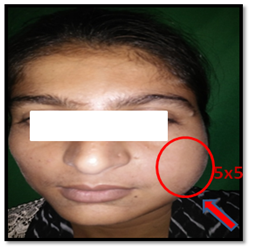
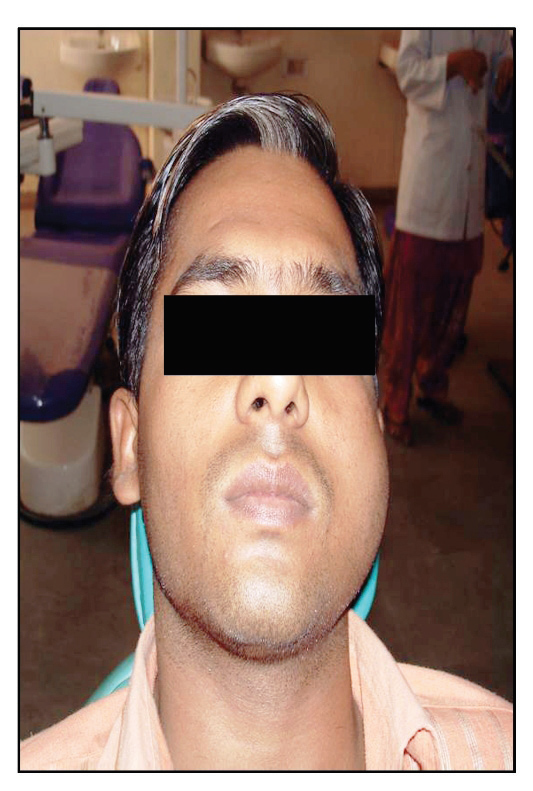
On examination vital parameter were seen to be within normal limit but the patient was febrile. Systemic examination revealed no other involvement of system except neurological involvement. On inspection, extraoral examination revealed generalized erythema of skin over the left side of the face (Fig 1), pre auricular region, pinna on left side. Single vesicle was found over the left pinna (Fig 2). There was loss of wrinkle over the forehead on the left side even while trying to do so. Inability to close the eyelid in the left side and blow the air due to paralysis of buccal or orbital branch of facial nerve ,deviation of angle of mouth to opposite side (Fig 3) were observed with the patient which are suggestive of facial palsy.
No swelling was found on the lt side of the face. Also the patient was having great difficulty in deglutition since 3 days. He was immunized as perNational Immunization schedule. On examination he was conscious, co- operative, normal built.There was absence of naso-labial fold on right side. Clinical diagnosis of Ramsay Hunt Syndrome was established.
By this time he had developed vesiculareruptions on the posterior one third of left half of the tongue which extended on anterior, posterior and lateral pharyngeal wall (which was also confirmed by laryngoscopy by the department of ENT On subsequent examination). The patient wasclinically diagnosed a case of Ramsay-Hunt Syndrome and wasadvised TabAcyclovir 800 mg five times a day x 7days, Tab Amoxycillin and clavalonic acid 625 mg thrice a day x 5 days, Tab Ibuprofen and paracetamol thrice a day x5 days, Multivitamins. There was lower motor neuron lesion facial palsy on left side which was complete.There was evidence of ulcerations over left tonsil,tonsillar pillars and posterior pharyngeal wall (Fig 4).The patient wasalso advised oral Tab Prednisolonalongwitheyedrop Carboxymethyl Cellulosefor local application. The patient was also referred to Ophthalmologist for corneal assessment and management of future complications.The patient was also examined by ENT specialist and confirmed the diagnosis after which the treatment was continued .The audiometric test wasalso carried out by Otolaryngologist whose result was suggestive of mild hearing loss on Lt ear and which was suggestingthe involvement of VIIIth cranial nerves,thereby confirming the diagnosis (Fig 5).


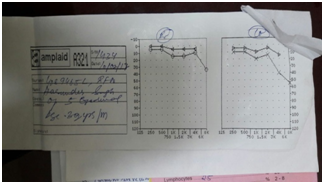
Fig No 5 AUDIOMETRIC ANALYSIS
DISCUSSION
Herpes zoster oticus also known as Ramsay Hunt Syndrome which is a rare complication of Herpes Zoster in which reactivation of latent Varicella Zoster virus infection in the geniculate ganglion causes otalgia,auricular vesicles and peripheral facial paralysis.
RHS is estimated at an occurrence of 5 per 100,000 and 12% of all facial nerve paralysis4. Females are 20% more commonly affected than males5. RHS is a relatively rare syndrome with no single definition which is agreed to be gold standard. Hunt classified the disease into four subgroups based on the pathological process taking place in geniculate ganglion as6 disease affecting the sensory portion of seventh cranial nerve, disease involving the sensory and motor divisions of seventh cranial nerve, disease involving the sensory and motor divisions of seventh cranial nerve with auditory symptoms, and disease involving the sensory and motor divisions of seventh cranial nerve with auditory and vestibular symptoms7.
The pathophysiology of the syndrome lies in VZV reactivation in geniculate ganglia and subsequent neural inflammation, pressure and possible destruction of facial nerve in temporal bone causing facial palsy along with migration of VZV from the ganglia to skin around the ear or oropharynx producing vesicular lesions1. There are also reported literature cases of reactivation of VZV following dental procedures such as incision of gingiva and fitting of a crown, treatment of carious teeth, extraction of a tooth, root canal therapy, and adjustment of dentures in immune-compromised patients8.
Ramsay Hunt syndrome (aka Herpes zoster oticus) is apolycranial neuropathy due to reactivation of varicellazoster virus in the geniculate ganglion, causing the triad ofipsilateral facial paralysis, ear pain, and vesicles in theauditory canal and auricle9.Our patient presented a case of polycranial neuropathy. Ramsay Hunt Syndrome is diagnosedclinically from paroxysmal deep otalgia onone side along with appearance of rash orherpetic blisters in the distribution of nervousintermedius and VII nerve palsy. Presence ofvirus can be proved by the rise of serologicaltiter of VZV in serum or CSF. Viral DNA inthe blister fluid can also be confirmedpolymerase chain reaction (PCR)10.
Treatment consists of anti viral agents(Acyclovir, Valacylovir and Famciclovir) forabout 7-10 days, steroid and a strong painreliever. Best results are reported whentreatment is started within 72 hoursof appearance of symptoms. Overall, patients with Ramsay Hunt syndrome achieved ahigh rate of complete recovery of the facial nerve function(70.4%) after the different proposed treatments. The combinationof steroids and acyclovir reached better recovery rates
than steroids in mono therapy. Dosage and period of treatmentgreatly varied among studies.
The prognosis of Ramsay Hunt Syndrome is not as good as that of Bell’s palsy. Unlike Bell’s palsy only 50% victims are likely toget a complete return of facial nerve function.
REFERENCES
- Prabhu RV, Volvoikar P, Dinkar A, Prabhu VD. Ramsay Hunt syndrome with cranial polyneuropathy. J Cranio Max Dis. 2013;2:154–7.
- Oviedo AM, Zamarro MTL, Hoyo JJU. Síndrome de Ramsay Hunt. An Med Interna 2007;24(1):31-34.
- Kannan SK, Sherubin JE, Sajesh S, Gopakumar KP. Ramsay Hunt syndrome (herpes zoster oticus) J Indian Acta Oral Med Radiol. 2012;24:70–2.
- Kim CH, Kang SI, Kim YH. A case of Ramsay Hunt syndrome with cranial polyneuropathy. Korean J Audiol. 2012;16:80–2.
Disclaimer from Guident
The views and opinions expressed in articles published in Guident are solely those of the authors and do not necessarily reflect the views of the editors, the editorial board or the publisher, Ivory India. Guident does not endorse any product, technique or treatment described. Clinical content is intended for qualified dental and medical professionals and is not a substitute for individual clinical judgement. Guident, its editors and the publisher accept no liability for any consequence arising from the use of information published in the journal.
How to cite this article
Lt Col Indrani Mukhpadhyaya Col S K Rath Capt Anu Bharti Department of Dentistry. Ramsay Hunt Syndrome. Guident. 2017 Dec;11(1). Available from: https://guident.in/articles/oral-medicine/ramsay-hunt-syndrome.html