Osseodensification - a Pioneer Approach to Implant Dentistry
K.D. Dental College & Hospital, Mathura (U.P) India
ABSTRACT
For achieving successful osseointegration, primary stability of implant is most important factor. Sufficient bone bulk and density at the implant site in order to achieve good bone-to-implant contact and primary stability are crucial for osseointegration. This novel technique would increase primary implant stability, bone mineral density, and the percentage of bone at the implant surface compared with drilling technique. It is primarily creating an autograft layer of condensed bone at the periphery of the implant bed by the aid of specially designed burs rotating in a clockwise and anti-clockwise direction. This procedure has also shown improvement in achieving better implant primary stability and better osteotomy than conventional implant drills.
Key words: Osseodensification, Implant Stability, Bone Condensation, Insertion Torque, Bone Density
INTRODUCTION
Albrektsson et al in 1981 demonstrated that osseointegration depends mainly on six factors namely: the implant surface, the implant material, the implant design, the condition of the host bone, the surgical technique and the loading conditions. Osseointegration is defined as a direct structural and functional connection between living bone and an implant surface and is considered a prerequisite for implant loading and long term clinical success.The key factors in enhancing implant primary stability are bone density, surgical protocol, implant thread type and geometry. Primary stability is provided by the mechanical friction between the external implant surface and walls of the implant osteotomy.
Drilling is an extensive osteotomy preparation technique and standard drill designs used in dental implantology are made to excavate bone to create room for implant placement. They cut away bone effectively but typically do not produce a precise circumferential osteotomy. These drills lead to elongated or elliptical osteotomies. Implant insertion torque is reduced in these circumstances leading to poor primary stability and lack of osseointegration. According to Norton, torque of 25 Ncm is sufficient to yield a favourable clinical outcome. For immediate implant loading the insertion torque is increased to 32 Ncm and to 45Ncm in sites of low quality bone.
An implant micromotion above 50 to 100 mm could induce peri-implant bone resorption or lead to fibrous integration of the implant, known as implant failure. Therefore, for an implant to be “stable” its micromovement must be less than this threshold. If standard drills extract enough bone such that the strains in the remaining bone reach or exceed the bone micro-damage (MDX) threshold, 3 months’ time period is required for the bone-remodeling unit (BMU) to repair the damaged area, so maintaining bone bulk will enhance healing and shorten the healing period. Osseodensification (OD) is a new method of biomechanical bone preparation characterized by low plastic deformation of bone that is created by rolling and sliding contact using a densifying bur that is fluted such that it densifies the bone with minimal heat elevation.
INCREASING THE PRIMARY STABILITY OF AN IMPLANT
During the past decades many surgical techniques have been developed to increase the primary stability of an implant placed in low density bone especially posterior region of the maxilla.
A widely used method to surgically increase implant primary stability is the under-preparation for the implant bed. This is usually achieved by using as a last drill one or more sizes smaller that the implant diameter. A variation of the method of under-preparation is the stepped osteotomy of the implant bed.
Bone compaction utilizing the osteotome technique was introduced by Summers to increase the primary stability of dental implants without removing bone tissue. The technique involves the use of implant shaped tapered tools of increasing diameter with the aid of which bone, instead of being removed from the implant bed, is compressed inwards. It is emphasized that bone condensation technique should be performed in low density bone, while in denser bone this technique may exhibit a negative effect as it may impair the biomechanical environment of the bone-implant interface due to the osteocyte damage and extensive microfractures. Ridge expansion and spreading utilizing screw-type expanders are other reported techniques to expand bone and create an osteotomy without removing any bone stock but rather displacing it. Recently a new technique of preparation the implant bed has been developed based on an osseodensification drilling concept.
OSSEODENSIFICATION VERSUS CONVENTIONAL OSTEOTOMY
Traditional drilling for osteotomy preparation using conventional drills is considered to be a subtractive procedure that cuts and removes bone tissue from the implant site. Osseodensifying burs are novel surgical devices designed to work in a non-subtractive manner. They have many lands with negative rake angle which work in a non-cutting mode. They have a cutting chisel edge and a tapered shank, so as they enter deeper into the osteotomy they have a progressively increasing diameter that controls the expansion process. Rather than removing it from the implant bed they forward bone chips and debris inwards the implant bed. These burs can densify bone by rotating in the non-cutting direction (counter-clockwise at 800–1,200 rotations per minute) or drill bone by rotating in the cutting direction (clockwise at 800–1,200 rotations per minute).
This new method of bone compaction is through the application of controlled deformation due to rolling and sliding contact along the inner surface of the osteotomy with the rotating lands of the densifying bur. Copious amounts of irrigation fluid during this procedure provide lubrication between the bur and bone surfaces and eliminate overheating. The irrigation fluid that is forced into the osteotomy may also facilitate autografting of bone particles along the inner surface of the osteotomy. The surgeon can safely control the osseous
densification process because the bur-to-bone contact applies an opposing axial reaction force that is proportional to the intensity of the force applied by the surgeon.
Densah burs though having larger diameters than the standard bur,creates osteotomies approximately 0.5 mm smaller than standard drilling osteotomies. Microcomputed tomography imaging shows a crust of compacted bone with increased bone mineral density around the periphery of osseous densification osteotomies, but relatively constant bone mineral density around osteotomies created through drilling(Fig 1).
Histologic sections show that the percentage of bone at the implant surface was increased with the osseous densification technique compared to drilling(fig 2).
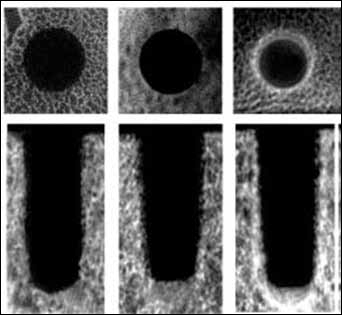
Fig 1(a) Microcomputed tomography midsection and (c) cross section of standard drilling (SD), extraction drilling (ED), and osseous densification (OD) osteotomies.
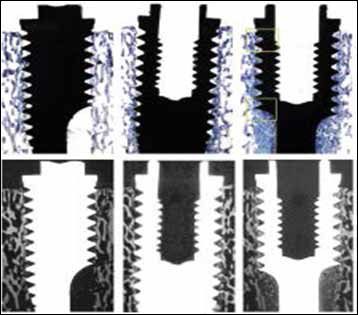
Fig 2. Histology sections of standard drilling (SD), excavation drilling (ED), and osseous densification (OD) osteotomies stained with toluidine blue (×10).
The osseous densification preparation technique preserves bone bulk in two ways: compaction of cancellous bone due to viscoelastic and plastic deformation, and compaction autografting of bone particles along the length and at the apex of the osteotomy. Osseous densification is essentially a burnishing process that redistributes material on a surface through plastic deformation.
CONCLUSION
Osseodensification is a new promising procedure for enhancing bone density around implants and increase primary stability. Unlike conventional osteotomy, it uses specialized high speed densifying burs to prepare osteotomy and autograft bone in the phase of plastic deformation. Trabecular bone compaction produced during the osseous densification technique created a smaller osteotomy than drilling due to spring-back recovery of viscoelastic deformation when the bur was removed from the osteotomy. Use of dednsifying burs in osseodensification led to the formation of undersized osteotomy when compared to conventional drills. It helped improve bone density and also increased the percent of BV and increased bone to implant contact, thereby improving implant stability.
REFERENCES
- Albrektsson T, Brånemark PI, Hansson HA, Lindström J. Osseointegrated titanium implants. Requirements for ensuring a long-lasting, direct bone-to-implant anchorage in man. Acta Orthop Scand, 1981;52:155-170.
- Stavropoulos A, Nyengaard JR, Lang NP, Karring T. Immediate loading of single SLA implants: Drilling vs. osteotomes for the preparation of the implant site. Clin Oral Implants Res 2008;19:55–65.
- Summers RB. A new concept in maxillary implant surgery: The osteotome technique. Compendium 1994;15:152,154–162.
- Trisi P, Perfetti G, Baldoni E, Berardi D, Colagiovanni M, Scogna G. Implant micromotion is related to peak insertion torque and bone density. Clin Oral Implants Res, 2009;20:467-471.
- Leonidas Podaropoulos. Increasing the Stability of Dental Implants: the
- Concept of Osseodensification. Balk J Dent Med, 2017;133-140
- Salah Huwais, Eric G. Meyer. A Novel Osseous Densification Approach in Implant Osteotomy Preparation to Increase Biomechanical Primary
- Stability, Bone Mineral Density, and Bone-to-Implant Contact. Int J Oral Maxillofac Implants 2016; (10 pages). doi: 10.11607/jomi.4817
- Pai UY, Rodrigues SJ, Talreja KS, Mundathaje M. Osseodensification – A novel approach in implant dentistry. J Indian Prosthodont Soc 2018;18:196-200.
Disclaimer from Guident
The views and opinions expressed in articles published in Guident are solely those of the authors and do not necessarily reflect the views of the editors, the editorial board or the publisher, Ivory India. Guident does not endorse any product, technique or treatment described. Clinical content is intended for qualified dental and medical professionals and is not a substitute for individual clinical judgement. Guident, its editors and the publisher accept no liability for any consequence arising from the use of information published in the journal.
How to cite this article
Dr. Yashi Garg, Dr. Adil Khursheed Sheikh, Dr. Manesh Lahori Department of Prosthodontics. Osseodensification - a Pioneer Approach to Implant Dentistry. Guident. 2018 Oct;11(11). Available from: https://guident.in/articles/implantology/osseodensification-a-pioneer-approach-to-implant-dentistry.html