
Esthetic Treatment Options for Dental Flurosis - Present Scenario
Department of Pedodontics and Preventive Dentistry, Wisdom Dental Clinic, Jaipur, India
ABSTRACT
Esthetic or cosmetic dentistry is one of the main areas of dental practice. Increasing demand of patients for esthetics has resulted in the development of several techniques for restoring the anterior teeth. Composite resin restorations have become an integral part of contemporary restorative dentistry and can be called “star of minimal invasion” due to its conservative concepts. Many treatment options are available such as removal of surface stains, bleaching, microabrasion or macroabrasion, veneering, and placement of porcelain crowns, conservative approach such as veneer preserves the natural tooth as much as possible. This article presents case reports of esthetic rehabilitation of anterior teeth using various methods in most natural way with preservation of sound tooth structure and acceptable outcome.
Keywords: Composite restorations, Esthetic dentistry, Veneers
INTRODUCTION
Restorative aesthetic dentistry should be practiced as conservatively as possible. The material and technique should be conservative which not only satisfies the patient’s aesthetic, structural and biologic requirements but also fulfills the mechanical requirements.1Many treatment modalities exist for esthetic rehabilitation like microabrasion, direct composite resin restorations or combination of both, indirect composites, crowns, esthetic veneers, and so forth.
Since 1983, veneers have been considered one of the most viable treatment modalities, based on their strength, longevity, conservative nature, biocompatibility, and aesthetics.2Aesthetic veneers in ceramic materials demonstrate excellent clinical performance and, as materials and techniques have evolved, veneers have become one of the most predictable, most aesthetic, and least invasive modalities of treatment.3For this reason, both materials and techniques provide the dentist and patient an opportunity to enhance the patient’s smile in a minimally invasive to virtually noninvasive way. Nowadays more conservative therapeutic modalities such as bleaching and enamel micro abrasion are considered over Porcelain laminate veneers for treating various kinds of tooth discoloration .4
However, this evolution has not led to a decrease in indications for veneers, as materials and techniques continue to be developed. Ceramic veneers leave nearly all of the enamel intact before the veneer is placed hence considered as the ultimate option for a conservative aesthetic approach.5
One such breakthrough in veneer technology is introduction of componeer system. For veneering of anterior teeth, generally two type of materials are in use either ceramic or composite. Ceramic veneers demonstrate high biocompatibility, high color stability and high abrasion resistance. However, these have numerous undesirable characteristics such as fabrication is time consuming, technique sensitive and it is abrasive for opposing natural tooth structure.6
Componeer is a direct composite veneer system. These are extremely thin veneer coatings made from nanohybride composite, thickness ranges from 0.3 to 1 mm which allows a high level of conservation of tooth structure during preparation. These composite veneers are very easy to finish and polish, can be modified before luting without compromising either their adhesive potential or their mechanical properties.6
This article presents case reports of esthetic rehabilitation of anterior teeth using various methods in most natural way with preservation of sound tooth structure and acceptable outcome.
CASE REPORT - 1
A 25 year old male patient came with the complain of brownish yellowish discolouration on the anterior teeth. On the examination, poor oral hygiene with moderate fluorosis was detected. Treatment plan involved oral prophylaxis with selective direct composite veneering.
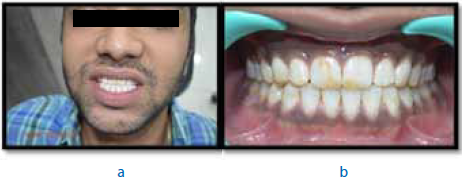
(Figure.1a,b - Brownish yellowish discolouration)
The procedure involved
- The color was recorded using the VITA Classical shade guide, and shades A1 and A2 were considered as the initial color.
- In tooth preparation, minimal chamfer on the facial surfaces was done. Cotton rolls and salivary ejectors were used for field isolation.
- The enamel surface was acid etched using 37% phosphoric acid (D-Tech Etching Gel, Kerr, USA) for 30 seconds (additional etching time of 20 sec because teeth are affected with severe fluorosis), rinsed for 10 seconds, and dried.
- A bonding agent (Adper Single Bond, 3M ESPE, USA) was applied on the prepared enamel and light-cured for 10 seconds.
- A stratified layering technique was used to fill the tooth with Filtek™ Z350 XT (3M ESPE, USA) shade A1E. On each surface composite was light-cured for 10 seconds.
- Additional 20 second polymerization from incisal/occlusal, facial, and lingual aspects was done.
- Restoration was finished and polished with polishing discs (Ultra Gloss Composite Polishing System, Axis, USA).
- Patient was motivated for maintenance of oral hygiene and informed for regular recalls. Recall check-up was done every 6 months and there was no sensitivity or discoloration detected.
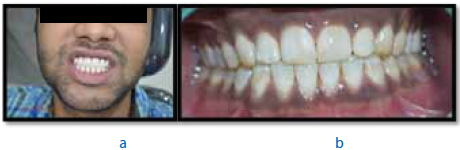
(Figure. 2a,b - Selective direct composite veneering irt 11 & 21)
CASE REPORT - 2
A 20 year old male patient came to our clinic with complain of yellowish stains on anterior front teeth and he was extremely unhappy with his smile. Patient gave history of discolored teeth from his childhood. On examination, he had a poor oral hygiene with severe fluorosis with yellowish brown stains on teeth. (Figure.5) The gingiva were also inflamed. Treatment plan involved oral prophylaxis and ceramic veneers.
The procedure involved
- Oral prophylaxis followed by shade selection
- Shade was selected based on the underlying tooth colour, the luting resin and the opacity/translucency of the porcelain used. The colour of the existing teeth can be shared with the ceramist, using photographs.
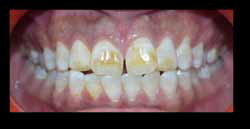
(Figure. 3- Fluorosis stains)
- Tooth was prepared with a depth cutting diamond bur of 0.3 mm depth
- Veneer preparation with window design was done taking care to remove any brownish discolorations

(Figure. 4 - Facial surface preparation done)
- Gingival retraction cord was used after veneer preparation to expose the margins. Slight extension of the margin was done sub gingival
- Once the material for the veneer was chosen (feldspathic ceramic), and the ceramist has created the veneers, the tooth surface was cleaned of any residual resin cement or provisional material, to ensure perfect adaptation of the veneers, and each veneer was tried individually to assess fit.
- The inner surface of veneers (being silica-based restorations) must be etched with 9.5% hydrofluoric acid for 20 seconds.

(Figure. 5a,b - Post-operative treatment after ceramic veneer i.r.t 11 and 21)
- A fine diamond bur can be used to adjust the porcelain that will be then carefully polished. Initially occlusion was checked with centric occlusion followed by other excursive movements. To adjust porcelain rugby-shaped diamonds with water spray can be used. Patient was satisfied with treatment outcome. Advised to the patient for check-up after every six months
CASE REPORT -3
A 23 year old female patient came with the complain of brownish yellowish discolouration on the anterior teeth. On the examination, poor oral hygiene with severe fluorosis was detected. Treatment plan involved oral prophylaxis and componeer restorations from canine to canine in both maxilla and mandible.
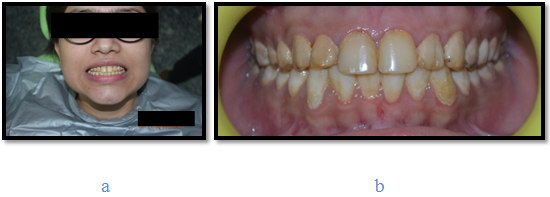
(Figure. 6a,b Brownish yellowish discolouration due to severe fluorosis)
The procedure involved
- Individual teeth's shape, size and colour of individual was recorded and according to that Componeer veneer was chosen.
- For the componeer sizes, componeer contour and teeth size guide was used.
- Six upper and lower teeth has to be treated , therefore “L” size componeer was selected for the central incisors, “M” size for the lateral incisors, “L” size for canine was chosen.
- Shades selected were White Opalescence shade for Componeer and for dentine, corresponding A2 shade selected from the componeer kit.
- Tooth preparation involveminimal preparation (0.2mm – 0.3mm) on labial surface of the tooth involving incisor edge.
- For etching teeth, 35 % phosphoric acid was used for 30 seconds.
- The One Coat Bond (Coltene Whaledent, Switzerland) was then applied to all the enamel surfaces and transparent matrices were placed in the interdentally spacebefore light-curing for 10 seconds per tooth
- The Componeer were wetted with One Coat Bond and properly blow-dried with air.
- White Bleach dentine composite was applied to all the fitting surface of each Componeer.
- With the help of Placer instrument, one by one Componeer were pressed onto the teeth surfaces beginning with the two central incisors.
- After that each Componeer was subsequently cured after correcting alignment.
- Finishing was done by using finest finishing diamond points as well as flexible discs and strips.
- Follow up done after 1 week, 3 months, 6 months and 1 year follow-up the patient was healthy and happy with his aesthetically treated teeth without complain of any stain and sensitivity.
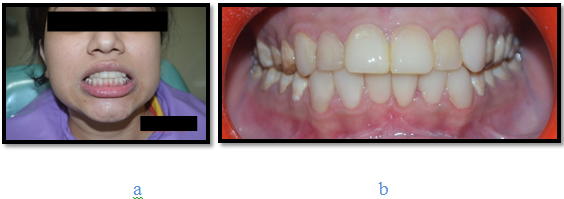
(Figure. 7a,b - Componeers done in front 6 teeth i.e. from canine to canine each in maxilla and mandible)
DISCUSSION
The demand for esthetics is increasing which motivates the patient to seek dental treatment which is often dictated by cultural, ethnic, and individual preferences. The aim of treatment in all the cases is to restore patient’s esthetics and self-esteem.
Direct and indirect laminate veneers, as esthetic procedures, have become treatment alternatives for patients with esthetic problems of anterior teeth in recent years. In deciding between those two treatment options, the cost, social and time factors have to be considered. Although ceramic laminate veneer restorations have some advantages like color stability and high resistance against abrasion, they have also some disadvantages, including high cost and long chair time.4
In today’s dentistry conservative treatments are preferred, composite laminate veneer restorations are one of the best treatment choices. It has many advantages such as one appointment for the whole treatment, low costs compared with the ceramics and no long laboratory procedures. When compared with indirect composite laminate veneers and ceramic laminates, direct composite laminate restorations are popular, but it has less resistance against abrasions and fractures. Advantages of indirect composite laminate veneer restorations are it is polymerized outside the oral cavity and ceramic laminate veneers have better color stability and less affected by the fluids of the oral cavity which make it superior over direct composite laminates.7,8
To establish both functional and esthetic integrity, direct composite laminate veneer restorations were considered as it has more resistance and compressive strength than ceramics and similar abrasion rates compared with natural tooth structures, Full-ceramic crown restorations were not considered because they result in excessive tooth structure loss.9Veneering of anterior teeth can be done with direct (with Composite) or indirect technique (with composite or ceramic veneer). Most commonly used techniques for composite restoration is natural layering technique. This technique has various advantages like no impression is required; fewer appointment is needed as compared to lab made veneer.10
This Prefabricated composite veneer system (componeer ) has advantage of both direct composite as there is no need of impression & lab work , single appointment procedure and of laboratory processed veneer such as improved wear resistance, excellent esthetics. Veneering composites have a good percentage of inorganic fillers (approximately 66%) which improves its mechanical properties i.e. 120 and 160 M Pa and elastic modulus of 8.5 -12 GPa.10
Most veneering composite applied with a post-curing process that result in better flexural strength compared to ceramic veneer, less polymerization shrinkage, and wear rate comparable to tooth enamel 10. As this prefabricated composite veneer system (componeers) have been recently introduced and they are not widely used so the technique mentioned in this paper will help in restoring function and esthetics of anterior teeth in one office visit.11
CONCLUSION
Even though porcelain is brilliant, glassy and glossy with a permanent finish, it is expensive and cannot be afforded by many. Componeers may be the solution to an average working class population.. Therefore, based on this literature review, it is possible to conclude that the clinical success of laminate veneers depends on both the suitable indications of the patient and the correct application of the materials and techniques available for that, in accordance with the necessity and goals of the aesthetic treatment.
REFERENCES
- McLaren EA, Whiteman YY. Ceramics: rationale for material selection. Compend Contin Educ Dent. 2010;31(9):666-8.
- McLaren EA, Le Sage B. Feldspathic veneers: what are their indications?.Compendium of continuing education in dentistry (Jamesburg, NJ: 1995). 2011 Apr;32(3):44-9.
- Radz GM. Minimum thickness anterior porcelain restorations. Dental Clinics of North America. 2011 Apr 1;55(2):353-70.
- Belser UC, MACNE P, MACNE M. Ceramic laminate veneers: continuous evolution of indications. Journal of Esthetic and Restorative Dentistry. 1997 Jul;9(4):197-207.
- Strassler HE. Minimally invasive porcelain veneers: indications for a conservative esthetic dentistry treatment modality. Gen Dent. 2007 Nov;55(7):686-94.
- Gurtu A, Bansal R, Chowdhary P, Mehrotra N, Mohan S, Mehrotra A, Kishore A. Componeer: an emerging esthetic solution. J Dent Sci Oral Rehab. 2016 Jul;7(3):146-8.
- Hickel R, Heidemann D, Staehle HJ, Minnig P, Wilson NH. Direct composite restorations.Clin Oral Invest. 2004;8:43-4.
- Stappert CF, Ozden U, Gerds T, Strub JR. Longevity and failure load of ceramic veneers with different preparation designs after exposure to masticatory simulation. The Journal of prosthetic dentistry. 2005 Aug 1;94(2):132-9.
- Jordan RE. Esthetic Composite Bonding Techniques and Materials. St. Louis, Mosby-Year Book. Inc. 1993:84-6.
- Gomes G, Perdigão J. Prefabricated composite resin veneers–A clinical review. Journal of Esthetic and Restorative Dentistry. 2014 Sep;26(5):302-13.
- Chandramouli M. Componeers. Int J PrevClin Dent Res 2017;4(2):1-3.
Disclaimer from Guident
The views and opinions expressed in articles published in Guident are solely those of the authors and do not necessarily reflect the views of the editors, the editorial board or the publisher, Ivory India. Guident does not endorse any product, technique or treatment described. Clinical content is intended for qualified dental and medical professionals and is not a substitute for individual clinical judgement. Guident, its editors and the publisher accept no liability for any consequence arising from the use of information published in the journal.
How to cite this article
Dr. Gaurav Gupta Jaipur Dental College, Dr. D.K Gupta Dr.Neelija Gupta. Esthetic Treatment Options for Dental Flurosis - Present Scenario. Guident. 2018 Oct;11(11). Available from: https://guident.in/articles/general/esthetic-treatment-options-for-dental-flurosis-present-scenario.html
