Full Arch Mandibular Fixed Prosthesis on Three Implants in Disabled Patient : A Two Years Study
Wisdom Dental Clinics, Jaipur, India
ABSTRACT
Many elderly people have life-long problems with their dentures, such as difficulties with speaking and eating, loose denture, sore mouth syndrome and many more. The evolution of dental implant supported prosthesis gives these patients a real solution to led normal healthy life with functional and esthetic advantages. This case report presents the dentists' reconstruction experiences and the patients' followâ€up care and discuss how a healthy 75 year old lady who was planned for overdenture over mandible with 3 implants ended up in hybrid fixed prosthesis due to physical disability occurred within that period of time.
Keywords - Dental Implant, Hybrid Prosthesis, Disabled
INTRODUCTION
Edentulism which is a irreversible condition is described as the ‘final marker of disease burden for oral health. Although the prevalence of complete tooth loss has declined over the past decade, still it remains a major disease worldwide especially among older adults.1
Complete denture therapy has become the conventional and most prescribed treatment option for edentulous patients however, bone resorption of the alveolar ridge, as a consequence of edentulism, causes lack of stability and retention of denture especially for the lower prosthesis, reducing patient comfort, chewing, phonetics and aesthetics.2
Patient who sufferers from neurologic disabilities or any other disabilities in which they have difficulty in chewing, speaking and swallowing because of the involuntary muscle spasms caused by their condition, makes it very difficult or even impossible to wear complete mandibular dentures.
Various other treatment options are available for rehabilitation of the edentulous mandible using implants and overdentures. For rehabilitation of masticatory and phonetic functions, simple implantological measures can be used by stabilizing the position of the removable restoration.3
However, number of implants to be placed is still controversial for supporting a removable full denture. Though the placement of four implants is supported by German Society for Oral and Maxillofacial Medicine (DGZMK),while other authors regard two implants as adequate.3
This case report discuss different aspects and recommendation for treating the edentulous mandible in disabled patient from overdentures to hybrid prosthesis on 3 implants.
CASE REPORT
A 75 year old healthy female patient came with the complain of decayed teeth since many years. Patient has no relevant past medical history. On oral examination, she had failing dentition with multiple root stumps and decayed teeth. Patient was advised for OPG. (Figure. 1)

Figure. 1 Pre - operative OPG
After discussing the treatment plan with the patient, extraction of remaining teeth were done. Following 1 month of healing period, complete denture was delivered with acceptable esthetic and function but consistently patient was not happy with the retention of lower denture.
So after 1 month of follow up patient was satisfied with her upper denture but having problem in lower denture regarding chewing , phonetics and esthetic. On oral examination it was found that lower denture has very less retention, therefore various treatment options were discussed and among them, implant retained overdentures was preferred because of very less retention of lower dentures.
All the necessary parameters like CBCT were advised to the patient. After proper evaluation, 3 implants measuring 3.5mm × 11.5mm were selected and placed. ( Figure. 2) The relining of intaglio surface of lower denture was done. After a cooling period of 3-4 months for osteointegration, patient was recalled for locator abutment placement but she returned after 8-9 months.
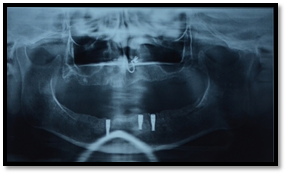
Figure. 2 Post implant OPG
Seven months ago, she had a stroke which left her with paralysis of half of the body. Her motor and sensory coordination were disturbed , making her physically challenged to use overdenture and patient was also not ready for further more invasive procedures for full arch fixed rehabilitation on more implants. So the situation was discussed with guardians and after referring literature, we thought to give her fixed hybrid on lower arch on 3 implants only. Prior consent was taken. Her visits were also reduced (as she was on wheel chair)by making her lower denture as special tray ( Figure. 3) for implant level impression making, followed by placing healing abutment. ( Figure. 4 )
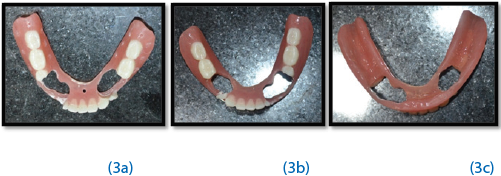
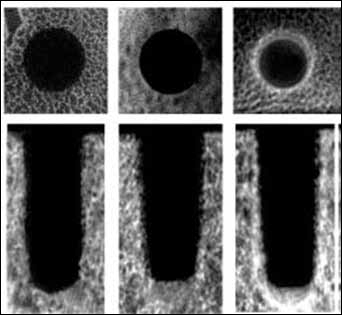
Figure. 3a,b,c Lower denture as modified special tray
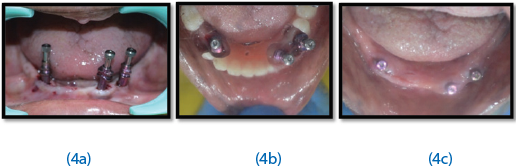
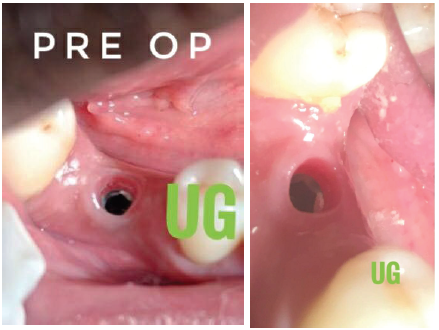
Figure. 4a,b,c Impression making and Healing abutment

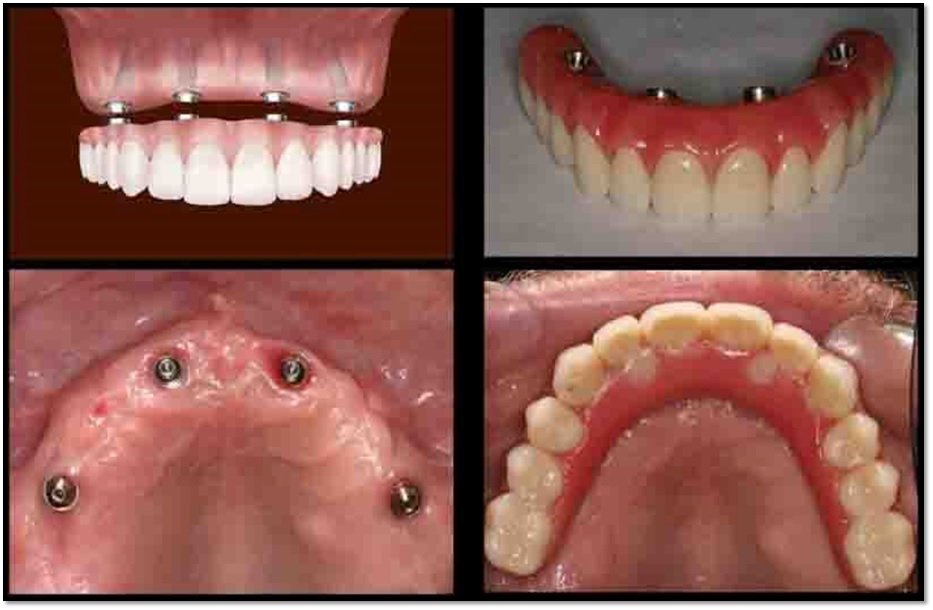
Figure. 5 Final prosthesis with passive fit
After which a very passive hybrid prosthesis was delivered on lower archon 3 implants(Figure.5)
Patient was completely satisfied with the treatment and recalled for follow up after 2 years, upon which acceptable soft and hard tissue harmony with occlusion was observed.( Figure.6 )
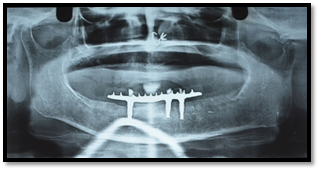
Figure. 6 Follow up after 2 years
DISCUSSION
Edentulism not only correlated with functional and esthetic concerns of the patient but also with psychological problems possibly affecting routine activities.4 Tooth absence can severely affect a patient's psychosocial status, even for patients who adapt well to a conventional complete denture.5 Restorations supported by implants offer multiple advantages over ordinary removable prostheses such as efficient retention and stability.6
Patients who suffer from mental or physical disabilities are in great need of an oral fixed rehabilitation owing to the fact that the neurologic impairment, neuromuscular disorders, genetic syndromes or oro-craniofacial anomalies involve more frequency of dental agenesis7and the difficulty of ensuring adequate oral hygiene.8 Wearing removable prostheses may pose some difficulties in their manipulation and hygiene.9 When conventional fixed prostheses cannot be placed in such cases, an implant-supported rehabilitation may be the only solution.
López Jiménez and col made a study between 1992 and 2001 in which 67 implants were placed in 18 patients from 12 to 71 years old who had the following detection: cerebral palsy, head injuries, Rieger syndrome, senile dementia, pyknodysostosis and Down syndrome. The lack of clinical symptoms and mobility were considered successful criteria as well as the absence of radio-transparencies when radiological follow-up was possible.10
Rogers studied the response from a patient who suffered from athetoid cerebral palsy towards the implantological treatment necessary to place a mandibular implant overdenture. The patient was 64 years old and had adequate bone quality and quantity for implant surgery. Her dental hygiene was good but due to her involuntary movements of the mandible, tongue and lips it leds to incapability to wear the prostheses. In general anesthesia, four implants were placed in the canine and premolar regions of the mandible so to control involuntary movements. Finally, the prostheses was placed over two implants, leaving the other two submucous and getting positive results because of the improvement in speech and chewing.11
In the present study, the patient suffered from stroke which left her with paralysis of half of the body. Her motor and sensory coordination were disturbed, making her physically challenged to use overdenture . So the situation was discussed with guardians and after referring literature, it was decided to give her fixed hybrid on lower arch on 3 implants only and just after a year Trefoil system(Nobel Biocare) was launched which supported our concept.
Trefoil - a Nobel Biocare product was a breakthrough in the efficient treatment of the edentulous mandible. Trefoil system has made the passive fit of a pre-manufactured bar possible for the very first time, using a revolutionary, self-adjusting fixation mechanism and just with three implants. It makes a fixed full-arch implant solution a actual possibility for more patients.
The rehabilitation of edentulous patients is seen better with the hybrid dentures than with conventional over-dentures. Hybrid denture achieve greater masticatory function and psychological satisfaction.12 Occlusal forces also increased after the placement of an implant-supported prosthesis. Many authors have studied occlusal force measurements in patients with implant-supported prostheses opposing complete maxillary dentures, but their force measurements vary significantly.13
CONCLUSION
Oral health is an integral part of general health and therefore it must be reestablished when it is altered, especially in those patients who have the greatest need. Regardless of their physical or neurological condition , all the modern resources of Dentistry should be provided to them so as to improve their oral function and aesthetics. Each case should be evaluated individually, following a strict surgical protocol and frequent checkups, as well as explaining the patient’s caregivers about the importance of maintaining good oral hygiene and the absence of oral habits.
REFERENCES
- Emami E, de Souza RF, Kabawat M, Feine JS. The impact of edentulism on oral and general health. International journal of dentistry. 2013;2013:498305
- Caetano CR, Consani RL, Bacchi A, Correr AB, dos Santos MB. Influence of different flask systems on tooth displacement and framework misfit in mandibular fixed implant-supported complete dentures. Journal of prosthodontic research. 2013;57(3):213-8.
- Ketabi AR, Bornemann G, Ketabi S, Lauer HC. Hybrid Prosthetic Treatment of the Edentulous Mandible with Two or Four Implants-A Literature Review. Dentistry. 2014 Jan 1(S2):1.
- Dierens M, Collaert B, Deschepper E, Browaeys H, Klinge B, De Bruyn H. Patientâ€centered outcome of immediately loaded implants in the rehabilitation of fully edentulous jaws. Clinical oral implants research. 2009 Oct;20(10):1070-7.
- Fiske J, Davis DM, Frances C, Gelbier S. The emotional effects of tooth loss in edentulous people. British dental journal. 1998 Jan 24;184(2):90-3.
- Feine JS, Carlsson GE, Awad MA et al. The McGill consensus statement on overdentures. Mandibular two-implant overdentures as first choice standard of care for edentulous patients. Int J Oral Maxillofac Implants. 2002;17(4):601-2.
- Di Lenarda R. Anomalíasdentariasenfaseevolutiva. OdontoEstomatolImplanto. 1992;2:157–61.
- Waldman HB, Perlman SP, Swerdloff M. Dental care for children with mental retardation: thoughts about the Americans with Disabilities Act. ASDC journal of dentistry for children. 1998;65(6):487-91.
- Hoffman JW, Bomberg TJ. Removable partial denture variations for the elderly patient. Gerodontics. 1986 Apr;2(2):47-9.
- López Jiménez J, Romero-Domínguez A, Giménez-Prats MJ. Implantesenpacientesdiscapacitados. Med Oral. 2003;8:288–93. [PubMed]
- Rogers JO. Implant-stabilized complete mandibular denture for a patient with cerebral palsy. Dental update. 1995;22(1):23-6.
- Bauman GR, Mills M, Rapley JW, Hallmon WW. Plaque-induced inflammation around implants. International Journal of Oral & Maxillofacial Implants. 1992 Sep 1;7(3):330-7.
- Haanaes HR. Implants and infections with special reference to oral bacteria. Journal of clinical periodontology. 1990 Aug;17:516-24.
Disclaimer from Guident
The views and opinions expressed in articles published in Guident are solely those of the authors and do not necessarily reflect the views of the editors, the editorial board or the publisher, Ivory India. Guident does not endorse any product, technique or treatment described. Clinical content is intended for qualified dental and medical professionals and is not a substitute for individual clinical judgement. Guident, its editors and the publisher accept no liability for any consequence arising from the use of information published in the journal.
How to cite this article
Dr. Gaurav Gupta, Dr. Priyanka Gupta, Dr. D.K. Gupta. Full Arch Mandibular Fixed Prosthesis on Three Implants in Disabled Patient : A Two Years Study. Guident. 2018 Nov;11(12). Available from: https://guident.in/articles/implantology/full-arch-mandibular-fixed-prosthesis-on-three-implants-in-disabled-patient-a-two-years-study.html