Restoration of Badly Broken Teeth Using Edelweiss Post and Core
Department Of Conservative Dentistry & Endodontics K. D. Dental College & Hospital, Mathura
Abstract
With a wide variety of post systems and materials available for the restoration of lost tooth structure of endodontically treated teeth, the clinical decision of which to use constitutes a challenge to dental practitioners.
Cast metal post and cores are widely used for restoring endodontically treated teeth with extensive loss of coronal tooth structure and to retain metal-ceramic crowns. When dental aesthetics is of primary concern, the selection of the underlying restorative material becomes an important factor to consider. The fibre-reinforced posts combined with all-ceramic crowns offer a highly aesthetic outcome in anterior region restorations, but long term evaluation is necessary in order to assess their clinical performance and longevity.
The purpose of this case report was to present prosthetic rehabilitation of cases using Edelweiss post and core system with inadequate aesthetic appearance or fractured maxillary posterior teeth.
Keywords: Fibre Posts, Endodontically treated teeth, Edelweiss post and core system, Laser sintered monoblock
Introduction
Currently, an increased demand for clinically convenient post-and-core systems to replace lost tooth structure has provided the clinician with a plethora of simplified “onevisit” post-and-core restorative options. However, in view of the previous considerations, it is understandable that clinicians have uncertainties about selection of restorative materials and techniques to achieve optimal results for post-and-core build-up procedures.
According to studies by the CR Foundation (formerly known as Clinical Research Associates), the fiber reinforced systems are superior to metal prefabricated posts.
It generally is agreed that the successful treatment of a badly broken down tooth with pulpal disease depends not only on good endodontic therapy, but also on good prosthetic reconstruction of the tooth after endodontic therapy is completed.
In the last few years, there has been a major shift away from metal custom cast post-and-cores toward resin-based composite cores.1
Prefabricated composite post systems are replacing metal post systems because an adhesive procedure with the fiber-reinforced composite post system adds strength to the tooth-restorative interface after bonding.
Therefore, the fiber-reinforced post has an advantage after assembly. The fiber reinforced composite post system has a similar modulus of elasticity to the dentin after bonding, whereas the metal post assembly has an appreciably higher modulus of elasticity.2
Although a wide variety of post and core restoration technologies and materials have been introduced into the dental market, there is no consensus on the most appropriate treatment choice for post and core systems.
Prefabricated posts have good bio-mechanical and physical properties. However, they cannot be customized for optimal adaptation to the prepared post space. On the other hand, using composite resin for core material may have a higher failure rate because of the weak bonding between the prefabricated post and composite core.
Since fiber-reinforced posts are metal-free, they do not cause metal allergies or corrode. They offer good esthetics in easily visible areas of the mouth, especially under the all-ceramic crowns and bridges. Finally, fiber-reinforced posts can be removed easily in case of an endodontic failure requiring re-treatment.3,4
The edelweiss post and core system is a laser sintered monoblock which avoids the wedging effect. The posts have a conical shape for perfect post space adaptation. The translucency of the post allows uninterrupted light transmission for complete polymerization.
The adhesive bonding also avoids the wedging effect. The preparation of the core feels like preparing the natural tooth and makes handling easier. The opaque buildup in A1 also offers different anatomical forms. The buildup from the edelweiss post and core has a rough surface for better retention of the clinical crowns. It is possible to carry out the treatment in just one session, which is both time and cost effective for patient and dentist alike.
ADVANTAGES:
- Prefabricated post and core
- Translucent post for perapical light polymerization
- Innovate monoblock of post and core with A1 buildup for natural integration
- Monoblock avoids wedge effect
- Biocompatible
- Flexural strength 20Gpa like dentin (15-20 Gpa)
- Unmatched radiographic visibility
- Cuts like dentin
- Superior adhesion to root canal
- One session, reduced treatment time
- Time and cost effective.5
CASE REPORT 1
A patient name Hemant, came to Department of Conservative Dentistry & Endodontics at K.D. Dental College & hospital, Mathura with a chief complaint of broken tooth in his left upper back region of mouth since 2 months. Patient gave a history of fractured tooth in his maxillary left posterior region. Patient had a history of root canal treatment in relation to 25, one year back.
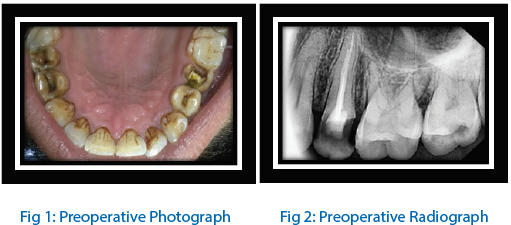
On clinical examination there was only buccal wall was present in relation to 25. (Fig 1 & 2) Dental caries was present in relation to 15.
On radiographic examination, the root canal treatment was satisfactory and there was no periapical changes were evident.
Treatment plan: Restoration using Edelweiss post and core system followed by zirconia crown in relation to 25.
PROCEDURE
First the old temporary restoration was removed and G.P. was removed using peeso reamer no 2. After removing G.P. the post space was prepared using the drill which was provided with Edelweiss post and core system. (fig 3 & fig 4)

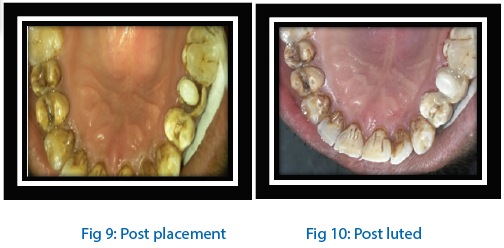
After that post & core cementation using dual core adhesive cement (Luxacore) and polymerization was done for 60 seconds. (Fig 10)
After cementation of Post & core crown preparation was done and impression was taken using elastomeric impression material. (fig 11 & 12)
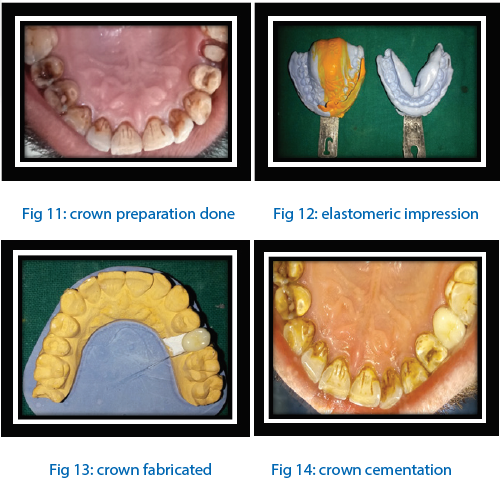
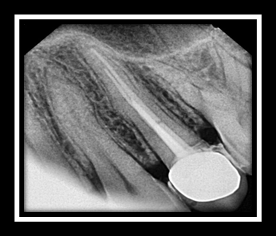
Fig 15: crown cementation radiograph
Zirconia Crown was fabricated and crown placement was done using Calibra self-adhesive resin cement.
CASE REPORT 2
A patient name Hemlata, came to Department of Conservative Dentistry & Endodontics at K.D. Dental College & hospital, Mathura with a chief complaint of pain and broken tooth in his left upper back region of mouth since 2 months. Patient gave a history of pain in left maxillary posterior region pain was sharp, severe and continuous in nature.
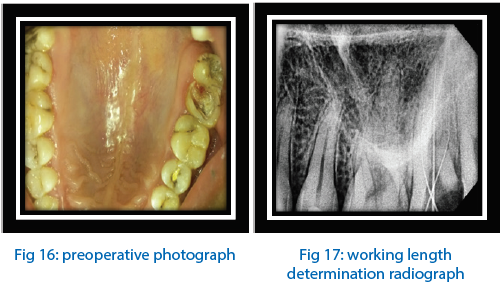
On clinical examination there was pulp exposure in relation to 27 and it was tender on percussion in relation to 27. (fig 16)
On radiographic examination there was radiolucency involving enamel, dentin, and pulp in relation to 27.
Diagnosis: Symptomatic irreversible pulpitis with apical periodontitis in relation 27.
Treatment plan: Root canal treatment followed by restoration with Edelweiss post & core and PFM crown in relation to 27.
PROCEDURE:
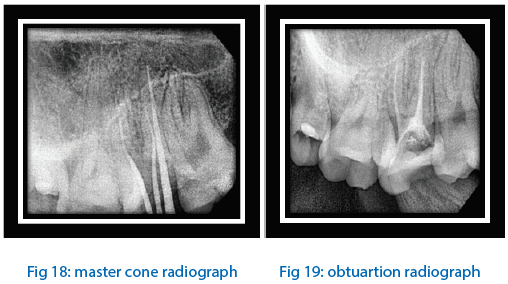
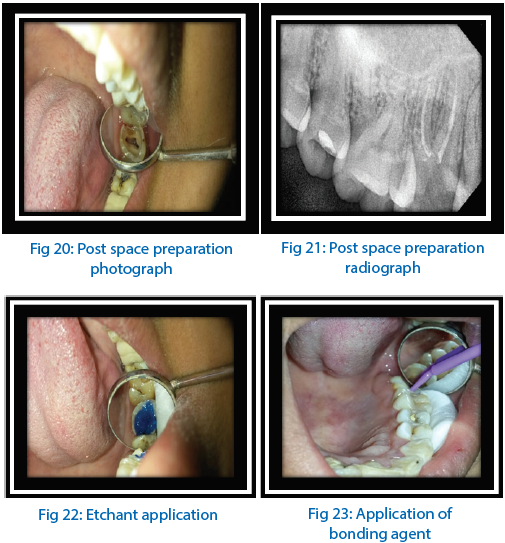
Initially, local anaesthesia was administered and access cavity was made with endo access bur and working length was established and radiographically with #10 k-file. (fig. 17) Pulp extirpation was done and the canal was gently instrumented till #25.04 in mesiobuccal and distobuccal canal and #25.06 in palatal canal and irrigated with 3% sodium hypochlorite solution, 17% EDTA, and saline. Patient was recalled after three days. After 3 days, patient was asymptomatic, the canal was irrigated with sodium hypochlorite, saline and 2 % chlorhexidine and master cone was evaluated (fig 18) then the canal was dried with paper points and were obturated with 25.04 and 25.06 guttapercha and AH plus sealer (fig 19). Cavity was sealed with temporary restoration and patient was recalled after 5 days for post space preparation. The length of the post was determined from the X-ray taken and a portion of the guttapercha was removed with peeso reamers till peeso size no 2 and the post space was prepared using the drills provided. (Fig. 20, 21).
Etching the post space for 20 seconds. After etching post space was rinsed, dried and bonding agent was applied for 20 seconds.(fig. 22, 23)
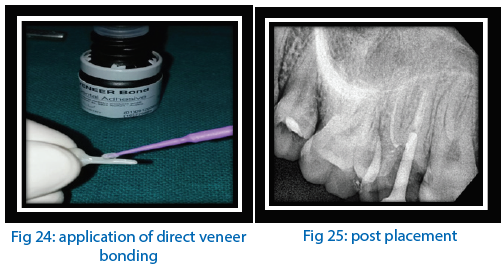
Post and core with direct veneer bonding for 30 seconds.(fig.24)
After that post & core cementation using dual core adhesive cement (Luxacore) and polymerization was done for 60 seconds. (fig 25)
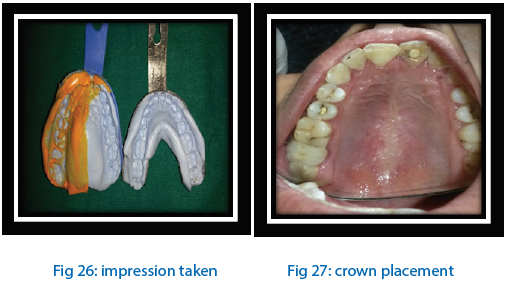
The remaining tooth structure was prepared and impression was taken with putty material and then poured with die stone. Crown placement was done (Fig.)
DISCUSSION
The restoration of ETT with different post and core systems is a topic that is extensively studied and yet remains controversial from many perspectives.6-8 The main function of a post is to build up and securely retain a core for crown retention, but this post does not strengthen or reinforce ETT. The choice of appropriate post and core restorations is often complicated and should be guided by knowledge of their physical properties, indications, advantages and disadvantages, as well as the amount of coronal structure missing and aesthetic case need.9-13
With use of fiber-reinforced composite post, the treatment of traumatically involved and endodontically weakened teeth can be easier and also more beneficial than other system. However, incorporation of various advantageous properties of post (ferrule effect, diameter, length, luting cement etc.) is of paramount importance for long-term success of such restorations.
Prefabricated fibre post systems have some advantages over cast post and cores:
- Best aesthetics; a white or tooth-coloured dowel prevents the “shine-through” effect that occurs with metal dowel systems and improves the translucency and appearance of all-ceramic crowns;14
- Uninterrupted bonding at all interfaces and adhesive integration between 5 components of the fibre reinforced composite resin system (dentine surface, luting cement, fibre post, core build-up, and crown);14,15
- Fibre posts are also more flexible, require less dentin removal to accommodate a shorter and thinner dowel, and lead to lower susceptibility to root fracture;16,17
- Involve less-time consuming chair side procedure and requires one appointment to complete the restoration.14,18
CONCLUSION
Post and core treatment is a viable choice for a clinician when there is little or no coronal tooth structure present. Selection of the most suitable post and core systems is challenging and should be guided by knowledge of their indications, advantages and disadvantages, as well as the amount and quality of remaining tooth structure and aesthetic requirements.
The use of cast metallic posts and cores are recommended to restore severe loss of coronal tooth structure and to retain metal-ceramic crowns.
Prefabricated fibre posts and all-ceramic restorations offer a promising alternative to the restoration of ETT with cast metallic posts and porcelain fused to metal crowns. The use of fibre posts with resin composite core is preferred when the hard dental tissue loss is moderate and dental aesthetics is of primary concern.
REFERENCES
- Clinical Research Associates. Posts: a shift away from metal? / CRA Newsletter/. 2004;28:1-3
- Terry, Swift. Post-and-Cores: Past to Present. International Dentistry SA; 2, 2
- Ping NAI, Cabornero AA. Fiber reinforced post and core adapted to a previous metal ceramic crown. J Prosthet Dent 2004;91:191- 4.
- Morgano SM. Clinical success of cast metal posts and cores. J Prosthet Dent 1999;69:70:11-6.
- Edelweiss post and core system brochure pdf
- Aquilino SA, Caplan DJ. Relationship between crown placement and the survival of endodontically treated teeth. J Prosthet Dent, 2002; 87:256-263.
- Smith CT, Schuman NJ, Wasson W. Biomechanical criteria for evaluating prefabricated post-and-core systems. A guide for the restorative dentist. Quintessence Int, 1998; 29:305-312.
- Reeh ES, Douglas WH. Stiffness of endodontically-treated teeth related to restoration technique. J Dent Res, 1989; 68:1540-1544.
- Sorensen JA, Engelman MJ. Ferrule design and fracture resistance of endodontically treated teeth. J Prosthet Dent, 1990; 63:529-536.
- Caputo AA, Standlee. Pins and posts - why, when and how.Dent Clin North Am, 1976; 20:299-311.
- Trope M, Maltz DO, Tronstad L. Resistance to fracture of restored endodontically treated teeth. Endod Dent Traumatol, 1985; 1:108-111.
- Sorensen JA, Engelmen MJ. Effect of post adaptation on fracture resistance of endodontically-treated teeth. J Prosthet Dent, 1990; 64:419-424.
- Tjan AH, Whang SB. Resistance to root fracture of dowel channels with various thickness of buccal dentin walls. J Prosthet Dent, 1985; 53:496-500.
- Bateman G, Ricketts DNJ, Saunders WP. Fibre-based post systems: a review. Br Dent J, 2003; 195:43-48.
- Newman MP, Yaman P, Dennison J, Rafter M, Billy E. Fracture resistance of endodontically treated anterior teeth restored with four post-and-core systems J Prosthet Dent, 2003; 89:360-367.
- Pontius O, Hutter JW. Survival rate and fracture strength of incisors restored with different post and core systems and endodontically treated incisors without coronoradicular reinforcrment. J Endod, 2002; 28:710-715.
- Evangelinaki E, Tortopidis D, Kontonasaki E, Fragou T, Gogos C, Koidis P. Effect of a crown ferrule on the fracture strength of endodontically treated canines restored with fiber posts and metal-ceramic or all-ceramic crowns. Int J Prosthodont, 2013; 26:384-387.
- Morgano SM, Brackett SE. Foundation restorations in fixed prosthodontics: Current knowledge and future needs. J Prosthet Dent, 1999; 82:643-657.
Disclaimer from Guident
The views and opinions expressed in articles published in Guident are solely those of the authors and do not necessarily reflect the views of the editors, the editorial board or the publisher, Ivory India. Guident does not endorse any product, technique or treatment described. Clinical content is intended for qualified dental and medical professionals and is not a substitute for individual clinical judgement. Guident, its editors and the publisher accept no liability for any consequence arising from the use of information published in the journal.
How to cite this article
Dr. Abhishek Sharma, Dr. Rohit Paul, Dr. Ajay Nagpal. Restoration of Badly Broken Teeth Using Edelweiss Post and Core. Guident. 2018 Nov;11(12). Available from: https://guident.in/articles/endodontics/restoration-of-badly-broken-teeth-using-edelweiss-post-and-core.html