
All on 4 Concept - Revisited
Royal Dental College, Kerala, India.
ABSTRACT
Professor Per Ingwar Branemark, who discovered Osseointegration, have published several articles in the 70’s with successful rehabilitation of full arch supported by several implants.
During the 1990’s, it was the angulation of the posterior implants, which led to today’s All-on-Four Concept, which has been trialed by various clinicians of Sweden, & South America.
The technique evolved in an attempt to avoid certain anatomical limitations typically seen in the back of the upper and lower jaws have, clinicians successfully avoided bone-deficient areas with the use of angulated implants. Anatomical limitations are more seen in patients with full dentures, and once the posterior implants are placed at an angle, there is often only enough room left for two more implants in the anterior region. This has led to the use of only four implants to support a full set of teeth.
INTRODUCTION
In the field of implant dentistry, the advanced technology has allowed a shift from the early concepts established by the pioneer work of Professor Branemark & his colleagues. While the recommended healing was 3 months in the case of mandible and 6 months in the case of maxilla, nowadays, in specific clinical situations, the progress in understanding biology & technical developments have allowed us immediate loading of implants. Such a situation is represented in the completely edentulous jaw. The All-on-4 concept is a treatment procedure specifically for edentulous patients, which leaves behind the usual treatment alternative for conventional dentures with more successful treatment outcome for short term or long term.
Historical Background
The Evolution of All-on-4 technique was identified first by the implant manufacturer Nobel Biocare, as a cost-effective alternative to conventional implant techniques and Portuguese dentist Paulo Malo funded studies to determine the efficacy of this very approach.
During this time period, the All-in-4 concepts were used by various clinicians all around the world. An Australian dentist Dr. Alex Fibishenko who was an educator and a lecturer for Nobel Biocare, believed that he pioneered this concept of treatment in Australia, applied first for the registration of All-on-4 as a protected Trademark.
ALL ON FOUR CONCEPT
The placement of dental implants will be hindered by the Alveolar atrophy in the posterior regions of completely edentulous patients without being augmented to increase the height and width of available alveolus.
The protentional for increased patient morbidity and complications can be achieved by augmentation surgery for the atrophied alveolus.
A successful treatment option is to avoid these unfavourable posterior areas, is the use of titled implants, which allows for a better anterior-posterior spread of dental implants, which favours a much better load distribution.
In 2003, Paulo Malo and his colleagues described the concept of “All-on-Four”. To brief, in the anterior part of the fully edentulous jaw, four or maybe more implants are placed. To avoid anatomic structures (ie. Mental nerve and the anterior border of the maxillary sinus), the two of the most anterior implants are placed axially. Provisional fixed dental prosthesis is loaded in the implants immediately.
GENERAL CONSIDERATIONS
- If angulation is 300 or more than 300, there is a chance that the tilted implants can be splinted.
- Aim is to achieve primary implant stability (insertion Torque should be 35 to 45 N cm).
- Usually in cases with a minimum bone height of 10mm and a minimum bone width of 5mm from canine to canine in maxilla and 8mm in mandible.
- The distal screw access holes are to be located at the occlusal face of the first molar, 2nd premolar or the first premolar in the case oftitled posterior implants.

SURGICAL PROCEDURE
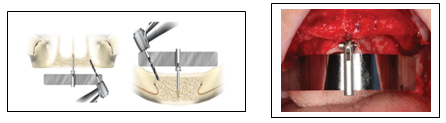
The mandible implants are positioned anterior to the mental foramen and the implants in the maxilla are placed with two distal implants in the posterior region which are tilted anterior to the maxillary antrum. The insertion should be at an angulation of 300- 450.
To ensure the implants with correct positioning, emergence and angulation, the use of All-on-4 surgical guide assists. A 2mm osteotomy is prepared in the midline of maxilla or mandible to place the guide.
After that, a titanium band is contoured which follows the arc of the opposing arch. In the mandible, the guide helps in the retraction of the tongue. There are vertical lines on the guide which helps in drilling at correct angulation. Angulation should not exceed 45 degrees.
There are 3 Phases in All-on-Four concept:
- Surgical Phase
- Anteroposterior Spread
- Prosthetic Phase
1.Surgical Phase:
Step:1 Select the case.
Step:2 Plan the implant placement with the help of surgical guide.
Step:3 Locate the maxillary antrum and mental foramen with the guide.
Step:4 Implant Placement.
2.Antero-Posterior Spread
Rangert-10 mm for a cantilever of 20 mm (2 x Anteroposterior spread) for mandibular ISFPs.
English-ISFPs should be 1.5 times A-P-Spread for mandible maxillary ISFP posterior cantilever should be reduced to 6 – 8 mm as bone density is low.
3.Prosthetic Phase
Step:1 Using wire and GC resin splinting open tray impression is made.
Step:2 Being splinted with GC resin and metal final impression is verified after intergration.
Step:3 Using CAD CAM technology, all Zirconia crowns are designed.
Step:4 Milling of crowns or titanium framework using CAD/CAM
Step:5 Luting of crowns to titanium framework
Step:6 Crowns luted to the framework.
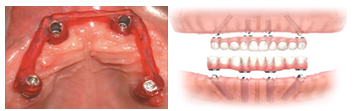
Fig.Prosthetic phase–a resin splinting and final prosthesis
LOADING IN ALL ON FOUR CONCEPT
For All on four concept, immediate loading is done. Immediate loading reduces healing time and the implants osseointegrate early provided primary stability is achieved.
DISCUSSION
Advantages
- Angled posterior implants are used in order to avoid anatomical structures.
- To allow longer implants anchored in better quality bone, Angled Posterior Implants are used.
- High Success Rates.
- Reduces posterior cantilever.
- Overall reduction in cost, as less number of implants are used and hence, avoidance of grafting in the majority of cases.
- Bone grafts can be eliminated in the edentulous maxilla and mandible in most of the cases.
- The implants are easy to clean, immediate function, aesthetics, well-spaced and with good biomechanics.
- Final restoration is optional; Fixed or Removable.
Disadvantages
- As the implant placement is completely prosthetically driven, free hand arbitrary surgical placement of implant is not always possible.
- There is a limit for extension for the length of the cantilever.
- Requires elaborate pre-surgical preparations such as CAM/CAM, surgical splint as the technique is very sensitive.
Limitations
- Sufficient stability can be attained by the implants for immediate function.
- Sufficient bone for 4 implants of atleast 10mm in length.
- Acceptable oral hygiene and good general health
CONCLUSION
All on Four Concept is not an invention, but a treatment technique that has evolved over time. It is a clinically proven and successful treatment for edentulous patients especially with atrophied maxillary and mandibular ridges.
REFERENCES
- Clark Stanford, DDS, PhD;All on Four-where are we now; The International Journal of Oral and Maxillofacial Implants;29(2) (2014)
- Marco Bevilacqua; Three Dimensional Finite Elemental Analysis of Load Transmission Using Different Implant Inclinations and Cantilever lengths,;The International Journal of Prosthodontics;21(6) (2008)
- T Charles Babbush; The All on Four Immediate Function Treatment Concept with Nobel Active Implants: A Retrospective Study;Journal of Oral Implantology;Vol.XXXVII/No.4/2011
- Paulo Malo, DDS;All on 4 Immediate Function Concept with Branemark System Implants for Completely Edentulous Mandibles: A 1 Year Retrospective Clinical Study; Clinical Implant Dentistry and Related Research;vol.5;Supplement 1;2003
- Paulo Malo DDS;All on 4 Immediate Function Concept with Branemark System Implants for Completely Edentulous Maxillae:A 1 Year Retrospective Clinical Study;Clinical Implant Dentistry and Related Research; Vol.7;Supplement 1,2003
Disclaimer from Guident
The views and opinions expressed in articles published in Guident are solely those of the authors and do not necessarily reflect the views of the editors, the editorial board or the publisher, Ivory India. Guident does not endorse any product, technique or treatment described. Clinical content is intended for qualified dental and medical professionals and is not a substitute for individual clinical judgement. Guident, its editors and the publisher accept no liability for any consequence arising from the use of information published in the journal.
How to cite this article
Dr. Rohit Raghavan Dr.Shajahan PA Dr.Gouri. S. R Department of Prosthodontics. All on 4 Concept - Revisited. Guident. 2017 Dec;11(1). Available from: https://guident.in/articles/implantology/all-on-4-concept-revisited.html

