The Tool for Thinking and Analyzing - Welcome to the World of Evidence Based Practice
Abstract
In dental practice, the clinician is influenced by factors based on experience, anecdotes and observations. But how much of it is reliable and can guarantee a successful treatment outcome? Basing decision making on systematic reviews and research along with good clinical acumen forms the crux of Evidence Based Practice. This allows standardisation of work and assured quality of treatment delivered to the patient. It also increases patient’s confidence and co-operation with treatment procedures.
Keywords : Evidence based dentistry, Evidence based practice, Evidence based prosthodontics
INTRODUCTION
How does a dental practitioner decide what kind of treatment modality to use in different clinical scenarios? Often this depends the age of the practitioner and for how long he/she has been in practice. As long as the person is in college, they are guided by the senior teachers and need not brood much on the matter. But what happens once the dental graduates and starts private practice? Once in practice, the clinician is influenced by observations based on experience. Such observations, however, are often flawed, and associations, only casual.1 Anecdotes from colleagues about their practice may influence our decision-making. With the widespread use of the internet, such anecdotes may come from a completely unknown overseas Dental Surgeon. As clinicians expand their knowledge through lectures and by reading journals, they constantly modify their clinical methods. There are uncountable new instruments, equipment and materials with very convincing advertisement that mould our choices of treatments. This form of practice is unethical and is referred to as Experimental Dentistry. Here, instead of proper verification of the studies and research conducted for the new material, the dental practitioner decides to use it on a patient simply based on its attractive marketing. Companies market directly to the public who, with inadequate ability to evaluate the hype, pressure the practitioner to change therapy, often with inadequate research to justify the change.1
EVIDENCE-BASED PRACTICE (EBP)—WHAT IS IT?
The modern concept of evidence-based practice (or evidence-based medicine) was introduced by David Sackett and defined it as “…the conscientious, explicit and judicious use of current best evidence in making decisions about the care of individual patients. The practice of evidence-based medicine means integrating individual clinical expertise with the best available external clinical evidence from systematic research.”2
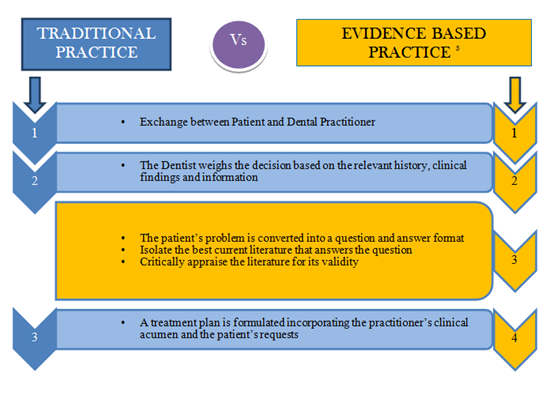
This new paradigm assumes that all structures in the previous model are still in place. An analysis of the complaint is still needed; the practitioner’s experience is valuable; and the patient’s surrounding circumstances still need to be considered.3
THE NEW MODEL

The new model begins with a patient’s problem, and if there is any uncertainty about the treatment plan, the problem is converted into an answerable question.
The second step is to isolate quickly and efficiently the best current literature that answers the question.
The third step is to critically appraise that literature for its validity and applicability to the present patient.
Finally, the evidence is integrated with everything else that is known about the patient’s condition to come up with a treatment decision.3

What makes it revolutionary is the work routine, the confidence one
derives from the results and, importantly, it prevents a decline in skills throughout the career.3 We cannot suggest that patient treatment should be driven by the literature alone, absent clinical judgment, any more than one could suggest that clinical judgment should ignore the evidence.3
WHY SOULD WE PRACTICE EBD?
First, the amount of prosthodontic literature makes it no mere feat to keep up with current reading. Reading every article from every journal, is not only impossible, but is also unfocused and a waste of time. This kind of reading, in “browse mode”, offers no connection to current problems, unless by chance.
Second, the increasing use of the randomized trial and more emphasis on research methodology has ensured validity of evidence.
Third, if one cannot keep up with the reading, how can we prevent ourselves from “falling behind”? There is evidence that clinical skills deteriorate with increasing years since graduation. After considering these issues, it should be evident that one can hardly afford not to develop the skills of EBP.3
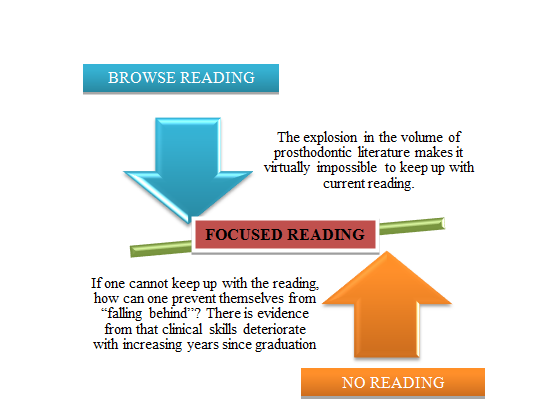
Journal reading now-a-days is in “browse mode,” persuing subscribed journals and reading a few articles in a little more detail. On the other hand, EBP requires a search of the available literature and specific reading to answer a question posed by the patient’s condition.
This is reading in “focused mode”. It builds a collection of answers to questions faced in everyday practice, and the practitioner is ready for the next time the issues come up.
WILL THE RESULTS BETTER THE QUALITY OF CARE OF PATIENTS ?
If the methodology is good, if the results have clinical relevance, and if the data interpretation is rational, with equal regard to the dental surgeon’s clinical acumen, then the outcome will be a success.
If, however, the sample is different from a clinician’s practice or if the inclusion and exclusion criteria do not match the practice population, clinicians should be hesitant about applying the results to the population they are treating.2
BENEFITS FOR THE PRACTICING DENTAL SURGEON
There are many potential benefits to dental practitioners who use EBD in clinical practice.
- Improved patient, staff, and dental professionals’ satisfaction
- Improved clinical decision-making capability
- Confidence in treatment planning
- Satisfaction derived from creating treatment plans based on the combination of scientific evidence, clinician judgment, and experience, as well as patient preferences
- Higher treatment-plan acceptance as dental professionals add to their presentation tool box, the sharing of high-quality meaningful evidence with patients
- Enhanced patient trust and rapport when patients who know their dental practitioner relies on the highest level of evidence for making treatment recommendations.
GETTING THE EVIDENCE
Once the question is formed, the best available evidence must be assembled as efficiently as possible. There are several options.
One can take advice from a colleague. This strategy is good but there is a possibility of the blind leading the blind. One can also refer textbooks and other notes from
personal libraries. Given the difficulty of keeping a library up to date, it is unlikely it will contain the most current information on the question. One may look to the literature for the most current information on the topic. Searching engines available on the World Wide Web make this a viable option that offers great efficiency.3
APPRAISING THE LITERATURE AND APPLYING THE EVIDENCE TO OUR PATIENTS
Once a supply of evidence that shows promise of answering the question has been isolated, it will have to be critically appraised as quickly as possible. To determine
whether the literature should mould the dental surgeon’s opinion and behaviour, or be discarded, requires some idea on what is considered as a valid study or literature.
Studies, case reports and articles are dime a dozen these days. Asking the right questions to evaluate the specificity and sensitivity of the study enables us to differentiate what evidence to believe and what to disregard.
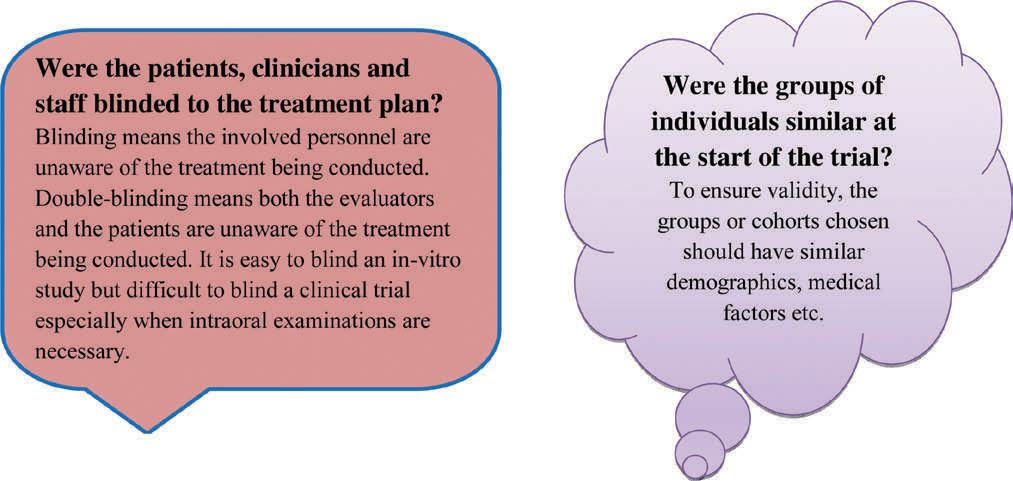
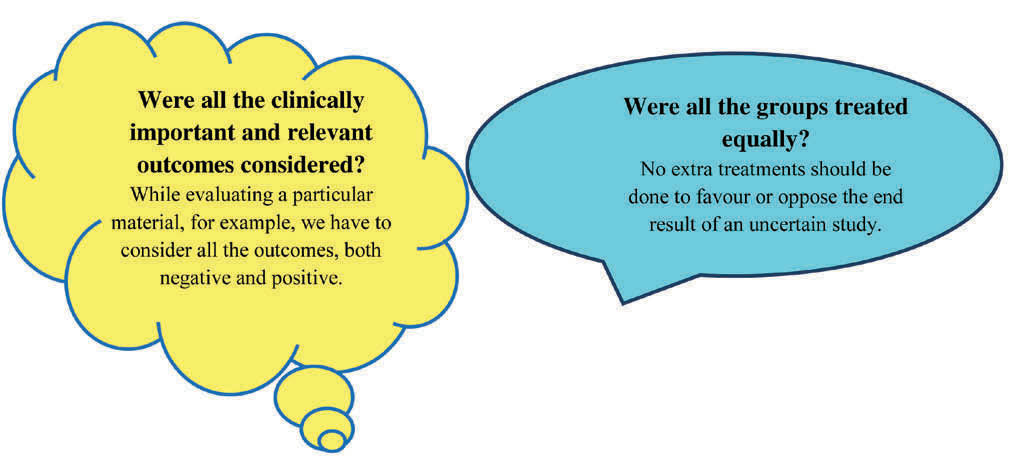
Control of bias is a major determinant of the strength of a design. The randomized controlled trial (RCT) and the structured critical review or meta-analysis of RCTs are
accepted as the “gold standards” of clinical research.
Without randomization and blinding, the estimate of the size of the treatment effect can be greatly exaggerated as evidenced in analyses of multiple, uncontrolled
and unblinded studies. In the appraisal of literature, these are a few questions we should ask ourselves :
THE NEED OF EVIDENCE BASED PRACTICE IN PROSTHODONTICS
With the advent of technology and sciences, there are a plethora of treatment options to choose from in prosthodontics.
Restoration of a single missing anterior tooth4 itself has several options to choose from. Fixed partial dentures, Resin Bonded

restorations, Implant supported crown or removable partial dentures. The clinician often uses his clinical acumen to select the therapy required based on the clinical assessment of the patient.
However, in circumstances where two treatment modalities are acceptable such as, endodontic treatment versus extraction of the carious tooth followed by placement of an implant supported crown, or Fixed partial denture versus implant supported crown, then how do we advocate which treatment to follow? A decision such as this should be based on the evidence supported literature , regarding each therapy and its success and outcomes5.
The same applies to various impression materials, cements, types of ceramics, waxes etc. A thorough background study and reading the literature helps us to decide independently the utility of a new device or material without being misled by the advertisement or propagandas.
DISCUSSION
Therapy and judgement of a clinician is often clouded by bias or conventional thinking or hearsay from a colleague. It is common place to return from attending a conference or an exhibition bursting with information regarding latest gadgets or materials and decide to use this in our practice.6 This is dangerous because we assume the retailer has informed us all there is to know about this material. To stay true to our profession, it is of paramount importance to learn how to differentiate between weak evidence and substantial evidence. All latest gadgets release into the market with their studies being conducted by their companies. Each company tailors studies to suit its marketing strategy hence we must be able to ask the right questions and appraise the validity of the study ourselves before adopting the new techniques.
Adopting that which has evidentiary support, not only gives us confidence and predictable success , it also keeps us in good stead in legal situations. Thus it is all around beneficial to the clinician as well as the patient.
CONCLUSION
Ultimately, the beneficiary of Evidence based practice is the patient, who reaps the rewards of quality care. Dental practitioners also benefit from Evidence based practice as it helps to predict the outcome of treatment. The practice of evidence based dentistry is not a process of blindly following the conclusions found in the literature. Clinicians can safeguard the patient and themselves against the inappropriate use of irrelevant therapy in the conduct of daily practice. This skill adds confidence to decision making in clinical practice and prevents the decline in skills throughout a career. Evidence based practice is a new level of sophistication in the practice of dentistry. Armed with the tools of EBD, the clinician can readily evaluate the mass of data and choose, in an educated manner, what to use and what to discard.
REFERENCES
1. Goldstein Gary R., Preston Jack. Therapy- Anecdote, Experience, or Evidence? DCNA 2002 vol 46(1);21-29
2. Glodstein Gary R. What is Evidence Based Dentistry? DCNA 2002 Vol 46(1);1-9
3. Anderson James D. Need for Evidence Based Practice In Prosthodontics. The Journal of Prosthetic Dentistry 2000;83:58-65
4. Paul A. Fugazzotto. Evidence based decision making : The replacement of a single missing tooth. Dent Clin N Am 53 (2009) 97–129
5. P. M. M. Rohelin, "Decision analysis in dentistry - the last thirty years.," Journal of Dentistry, vol. 28, pp. 453-468, 2000.
6. David W. Chambers, Ethics of experimenting in dental practice.Dent Clin N Am 2002 Vol 46 (1)
Disclaimer from Guident
The views and opinions expressed in articles published in Guident are solely those of the authors and do not necessarily reflect the views of the editors, the editorial board or the publisher, Ivory India. Guident does not endorse any product, technique or treatment described. Clinical content is intended for qualified dental and medical professionals and is not a substitute for individual clinical judgement. Guident, its editors and the publisher accept no liability for any consequence arising from the use of information published in the journal.
How to cite this article
Dr. Krishna Prasad, Dr. Archana Ashok S., Dr. Anupama Prasad. The Tool for Thinking and Analyzing - Welcome to the World of Evidence Based Practice. Guident. 2014 Jan;7(2). Available from: https://guident.in/articles/general/the-tool-for-thinking-and-analyzing-welcome-to-the-world-of-evidence-based-practice.html