The Prevalence and Severity of Non -Carious Cervical Lesions in Patients Reporting to Department of Conservative Dentistry of a North Indian Dental College
School of Dental Sciences, Sharda University, Greater Noida, India, Gurgaon, India, DJ College of Dental Sciences and Research, Modinagar, UP, India, Department of Conservative Dentistry & Endodontics
Abstract
Background: Non- carious cervical lesions are now recognised to be multifactorial. These lesions cause structural undermining of the tooth, plaque retention, sensitivity, estheticissues, restorative challenges and lower restoration retention rates . There’s a need for public awareness and preventive strategies against these lesions. For that , the community burden has to be assessed. Aim:The aim of the present study was to study the prevalence and severity of NCCL s in patients attending the Department of Conservative Dentistry and Endodontics at our Institute.Methods: In between February- August 2013, new patients were screened for cervical wear and TWI with modifications was used to score the prevalence and severity.Results: The present study has found 20.3% patient prevalence , 16% tooth prevalence and an overall percentage of NCCL s within dentin to be 9.3% .Maxillary premolars and first molars were the most affected teeth, closely followed by mandibular premolars. Conclusions: Result of the present study indicate that in the examined population every seventh tooth was affected by some form of NCCL. Every seventh premolar and every tenth molar was affected to some degree. Such frequent occurrences cannot be ignored.Multicentre case control studies designed on the younger local population are in order.
Key words: non carious cervical lesions, cervical wear, prevalence
INTRODUCTION
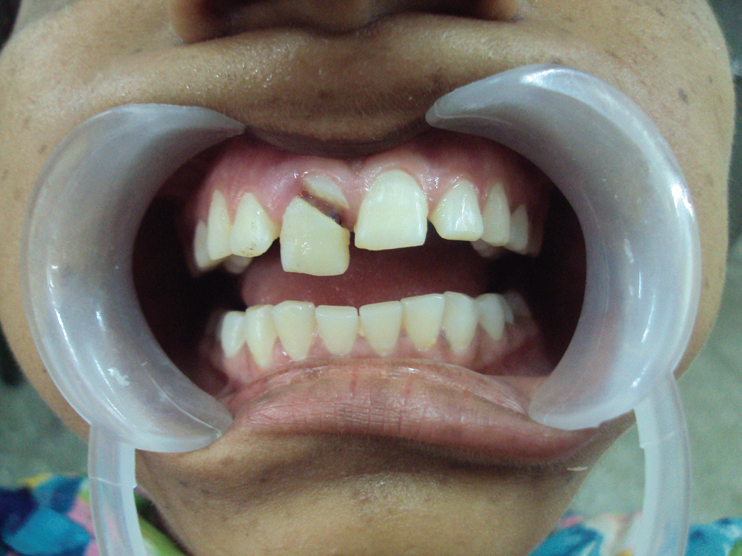
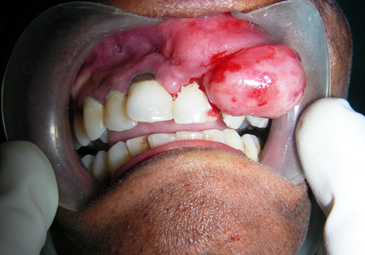
The term non- carious cervical lesions has been ascribed to the loss of tooth substance at the cementoenamel junction, unrelated to dental caries1.(Figure 1 and 2).

In the last few years, major investigators in this field have attributed the etiology of these lesions to bemultifactorial. In a critical review, Bartlett et al noted that cervical wear lesions are probably created by a combination of erosion, abrasion, and attrition2.Having coined the term abfraction ,Grippo in 2012 , stated that abfraction, representing the mechanism of stress, as the loss of tooth substance in areas of stress concentration, should not be used to designate all NCCLs because these lesions are commonly multifactorial in origin.Grippo commented that development of NCCLs depends ultimately on whether or not the confluence of pathodynamic factors exceeds the odontolytic threshold for a tooth in its oral environment. He suggested that the term “biocorrosion”, because both exogenous and endogenous acids, proteolysis and electrochemical action can be embraced by this more precise term3.
CLINICAL CONCERNS WITH NCCL S:
- These lesions cause a structural undermining of the tooth structure.The initial small lesions can become alarmingly deeper with time, leading to either pulpal involvement or loss of tooth crown by severe notching of tooth necks.
- Unestheticdisfigurement of dentition.
- Predispose to plaque retention, caries incidence and sensitivity.4,5
- Problematic restorations with difficulity in isolation, adhesion , accessing of sub/ equigingival margins and polishing (5).
- Lower retention rate of restorations at these sites6.
As life expectancy and public desire for good oral health is increasing , this disease presentation needs effective solutions. There is a need to design strategies for public awareness and prevention of these lesions. For that the local community disease burden has to be assessed .The prevalence and severity of these lesions is unreported so far in a North Indian population.It was decided to conduct two phase study – First to assess the prevalence and then to do a case control study to assess the etiology of these lesions in the North Indian population. The first phase of our study is reported here.
AIM:
The aim of the study was to determine the prevalence and severity of NCCL s in patients attending the Department of Conservative Dentistry and Endodontics at our Institute.
MATERIAL AND METHODS
Institutional ethical clearance was obtained.All new patients(above 18 yrs) , attending the department during months February- August 2013, between 10.30am -12.30 pm hours , for the first week of the month were included.
Patients who presentedwith non –carious cervical tooth wear were clinically examined by one examiner.The distribution and severity of tooth wear were recorded using the Smith and Knighttooth wear index (TWI)7. Before undertaking the study , the author underwent a training to assess non-carious cervical lesions. For intraoperator reproducibility,the author examined three subjects twice with a15-minute interval between each examination.
Discrepancy was addressed by discussion with colleagues , further study and re-examination.Clinical examination was performed with the patient in almost supine position and undergood lighting conditions. The vestibular surfaces of the teeth were thoroughly dried prior to the examination and the cervicalsurfaces of each tooth from second molar to second molar were examined in the same sequence for each patient . The data was recorded with the help of an assistant. In addition to the TWI, the frequency of cervical lesions was also recorded for each patient.
The TWI has five scores:0 is no loss of contour; 1 is minimal loss of contour ; 2 is defect <1 mm deep; 3 defect 1-2mm deep; 4 is defect more than 2 mm deep, or pulp exposure, or exposure of secondary dentine. In cases of doubt, a lower score was assigned.Useful modifications have been suggested in the use of this index8 . They were adopted as follows. The examiningprobe was passed along the tooth surfacefrom the root onto the crown and if therewas no change in contour detected as itcrossed the CEJ, or only a smooth disturbance,the surface was scored Code0 - "No change in contour". A distinctjump or "click" as the probe crossed theCEJ indicating a definite jutiction, barelyvisible to the naked eye, was scored Code 1 "Minimal loss of contour". A defectat the CEJ or just below, visible to thenaked eye and producing a marked jump,could be scored as Code 2 - "Defect < 1mm deep" or higher, as appropriate. Any calculus/ restorationregardless of size, if it was presenton the root surface at the maximumdepth of anarea of cervical wear, wouldprevent an accurate score for that surfacefrom being made. The surface wasthen scored Code R. However, if it wasclear that the maximum depth of a cervicaldefect was located away from suchobscuring influences, then the appropriateCode 0 -4 was applied.
RESULTS
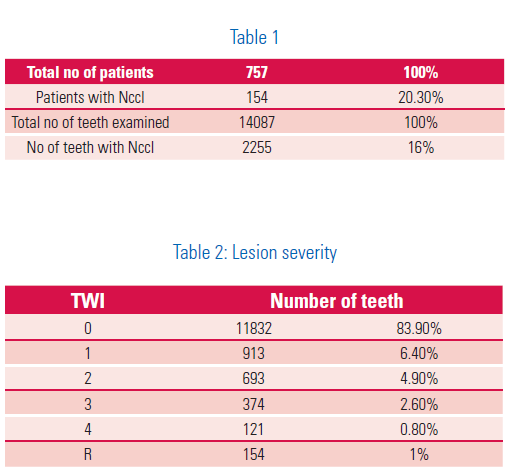
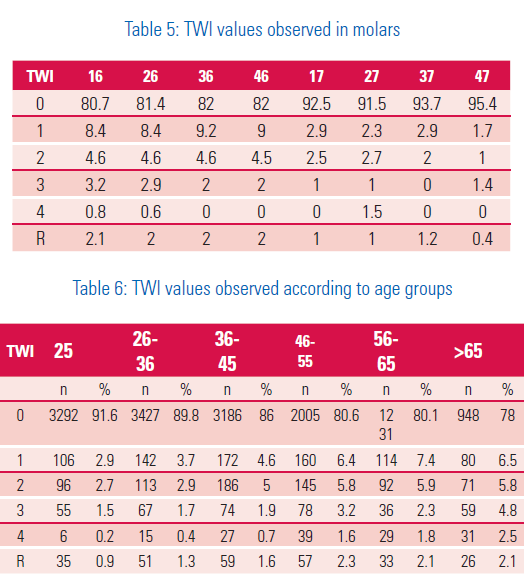
Nccl patient prevalence was found to be 20.3% and tooth prevalence found to be 16%(Table 1). Overall percentage of NCCL s within dentin was 9.3%(Table 2).The levels 2-4 and R represent lesions in dentine .
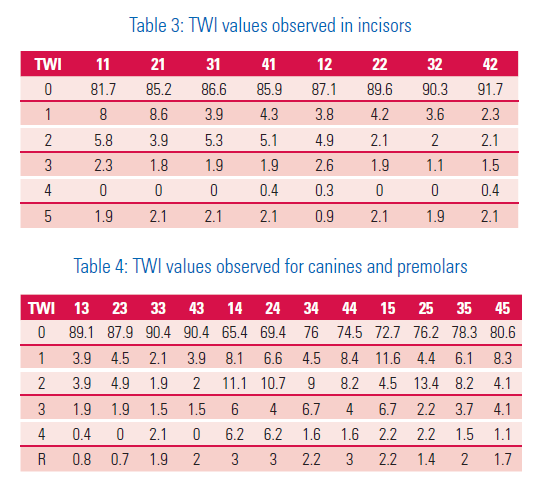
The TWI distribution of incisors , canines and pre-molars is depicted in Tables 3, 4, 5 respectively. The highest frequency of level 2 was found for maxillary second premolars.Highest frequency for level 3 was found for upper and lower first premolars.Level 4 was highest for maxillary first premolars.Overall maxillary premolars were maximally affected , closely followed by maxillary molars and mandibular premolars.
The disease burden increased with age. Frequency of all index levels were shown to increase with age(Table 6).
DISCUSSION
A new index for tooth wear index has been introduced in 2009 9. Its advantage over TWI is that , that it details the tooth loss in enamel and also reports on area of surface involved in cervical lesions. The investigators in their discussion themselves admitted to it being a challenging system for scoring , requiring dedicated examiner training. And despite its increased number of grades, it can still be collapsed to the original TWI. Its’ very good use would be for interventional studies aimed at prevention. For ease of scoring, Smith and Knight TWI with modifications by Donachie and Walls was used.
Kitchin noted that vestibular surfaces of teeth were the main locations of cervical wear lesions, very less on lingual and rarely on proximal10.
The prevalence of non- carious cervical lesions has been reported to be 5-85%(11).
The present study has found 20.3% patient prevalence , 16% tooth prevalence and an overall percentage of NCCL s within dentin to be 9.3%; which lies within this reported range. Maxillary premolars and first molars were the most affected teeth, closely followed by mandibular premolars. Increased prevalence and severity was noted with increasing age.
12.2% of patients had dentine involved and 100% patients had enamel involved at cervical sites in a study done on 1010 patients(9).
In a study on Central Indian population there was a high prevalence cervical abrasion was noted. More wear was recorded among rural (76.9%) when compared to urban dwellers (63.7%). Presence of abrasion was significant in relation to age, rural urban difference and variations in habit of oral hygiene care11
Prevalence of non –carious cervical lesions was found to be 26% in an archaeological study on Mexicans, with NCCL s being non prevalent in the other studied archaeological populations12,13.
62.2% of NCCl s were reported in a sample of 16 patients attending a university hospital in Trindad. 45% lesions were sensitive to compressed air and it was more prevalent in older age groups14.
A study on 1002 Croatians found a prevalence of NCCL tooth prevalence to be 16.6%. Lower premolars were maximally and most severely involved. The severity of lesions was noted to increase with age15.
Others found more pronounced lesions on incisors, canines, and premolars.And more prevalent in the maxilla than in the mandible 10.
In a study that sorted patients into multiple age groupings reported that the prevalence of NCCLs increased with increasing age; maxillary posterior teeth appeared more prone to NCCLs, and first premolars had the highest prevalence followed by first molars.16
A study of 2,849 teeth reported maxillary and mandibular first premolars most frequently affected by NCCLs, and increasing prevalence with increasing age.17
The association with age could be attributed to disrupted chemical bonds betweenhydroxyapatite crystals due to ageing, lack of canine guidance , multiple missing teeth, a higherincidence of dry mouth and diminishedquality and buffering capacity of saliva.
CONCLUSIONS
- Result of the present study indicate that in the examined population every seventh tooth was affected by some form of NCCL
- Every seventh premolar and every tenth molar was affected to some degree.
- The disease burden increased with age. Frequency of all index levels were shown to increase with age.
RECOMMENDATIONS
- Such frequent occurrences cannot be ignored.
- Multicentre case control studies designed on the younger local population are in order.
- Existing knowledge should be used to implement effective public awareness and preventive programs.
REFERENCES
- Mair L H .Wear in dentistry- current terminology. J Dent, 1992, 20: 140-144.
- D. W. Bartlett, P Shah. A critical review of non-carious cervical(wear) lesions and the role of abfraction, erosion and abrasion. J Dent Res 2006, 85(4),306-312.
- John O. Grippo, Marvin Simring, Thomas A. Coleman,Abfraction, Abrasion, Biocorrosion, and the Enigma of Noncarious Cervical Lesions: A 20-Year Perspective.JEsthetRestor Dent 24:10–25, 2012
- Grippo JO. Noncarious cervical lesions: the decision to ignore or restore. J Esthet Dent. 1992;4(Suppl):55–64.
- JA Michael, GC Townsend, LF Greenwood, JA Kaidonis. Abfraction: separating fact from fiction. Australian Dental Journal, 2009; 54: 2-8.
- C. R. Perez, “Alternative technique for class v resin composite restorations with minimum finishing/ polishing procedures,”.Operative Dentistry, vol. 35, no. 3, pp. 375–379, 2010.
- Smith BG, Knight JK .An index for measuring the wear of teeth. Br Dent J.1984b; 156: 435-438.
- Donachie MA, Walls AWG; The tooth wear index; a flawed epidemiological tool in an ageing population group. Community Dent Oral Fpidemiol 1996; 24: 152-8.
- J Fares, S. Shirodaria, K. Chiu, N. Ahmad, M. Sherriff, D. Bartlett. A new index of tooth wear . Caries Res, 2009; 43:119-125
- Kitchin P C. The prevalence of tooth root exposure and the relation of the extent of such exposure to the degree of abrasion in different age classes.J Dent Res 1941, 20:565-581.
- Andre V Ritter, John O Grippo , Thomas A. Coleman, Michele E. Morgan. Prevalence of carious and non-carious cervical lesions in archaeological populations from North America and Europe. J EsthetRestor Dent 2009;21(5):324–35.
- John R. Antonelli, Timothy L Hottel, Franklin Garcia-Godoy.Abfraction lesions - where do they come from. A review of the literature journal of the tennessee dental association ,2013:14-19.
- Smith WAJ, Marchan S, Rafeek RN: The prevalence and severity of non-carious cervical lesions in a group of patients attending a university hospital in Trinidad. J Oral Rehab 2008:35:128-134.
- J. Borcic, I. Anic, M. M. Urek, S. Ferreri. The prevalence of non- carious cervical lesions in permanent dentition. Journal of Oral Rehabilitation, 2004:31: 117-123.
- Aw TC, Lepe X, Johnson GH et al.: Characteristics of noncarious cervical lesions. JADA June 2002;133:725-733.
- O. Bernhardt, D. Gesch, C. Schwahn, F. Mack, G. Meyer, U. John & T. Kocher.Epidemiological evaluation of the multifactorial aetiology of Abfractions. Journal of Oral Rehabilitation, 2006, 33; 17–25
Disclaimer from Guident
The views and opinions expressed in articles published in Guident are solely those of the authors and do not necessarily reflect the views of the editors, the editorial board or the publisher, Ivory India. Guident does not endorse any product, technique or treatment described. Clinical content is intended for qualified dental and medical professionals and is not a substitute for individual clinical judgement. Guident, its editors and the publisher accept no liability for any consequence arising from the use of information published in the journal.
How to cite this article
Dr. Ritu Sharma, Dr. Kriti Maroli, Dr. Nidhi Nagar. The Prevalence and Severity of Non -Carious Cervical Lesions in Patients Reporting to Department of Conservative Dentistry of a North Indian Dental College. Guident. 2014 Jan;7(2). Available from: https://guident.in/articles/endodontics/the-prevalence-and-severity-of-non-carious-cervical-lesions-in-patients-reporting-to-department-of.html