Green Dentistry- a Revolution: A Review
Department of Public Health Dentistry, Department of Orthodontics, Manipal College of Dental Sciences, Manipal, India.
Abstract
Green dentistry is a relatively new term and an emerging concept in dentistry. Most dental offices are privately-owned small businesses and have no financial advantage to invest in many environmentally-friendly practices. For this reason, more research is needed to find cost-effective environmental alternatives in dentistry.The aim of this article is to expand awareness and practice of eco-friendly dentistry.
Key Words: Green dentistry, environment, dental waste.
INTRODUCTION
Green dentistry is a high-tech approach that reduces the environmental impact of dental practices and encompasses a service model for dentistry that supports and maintains wellness.Green dentistry meets the needs of millions of wellness lifestyle patients, and helps dental professionals protect planetary and community health, as well as the financial health of their practices.The aim of this article is to expand awareness and practice of eco-friendly dentistry.
WHAT IS GREEN DENTISTRY?
The Eco-Dentistry Associationdefines green dentistry as practice that:Reduces waste and pollution;Saves energy, water and money;Incorporates high-tech innovations and is wellness based.1 It involves the concept of 4R- Reduce, Re-use,Recycle and Re-think.2
COMPONENTS OF GREEN DENTISTRY
Green Dentistry includes four categories of green practice, providing acomprehensive, eco-friendly model for the dental office.
1. Waste reduction
2. Pollution prevention
3. Energy Conservation
4. Water Conservation
GREEN RECOMMENDATIONS
Here is a list of recommendations3-5 for making your dental office more eco-friendly:
- Implement an eco-friendly sterilization program, which simultaneously eliminates the need for disposable auto clave wraps and disposable patient bibs.
- Use a community’s existing recycling program to separa tely recycle the paper and plastic halves of autoclave bags.
- Use a dry dental vacuum pump, instead of a wet one.
- Use digital radiography instead of traditional film-based x-rays.
- If using traditional x-rays, recycle fixer and developer solutions and recycle lead foil from x-rays.
- Consider using less harmful surface disinfectants in dental offices, such as tea tree oil and thyme.
- Use reusable and biodegradable sundries wherever possible:reusable operating room cotton towels instead of disposable plastic or paper patient bibs, reusable stainless steel high- and low-volume, surgical/endodontic suction tips as an alternative to disposable plastic, reusable glass irrigation syringe as a substitute for disposable
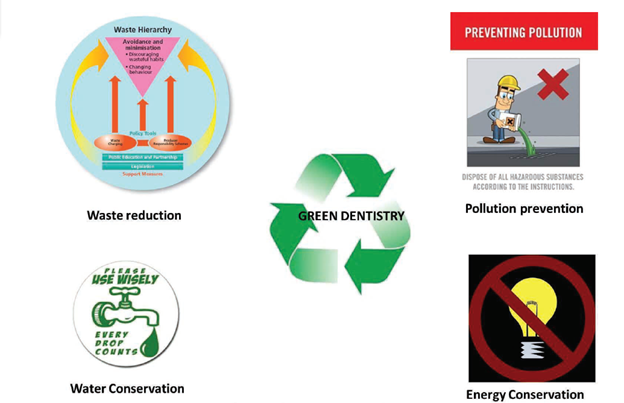
Figure 1: Showing the components of Green Dentistry
plastic, biodegradable disposable cups instead of regular paper cups,chlorine-free high post-consumer recycled paper products instead of traditional paper products.
8. Use stainless steel prophy cups instead of disposable prophycontaining cups. This means purchasing prophy paste in tubes or tubs. This also allows you to use only the amount of paste that is neededversus a predetermined amount, which is often more than you need, and thus wasteful and costly.
9. Use disposable, plastic or paper barriers only as truly needed. An effective exercise would be for each office to do a one-day consumption analysis exclusively for barriers and then calculate howmany barriers are used per week, month and year, and throughoutone’s dental career.
10. Use an Energy Star washer and dryer, where applicable.
11. Use fluorescent instead of halogen lighting, where practical.
12. Use liquid crystal display (LCD) instead of cathode ray tube (CRT) computer monitors.
13. Use linoleum, a more environmentally friendly choice for flooring.
14. Use an ultra-low volatile organic compound (VOC) paint.
15. Hire an environmentally friendly landscape company that uses naturalgrowth product and procedures as an alternative to harmful pesticidesto care for your office’s lawn.
CONCLUSION
Eco-friendly dentistry is not merely a “feel good”endeavor. There is overwhelming evidence of global climate changes and the finite capacity of our planet’s eco-system to absorb further depletion and degradation. If environmental degradation was a stock, the industrial nations would be the primary share-holders. Thus, it is an ethical duty for all the dentists in world to play a primary role in developing sustainable solutions.
REFERENCES
- Available from Hu Friedy. Green Dentistry definition retrieved from www.friendsofhu-friedy.com/WhatExactlyIsGreenDentistry.aspLast Acessed (January 2014)
- Pockrass F, Pockrass I. The four “Rs”of ecofriendly dentistry. Am Dent HygAssoc 2008;22:18-21.
- Adams E. Eco-friendly dentistry: Not a matter of choice. J Can Dent Assoc 2007;73:581-4.
- Lakshman P. Green dentistry-pollution free, ecofriendly dentistry. IDRR 2010;5:36-8.
- Rogers KD. Status of scrap (recyclable) dental amalgams as environmental health hazards or toxic substances. J Am Dent Assoc 1989;119:159-66.
Disclaimer from Guident
The views and opinions expressed in articles published in Guident are solely those of the authors and do not necessarily reflect the views of the editors, the editorial board or the publisher, Ivory India. Guident does not endorse any product, technique or treatment described. Clinical content is intended for qualified dental and medical professionals and is not a substitute for individual clinical judgement. Guident, its editors and the publisher accept no liability for any consequence arising from the use of information published in the journal.
How to cite this article
Dr. Nishu Singla, Dr. Ritesh Singla. Green Dentistry- a Revolution: A Review. Guident. 2014 Mar;7(4). Available from: https://guident.in/articles/general/green-dentistry-a-revolution-a-review.html