AYURVEDA AND ORAL HEALTH Review Article
(Guide, HOD), Department of Public Health Dentistry, Buddha Institute of Dental Sciences & Hospital, Patna, India
ABSTRACT
Ayurveda is a comprehensive system of natural health care that originated in the ancient Vedic times of India. Its primary emphasis is on prevention of disease and maintenance of health. It also provides treatment for disease. Ayurveda translates as the ‘Science of Life,’ and it addresses all aspects of life, including consciousness/mind, physiology, behaviour, and environment. Dentistry was included in the shalya-chikitsa section of Ayurveda. About 80% of the people in developing countries used traditional medicine for their health care. Recently, there is renewed interest in use of various Ayurvedic drugs for oral and dental health. Various plants and natural products have been used for their pharmacological applications in oral diseases. Herbal medicine has been successfully applied in dentistry as antiseptic, antioxidants, and analgesic. The natural phytochemicals play an alternative role to antibiotics and also aid in healing of oral infections and thereby improving immunity. Even WHO has always emphasized on rules and regulations time to time for the practice of Traditional medicine. Thus, Ayurveda must be reinterpreted in the light of our new knowledge and it must be incorporated in modern medicine along with other forms of traditional medicine.
Keywords: Ayurveda; Shalya – Chikitsa ; Oral Health; Herbal medicine
INTRODUCTION
Ayurveda is a comprehensive system of natural health care that originated in the ancient Vedic times of India.1 “AYURVEDA” which combines the Sanskrit word “AYUR” (life) and “VEDA” (Science of knowledge) is a holistic ethnic medical care system which evolved in India 3000-5000 year ago, is now practiced in other parts of the world as a form of complementary medicine. The earliest literature on the practice of India system of medicine appeared during the Vedic period in India. The Sushruta samhita and Charak samhita are its earliest authoritative text.2 With passage of time, Ayurvedic practitioners developed large numbers of medicinal preparations and surgical procedures for the treatment of various ailments and diseases. Dentistry was included in the SHALYA CHIKITSA section of Ayurveda.3
AYURVEDA AND ORAL HEALTH
“AYURVEDA” meaning living in tune with nature. This ancient system of medicine has a rich repository of resources even for dentistry. The body structure is categorized based on hegemony of any of three physical humors (dosha).Imbalance in any one of these doshas governs health care in Ayurveda and dental health.4
Various plants and natural products have been used for their pharmacological applications such as in antiulcer agent, wound healing, anti‑inflammatory, antimicrobial, antioxidant properties etc. The review of the recent studies undertaken to use of natural products for oral diseases and also have looked into the multitude prospects and perspectives of Ayurveda in the management of orofacial diseases.5
Varieties of Ayurvedic and herbal preparation such as chewing sticks, herbal brushes (Babool, miswalk, neem and mango), turmeric, amla, aloe Vera, garlic and ginger are used for various oral hygiene procedures as well as for treatment of various gum and oral diseases.6 Several unconventional medicinal herbs are described to familiarize dental practitioners and researchers with a variety of theories that are applicable to dentistry.7
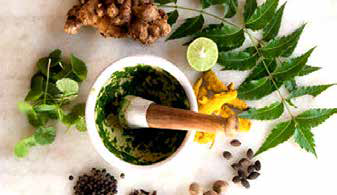
Medicinal Herbs Used In Dentistry
Plants Used In Oral Care
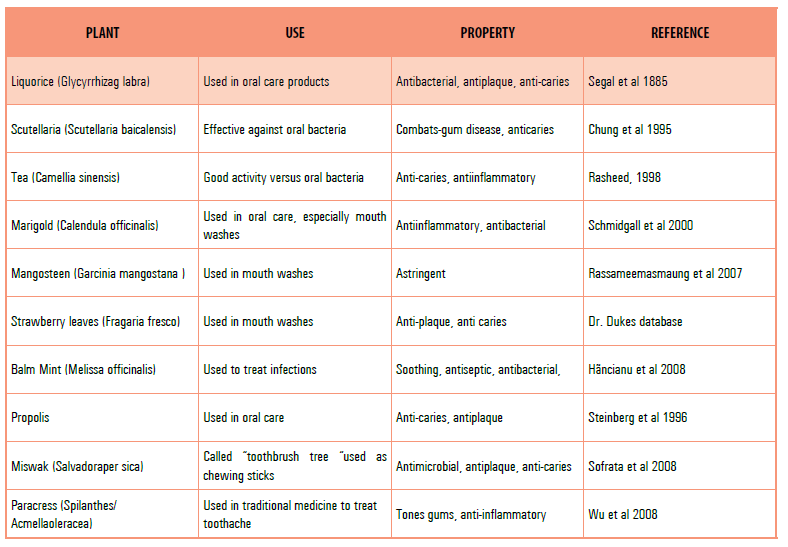
Thus we can say that use of herbal medicine has been successfully applied in dentistry as antiseptic, antioxidants, and analgesic.8 The natural phytochemicals play an alternative role to antibiotics and also aid in healing of oral infections and thereby improving immunity. However, well controlled clinical trials are required to validate the use of these traditional therapeutics strategies in the dental field.9
AYURVEDA AND ORAL HEALTH CARE IN INDIA
Over the centuries, India has used its rich knowledge of traditional medicine to prevent and treat diseases. According to World health Organization (WHO) 75% of the world’s population uses herbs for basic health care needs. WHO has recommended for the incorporation of the traditional systems of medicine like Ayurveda into the primary health care system, for those communities where it is accepted.10 All the ayurvedic medicines and local remedies discussed above (oil pulling, herbal chewing sticks, turmeric, amla, ginger, garlic and guggul) are easily available in the rural areas where socioeconomic condition of the people is not good enough to buy costly toothpaste or curative medicines.11 Ayurveda must be reinterpreted in the light of our new knowledge and it must be incorporated in modern medicine along with other forms of traditional medicine.12
Specific strategies of WHO for promotion of traditional medicine (TM) in India:-
WHO is mainstreaming (TM) in health systems that cover every potential of TM. It involves the use of herbal medicines, as well as the use of animal parts, minerals, and other complex factors (in pharmaceutical processes). These include:13
- Regulation of herbal medicine
- Classification of herbal medicines
- Standardization of herbal medicine
- Rational use of herbal medicine
- Pharmacovigilance program for herbal medicine
- Consumer guidelines of herbal medicines
- Fellowship at collaborative centers.
Regulatory act for herbal medicines
WHO has always emphasized on rules and regulations time to time for the practice of TM, as well as its global appraisal, among the member countries. From literatures, it is well-documented about the evolution of Ayurveda from Indian subcontinent. Hence, Indian Government has already recognized Ayurveda to be practiced as the official system of medicine. In India rules for practice and education of Ayurveda have been laid in 1970 by the Indian Medicine Central Act whereas herbal medicines of Ayurveda are governed by Drugs and Cosmetics Act 1940 (Chapter IV A).14
Apart from that recently, in August 2010, Department of AYUSH of the Government of India has modified Rule 158 of The Drugs and Cosmetics Rules, 1945 to facilitate licensing and export of Ayurvedic herbal medicines under categories of Ayurvedic cosmeceuticals, Ayurvedic nutraceuticals and Ayurvedic extracts.15
CONCLUSION
The traditional knowledge of Ayurveda should be integrated with the modern dentistry. For this, the active principles of plants should be incorporated into modern oral health-care practices and dentists should be encouraged to use natural remedies in various oral health treatments. This will make dentistry much safer, affordable and more accessible for the lower socio-economic groups in society.16
REFERENCES
- Roopali Gupta , Navin Anand Ingle , Navpreet Kaur, Pramod Yadav , Ekta Ingle , Zohara Charania; Ayurveda in Dentistry: A Review; Journal of International Oral Health 2015; 7(8):141-143
- Nilesh Arjun Torwane, Sudhir Hongal, Pankaj Goel, and B. R. Chandrashekar; Role of Ayurveda in management of oral health; Torwane NA, Hongal S, Goel P, Chandrashekar BR. Role of Ayurveda in management of oral health. Pharmacognosy Rev. 2014; 8(15):16–21.
- Dr. Prathima G.S, Dr. Kavitha.M, Dr. Prathima G.S; Ayurveda In Dentistry; India Gandhi Institute Of Dental Sciences;Pg 19-34
- Patil AA, Deosarkarb B, Nirasc S, Chaudhari V: Oral Health & Ayurveda. J Ayurveda Integr Med 2(2): 64–68.
- Gopinath, B. G. (2013); Foundational ideas of ayurveda (Chap 2). In B. V. Subbarayappa (Ed.), Medicine and life sciences in India (Vol. IV, Part 2). Publications in Project of History of Indian Science, Philosophy, and Culture series.
- Robert H. Schneider, Kenneth L. Cavanaugh, H.S. Kasture, Stuart Rothenberg, Richard Averbach, Donald Robinson, and Robert Keith Wallace; Health Promotion With a Traditional System of Natural Health Care: Maharishi Ayurveda; Journal of Social Behavior and Personality, Vol. 5, No. 3, pp. 1-27, 1990.
- Deepti S , Anshad suprretha S,Shyl;aja MD,Shilpa M, Vinay kumar K;Ayurvedic Medicine And Oral Health:A Review; IJOCR Oct-Dec 2015, Vol 3 , Issue 4; Pg-48-51
- Nilesh Arjun Torwane, B R Chandra shekar, Sudheer Hongal; Role of Ayurveda in management of oral health; Pharmacognosy Reviews; Vol 8/ Issue 15/ Jan-Jun 2014; Pg-17-21
- Vinay Kumar Bhardwaj; Ayurveda and holistic approach in oro-dental care: An overview; SRM Journal of Research in Dental Sciences | Vol. 6 | Issue 3 | July-September 2015; 181-186
- Markose A, Krishnan R and Ramesh M; Management of Oral Health through Ayurvedic Methods; J Dent App - Volume 3 Issue 2 – 2016; Pg-319-321
- Rajeswar Digra, NC Rao; Nidhi Gupta, Shelja Vasi; Ayurvedic Herbs In Dentistry; Journal of orofacial research ; January –March 2014 ;4(1): 41-45
- Gunjan Kumar, Md. Jalaludd in , Purnendu Rout , Rajat Mohanty , C.L. Dileep; Emerging Trends of Herbal Care in Dentistry; Journal of Clinical and Diagnostic Research. 2013 Aug, Vol-7(8): 1827-1829
- Dr.Lahari Buggapati; Herbs in Dentistry; International Journal of Pharmaceutical Science Invention; Volume 5 Issue 6 | October 2016 | PP. 07-12
- Ravleen Nagi; Role of Medicinal Herbs in Management of Oral Diseases – A Review; IOSR Journal of Dental and Medical Sciences; Volume 13, Issue 9; PP 40-44
- Pradeep Kumar R; Ethno medicinal plants used for oral health care in India; International Journal of Herbal Medicine 2014; 2 (1): 81-87
- Vikas Gupta, Parveen Bansal , Renu Bansal , Payal Mittal and Sanjiv Kumar; Folklore Herbal Remedies Used in Dental Care in Northern India and Their Pharmacological Potential; American Journal of Ethnomedicine; 2015, Vol. 2, No. 6
Disclaimer from Guident
The views and opinions expressed in articles published in Guident are solely those of the authors and do not necessarily reflect the views of the editors, the editorial board or the publisher, Ivory India. Guident does not endorse any product, technique or treatment described. Clinical content is intended for qualified dental and medical professionals and is not a substitute for individual clinical judgement. Guident, its editors and the publisher accept no liability for any consequence arising from the use of information published in the journal.
How to cite this article
Dr. Gagan Raj, Dr. Suma B.S. Professor, Dr. Garima Mangal. AYURVEDA AND ORAL HEALTH Review Article. Guident. 2020 Apr;13(5). Available from: https://guident.in/articles/general/ayurveda-and-oral-health-review-article.html