A Cross Sectional Study to Assess Tobacco Use, Oral Mucosal Conditions and Periodontal Status Among 35-44 Year Old Women Beedi Rollers Attending Outreach Programmes in Mangalore City
Department of Public Health Dentistry, A. J. Institute of Dental Sciences, Department of Public Health Dentistry, P.S.M. College of Dental Science and Research
ABSTRACT
BACKGROUND: Beedi rolling is a major occupation for a lot of women in Mangalore. Though studies have found that beedirollers suffered from health problems, information about their oral health status is lacking.
OBJECTIVE: To assess the tobacco use, oral mucosal conditions and periodontal status among 35-44 year old women beedi rollers.
BASIC RESEARCH DESIGN: It is across sectional study.
CLINICAL SETTING: Outreach programmes conducted by the Institute.
PARTICIPANTS: Women Beedi rollers aged 35-44 years.
METHODOLOGY: The study subjects comprised of 550 women beedi rollers. After obtaining informed consent, their tobacco use, oral mucosal conditions and periodontal statuswere recorded using WHO oral health assessment proforma. Statistical analysis was done by using SPSS (Statistical Package for Social Sciences) version 17. Chi-square tests was used to analyze the data. The level of significance was set at 0.05.
RESULTS: The prevalence of oral mucosal conditions among study subjects was 4.4%. Calculus was present in 85.3% of the study subjects and 7.1% had loss of attachment of 4-5mm. The prevalence of smokeless tobacco users was 21.5% and the oral mucosal conditions and periodontal diseases were significantly higher among them (p<0.05). CONCLUSION: From the present study we can conclude that the women Beedi rollers have a high prevalence of smokeless tobacco use and oral diseases.
KEY WORDS: Prevalence; tobacco use; oral health; periodontal diseases
INTRODUCTION
India is the third largest tobacco producing country in the world. Although it is not very clear as to when tobacco was first introduced in India, it is believed that tobacco was introduced by Portuguese traders during 1600 AD.1,2 Its use has been prevalent across class, caste, ethnicity and other social divisions. The first formal production of beedis started in 1902, although rural people are known to have made beedis for their own consumption much before this date.1 A large part of Beedi industry is unregulated, home based and is dominated by women who are usually involved in the process of rolling of raw beedis. The government estimates that about 4.4 million workers are in the beedi rolling industry, while the trade unions claim that there are over 7 million beedi workers. Out of them 90% are home based workers and most of them are women. Beedi manufacturing takes place in almost all the major states of India. Karnataka accounts for 12% of the beedi workers nationally and Dakshina Kannada is the major beedi producing centre in the state with over 36 beedi companies. It has been estimated that around 2.5 lakhs of beedi workers are in Mangalore region.1
Beedi rolling is a major occupation in Mangalore for a lot of women, who form the root of the industry. They are engaged in the process of beedi rolling since a very young age and they roll approximately 500-1000 beedis every day. Beedi rolling is a tedious, time consuming process. Beedis are hand rolled with non filtered tobacco, wrapped in tendu leaves and tied with a cotton thread.3 Tobacco use among women is prevalent in allregions of India and among all sections of society.2 Since women beedi rollers have easier access to tobacco they may be more predisposed to smokeless tobacco habits.
Due to exposure to raw tobacco, smokeless tobacco habits and neglect of oral health due to their poor standard of living, lack of time, financial instability, and lack of access to health care facilities, the women beedi rollers are predisposed to oral diseases. Though studies have found that beedi rollers suffered from ophthalmic, gastrointestinal, nervous, respiratory and osteological problems,4,5,6 information about their oral health status is lacking.
The assessment of oral health will enable us to suggest any possible remedial measures to improve their oral health status. Hence the objective of this study was to assess the tobacco use, oral mucosal conditions and periodontal status among 35-44 year old women beedi rollers.
METHODOLOGY
A cross sectional study was conducted to assess the tobacco use, oral mucosal conditions and periodontal status among women beedi rollers.
Study population and selection
The study population consisted of 35-44 year old women beedi rollers attending outreach programmes conducted by a Dental Institute in Mangalore. This age group was focused on as it is the WHO recommended standard monitoring group for oral health conditions of adults.7
Subjects were selected based on the following inclusion and exclusion criteria:
Inclusion criteria
Subjects consenting to participate in the study.
Female beedi rollers in the age group of 35-44 years.
Exclusion criteria
Subjects giving a history of systemic disorders and those giving a history of long term medication or drugs which may alter the oral mucosal conditions and periodontal status.
Subjects with oral diseases or conditions that limit them from oral examination.
Beedi rollers who have been rolling beedis for less than one year.
Ethical clearance
The study was reviewed and approved by the Institutional Ethical Committee.
Pilot study
A pilot study was conducted among 30 women beedi rollers aged 35-44 years to assess the sample size.
Sample Size determination
Sample size was determined to be 547 using the formula
n= Zα2pq
E2
where p = 23.8% (Prevalence of tobacco users), Confidence interval = 95% and Power = 85%
The sample size was rounded off to 550
Calibration of the examiner
Examination was done by a single examiner. Intra examiner calibration of the examiner was carried out. The Kappa co-efficient was found to be 0.86, reflecting a high degree of agreement in the observations.
Study setting: The study was carried out in outreach programmes conducted by the Institute.
Study duration: Data was collected for a period of eight months.
Examination procedure
Women Beedi rollers aged 35-44years attending the outreach programmes conducted by a Dental Institute in Mangalore were included in the study. The study subjects were selected based on convenience sampling. All the participants were informed about the purpose of the study and after obtaining consent they were examined.Their socio-demographic profile and their exposure to tobacco were recorded. Clinical data was recorded by using Type III examination (ADA). Plane mouth mirrors and CPI probes were used for examination. The oral mucosal conditions and periodontal status were recorded using WHO Oral Health Assessment Proforma (1997).7 The study subjects were examined at the outreach programmes. Subjects requiring treatment were referred to the dental hospital.
Data analysis
The data obtained was coded and fed into the SPSS (Statistical Package for Social Sciences) version 17 for analysis. Descriptive data was obtained. The oral mucosal conditions and periodontal status were compared among tobacco users and non-users using Chi-Square test. The level of significance was set at 0.05.
RESULTS
The study population consisted of 550 women beedi rollers aged 35-44 years with their mean age being 39.64 years. Among them 23.5% of the study subjects were illiterate.Toothbrush and toothpaste were used by 98% of the study subjects and 63.1% of them brushed their teeth twice daily. It was found that the mean number of beedis rolled per day was 555 for a mean duration of 15.42 years.
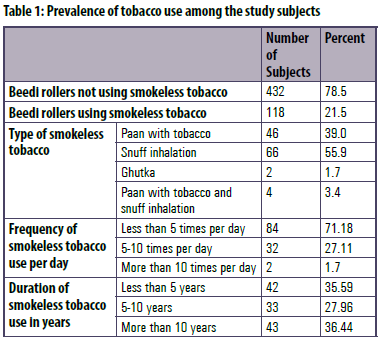
Among the study subjects 21.5% were smokeless tobacco users. There were no users of smoked tobacco products. Among them 71.18% used tobacco less than 5 times per day, while 36.44% used tobacco for more than 10 years. Among the tobacco users 55.9% inhaled snuff, 39% chewed paan with tobacco as given in Table 1.
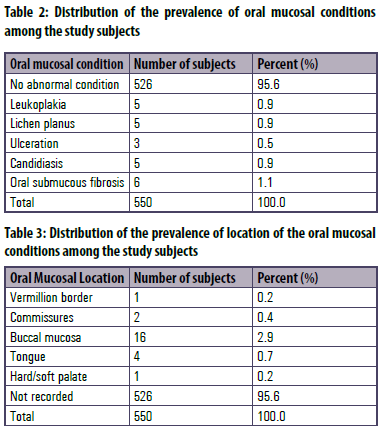
It was observed that among the study subjects the prevalence of oral mucosal conditions was 4.4%. The most prevalent oral mucosal condition was Oral Submucous Fibrosis which was found in 1.1% of the study subjects as given in Table 2. The oral mucosal conditions were most commonly located in the buccal mucosa in 2.9% of the study subjects as given in Table 3.
The periodontal status was recorded using the Community Periodontal Index. In the present study it was observed that 85.3% of the study subjects had calculus as shown in Table 4.
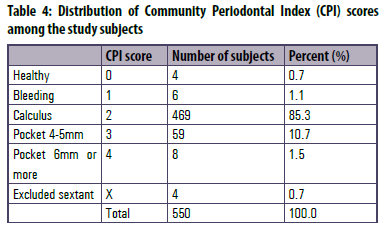
It was observed that 7.1% had loss of attachment of 4-5mm and 6% had loss of attachment of 6-8mmas given in Table 5.
Table 6 shows that the prevalence of oral mucosal conditions was 13.6% among tobacco users compared to 1.9% among non users and the difference was statistically significant (p<0.05).
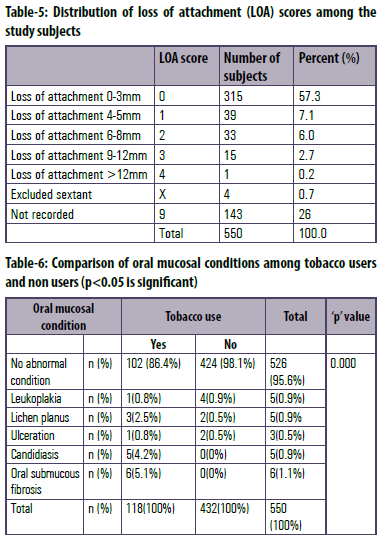
Table7 shows that all the tobacco users had periodontal findings. Calculus was observed in 85.6% of the tobacco users and 85.2% of the non-users. Deep pockets of more than 6mm were seen in 4.2% of the tobacco users and 0.7% of the non-users. The periodontal status among tobacco users and non-users were compared using Chi-Square test and it was observed that there was a statistically significant difference (p<0.05).
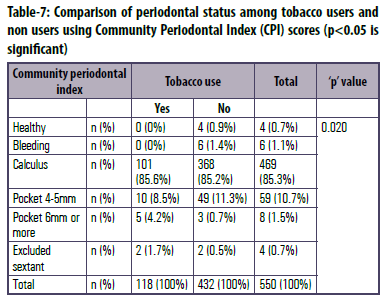
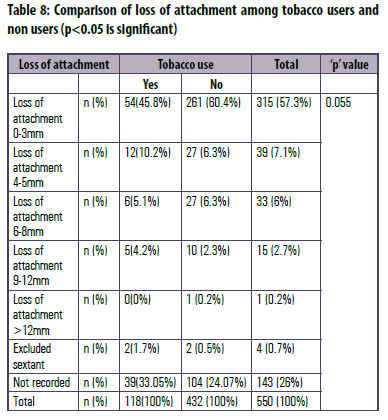
Table 8 shows that there was loss of attachment of 4-5mm among 10.2% of the tobacco users and 6.3% of the non-users. Loss of attachment of 9-12mm was seen among 4.2% of the tobacco users and 2.3% of the non-users. Loss of attachment among tobacco users and non-users was compared using Chi-Square test and the difference was found to be statistically significant (p<0.05).
DISCUSSION
Beedi manufacturing is a traditional agro-forest based industry in India, highly labor intensive and predominantly unorganized.1,3 Although beedi rolling began in factory sector with equal involvement of men and women, the beedi manufacturers have shifted most of their work from factories into households with increasingly more involvement of women.1 Beedirollers handle tobacco flakes while inhaling tobacco dust in their work environment exposing them to health hazards.1,3,4, 5,6 Most of the beedi workers are home based with lack of information and provision for health care.1
In the present study beedi rollers in the 35-44 year age group was considered. This age group is the standard monitoring group for health conditions of adults. The full effect of dental caries, the level of severe periodontal involvement and the general effects of care provided can be monitored using data for this age group.7
In the present study 23.5% were illiterate. Our study results are in contrast to the study conducted by Voluntary Health Association of India among beedi workers where it was found that 58% and 90% of the respondents were illiterate in Jharkhand and Bihar respectively.3 Yasmin S et al4 in their study among beedi rollers of Bihar observed that 90.5% of the respondents were illiterate which is in contrast to the results of our study. In the study conducted by Sabale RV et al6 among Beedi rollers residing in urban slums of Mumbai it was found that 42.31% of the participants were illiterate which is a higher rate of illiteracy compared to our study. The findings of our study is similar to the study conducted among the female beedi workers of Mangalore by Anil M et al8 where it was observed that 81% of the participants received some form of formal education while only 19% were illiterate. The higher literacy level among female beedi rollers of Mangalore may be attributed to the overall higher literacy rate among females in Dakshina Kannada district which was found to be 84.04% according to the provisional report of Census of India 2011.9
In the present study 98% of the study subjects used toothbrush and toothpaste to clean their teeth which is in accordance to the results of the National Oral Health Survey10,11 where majority of the 35-44 year old females in India and Karnataka used toothbrush and toothpaste to clean their teeth. Majority of the participants in the present study brushed their teeth twice daily which is unlike the results of the National Oral Health Survey where majority of the study subjects brushed their teeth once daily.10,11
The mean number of beedis rolled per day was found to be 555 and the mean duration of beedi rolling was found to be 15.42 years indicating that women beedirollers start their profession at an early stage of their life. This is in accordance to the studies conducted by Bhisey RA et al12, Voluntary Health Association of India3, Yasmin S et al4, Sabale RV et al6 and Mittal S et al.13
In the present study, the prevalence of oral mucosal conditions was higher in comparison to the prevalence found in Karnataka which is 0.6% according to the National Oral Health Survey.11 The most prevalent oral mucosal condition in the present study was oral submucous fibrosis which are in accordance to the report on Tobacco Control in India2 and National Oral Health Survey.10 In the present study 0.9% of the study subjects had candidiasis, lichen planus and leukoplakia respectively. In a study conducted by Kawatra A et al14 among the tobacco industry workers of rural Maharastra it was observed that 18.89% of the employees had OSMF, 15.27% had leukoplakia which is higher prevalence compared to the findings of our present study. This variation in the prevalence rate of oral mucosal lesions might be attributed to the much higher use of smokeless tobacco and arecanut related products observed among the tobacco industry workers of rural Maharastra.14 The prevalence of oral lichen planus was found to be higher in comparison to the prevalence in India according to the report on Tobacco Control in India2 and National Oral Health Survey.10
The oral mucosal conditions in our current study was predominant in the buccal mucosa which is in agreement to the results obtained in National Oral Health Survey,10,11 where buccal mucosa is the most favored site in the mouth for oral mucosal conditions.
The periodontal status observed in the present study is in accordance to a study conducted by Shaikh H et al15 among beedi factory workers. Loss of attachment was present in 42.7% of the beedi rollers which is in accordance to the results of the National Oral Health Survey.10
The prevalence of smokeless tobacco use in the present study was 21.5%. This was much lesser in comparison to the study conducted by Tekade AP et al16 among the female tobacco field workers, Kawatra A et al14 among tobacco industry workers in area of rural Maharashtra and by Sabale RV et al6 among beedi rollers residing in the urban slums of Mumbai. According to the National Oral Health Survey,10,11 the prevalence of chewing tobacco among 35-44 year old females is 18.5% in Karnataka state and 6.6% in India, which is lower in comparison to the prevalence found in the present study. According to the Global Adult Tobacco Survey 2009-2010,17 the prevalence of smokeless tobacco use among females in India is 18%.
In the current study among the smokeless tobacco users majority of them inhaled snuff which are similar to the results of the Global Adult Tobacco Survey 2009-2010,17 among the adult females of India.
Majority of the tobacco users, used tobacco less than 5 times per day similar to the findings of the study by Kawatra A et al14 and National Oral Health Survey.10,11 According to the present study majority of them have been using tobacco for more than 10 years. This is unlike the results of a study conducted by Kawatra A et al14 among the tobacco field workers in rural Maharashtra where majority of the tobacco users used tobacco for less than 5 years. It is also dissimilar to the results of the National Oral Health Survey10 where majority of the 35-44 year old females in India used tobacco for a period of 5-10 years. Higher duration of tobacco use among majority of the study subjects in the present study might be attributed to the early exposure to tobacco owing to their occupation.
In the present study it was observed that the prevalence of oral mucosal conditions was more among tobacco users compared to among non users. Winn DM18 in her review has mentioned that oral mucosal lesions are common in smokeless tobacco users. A survey of 17, 027 U.S. adolescents conducted in 1986-87 determined that mucosal lesions were found in 27 percent of snuff and chewing tobacco users, in contrast to 0.4 percent among those who had never used smokeless tobacco which was similar to the findings of the present study.18 Tobacco in any form, either smoked or smokeless, can cause a wide spectrum of oral mucosal alterations or lesions. The type and location of the lesion varies with the person’s specific tobacco habits, type of tobacco used, the way it is used and the frequency and duration of use.2,19,20,21,22 Inflammatory mediators such as prostaglandin E2 and interleukin-1 are elevated contributing to erythema. In addition there is keratinocyte proliferation leading to development of hyperplastic epithelial lesions or dysplasia. Exposure of keratinocytes and monocytes to smokeless tobacco products leads to an increased keratinocyte proliferation.19,20 Subepithelial inflammatory reaction followed by fibroelastic changes of the lamina propria, accompanied by epithelial atrophy was found to be associated with the use of tobacco and arecanut.23
The smokeless tobacco users had a significantly higher (p<0.05) CPI scores compared to non users indicating that they had a poorer periodontal status compared to non users of tobacco. These findings are similar to the findings of a study conducted by Jagadessan M et al24 among rural women of Pondicherry where the prevalence of periodontal disease was 70.7% among tobacco chewers and 32.8% among the non-users and the difference was found to be statistically significant. This study is also in coherence to a study conducted by Chatrchaiwiwatana S25 where betel quid chewing was directly associated with periodontitis. The findings of the present study are similar to the findings of the study conducted by Singh GP et al26 where the incidence as well as severity of calculus was significantly higher amongst smokeless tobacco users as compared to non-users. The ingredients of betel quid including betel leaf, areca nut, slaked lime and tobacco can exhibit harmful effects on periodontal tissues. The cholinergic effect of betel quid together with calcium salt of saliva can produce hypersalivation causing calculus deposition which can then induce destruction of gingival tissue and periodontal membrane among habitual betel quid chewers. Additionally arecoline the main ingredient in are canut can inhibit cell attachment, cell spreading, cell migration, decrease cell growth and collagen synthesis.25 The primary periodontal alteration usually in smokeless tobacco users is gingival recession which may be localized to the site of placement of smokeless tobacco.20,22 The effect of tobacco on the immune system also plays a major role in the development of periodontal disease.18 Exposure to tobacco among beedi rollers and use of smokeless tobacco can lead to poorer periodontal conditions. Smokeless tobacco extracts affect monocyte and oral keratinocyte production of inflammatory mediators which may play a role in localized periodontal tissue alterations. Nicotine is a major and most pharmacologically active agent in tobacco which is a contributing factor for all deleterious effects associated with tobacco which impairs gingival blood flow, alter fibroblast attachment and integrin expression and decrease collagen production and increasing collagenase production. It negatively impacts bone healing, inhibits growth factors and delays revascularization.27
Loss of attachment was more among tobacco users. The findings of the present study are in coherence to the findings of the study conducted by Singh GP et al26 where clinical attachment loss and gingival recession were significantly higher amongst smokeless tobacco users as compared to those not consuming smokeless tobacco. Clinical attachment loss of more than 5mm was observed more among smokeless tobacco users than non-users similar to the findings of the present study.26 Winn DM18 in her review has stated that smokeless tobacco users appear to have more gingival recession than non-users. Chemical injury to thin areas of gingiva and alveolar dehiscence occurs in periodontal tissue chronically exposed to smokeless tobacco.26
CONCLUSION
From the present study we can conclude that the women Beedi rollers have a high prevalence of smokeless tobacco use and oral diseases. Oral health educational and treatment programmes must be organized for the women Beedi rollers to meet the unmet needs of this population. They must be advised to explore alternative employment opportunities if possible. Those continuing in the same profession must be advised to adopt protective measures like use of mouth masks and gloves during their beedi rolling procedure and roll beedis in well ventilated places to reduce their exposure to tobacco. Educational and tobacco interventional programmes must be carried out for the smokeless tobacco users and thus motivate them in improving their oral and general health.
REFERENCES
- ILO-Dept. of Labour, Karnataka. The ILO Beedi Sector Programme. The Beedi Industry in India: An Overview. Improving Working Conditions and Employment Opportunities for Women Workers in Beedi Industry. Beedi Industry Workshop, 22-23 February 2001, Mangalore (Karnataka) 2001. Available from: URL: http://www.bestpracticesfoundation.org/pdf/BeediSector.pdf.
- Reddy KS, Gupta PC (Editors). Report on Tobacco Control in India. Ministry of Health and Family Welfare, New Delhi: Government of India; 2004. Available from: URL: http://www.who.int/fctc/reporting/Annex6_Report_on_Tobacco_Control_in_India_2004.pdf.
- Voluntary Health Association of India. At the crossroads of life and livelihood: The economics, Poverty and Working conditions of people employed in the Tobacco Industry in India. Final research report 2010. Available from: URL: http://www.healthbridge.ca/assets/images/pdf/Tobacco/tobacco_poverty_Appendix%205%20India%20Final%20Research%20Report.pdf.
- Yasmin S, Afroz B, Hyat B, D’Souza D. Occupational Health Hazards in Women Beedi Rollers in Bihar, India. Bull Environ Contam Toxicol 2010; 85: 87-91.Available from: URL: http://link.springer.com/article/10.1007%2Fs00128-010-0037-6.
- Kumar Senthil, Bharathi Subburethina. A study on Occupational Health Hazards among Women Beedi Rollers in Tamilnadu, India. International Journal of Current Research, December 2010; 11: 117-122.Available from: URL: http://mpra.ub.uni-muenchen.de/27278/1/MPRA_paper_27278.pdf.
- Sabale RV, Kowli SS, Chowdhary PH. Working condition and health hazards in beedi rollers residing in the urban slums of Mumbai. Indian J Occup Environ Med. 2012; 16(2):72-4. Available from: URL: http://www.ijoem.com/temp/IndianJOccupEnvironMed16272-1153661_031216 pdf.
- World Health Organization. Oral health surveys: basic methods. 4th ed. Geneva: World Health Organization; 1997.
- Anil M, Machado L, Sequeira A, Prasanna KS, Subramanya J. Study of Morbidity pattern of female beedi workers in the urban field practice area of Mangalore, Southern India. International Journal of A. J Institute of Medical Sciences 2012; 1(1): 41-46.
- Karnataka, Provisional Population Totals. Paper I of Census 2011. Directorate of Census Operations, Karnataka, 2011. Available from: URL: http://censuskarnataka.gov.in/provisional%20population%20totals_2011_karnataka.pdf.
- Bali RK, Mathur VB, Talwar PP, Chanana HB. National Oral Health Survey and Fluoride Mapping. New Delhi: Dental Council of India; 2004.
- Bali RK, Hiremath SS, Manjunath P.National Oral Health Survey & Fluoride Mapping 2002-2003. Karnataka: Dental Council of India; 2004.
- Bhisey R.A, Govekar R.B, Bhagwe A.N. Toxic Effects of Exposure to Tobacco among Bidi Rollers. Control of Tobacco-related Cancers and Other Diseases. International Symposium 1990. Gupta P.C, Hamner J.E and Murti P.R. Oxford University Press, Bombay, 1992; 224-227.
- Mittal S, Mittal A, Rengappa R. Ocular manifestations in bidi industry workers: Possible consequences of occupational exposure to tobacco dust. Indian J Ophthalmol 2008; 56:319-22. Available from: URL: http://www.ijo.in/temp/IndianJOphthalmol564319-1224378_032403.pdf.
- Kawatra A, Lathi A, Kamble SV, Sharma P, Parhar G. Oral premalignant lesions associated with Areca nut and tobacco chewing among the Tobacco industry workers in area of rural Maharashtra. National Journal of Community Medicine 2012; 3(2): 333-338.Available from: URL: http://njcmindia.org/uploads/3-2_333-338.pdf.
- Shaikh H, Shanker S, Vinay S. Assessment of periodontal status and treatment needs among Beedi factory workers Harapanahalli Town, Davanagere district, Karnataka. JIADS 2011; 2(2):13-17. Available from: URL:http://jiads.net/Archives/2011/4.pdf.
- Tekade AP, Srijampana VV, Silpa G , Babu SL, Sarathi VY. A study on tobacco consumption in various forms among the tobacco field workers. Int J Biol Med Res. 2012; 3(2):1509-1511.Available from: URL: http://www.biomedscidirect.com/journalfiles/IJBMRF2012533/a_study_on_tobacco_consumption_in_various_forms_among_the_tobacco_field_workers.pdf.
- Global Adult Tobacco Survey India Report 2009-2010.Ministry of Health and Family Welfare, New Delhi: Government of India; 2010. Available from: http://www.searo.who.int/entity/tobacco/documents/2010-pub2.pdf.
- Winn DM. Tobacco use and Oral disease. Journal of Dental education 2001; 65(4): 306-312. Available from: URL: http://www.jdentaled.org/content/65/4/306.long.
- Walsh PM, Epstein JB. The Oral Effects of Smokeless Tobacco. J Can Dent Assoc 2000; 66(1):22-5.Available from: URL: http://www.cda-adc.ca/jadc/vol-66/issue-1/22.pdf.
- Johnson GK, Slach NA. Impact of Tobacco Use on Periodontal Status. Journal of Dental Education 2001; 65(4):313-321. Available from: URL: http://www.jdentaled.org/content/65/4/313.full.pdf.
- Gupta PC, Ray CS. Smokeless tobacco and health in India and South Asia. Respirology. 2003; 8: 419–431. Available from: URL: http://www.ihra.net/files/2011/07/13/Gupta_Smokeless_Tobacco_Health_in_India.pdf.
- Greer RO Jr. Oral Manifestations of Smokeless Tobacco Use. Otolaryngol Clin N Am 2011; 44(1): 31–56.
- Avon SL. Oral mucosal lesions associated with the use of Quid. Available from: URL: http://www.cda-adc.ca/jadc/vol-70/issue-4/244.pdf.
- Jagadeesan M, Rotti SB, Danabalan M. Oral health status and risk factors for dental and periodontal diseases among rural women in Pondicherry. Indian Journal of community medicine 25(1):Available from: URL: http://www.indmedica.com/journals.php?journalid=7&issueid=51&articleid=620&action=article.
- Chatrchaiwiwatana S. Dental caries and periodontitis associated with betel quid chewing: analysis of two data sets. J Med Assoc Thai 2006; 89(7):1004-11. Available from: URL: http://www.mat.or.th/journal/files/Vol89_No7_1004.pdf.
- Singh GP, Rizvi I, Gupta V, Bains VK. Influence of smokeless tobacco on periodontal health status in local population of north India: A cross-sectional study. Dent Res J (Isfahan) 2011;8(4):211-20. Available from: URL: http://www.ncbi.nlm.nih.gov/pmc/articles/PMC3221089/.
- Malhotra R, Kapoor A, Grover V, Kaushal S. Nicotine and periodontal tissues. J Indian Soc Periodontol 2010; 14:72-9. Available from: URL: http://www.jisponline.com/temp/JIndianSocPeriodontol14172-259269_032952. pdf.
Disclaimer from Guident
The views and opinions expressed in articles published in Guident are solely those of the authors and do not necessarily reflect the views of the editors, the editorial board or the publisher, Ivory India. Guident does not endorse any product, technique or treatment described. Clinical content is intended for qualified dental and medical professionals and is not a substitute for individual clinical judgement. Guident, its editors and the publisher accept no liability for any consequence arising from the use of information published in the journal.
How to cite this article
Dr. Pooja J Shetty, Dr. Vijaya Hegde, Dr. Rajani Mary George. A Cross Sectional Study to Assess Tobacco Use, Oral Mucosal Conditions and Periodontal Status Among 35-44 Year Old Women Beedi Rollers Attending Outreach Programmes in Mangalore City. Guident. 2020 Apr;13(5). Available from: https://guident.in/articles/research/a-cross-sectional-study-to-assess-tobacco-use-oral-mucosal-conditions-and-periodontal-status-among-35-44-year.html