Aggrandize Oral Health Care System- a Need of an Hour!
Department of Prosthodontics, Seema Dental College & Hospital, Rishikesh, Uttarakhand, India, All India Institute of Medical Sciences, Rishikesh, Uttarakhand, India
INTRODUCTION
Dental diseases are a significant public health burden in India as well as across the globe. It is fundamental and universal right of all citizens of India to health which needs to be respected and realized within a definite time frame.1 Now these days, as dental surgeonry is advancing in many ways but still it is access is dream to many, especially the rural population. In India, oral health is not identified as a priority by policy makers nor by public.2 The situation is quiet ironic where in India number of Dental Colleges and graduating dental surgeons exceeds that of various developed countries, only 10% of dental surgeon serve the rural population who constitutes around more than 68% of the population.3 There are various reasons for burden of oral diseases increasing like fast growing population, rapid westernization and lack of resources.
Method of Literature Search
Literature search for the current article was done both electronically and manually. Electronic search was conducted using databases like PubMed, Medline, and so on extracting relevant articles published in peer-reviewed journals. Various web-based search engines like Goggle Scholar were also used to find appropriate manuscripts. Various key words and their combinations were used for literature search like oral health policy, rural India, dental surgeonry in developing countries, dental policies. The present review emphasized on various aspects of dental oral health care system in rural population.
Oral Health Burden in India and reasons for increasing
Oral problems are major emerging concern in Indian population. Oral problems cause pain, agony, any functional, aesthetic problems and also leads to loss of working man hours. Oral precancers and cancers are emerging as a major threat to younger people and are increasing to alarming proportion in India. There are drastic changes in dental sector and increase in dental workforce in India during the study period, opening of private dental sectors, it is logical to believe that oral disease burden during the period should be reduced but on other hand, the explosion of population, particularly increase in geriatric population as well as disproportionate dental workforce distribution, is being noted in India.4 Burden of oral diseases in our country is also increasing because of fast growing population, rapid westernization and lack of resources.5
Oral Health Promotion Barriers
The current concept of ‘access to dental care’ has changed completely nowthese days. Now, concept not only includes the adequacy of workforce which should be patient based but now the access to dental care services are being perceived as both the availability of care and willingness of the patient to seek care . Now, the connotation of access has changed to supply-demand consideration.6,7 India as being the developing country there are various barriers which come across oral health promotion which are as follows:
- Workforce in Oral Health Care: According to survey, the number of 1,17825 working dental surgeons in country8 but there is no improvement in the accessibility of oral health care services in rural population. Lack of perceived oral health need and non-availability of dental health services to the rural areas are the main two reasons for this.
- Expenditure in Oral Health Care: Oral health care services are not being considered as life threatening except oral cancer along with this the treatment of these dental diseases are quiet expensive and time consuming. Budget allocation in India the situation is quiet devastating as the budget allocated to health is merely 2% and in which there is no separate budget for oral health.9
- Affecting daily lives: Nearly 26% of Indian population is below poverty line which works on daily wages so spending time or loss of working hours for dental treatment can stop them from working for one full day which may lead to situation where they can not arrange for their food and daily needs for their whole family.10
- Geriatric Oral Health: With the advancement in health and medical field person life expectancy has increased. Thus, in India as being developing country two-third of population is elderly. So, policies are required including oral health services serve as age processes.11 Govt. of India has to ensure that elderly individual should receive affordable and quality oral health care services.
- Children Oral Health: As geriatric dental surgeonry is to be focussed in same way, children oral health care services have to improve. Dental caries is the most common dental disease among children and even affects children socially as well as psychologically. Such dental treatment can be expensive directly or indirectly. Directly can be the charges and indirectly factors can be the time spent by child parents to take their kids to dental surgeons.12,13
- Addressing Quackery: As in Medical field the policy makers have given importance to stop giving quackery training in there health care facilities but in dental surgeonry this field is still to be focussed.14 The main motto of such quackery is in order to make money, or to maintain position of power in the society.
- Providing Dental services except traditional clinics: As about 80% of dental surgeons work in urban areas and according to data available in rural India, one dental surgeon is serving near about 250,000 population.15
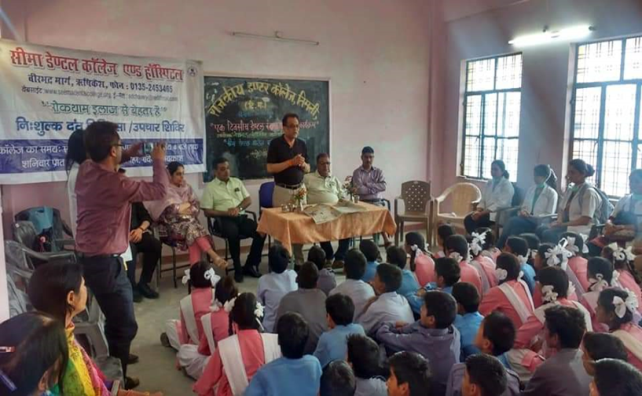
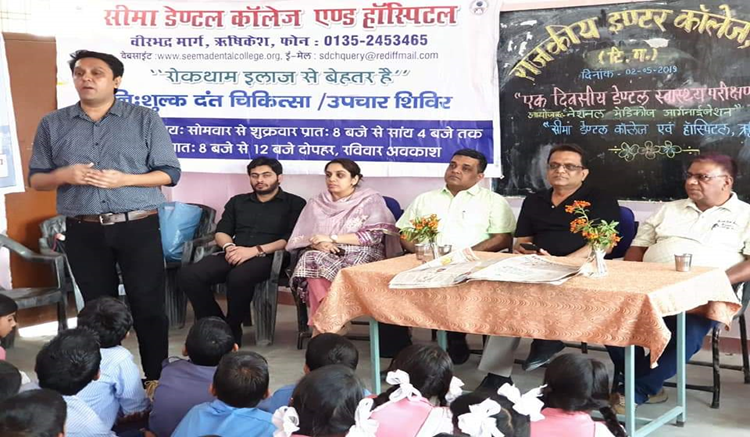
Awareness through Denture Camps in remote areas
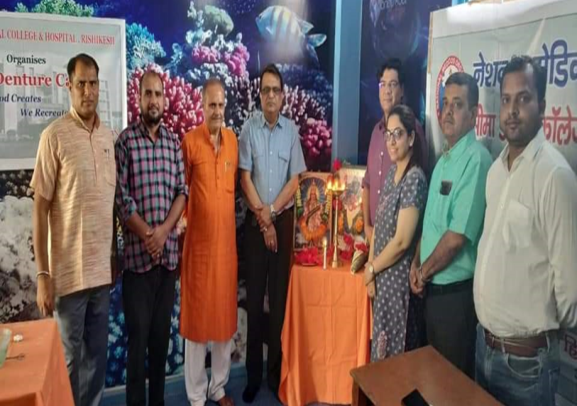


Conducting Free Denture Camps in remote areas
Measures can be taken to Improve Dental Health Care:
- Improving condition of National Oral Health Policy which should integrate with the general policy.
- Promotion of Geriatric dental surgeonry in dental undergraduate and post graduate curriculum.
- As Geriatric Dental surgeonry is to be promoted same like the Paediatric dental surgeonry has to be promoted because if oral disease can be diagnosed at the initial stage major oral diseases can be prevented at later stages as well as the monetary loss will be less as the disease will be treated at initial stage.
- Public Health System or policies related to dental and general health care services has to be strengthened.
- Government should be more focussed on training quackery in dental surgeonry and implement methods to stop this and provide some means of earning to such persons for which actually they are doing this.
- As in completion of medical courses there is field training of graduate trainees in the villages or rural areas to serve the population same like in Dental the trainees should be posted in such rural areas for certain amount of time by which such population should have better dental health care facilities.
- Mobile Vans and Mobile Dental clinics should be more used as maximum population is in rural areas which are deprived from basic dental health care facilities and can reach to door step.
- Contributing more in community oral health programmes. All the privatized as well government institutions should contributes maximum in community health programmes.
CONCLUSION
It is clear from above data that our developing country India needs more strong policies regarding oral health care services. Government and Dental Council of India is surely putting efforts to improve on this but still the bigger steps have to be taken. The effort should not be put by any single organization this has to be cumulative effort by various private as well government organizations. Preventive, curative and educational health care programs are the need of an hour.
REFERENCES
- Sarojini N, Amit Sengupta. Realizing the right to health care a policy brief. Jan Swasthya Abhiyan, 2014.
- Chandrashekhar Janakiram, Rajeev B Rudrappa, Farheen Taha, Venkatachalam Ramanarayanan, Harikiran G Akalgud, Sushi Kadanakuppe. Equity in oral health care in India. A review on health system analysis. Economic and Political Weekly 2017; 52(9):83-89.
- Ashish K. Jaiswal, Pachava Srinivas, Sanikommu Suresh. Dental manpower in India: Changing trends since 1920. International Dental Journal 2014; 64(4): 213-8.
- Balaji SM, Mathur VP. Dental practice, education and research in India. Oral health inequalities and health systems in Asia-Pacific Natl India 2017; [doi: 10.1038/nindia. 2017.28]
- Tendon S. Challenges to the oral health work force in India. J Dent Educ 2004; 68:28-33.
- Sankalp Yadav, Gautam Rawal. The current status of dental graduates in India. Pan African Medical Journal 2016; 23:22.
- Albert H. Guay. Access to dental care solving the problem for underserved populations. Journal of American Dental Association 2004; 135(11):1599-1605.
- Sudhakar Vundavalli. Dental manpower planning in India: current scenario and future projections for the year 2020. International Dental Journal 2014; 64(2): 62-67.
- Parkash H, Shah N. National Oral Health Care Programme: Implementation Strategies. New Delhi: National Oral Health Care Programme, Govt. of India; 2001.
- Singh A, Purohit BM. Targeting poor health: Improving oral health for the poor and the underserved. Int AffGlob Strategy 2012; 3:1-6
- Singh A, Purohit BM. Addressing geriatric oral health concerns through national oral health policy in India. Int J Health Policy Manag 2015; 4:39-42.
- Sheiham A. Oral health, general health and quality of life. Bull World Health Organ 2005; 83:644.
- Sheihman A. Dental caries affects body weight, growth and quality of life in pre-school children. Br Dent J 2006; 201: 625-6.
- Sandesh N, Mohapatra AK. Street Dental surgeonry: Time to tackle quackery. Indian J Dent Res 2009; 20:1-2.
- Ahuja KN, Parmar R. Demographics and current scenario with respect to dental surgeons, dental institutions and dental practices in India. Indian J Dent Sci 2011;3:8-11.
Disclaimer from Guident
The views and opinions expressed in articles published in Guident are solely those of the authors and do not necessarily reflect the views of the editors, the editorial board or the publisher, Ivory India. Guident does not endorse any product, technique or treatment described. Clinical content is intended for qualified dental and medical professionals and is not a substitute for individual clinical judgement. Guident, its editors and the publisher accept no liability for any consequence arising from the use of information published in the journal.
How to cite this article
Dr. Jyotsna Seth, Dr. Himanshu Aeran, Dr. Anubha Agarwal Hospital Adminstration. Aggrandize Oral Health Care System- a Need of an Hour!. Guident. 2020 May;13(6). Available from: https://guident.in/articles/general/aggrandize-oral-health-care-system-a-need-of-an-hour.html