Cast Metal Inlays Using Direct Wax Pattern Technique: A Two-Case Clinical Report
Department of Conservative Dentistry and Endodontics, Seema Dental College And Hospital, Rishikesh
ABSTRACT
Cast metal inlays continue to be a gold standard for posterior restorations due to their excellent marginal adaptation and longevity. The direct wax pattern technique offers superior accuracy by eliminating errors associated with indirect fabrication. This article presents two clinical cases of cast metal inlays fabricated using the direct wax technique—one conventional inlay and one with cusp capping—highlighting clinical workflow, advantages, and outcomes.
Keywords: Direct wax pattern, cast metal inlay, onlay, cusp capping, indirect restoration
INTRODUCTION
Cast metal inlays are precise indirect restorations fabricated using the lost wax technique. Traditionally, wax patterns are fabricated indirectly on die models; however, the direct wax pattern technique, performed intraorally, provides enhanced marginal accuracy by capturing preparation details directly from the tooth.
This technique is particularly advantageous in well-isolated fields and cooperative patients, reducing laboratory steps and minimizing dimensional distortion.
Why Direct Wax Pattern Technique?
- Eliminates errors from impression and die fabrication
- Superior marginal adaptation
- Reduced chairside-lab discrepancies
- Immediate evaluation of fit and contours
Armamentarium
- Inlay wax (Type I – medium)
- Die lubricant/separating medium
- PKT instruments
- Carvers and burnishers
- Sprue former
- Casting investment materials
CASE 1: CONVENTIONAL METAL INLAY IRT 46
Case Description
A mandibular molar presented with proximal caries with intact cuspal structure. A conservative cast metal inlay using direct wax pattern technique was planned.
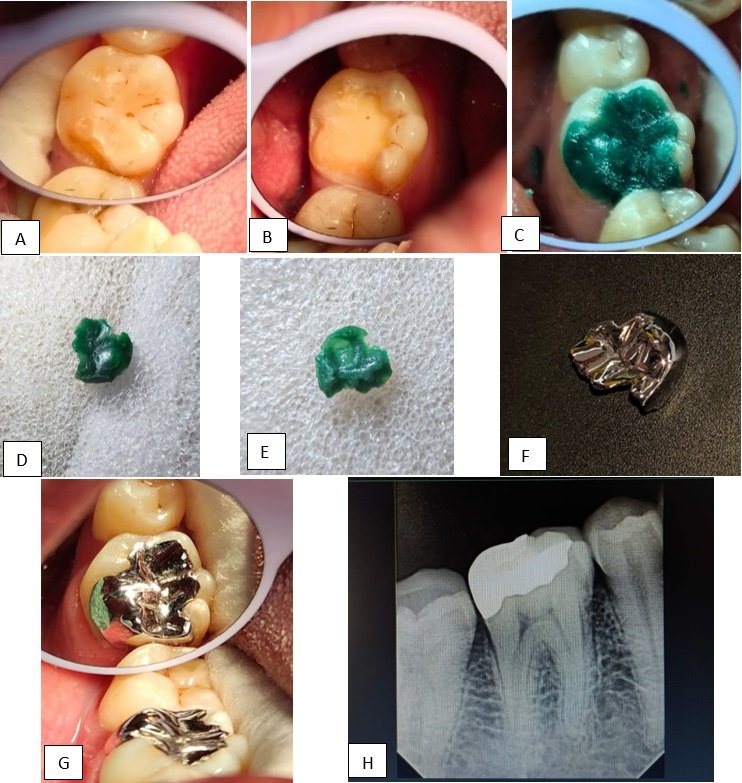
CASE 1- A)Preoperative photograph B)Cavity preparation C)Direct wax pattern recording D,E)Wax pattern F)Inlay Fabricated G)Inlay cementation H)Postoperative radiograph
CLINICAL PROCEDURE
1. Cavity Preparation
- Caries removal and refinement
- Divergent walls
- Rounded internal line angles
- No cusp reduction
2. Direct Wax Pattern Fabrication (Intraoral)
- Tooth isolated and lightly lubricated
- Inlay wax softened and adapted directly into cavity
- Incremental build-up to reproduce occlusal anatomy
- Margins refined using heated instruments
- Pattern carefully removed and inspected
3. Spruing and Casting
- Sprue attached to bulkiest portion
- Investment and burnout
- Casting using appropriate alloy
4. Finishing, Try-in and Cementation
- Marginal fit checked
- Occlusion evaluated
- Final cementation done
Outcome
- Excellent marginal seal
- Accurate proximal contact
- Minimal adjustment required
CASE 2: CONVENTIONAL METAL INLAY IRT 26
Case Description
A maxillary molar with extensive proximal caries required reinforcement. A cast metal inlay using direct wax pattern technique was planned.

CASE 2- A)Preoperative photograph B)Preoperative radiograph C)Cavity preparation D)Direct wax pattern recording E)Wax pattern F)Inlay Fabricated G)Inlay cementation H)Postoperative radiograph
Clinical Procedure
1. Cavity Preparation
- Caries removal and refinement
- Divergent walls
- Rounded internal line angles
- No cusp reduction
2. Direct Wax Pattern Fabrication (Intraoral)
- Tooth isolated and lightly lubricated
- Inlay wax softened and adapted directly into cavity
- Incremental build-up to reproduce occlusal anatomy
- Margins refined using heated instruments
- Pattern carefully removed and inspected
3. Spruing and Casting
- Sprue attached to bulkiest portion
- Investment and burnout
- Casting using appropriate alloy
4. Finishing, Try-in and Cementation
- Marginal fit checked
- Occlusion evaluated
- Final cementation done
Outcome
- Reinforced cuspal structure
- Excellent adaptation due to direct wax technique
- Functional and durable restoration
DISCUSSION
The direct wax pattern technique offers superior marginal accuracy by eliminating intermediate steps such as impression and die fabrication. In both cases, this technique resulted in excellent fit with minimal adjustments.
However, it is technique-sensitive and requires:
- Good moisture control
- Patient cooperation
- Operator skill
In cases requiring cusp capping, direct wax pattern allows precise control over occlusal morphology and cusp coverage, ensuring both strength and function.
CONCLUSION
Direct wax pattern fabrication for cast metal inlays is a highly precise and efficient technique. When executed correctly, it enhances marginal adaptation and reduces laboratory errors. Both conventional inlays and onlays fabricated using this method demonstrate excellent clinical outcomes.
Clinical Significance
- Improves marginal accuracy
- Reduces procedural errors
- Enhances longevity of restoration
- Ideal for well-controlled clinical environments
REFERENCES
- Sturdevant JR. Class II cast metal restorations. In: Sturdevant CM, editor. Sturdevant’s Art and Science of Operative Dentistry. 6th ed. St. Louis: Mosby Elsevier; 2013. p. 682-719.
- Summitt JB, Robbins JW, Hilton TJ, Schwartz RS. Fundamentals of Operative Dentistry: A Contemporary Approach. 4th ed. Chicago: Quintessence Publishing Co; 2013.
- Rosenstiel SF, Land MF, Fujimoto J. Contemporary Fixed Prosthodontics. 5th ed. St Louis: Elsevier; 2016.
- Jidewar NP, Gulve MN, Patil AR. Reviving the art of onlay cast metal restoration. Cureus. 2024;16(6):e62512.
- Hülsmann M. Methods for removing metal obstructions from root canals. Endod Dent Traumatol. 1993;9(6):223-37.
- Small BW. The use of cast gold restorations: scientific basis and clinical technique. Dent Today. 2000;19(12):104-9.
- Santos MJ, Mondelli RF, Navarro MF, Francischone CE, Rubo JH. Clinical evaluation of ceramic inlays and onlays fabricated with two systems: five-year follow-up. Oper Dent. 2013;38(1):3-11.
- McCabe JF, Walls AWG. Applied Dental Materials. 9th ed. Oxford: Blackwell Publishing; 2008.
- Donovan TE, Chee WW. Conservative indirect restorations for posterior teeth. Dent Clin North Am. 2004;48(2):429-44.
- Manhart J, Scheibenbogen-Fuchsbrunner A, Chen HY, Hickel R. A 2-year clinical study of composite and ceramic inlays. Clin Oral Investig. 2000;4(4):192-8.
- Ricketts DN. Advanced Operative Dentistry: A Practical Approach. Edinburgh: Elsevier; 2011.
- Craig RG, Powers JM. Restorative Dental Materials. 12th ed. St Louis: Mosby Elsevier; 2006.
Disclaimer from Guident
The views and opinions expressed in articles published in Guident are solely those of the authors and do not necessarily reflect the views of the editors, the editorial board or the publisher, Ivory India. Guident does not endorse any product, technique or treatment described. Clinical content is intended for qualified dental and medical professionals and is not a substitute for individual clinical judgement. Guident, its editors and the publisher accept no liability for any consequence arising from the use of information published in the journal.
How to cite this article
Dr. Deepti Kushwaha, Dr. Aashi Mittal, Dr. Seema Dixit. Cast Metal Inlays Using Direct Wax Pattern Technique: A Two-Case Clinical Report. Guident. 2026 Aug;19(9). Available from: https://guident.in/articles/endodontics/cast-metal-inlays-using-direct-wax-pattern-technique-a-two-case-clinical-report.html