Aesthetic Rehabilitation of Maxillary Anterior Teeth Using Direct Composite Veneers: A Case Report
Department of Conservative Dentistry and Endodontics, Seema Dental College & Hospital, Rishikesh, U.K, India
ABSTRACT
Background: Aesthetic concerns involving the maxillary anterior teeth can influence an individual's smile and overall dental appearance. Direct composite veneering is a conservative restorative approach that allows correction of tooth shape, contour, and appearance while preserving natural tooth structure. Case presentation: This case report describes the aesthetic rehabilitation of maxillary anterior teeth 11, 21, and 22 using direct composite veneering. The clinical photographs document the preoperative and postoperative appearance of the anterior dentition. The treatment aimed to improve the visual harmony of the treated teeth and achieve a more balanced anterior smile through an adhesive restorative approach. Clinical significance: Direct composite veneers provide a versatile and repairable option for selected anterior aesthetic concerns. Their success depends on appropriate case selection, shade matching, adhesive protocol, anatomical contouring, finishing, and polishing. Conclusion: Direct composite veneering can provide a conservative approach to improving anterior dental aesthetics. Long-term clinical evaluation is necessary to assess colour stability, marginal integrity, surface quality, and restoration longevity. Keywords: Direct composite veneer; anterior aesthetics; resin composite; adhesive dentistry; smile rehabilitation; minimally invasive dentistry.INTRODUCTION
The appearance of the maxillary anterior teeth is an important component of dental aesthetics. Variations in tooth shape, size, contour, colour, and surface characteristics may affect the harmony of the smile. Modern restorative dentistry therefore emphasizes treatment approaches that combine aesthetic improvement with maximum preservation of healthy tooth structure. Direct composite veneering is a conservative treatment option for selected anterior teeth. It allows the clinician to modify tooth morphology and surface appearance through the direct application of resin composite without requiring laboratory fabrication. The technique also offers the advantages of repairability, relatively low cost, and the possibility of completing treatment in a single appointment.1 Unlike conventional full-coverage restorations, direct composite veneers can often be performed with minimal or no tooth preparation, depending on the initial tooth position, existing morphology, restorative requirements, and available space. Contemporary evidence-based recommendations support minimally invasive direct restorative procedures for suitable anterior tooth-shape corrections.2; The clinical performance of composite veneers depends on several factors, including case selection, bonding effectiveness, material handling, occlusal considerations, and the quality of finishing and polishing. Although composite restorations may require maintenance over time, their repairability can be advantageous when compared with more extensive restorative procedures.3,4 This case report presents the aesthetic rehabilitation of teeth 11, 21, and 22 using direct composite veneering, highlighting the clinical relevance of a conservative adhesive approach to anterior smile enhancement.CASE PRESENTATION
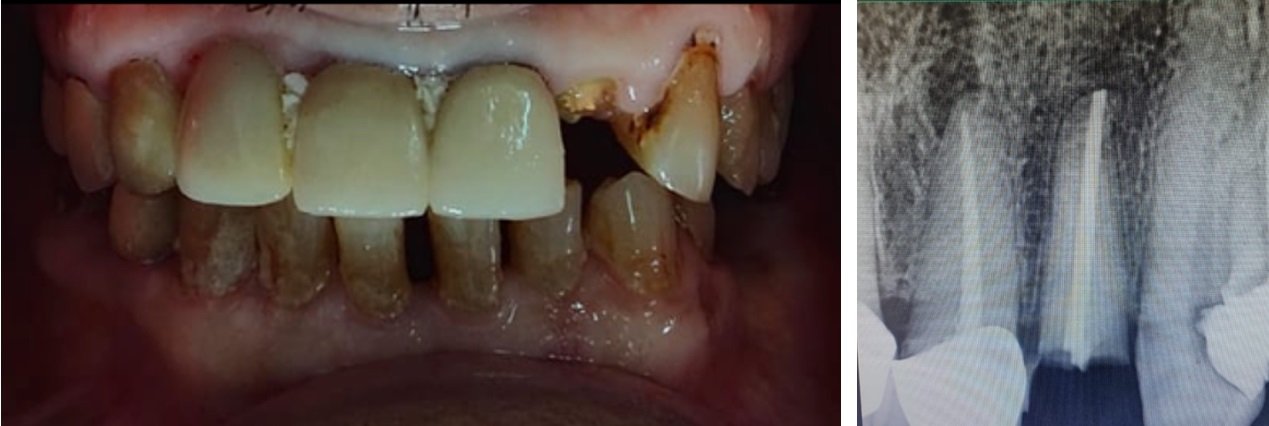
A patient reported concerns regarding the appearance of the maxillary anterior teeth and underwent aesthetic restorative treatment involving teeth 11, 21, and 22. Patient details: Female (40 year) Chief complaint: Patient complained of unaesthetic broken teeth in her upper front tooth region. A clinical examination of the anterior dentition was performed to evaluate tooth morphology, colour, surface characteristics, gingival condition, and the relationship of the maxillary anterior teeth with the opposing dentition. The treatment plan was formulated after assessing the patient's aesthetic expectations and the suitability of direct composite veneering. The selected teeth were 11 (maxillary right central incisor), 21 (maxillary left central incisor), and 22 (maxillary left lateral incisor). The objective was to improve the appearance and visual harmony of the treated teeth while retaining as much natural tooth structure as possible. Clinical photographs
Figure 1. Preoperative intraoral view of the maxillary anterior dentition before direct composite veneering.

Figure 2. Postoperative intraoral view following direct composite veneering of teeth 11, 21, and 22.
CLINICAL PROCEDURE
The treatment was planned to achieve an appropriate balance between tooth proportions, surface contour, colour, and the surrounding dentition. The clinical sequence for the direct composite veneering procedure should be documented according to the steps actually performed:- Preoperative assessment: The anterior teeth and surrounding gingival tissues were examined, and the restorative requirements were determined.
- Shade selection: The shade selection was performed using the VITA shade guide, and shade A2 was selected.
- Isolation: The operative field was isolated using OptraGate 2 to maintain moisture control.
- Tooth preparation: The tooth surfaces were roughened to enhance micromechanical retention before composite veneering.
- Adhesive procedure: Bonding agent (BeautiBond, Shofu Inc., Japan) was applied to the prepared tooth surface to promote adhesion between the tooth structure and the composite resin.
- Composite application: Composite veneering was performed using A2 shade composite resin from Beautifil II Basic kit (Shofu Inc., Japan). The composite resin was applied incrementally and each layer was light-cured according to the manufacturer’s instructions.
- Finishing and polishing: The restorations were finished to refine their anatomical contours, surface texture, and transitions with the natural tooth structure. Polishing was performed to improve surface smoothness and gloss.
- Final assessment: The restorations were assessed for marginal adaptation, appearance, and occlusal interference. Any adjustments and postoperative instructions should be recorded.
DISCUSSION
Direct composite veneering is an established option for selected anterior aesthetic restorations because it permits additive modification of tooth morphology while potentially limiting the removal of healthy dental tissues. The choice between direct composite and indirect ceramic veneers should be based on the clinical indication, tooth condition, aesthetic requirements, occlusal factors, patient expectations, and available resources. Evidence-based clinical guidance favours minimally invasive direct procedures for suitable anterior tooth-shape corrections.5 The direct technique provides the clinician with immediate control over the placement and contouring of the restorative material. Composite can be added incrementally to modify the facial surface and establish appropriate line angles, incisal form, and surface characteristics. A careful approach to anatomical development is essential because even small changes in contour can influence the perceived width, length, and symmetry of the anterior teeth. The direct-indirect technique has also been described as an alternative that combines intraoral composite shaping with extraoral finishing and processing, although that technique should not be confused with the direct procedure used in this case.6 Adhesive bonding is central to the retention and clinical performance of composite restorations. Adequate isolation, appropriate substrate management, correct application of the adhesive system, and compliance with the manufacturer's curing instructions are important considerations. A conservative approach that preserves enamel, whenever clinically appropriate, may be advantageous because enamel provides a favourable substrate for adhesive bonding.7 Clinical evidence indicates that direct composite veneers can provide satisfactory outcomes, although complications such as fracture, colour mismatch, marginal discoloration, and surface deterioration may occur. A systematic review of anterior composite restorations identified fracture and aesthetic changes among the important reasons for restoration failure. These findings emphasize the importance of appropriate case selection, careful execution, and periodic maintenance.8 The clinical performance of direct composite veneers may also vary according to tooth vitality, the extent of restoration, material selection, and operator-related factors. A retrospective clinical evaluation reported satisfactory overall performance but found a higher risk of failure for veneers placed on non-vital teeth than for those placed on vital teeth. This reinforces the need to consider the biological and restorative condition of each tooth before treatment.9 In the present case, the treatment of teeth 11, 21, and 22 illustrates the use of direct composite veneering to address anterior aesthetic concerns through an adhesive restorative approach. However, the available photographs alone cannot establish long-term success, patient satisfaction, or the absence of complications. These outcomes require clinical examination and follow-up documentation. A recent case report describing composite-based anterior aesthetic rehabilitation similarly demonstrates the role of conservative adhesive treatment in managing concerns involving the shape and appearance of anterior teeth. Such reports support the clinical relevance of this approach while also highlighting the importance of individualised treatment planning.10 The principal limitation of the present report is the lack of documented patient demographics, detailed clinical findings, restorative materials, procedural parameters, and follow-up duration in the information currently available. These details should be completed from the original clinical record before submission. A longer follow-up would strengthen the report by providing information on restoration maintenance, colour stability, and clinical performance.CONCLUSION
Direct composite veneering is a conservative and versatile restorative option for selected aesthetic concerns involving the maxillary anterior teeth. Treatment of teeth 11, 21, and 22 demonstrates the clinical application of an adhesive approach intended to improve anterior dental appearance while preserving natural tooth structure where possible. Appropriate case selection, moisture control, adhesive technique, anatomical contouring, finishing, and polishing are important to the quality of the final restoration. Long-term follow-up is required before conclusions regarding durability and clinical success can be drawn.Clinical significance
Direct composite veneers may offer an accessible, repairable, and minimally invasive alternative for selected anterior aesthetic restorations. Careful treatment planning and maintenance are essential to achieving and preserving satisfactory results.REFERENCES
- Irmaleny I, Hidayat OT, Handayani RAP. Componeer as an aesthetic treatment option for anterior teeth: a case report. BMC Oral Health. 2024;24(1):367. doi:10.1186/s12903-024-04081-4.
- Schwendicke F, et al. Direct composite restorations on permanent teeth in the anterior and posterior region – an evidence-based clinical practice guideline – Part 1: indications for composite restorations. J Adhes Dent. 2024;26:b5748881. doi:10.3290/j.jad.b5748881.
- Burke FJT. Longevity of indirect and direct restorations in anterior teeth. Prim Dent J. 2023;12(2):76-84. doi:10.1177/20501684231175591.
- Fahl N Jr, Ritter AV. Composite veneers: the direct-indirect technique revisited. J Esthet Restor Dent. 2021;33(1):7-19. doi:10.1111/jerd.12696.
- Schwendicke F, et al. Direct composite restorations on permanent teeth in the anterior and posterior region – an evidence-based clinical practice guideline – Part 1: indications for composite restorations. J Adhes Dent. 2024;26:b5748881. doi:10.3290/j.jad.2024.5748881.
- Fahl N Jr, Ritter AV. Composite veneers: the direct-indirect technique revisited. J Esthet Restor Dent. 2021;33(1):7-19. doi:10.1111/jerd.12696.
- Peumans M, Van Meerbeek B, Lambrechts P, Vanherle G. Porcelain veneers: a review of the literature. J Dent. 2000;28(3):163-177. doi:10.1016/S0300-5712(99)00066-4.
- Demarco FF, Collares K, Coelho-de-Souza FH, Correa MB, Cenci MS, Moraes RR, et al. Anterior composite restorations: a systematic review on long-term survival and reasons for failure. Dent Mater. 2015;31(10):1214-1224. doi:10.1016/j.dental.2015.07.005.
- Coelho-de-Souza FH, et al. Direct anterior composite veneers in vital and non-vital teeth: a retrospective clinical evaluation. J Dent. 2015;43(11):1330-1336. doi:10.1016/j.jdent.2015.08.011.
- Irmaleny I, Hidayat OT, Handayani RAP. Componeer as an aesthetic treatment option for anterior teeth: a case report. BMC Oral Health. 2024;24(1):367. doi:10.1186/s12903-024-04081-4.
Disclaimer from Guident
The views and opinions expressed in articles published in Guident are solely those of the authors and do not necessarily reflect the views of the editors, the editorial board or the publisher, Ivory India. Guident does not endorse any product, technique or treatment described. Clinical content is intended for qualified dental and medical professionals and is not a substitute for individual clinical judgement. Guident, its editors and the publisher accept no liability for any consequence arising from the use of information published in the journal.
How to cite this article
Dr. Soumya Garg, Dr. Shagun Bohra, Dr. Seema Dixit. Aesthetic Rehabilitation of Maxillary Anterior Teeth Using Direct Composite Veneers: A Case Report. Guident. 2026 Nov;19(12). Available from: https://guident.in/articles/endodontics/aesthetic-rehabilitation-of-maxillary-anterior-teeth-using-direct-composite-veneers-a-case-report.html