Beyond Alignment: An Integrated Approach to Orthodontic Correction and Implant-Supported Rehabilitation: A Case Report
Wisdom Dental Clinics ®, Jaipur, India
ABSTRACT
The combined use of orthodontic clear aligner therapy and dental implants offers an interdisciplinary approach to comprehensive dental rehabilitation. This case report describes a 26-year-old male patient treated using Invisalign clear aligners and dental implant placement. Invisalign therapy facilitates controlled tooth movement to improve alignment and establish appropriate restorative space, while dental implants provide support for prosthetic replacement of missing teeth. This case highlights the importance of individualized treatment planning, appropriate sequencing of orthodontic and implant procedures, and clinical and radiographic follow-up in achieving functional and aesthetic rehabilitation.
Keywords: Dental implants, clear aligner therapy, interdisciplinary dental rehabilitation.
INTRODUCTION
The management of patients requiring orthodontic correction and replacement of missing teeth presents a clinical challenge that often necessitates an interdisciplinary approach involving orthodontics, implant dentistry, and prosthodontics. Appropriate tooth alignment and restorative space are essential for achieving functional occlusion and satisfactory aesthetic outcomes. Dental implants provide a treatment option for replacing missing teeth; however, their long-term performance depends on appropriate patient selection, implant positioning, prosthetic planning, and maintenance.1,2
Invisalign is a clear aligner system that uses a sequence of custom-made thermoplastic appliances to achieve planned orthodontic tooth movements. Its removable design offers aesthetic advantages and facilitates oral hygiene during treatment. Evidence suggests that clear aligner therapy can be effective for selected malocclusions, particularly mild-to-moderate cases that do not require extractions. However, treatment predictability varies according to the complexity and type of tooth movement required, emphasizing the importance of appropriate diagnosis and treatment planning.3,4
The combination of Invisalign therapy and dental implant placement requires careful coordination because osseointegrated implants cannot be moved through conventional orthodontic forces in the same manner as natural teeth. Therefore, the timing of implant placement must be considered in relation to the planned tooth positions, available restorative space, root angulation, and final prosthetic requirements. In cases requiring orthodontic movement near a proposed implant site, establishing the appropriate tooth positions before definitive implant placement may help facilitate restorative planning.2,5
Radiographic evaluation is an important component of interdisciplinary treatment planning. Orthopantomography provides an overview of the dentition, jaw structures, and implant-related findings, while additional clinical assessments and appropriate imaging may be required to evaluate the implant site and surrounding bone. A comprehensive approach that integrates orthodontic planning, implant positioning, and restorative requirements can help address the functional and aesthetic needs of the patient.5
The present case report describes the interdisciplinary dental rehabilitation of a 26-year-old male patient involving Invisalign clear aligner therapy and dental implant placement. The case emphasizes the importance of coordinated treatment planning, appropriate sequencing of orthodontic and implant procedures, and radiographic assessment in comprehensive dental rehabilitation.
CASE REPORT
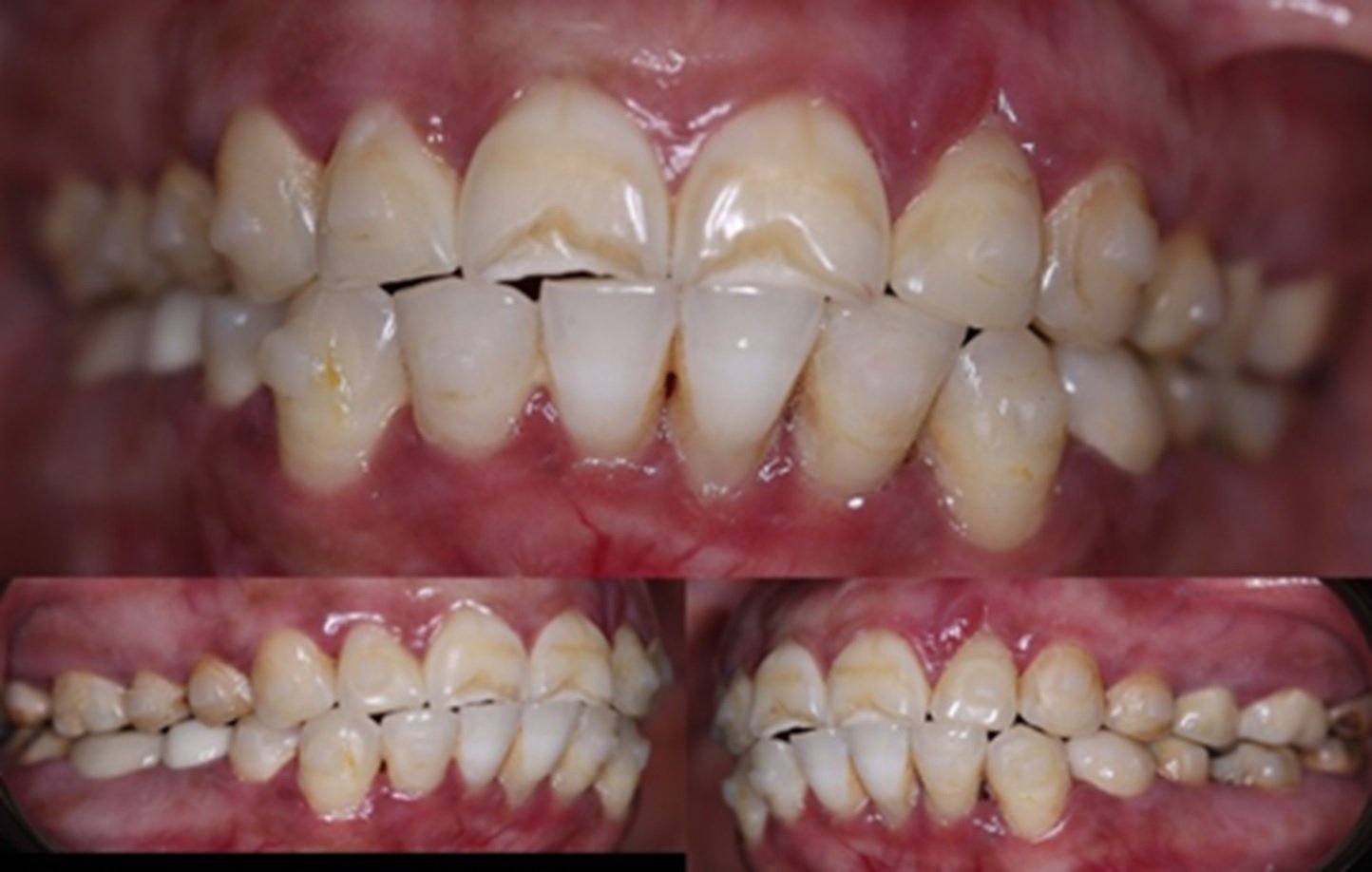
A 26-year-old male patient presented to the dental clinic for comprehensive dental rehabilitation involving replacement of missing maxillary anterior teeth and correction of dental alignment. The patient’s dental history revealed that teeth 21 and 23 had been extracted approximately two years earlier because patient had h/O of road side accident in which many upper & lower teeth got fractured & had to be taken out. His medical history was unremarkable, with no reported systemic diseases or known drug or food allergies.
A comprehensive clinical examination was performed to evaluate the remaining dentition, dental arch alignment, occlusal relationships, and restorative requirements. Intraoral photographs, digital intraoral scans, and an orthopantomogram (OPG) were obtained and evaluated for treatment planning. Particular attention was given to the edentulous regions corresponding to teeth 21 and 23, the available space for implant-supported restorations, and the alignment of the remaining teeth.[Figure 1]
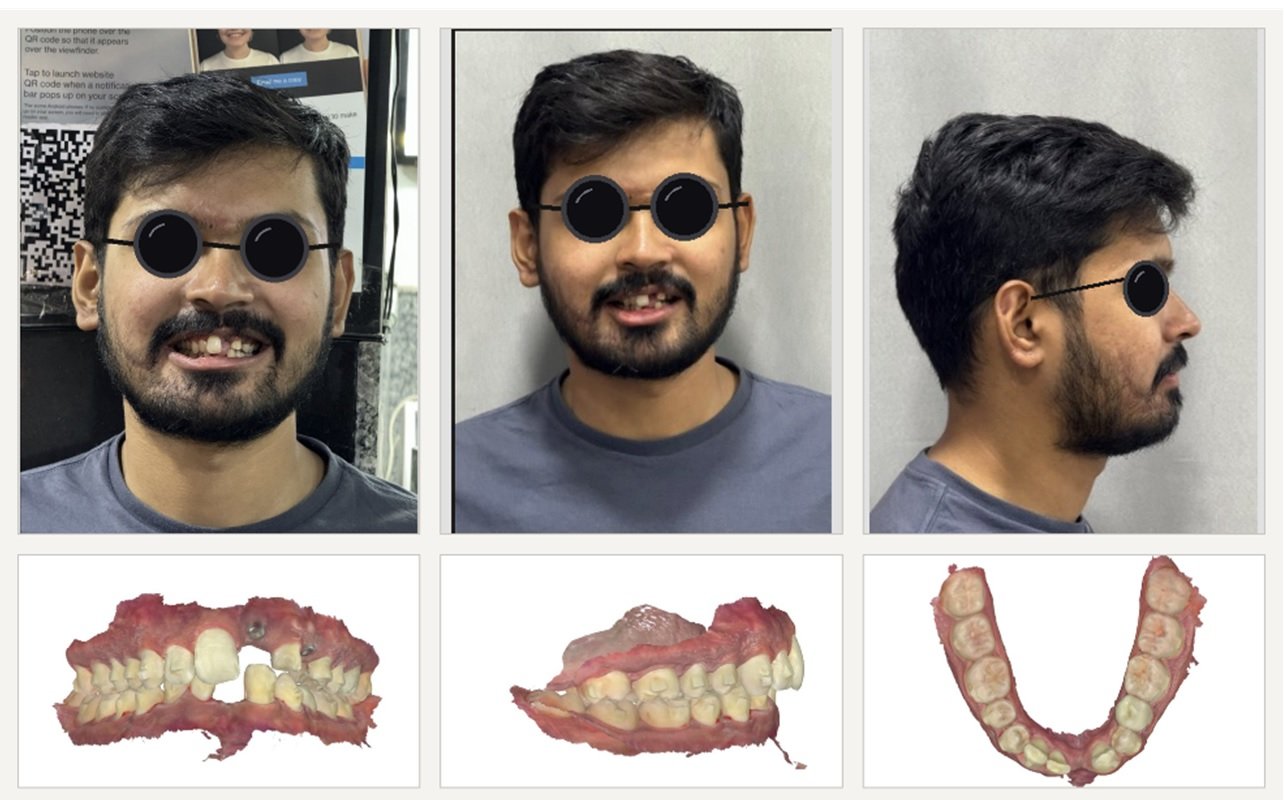
Figure 1: Pre-operative photograph
Following clinical and radiographic assessment, a multidisciplinary treatment plan was formulated involving implant placement at sites 21 and 23, followed by orthodontic treatment using Invisalign clear aligners. Implant placement was performed at the respective edentulous sites before initiation of orthodontic therapy. [Figure 2]

Figure 2: After implant placement OPG
After implant placement and the appropriate healing phase, Invisalign clear aligner therapy was initiated to address the patient's orthodontic requirements. The initial series consisted of 33 aligners, which were delivered following digital treatment planning. The patient was monitored throughout treatment to evaluate aligner fit, tooth movement, oral hygiene, and progress toward the planned orthodontic objectives.
Following completion of the initial aligner series, a refinement scan was obtained to assess the achieved tooth positions and identify any residual orthodontic discrepancies. Based on the digital refinement assessment, an additional series of 24 refinement aligners was provided to further improve dental alignment and occlusal relationships. Clinical photographs and digital intraoral scans were used to document the treatment progression.
Upon completion of Invisalign therapy, the implant-supported restorations corresponding to teeth 21 and 23 were placed to rehabilitate the missing teeth and restore dental function and aesthetics. The final restorative phase was undertaken after orthodontic treatment to coordinate the prosthetic restorations with the achieved tooth positions and available restorative space.[Figure 3]

Figure 3: Post treatment 3D scan
The final clinical assessment included evaluation of dental alignment, occlusal relationships, the appearance and function of the implant-supported restorations, and the overall integration of the orthodontic and restorative phases.
DISCUSSION
The integration of orthodontic treatment and dental implant placement requires an interdisciplinary approach to achieve appropriate tooth alignment, restorative space, and functional occlusion. Successful rehabilitation depends on coordinated treatment planning that considers the patient's dental condition and the final prosthetic requirements.
Invisalign clear aligner therapy is an established option for selected orthodontic conditions. Its removable design offers aesthetic advantages and facilitates oral hygiene compared with conventional fixed appliances. However, treatment predictability depends on malocclusion complexity, the type of tooth movement required, treatment planning, and patient compliance. Papadimitriou et al. reported that Invisalign can be effective in selected cases, while Rossini et al. highlighted limitations in the predictability of certain orthodontic movements.1,2 These findings emphasize the importance of appropriate case selection and regular monitoring, particularly when orthodontic treatment is combined with implant rehabilitation.
A major consideration in combined treatment is the biological difference between natural teeth and osseointegrated implants. Natural teeth respond to orthodontic forces through periodontal ligament-mediated bone remodelling, whereas integrated implants remain fixed within the surrounding bone. Consequently, implant placement must be coordinated with the planned tooth positions and restorative space. When orthodontic movement is required near a proposed implant site, establishing appropriate alignment and root positioning before definitive implant placement may facilitate prosthetic rehabilitation.3,4
Implant positioning should be guided by the intended restoration, available bone, adjacent anatomical structures, and soft-tissue conditions. Appropriate three-dimensional positioning helps support favourable restorative contours, occlusal relationships, and access for oral hygiene. Coordination among the orthodontist, implant surgeon, and restorative dentist is therefore essential throughout treatment planning.4
Radiographic assessment contributes to the evaluation and documentation of dental rehabilitation. Orthopantomography provides an overview of the dentition and implant location but has limitations in assessing three-dimensional bone anatomy and cannot independently confirm implant stability or osseointegration. Clinical examination and additional imaging, when indicated, are necessary for a comprehensive assessment.4,5 The clinical significance of this case lies in the importance of coordinating clear aligner therapy with implant-supported rehabilitation.
CONCLUSION
The present case highlights the importance of interdisciplinary treatment planning when combining Invisalign clear aligner therapy with dental implant rehabilitation. Careful coordination of orthodontic tooth movement, implant positioning, and prosthetic requirements is essential for achieving functional and aesthetic outcomes. Radiographic assessment, clinical evaluation, and regular follow-up should be integrated throughout treatment.
REFERENCES
- Papadimitriou A, Mousoulea S, Gkantidis N, Kloukos D. Clinical effectiveness of Invisalign orthodontic treatment: a systematic review. *Prog Orthod*. 2018;19(1):37. doi:10.1186/s40510-018-0235-z.
- Rossini G, Parrini S, Castroflorio T, Deregibus A, Debernardi CL. Efficacy of clear aligners in controlling orthodontic tooth movement: a systematic review. *Angle Orthod*. 2015;85(5):881-889. doi:10.2319/061614-436.1.
- Thilander B, Odman J, Lekholm U. Orthodontic aspects of the use of oral implants in adolescents: a 10-year follow-up study. *Eur J Orthod*. 2001;23(6):715-731.
- Buser D, Sennerby L, De Bruyn H. Modern implant dentistry based on osseointegration: 50 years of progress, current trends and open questions. *Periodontol 2000*. 2017;73(1):7-21.
- Morton D, Gallucci G, Lin WS, Pjetursson B, Polido W, Roehling S, et al. Group 2 ITI consensus report: prosthodontics and implant dentistry. *Clin Oral Implants Res*. 2018;29(Suppl 16):215-223.
Disclaimer from Guident
The views and opinions expressed in articles published in Guident are solely those of the authors and do not necessarily reflect the views of the editors, the editorial board or the publisher, Ivory India. Guident does not endorse any product, technique or treatment described. Clinical content is intended for qualified dental and medical professionals and is not a substitute for individual clinical judgement. Guident, its editors and the publisher accept no liability for any consequence arising from the use of information published in the journal.
How to cite this article
Dr. Gaurav Gupta, Dr. D.K. Gupta, Dr. Anirudh Agarwal. Beyond Alignment: An Integrated Approach to Orthodontic Correction and Implant-Supported Rehabilitation: A Case Report. Guident. 2026 Nov;19(12). Available from: https://guident.in/articles/orthodontics/beyond-alignment-an-integrated-approach-to-orthodontic-correction-and-implant-supported-rehabilitation-a-case.html