Evaluation of Prosthodontic Treatment Needs, Challenges, and Quality of Life Among Geriatric Patients: A Questionnaire-Based Study
Department of Prosthodontics, Government Dental College & Hospital, Chhatrapati Sambhajinagar
ABSTRACT
Background:
As the global geriatric population increases, oral health becomes a critical component of general well-being. Prosthodontic rehabilitation plays a vital role in improving functionality and quality of life among the elderly. This study evaluates prosthodontic treatment needs, associated challenges, and the impact on oral health-related quality of life (OHRQoL) among geriatric patients.
Objectives:
To assess treatment needs, barriers to prosthodontic care, and the influence of dental prostheses on the quality of life in elderly individuals.
Materials and Methods:
A cross-sectional questionnaire-based study was conducted among 100 geriatric patients aged 60 years and above. Data was collected on demographic profile, general and oral health status, dental history, prosthodontic challenges, and quality of life parameters. Statistical analysis was done using chi-square tests, with P-values <0.05 considered significant.
Results:
The study population consisted of 61% males and 39% females, majority aged 60–65 years. Significant associations were found between OHRQoL and factors such as education level (P=0.041), residential status (P=0.003), chronic illness (P=0.011), and physical limitations in oral hygiene (P=0.001). While 59% used a dental prosthesis, satisfaction was high (P<0.001). Chewing difficulties (P<0.001), discomfort (P=0.024), speech issues (P=0.045), and retention problems (P<0.001) were common. Despite challenges, 70% reported improved ability to eat, and 88% were willing to recommend treatment to others.
Conclusion:
Geriatric patients experience multiple prosthodontic challenges, yet with proper care and education, their quality of life can significantly improve. Focused interventions addressing accessibility, prosthesis comfort, and health education are crucial.
Keywords: OHRQoL, Prosthodontic Treatment, Geriatric patients
INTRODUCTION
The global rise in the aging population has intensified the need to address geriatric health, including oral care. Oral health significantly contributes to nutrition, self-esteem, and overall quality of life. Tooth loss, a common occurrence in old age, often leads to masticatory inefficiency, speech problems, and social withdrawal. Prosthodontic rehabilitation through dentures and implants can mitigate these issues.1 However, the elderly often face barriers in accessing and adapting to prosthodontic care.2
This study assesses the prosthodontic treatment needs and challenges faced by geriatric patients and evaluates how prosthetic rehabilitation influences their oral health-related quality of life (OHRQoL).
MATERIALS AND METHODS
Study Design and Population
A descriptive, cross-sectional study was conducted among 100 geriatric patients aged 60 years and above, attending a dental OPD.
Data Collection Tool
A structured questionnaire was designed to collect data on:
- Demographics (age, gender, education, residence)
- General and oral health status (chronic illness, physical limitations)
- Dental history (edentulism, prosthesis use)
- Prosthodontic challenges (chewing, speech, retention)
- OHRQoL (confidence, satisfaction, self-esteem)
Statistical Analysis
Data were analyzed using SPSS. Chi-square test was used, with P < 0.05 considered statistically significant.
RESULT TABLES
Table 1. Demographic Information
Variable: Age Group (in years)
60–65: 46 (46%)
66–70: 25 (25%)
70–75: 10 (10%)
>76: 19 (19%)
P-value: 0.213 (NS)
Gender
Female: 39 (39%)
Male: 61 (61%)
P-value: 0.092 (NS)
Education level
Illiterate: 7 (7%)
Primary: 55 (55%)
Secondary: 26 (26%)
Graduate: 6 (6%)
Postgraduate: 6 (6%)
P-value: 0.041* (S)
Residential Status
Urban: 18 (18%)
Rural: 82 (82%)
P-value: 0.003* (S)
Table 2. General Health Status
Any chronic illness
Yes: 20 (20%)
No: 80 (80%)
P-value: 0.011* (S)
Any physical limitation
Yes: 15 (15%)
No: 85 (85%)
P-value: 0.001* (S)
Ability to maintain oral hygiene
Yes: 15 (15%)
No: 85 (85%)
Table 3. Dental History and Habits
Duration toothless
0–5 years: 50 (50%)
6–10 years: 38 (38%)
>10 years: 12 (12%)
P-value: 0.412 (NS)
Regular visit to dentist
Yes: 38 (38%)
No: 62 (62%)
P-value: 0.065 (NS)
Use of dental prosthesis
Yes: 59 (59%)
No: 41 (41%)
P-value: 0.874 (NS)
Table 4. Prosthodontic Needs and Challenges
Frequency of chewing difficulty
Never: 9 (9%)
Sometimes: 21 (21%)
Often: 40 (40%)
Always: 30 (30%)
P-value: <0.001 (S)
Any discomfort/pain with denture
Yes: 27 (27%)
No: 73 (73%)
P-value: 0.024* (S)
Any speech difficulties
Yes: 32 (32%)
No: 68 (68%)
P-value: 0.045* (S)
Table 5. Impact on Quality of Life (Oral Health-Related QoL)
Prosthesis improved ability to eat?
Yes: 70 (70%)
No: 30 (30%)
P-value: 0.045* (S)
Feel embarrassed when socializing?
Never: 32 (32%)
Often: 40 (40%)
Always: 14 (14%)
P-value: 0.314 (NS)
Satisfied with prosthodontic treatment?
Very satisfied: 30 (30%)
Satisfied: 60 (64%)
Neutral: 6 (6%)
P-value: <0.05** (HS)
Table 6. Satisfaction with Treatment
Comfort of prosthesis during daily use
Yes: 70 (70%)
No: 30 (30%)
P-value: 0.046* (S)
Quality of life after prosthodontic care
Excellent: 24 (24%)
Good: 62 (62%)
Fair: 14 (14%)
P-value: 0.038* (S)
Recommend prosthodontic treatment?
Yes: 88 (88%)
No: 12 (12%)
P-value: <0.001** (HS)
RESULTS
Out of 100 geriatric participants, 46% were aged 60–65 years, followed by 25% in the 66–70 group. Males comprised 61%, females 39%. Significant associations were found between education level (P=0.041) and residential status (P=0.003) with OHRQoL.
Chronic illness (20%) and physical limitations (15%) significantly impacted OHRQoL (P=0.011, P=0.001 respectively)
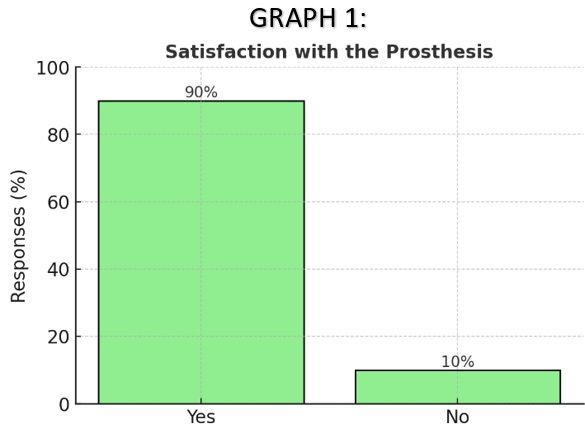
Although 59% used a prosthesis, its use alone was not significantly related to QoL (P=0.874). However, 90% reported satisfaction, which was highly significant (P<0.001) (Graph 1).
30% reported always and 40% often faced mastication issues (P<0.001). Pain/discomfort (27%), speech difficulties (32%) were statistically significant (P=0.024, P=0.045), as were retention problems (14%, P<0.001) 70% felt improved eating ability (P=0.045) (Graph 2), 62% rated their QoL post-treatment as excellent, and 88% would recommend prosthodontic care.

Regarding satisfaction with current prosthodontic treatment, 30 participants (30%) reported being very satisfied, 60 participants (60%) were satisfied, 6 participants (6%) expressed a neutral response, and 4 participants (4%) were dissatisfied. No participant reported being very dissatisfied. The findings indicate a predominance of positive satisfaction levels among the study population. (Graph 3)

DISCUSSION
The findings of this study reveal the multifactorial influence of prosthodontic status on oral health-related quality of life (OHRQoL) among the geriatric population. Notably, educational level and rural residential status were significantly associated with poorer OHRQoL outcomes.7 This can be attributed to limited oral health literacy, reduced exposure to health promotion activities, and inadequate access to specialized dental care in rural settings. These factors not only affect the awareness of treatment options but also influence the ability and willingness of elderly individuals to seek timely prosthodontic care.
The presence of chronic systemic illnesses such as diabetes and hypertension—conditions commonly prevalent among older adults—was found to significantly impact the maintenance of oral hygiene.8 These comorbidities can cause physical limitations, reducing manual dexterity and compliance with prosthesis hygiene instructions, thereby indirectly lowering overall prosthetic success. This underscores the bidirectional relationship between systemic health and oral health, which is particularly critical in geriatric care.
Interestingly, this study observed that prosthesis use alone did not show a direct correlation with improved quality of life. However, subjective satisfaction with the prosthesis was strongly linked to positive OHRQoL outcomes.9 This highlights the importance of individual perception, comfort, and functional acceptability over the mere presence of a prosthetic appliance. Elderly patients may continue to experience dissatisfaction if the prosthesis is ill-fitting, unstable, or poorly adapted to their expectations, regardless of its clinical adequacy.
A significant number of participants reported chewing difficulties, speech problems, and retention issues, which substantially affect their functional performance and social interactions.10 These complications may lead to avoidance of nutritious foods, decreased confidence in public speaking, and withdrawal from social settings—factors that contribute to psychological distress and diminished self-worth.12 Therefore, it is essential to emphasize customized prosthesis design, frequent follow-up appointments, and timely adjustments to enhance long-term functionality and acceptance.
Despite the presence of various prosthodontic challenges, the study found a strong positive perception of dietary improvement, increased self-esteem, and a high rate of willingness to recommend prosthodontic treatment to peers.11 This optimistic outlook reflects the intrinsic value that elderly patients place on regaining masticatory ability and aesthetic normalcy.18 It also indicates that, with appropriate guidance and well-executed care, geriatric individuals are capable of adapting to prosthodontic interventions and achieving a meaningful enhancement in their daily lives.16,17
Moreover, while logistical and financial barriers exist, they did not appear to be insurmountable for the studied population19 This could be attributed to increasing awareness, subsidized treatment in government institutions, and supportive family systems in India. Nevertheless, these factors need continuous policy attention, especially in underserved regions, to ensure equitable access to oral rehabilitation services for all elderly individuals.
In light of these findings, prosthodontic treatment planning for the geriatric population should adopt a holistic and patient-centered approach. Clinicians must consider not only the clinical parameters but also the psychological readiness, expectations, systemic limitations, and social context of the patient.20 Future efforts should focus on interdisciplinary collaboration, oral health education, and community outreach programs to empower elderly individuals and bridge the gap between need and utilization of prosthodontic services.
CONCLUSION
Prosthodontic rehabilitation has a substantial impact on OHRQoL in the elderly, particularly in mastication and psychological well-being. Factors like education, health, and residence influence outcomes. Strategies should address not just prosthesis provision but also patient education and accessibility to enhance satisfaction and function.
REFERENCES
- Petersen PE, Yamamoto T. Community Dent Oral Epidemiol. 2005;33(2):81–92.
- Locker D. Community Dent Health. 1992;9(2):109–24.
- Awad MA, et al. Int J Prosthodont. 2003;16(5):390–6.
- Heydecke G, et al. J Dent Res. 2004;83(11):722–6.
- Slade GD, Spencer AJ. Community Dent Health. 1994;11(1):3–11.
- Douglass CW, et al. J Prosthet Dent. 2002;87(1):5–8.
- Inglehart MR, Bagramian RA. Oral Health-Related Quality of Life. Chicago: Quintessence; 2002.
- Kharat DU, et al. J Indian Prosthodont Soc. 2016;16(1):45–9.
- Ellis JS, Thomson WM. Gerodontology. 2007;24(2):93–9.
- Felton DA. J Prosthodont. 2009;18(2):88–96.
- Müller F, et al. Clin Oral Implants Res. 2007;18 Suppl 3:2–14.
- Kuo HC, Kuo YS, Lee IC, Wang JC, Yang YH. The association of responsiveness in oral health-related quality of life to dental prosthesis treatment. BMC Oral Health. 2013 Dec 13;13:48.
- Komagamine Y, Kanazawa M, Kaiba Y, Sato Y, Minakuchi S. Association between perceived chewing ability and oral health-related quality of life in partially dentate patients. Health Qual Life Outcomes. 2017 Mar 6;15(1):62.
- MacEntee MI, Wyatt CCL, Beattie BL, Paterson B, Levy-Milne R, McCandless L, et al. Provision of mouth-care in long-term care facilities: an educational trial. Community Dent Oral Epidemiol. 2007 Aug;35(4):25–34.
- Jain M, Mathur A, Kumar S, Dagli RJ, Bhansali S, Duraiswamy P. Denture wearers’ satisfaction with denture quality and its correlation with oral health related quality of life. J Oral Rehabil. 2009 Jul;36(7):520–4.
- Abdul Razzak N, Bhat S. Oral Health-Related Quality of Life Among Elderly Patients Wearing Dentures in Mangalore, India. J Indian Prosthodont Soc. 2015 Oct-Dec;15(4):282–7.
- Naik AV, Pai RC. Study of factors affecting the satisfaction with complete dentures in patients treated at a teaching hospital in India. J Dent Res Dent Clin Dent Prospects. 2011 Summer;5(3):102–5.
- Douglass CW, Watson AJ. Future needs for fixed and removable partial dentures in the United States. J Prosthet Dent. 2002 Jan;87(1):9–14.
- Shigli K, Hebbal M, Angadi GS. Attitudes of prosthodontic postgraduate students toward complete denture procedures, teaching, and evaluation methods in dental colleges of India. J Dent Educ. 2007 May;71(5):692–6.
- Dable RA, Nazirkar GS, Singh SB, Wasnik PB. Assessment of oral health related quality of life in complete denture wearers. Indian J Dent Res. 2011 Nov-Dec;22(6):722–9.
QUESTIONNAIRE
1. Demographic Information:
- Age: (60-65, 66-70, 71-75, >76)
- Gender: (Male/Female/Other)
- Educational level: (Illiterate/Primary/Secondary/Graduate/Postgraduate)
- Residential Status: (Urban/Rural)
2. General Health Status:
- Do you suffer from any chronic diseases (e.g., diabetes, hypertension)? (Yes/No)
- If yes, what medication you take for that? -------------
- Have you experienced any recent physical limitations that affect your ability to maintain oral hygiene? (Yes/No)
3. Dental History and Habits:
- How long have you been edentulous (if applicable)?
- Years, 6-10 years)
- Years, >10 years)
- Do you visit a dentist regularly? (Yes/No)
- Do you use any form of prosthesis (complete dentures, partial dentures, or fixed prosthesis)? (Yes/No)
- How often do you clean your prosthesis? (Once a day/Twice a day/Occasionally/Never)
- Are you satisfied with the appearance of your teeth/prosthesis? (Yes/No)
4. Prosthodontic Needs and Challenges:
- Do you experience any difficulty in chewing food with your prosthesis? (Never/Sometimes/Often/Always)
- Are you facing any discomfort or pain while wearing dentures or other prostheses? (Yes/No)
- Have you experienced any speech difficulties due to your prosthesis?(Yes/No)
- Do you find it difficult to retain your dentures while eating or speaking? (Yes/No)
- Are you interested in exploring fixed prosthodontic options (e.g., implants)? (Yes/No)
5. Impact on Quality of Life (Oral Health-Related QoL):
- Do you feel that your prosthesis has improved your ability to eat a variety of foods? (Yes/No)
- Does your current oral condition affect your confidence when socializing? (Never/Sometimes/Often/Always)
- How satisfied are you with your current prosthodontic treatment? (Very satisfied/Satisfied/Neutral/Dissatisfied/Very dissatisfied)
- Does oral health impact your overall well-being and self-esteem? (Yes/No)
- How much does discomfort from oral health problems affect your daily life? (Not at all/Slightly/Moderately/Severely)
6. Satisfaction with Treatment:
- Are you satisfied with the comfort of your prosthesis during daily use? (Yes/No)
- Have you faced any difficulties in accessing prosthodontic care due to financial or transportation issues? (Yes/No)
- How would you rate the improvement in your quality of life after receiving prosthodontic care? (Excellent/Good/Fair/Poor)
- Would you recommend your prosthodontic treatment to others?(Yes/No)
Disclaimer from Guident
The views and opinions expressed in articles published in Guident are solely those of the authors and do not necessarily reflect the views of the editors, the editorial board or the publisher, Ivory India. Guident does not endorse any product, technique or treatment described. Clinical content is intended for qualified dental and medical professionals and is not a substitute for individual clinical judgement. Guident, its editors and the publisher accept no liability for any consequence arising from the use of information published in the journal.
How to cite this article
Dr. Kishor Mahale, Dr. Akanksha U. Mukwane, Dr. Smita Khalikar. Evaluation of Prosthodontic Treatment Needs, Challenges, and Quality of Life Among Geriatric Patients: A Questionnaire-Based Study. Guident. 2025 Sep;18(10). Available from: https://guident.in/articles/research/evaluation-of-prosthodontic-treatment-needs-challenges-and-quality-of-life-among-geriatric-patients-a.html