Non-Syndromic Oligodontia Associated with Ankyloglossia in a 13- Year Old- Boy: A Rare Case Report
epartment of Pediatric and Preventive Dentistry, Government Dental College and Research Institute, Bangalore Karnataka, India
ABSTRACT
Oligodontia is an uncommon genetic condition characterised by congenital absence of six or more permanent teeth excluding third molars. In most cases, it is a component of a syndrome and seldom manifests itself alone. Ankyloglossia, is a congenital condition marked by an unusually short lingual frenulum. Speech, swallowing, and mastication are all hampered by these developmental disturbances. Here by reporting a case of 13-year-old boy presenting with oligodontia and ankyloglossia without any associated syndromes. The patient was managed by performing laser frenectomy followed by Removable partial denture. This case report highlights the importance of multidisciplinary approach in diagnosing and managing the non-syndromic oligodontia in a child patient.
Keywords:
Ankyloglossia, Frenectomy, Non-syndromic oligodontia, Removable partial denture
INTRODUCTION
Agenesis of the teeth is the most prevalent developmental defect in humans and frequently causes significant clinical problems. Congenitally missing six or more teeth, excluding the third molars, is known as oligodontia.1 According to reports, 0.14–0.3% of the general population has oligodontia.1,2 Oligodontia can be a component of a syndrome known as syndromic oligodontia, even though it may manifests as an isolated characteristic known as non-syndromic oligodontia. The condition of oligodontia shouldn't be ignored because it can lead to a number of problems, such as aberrant occlusion, altered facial features that can lead to psychological effects, and trouble speech and mastication. Ankyloglossia is a congenital malformation of the lingual frenum that restricts the movement of the tongue. The prevalence of ankyloglossia reported in the literature varies from 0.1% to 10.7%.3 The degree of ankyloglossia varies from the mildest, where only a band of mucous membrane is fused to the frenulum and the underlying fibres of the genioglossus muscle, to the more severe, where the tongue is fused to the floor of the mouth (complete ankyloglossia). These patients frequently complain of speech and feeding issues, mandibular and orthodontic irregularities, and psychosocial issues.4 This case report gives insight into non-syndromic oligodontia assossiated with ankyloglossia. It aims to familiarize paediatric dentists on the value of early comprehensive diagnosis and interdisciplinary management along with follow-up.
CASE REPORT
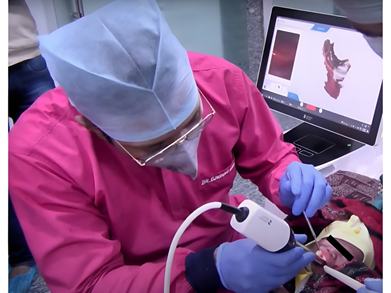
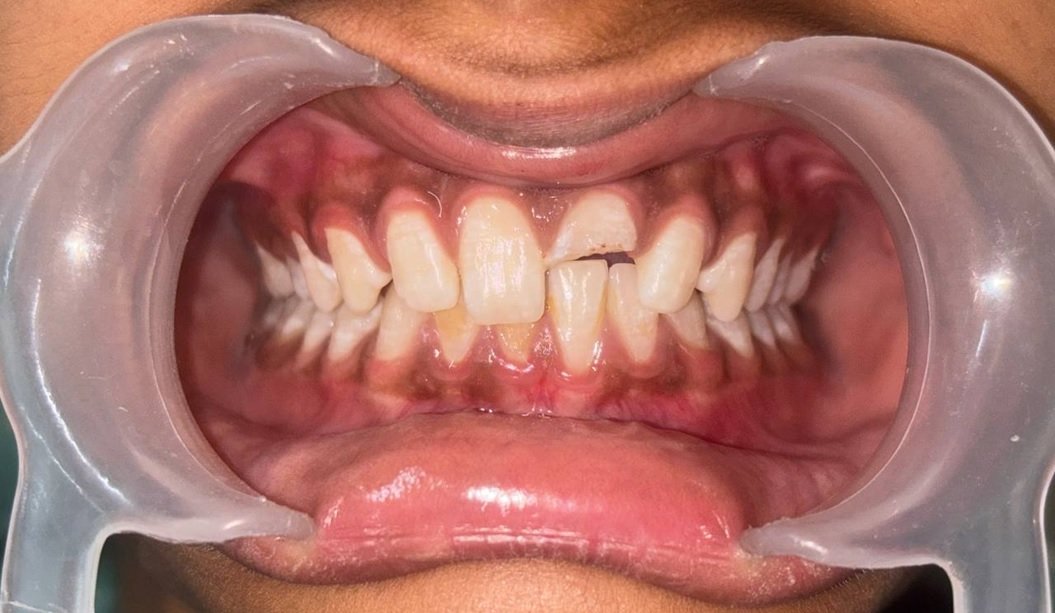
A 13-year-old boy reported to the department of pediatric and preventive dentistry with the chief compliant of missing teeth in the lower front tooth region. He was born to non- consanguineous marriage. Parents gave the medical history of Acynotic congenital heart disease, left atrium branch stenosis and was not under any medications. The child had reduced vision of left eye and parents gave the history of presence of natal teeth at birth. Extra oral examination reveals short stature, overhanging forehead and columella, absence of left third 3rd finger, Fusion of left 1st and 2nd toe, 3rd and 4th toe ( Figure -1). Intraoral examination reveals knife edged alveolar ridge in the mandibular anterior teeth region. Clinically missing teeth were 31,32,33,41,42,43.Orthopantomography (OPG) revealed congenitally missing teeth 31,32,33,41,42,43,18,28,38,48(Figure-2). Parents were informed about the missing 10 permanent teeth. His speech issue was caused by a short lingual frenulum. The patient had minimal tongue protrusion and was unable to lift his tongue to contact his palate. Class III ankyloglossia was diagnosed as per Kotlow's classification 1993 because the free tongue's length was 7mm. Report of chromosomal analysis revealed normal male karyotype-46,XY. Diagnosis of nonsyndromic oligodontia with ankyloglossia was made. Treatment planning included laser frenectomy followed by removable partial denture. Routine blood investigations and BT,CT were done and values were with in the normal limits. Consent from cardiologist was obtained regarding cardiac issue. Parents consent was obtained before carrying out the procedure. Protective goggles were used as part of the operator, assistant, and patient's safety precautions. Procedure was carried out under local anesthesia. laser-assisted lingual frenectomy using diode laser with 980nm was used for excision of lingual frenum( Figure -3A). After the excision of the lingual frenulum, a rhomboidal-shaped surgical area was seen.post operative instructions were given. Tongue exercises were advised to the patient. Patient was recalled after 15days, 1month which showed uneventful healing( Figure -3B and 3C). Glassionomer restorations were done in relation to 54,16. Alginate impressions were made and removable partial denture was fabricated and inserted in the mandibular anterior region(Figure – 4). Patient was happy with treatment done.

Figure 1: Extra oral images A- frontal profile view showing overhanging head and columela, B- lateral profile view showing low set ears, C- absence of left third 3rd finger, D- Fusion of left 1st and 2nd toe, 3rd and 4th toe.

Figure 2:Intraoral images A-upper arch with dental caries irt 54,16 ,B and C – kotlow’s class III Ankyloglossia with limited tongue protrusion, D- lower arch showing clinically missing 31,32,33,41,42,43, E-OPG showing congenitally missing 31,32,33,41,42,43,18,28,38,48.

Figure 3: A- laser assisted lingual frenectomy, B- Healing at 1 month follow up ,C- free tongue movement observed.
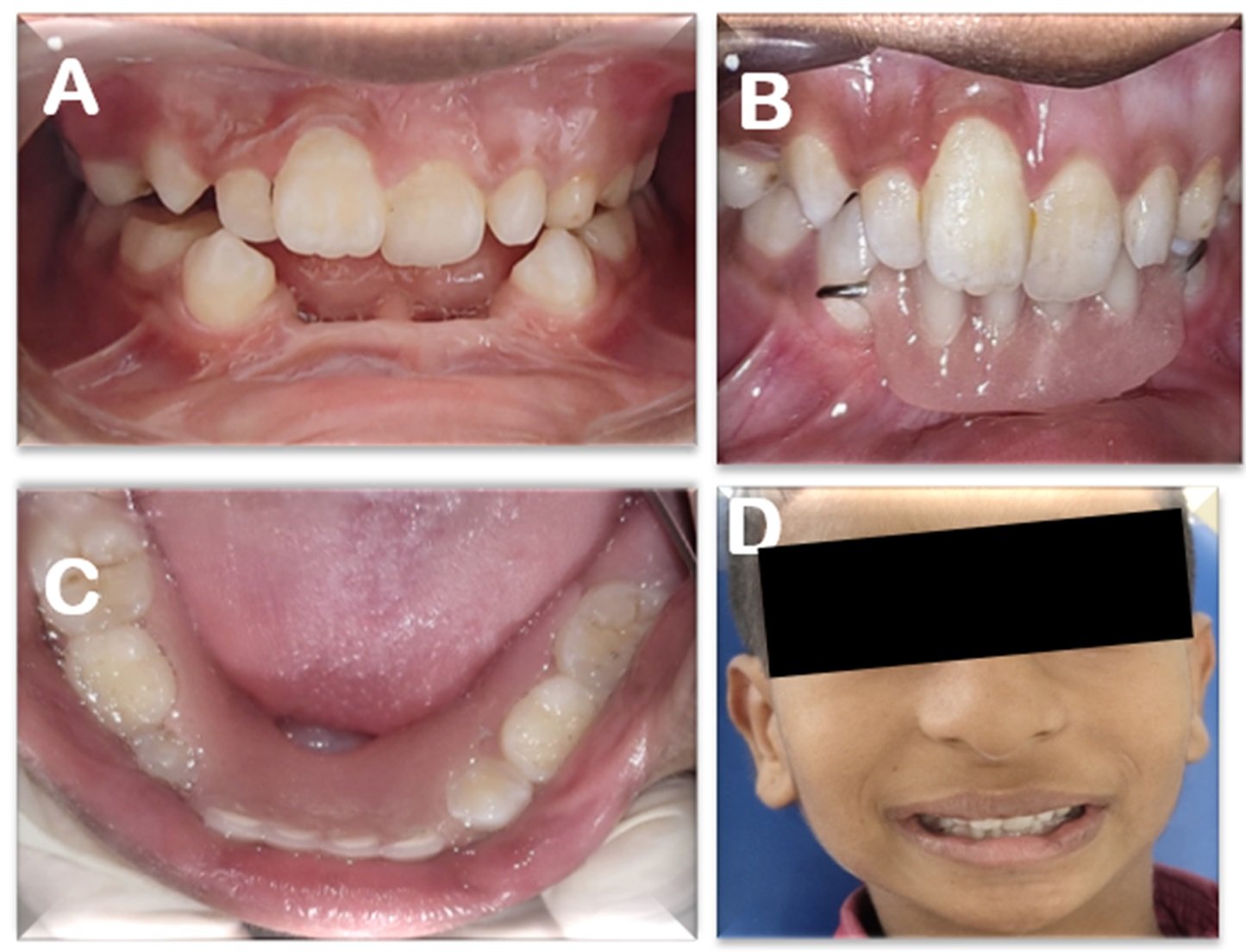
Figure 4: A -congenitally missing 31,32,33,41,42,43, B and C –Removable Partial Denture placed in the mandibular anterior region, C- Post operative image.
DISCUSSION
Oligodontia can compromise facial aesthetics by affecting the growth of the mandible and maxilla. A change in facial features and speech impairment affect a person's physiological and psychological well-being, leading to a lack of confidence and social acceptance. Nonsyndromic oligodontia can have either an X-linked or autosomal (dominant or recessive) inheritance pattern, with significant differences in penetrance and expressivity.5 Nonsyndromic tooth agenesis has been linked to defects in either genes that encode transcription factors (e.g., MSX1 and PAX9) or genes that encode a protein involved in Wnt signalling (AXIN2) and a transmembrane receptor of fibroblast growth factor (FGFR1).6 MC Hiremath reported a case of non syndromic oligodontia with 19 missing permanent teeth in 13 year old girl.7 Some children have partial or total ankyloglossia, which results in certain speech problems. Kotlow's classification of ankyloglossia states that based on the clinically evident free tongue, ankyloglossia can be one of four types: Class I: Mild ankyloglossia with clinically noticeable free tongue measuring 12–16 mm. Class II: moderate ankyloglossia with 8–11 mm free tongue and Class III: Severe ankyloglossia with free tongue ranging from 3 to 7 mm. class IV is Complete ankyloglossia. Pronouncing some tongue sounds, like "t," "d," "l," "th," and "s," can be challenging. In children with tongue tie, improper chewing and swallowing of food might raise the risk of bloating, bedwetting, snoring, and gastrointestinal distress.8 Researchers found that individuals with ankyloglossia were more likely to have open bites, crowding, protruding maxillary anteriors, and restricted maxillary arches.9 Lingual frenectomy can be treated surgically using a variety of techniques, including as laser frenectomy, electrocautery, and surgical excision. Frenectomy is more challenging and invasive to perform on younger children. Present case was managed using diode laser in contrast to traditional frenectomy because of its advantages which includes bloodless procedure, no pain or edema, has a high tissue affinity and reduces post-operative issues. The process of protein coagulation at the wound surface acts as a biological dressing, sealing sensory nerve ends and lessening pain perception. Because of the reduced collateral damage and lymphatic closure brought about by the laser, the postoperative outcomes were better.10
CONCLUSION
Early intervention and tailored treatment can significantly enhance oral function, esthetics, quality of life in individuals with rare dental anomalies like non-syndromic oligodontia with ankyloglossia. Successfull management of this case by performing laser assisted lingual frenectomy followed by insertion of removable partial denture highlights the need for personalized treatment planning. This case report contributes to the growing body of evidence on managing such dental anomalies, emphasing the importance of interdisciplinary collaboration.
REFERENCES
- Hobkirk JA, Brook AH. The management of patients with severe hypodontia. Journal of Oral Rehabilitation. 1980;7(4):289-98.
- Nieminen P. Genetic basis of tooth agenesis. Journal of Experimental Zoology Part B: Molecular and Developmental Evolution. 2009;312(4):320-42.
- Suter VG, Bornstein MM. Ankyloglossia: facts and myths in diagnosis and treatment. J Periodontol. 2009;80(8):1204-19.
- Naik SV, Ghousia S, Shashikran ND, Naik S, Shashihushan KK. A case report is the occurrence of partial ankyloglossia with isolated oligodontia in permanent dentition. pediatric dental journal. 2014;24(2):124-8.
- Maganur PC, Satish V, Panda S, et al. Non-syndromic oligodontia: a rare case report. Austin J Dent 2017;4(6):1090.
- Chhabra N, Goswami M, Chhabra A. Genetic basis of dental agenesis—molecular genetics patterning clinical dentistry. Med Oral Patol Oral Cir Bucal 2014;19(2):e112–e119.
- Hiremath MC, Srinath SK. Non-Syndromic Oligodontia: A Case Report. RGUHS Journal of Dental Sciences. 2021;13(3).
- Chikkanarasaiah N, Hrishida P, Rohith S, Krishnamurthy NH. Management of tongue tie in a 4 year old child using electrocautery-a case report. International Journal of Current Research. 2021;13:15928-31.
- Srinivasan B, Chitharanjan AB. Skeletal and dental characteristics in subjects with ankyloglossia. Progress in Orthodontics. 2013;14(1):1-7
- Akhil S, Paul J, D’Lima JP, Parackal ST, Thomas D, Archana NV. Management of ankyloglossia by diode laser-a case report. IP International Journal of Periodontology and Implantology. 2020;5:41-44
Disclaimer from Guident
The views and opinions expressed in articles published in Guident are solely those of the authors and do not necessarily reflect the views of the editors, the editorial board or the publisher, Ivory India. Guident does not endorse any product, technique or treatment described. Clinical content is intended for qualified dental and medical professionals and is not a substitute for individual clinical judgement. Guident, its editors and the publisher accept no liability for any consequence arising from the use of information published in the journal.
How to cite this article
Dr. Mallayya C. Hiremath, Dr. S K Srinath, Dr. Hemashree G S. Non-Syndromic Oligodontia Associated with Ankyloglossia in a 13- Year Old- Boy: A Rare Case Report. Guident. 2025 Sep;18(10). Available from: https://guident.in/articles/pedodontics/non-syndromic-oligodontia-associated-with-ankyloglossia-in-a-13-year-old-boy-a-rare-case-report.html