Zirconia in Dentistry- an Overview
Department of Prosthodontics & Implantology, K. D. Dental College & Hospital, Mathura (U.P) India
ABSTRACT
Due to an increasing interest in esthetics and concerns about toxic and allergic reactions to certain alloys, zirconia was proposed as a new ceramic material in the later part of 20th century. It has become a popular alternative toalumina as biomaterial and is being used in dental applications for fabricating endodontic posts, crown and bridge restorations and implant abutments. Zirconia frameworks are realized by using computer-aided design/manufacturing (CAD/CAM) technology. Cementation of Zr-ceramic restorations can be performed with adhesive luting. Mechanical properties of zirconium oxide FPDs have proved superior to those of other metal-free restorations. Clinical evaluations, which have been ongoing for 3 years, indicate a good success rate for zirconia FPDs. Zirconia implant abutments can also be used to improve the aesthetic outcome of implant-supported rehabilitations. This article presents a brief history, dental applications and new methods for fabrication of zirconia improving its mechanical properties along with the current status of dental CAD/CAM systems, CAD/CAM and zirconia restoration clinical evaluation of zirconia restoration are also reviewed.
Keywords: Zirconia, dentistry, , Dental CAD/CAM; FDPs; Zirconia, Implant abutment
INTRODUCTION
Zircon has been known as a gem since ancient times. The name zirconium comes from the Arabic “Zargun” (golden in color) which in turn comes from the two Persian words “Zar” (Gold) and “Gun” (Color).1 Zirconia is a crystalline dioxide of zirconium. Zirconium oxide was first used for medical purposes in 1969 for orthopedic application.It was proposed as a new material for hip head replacement instead of titanium or alumina prostheses. Zirconia is a crystalline dioxide of zirconium. Its mechanical properties are very similar to those of metals and its color is similar to tooth color.1 In 1975, Garvie proposed a model to rationalize the good mechanical properties of zirconia, by virtue of which it has been called ‘‘ceramic steel’’
Zirconia is organized in three different patterns:
monoclinic (M), tetragonal (T), and cubic (C). Pure zirconia is monoclinic at room temperature and remains stable up to 1170°C. Above this temperature, it transforms into tetragonal and then into cubic phase that exists up to the melting point at 2370°C.2 During cooling, the tetragonal phase transforms back to monoclinic in a temperature ranging from 100°C to 1070°C.1
It has become a popular alternative to alumina as biomaterial and is used in dental applications for fabricating endodontic posts, crown and bridge restorations and implant abutments. It has also been applied for the fabrication of esthetic orthodontic brackets .
The mechanical properties of commercial yttria stabilized zirconia are given in Table 1.1
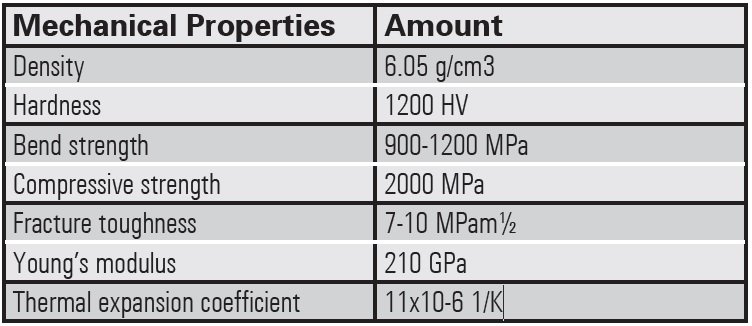
Table 1
DENTAL APPLICATION OF ZIRCONIA
Although many types of zirconia-containing ceramic systems are currently available , only three are used to date in dentistry.3 These are yttrium cation-doped tetragonal zirconia polycrystals (3Y-TZP), magnesium cation-doped partially stabilized zirconia (Mg-PSZ) and zirconiatoughened alumina (ZTA).Zirconia-Based Dental Posts
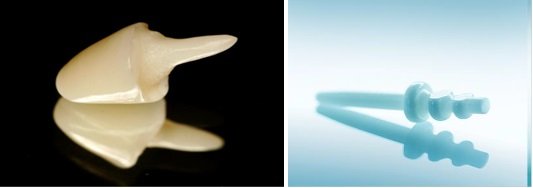
The requirement for more esthetic posts, especially under all ceramic restorations, has started the development of new post materials (Fig. 1).
Zirconia-Based Crown and Bridge
The fabrication of zirconia frameworks of either presintered or highly isostatic pressed zirconia for crown and bridge has also been employed.
Zirconia frameworks offer new perspectives in metal free fixed partial dentures and single tooth reconstructions because of zirconium’s high flexural strength of more than 900 MPa and showed good first clinical results .
Tinschert et al. compared survival time of different metal-free core forthree unit fixed prostheses and reported that zirconia-ceramic with alumina oxide had the highest initial and most favorable long-term strength. Sailer et al. investigated zirconia bridges fabricated by the direct ceramic machining system clinically. Their results exhibited a survival rate of 84% in a period of 3.5 years. Minor porcelain chipping was reported in 11% of the bridges. Tinschert et al. fabricated. zirconia bridges fabricated with the DCS President® system. He and his colleagues observed the zirconia bridges for a mean period of three years and reported a small chipping of the veneering material in 6% of the bridges, which showed a cumulative survival rate of 86%.
Zirconia-Based Implant Abutments
As a result of utilizing the zirconia ceramics for the fabrication of tooth-supported restorations, this encouraged the clinicians to extend its application for implant-supported restorations.
Utilizing zirconia as implant-supported restorations is due to the higher toughness and the lower modulus of elasticity of zirconia. In stabilized and transformation toughened forms, zirconia provides some advantages over alumina in order to solve the problem of alumina brittleness and the consequent potential failure of implants. These abutments are distinguished by their tooth-matched color, their good tissue compatibility, and their lower plaque accumulation Nevertheless, a number of clinical studies exhibited the high reliability of zirconia as abutment as well as framework material for implant-borne crowns and fixed dental prostheses. However, the clinical success of zirconia based implant is an obstacle by veneering porcelain fractures. The zirconia fractures are due to technical complication.4-6 Additionally, long-term stability of zirconia is questionable. Therefore, the replacement of titanium implant by zirconia implant is controversial . Recently, Guess et al. reviewed the utility of zirconia in fixed implant prosthodontics. They found that clinical long-term success of zirconia in fixed implant prosthodontics is questionable as a result to fracture of the veneering ceramics and the susceptibility of zirconia to aging. Due to scarcity of clinical studies available, the authors suggested evaluating the performance of zirconia abutments and implant-supported fixed restorations before recommending it for using in daily private practice. FIG 2

Besides the dental applications that were mentioned previously, zirconia has also been applied for the fabrication of esthetic orthodontic brackets.6 Polycrystalline zirconia brackets, which reportedly have the greatest toughness amongst all ceramics, have been offered as an alternative to alumina ceramic brackets. They are cheaper than the monocrystalline alumina ceramic brackets but they are very opaque and can exhibit intrinsic colors making them less aesthetic. Good sliding properties have been reported with both stainless steel and nickel-titanium archwires along with reduced plaque adhesion, clinically acceptable bond strengths and bond failure loci at the bracket/adhesive interface. However, Keith et al.6 found no significant advantage of zirconia brackets over polycrystalline alumina brackets with regard to their frictional characteristics.
CAD/CAM AND ZIRCONIA RESTORATION
The current status of dental CAD/CAMCAD/CAM technology was introduced into dentistry, and FDPs could be fabricated using a series of steps, as shown in Fig-3. The intraoral abutment was scanned by an intraoral digitizer to obtain an optical impression. Digitized data were reconstructed as 3-D graphics on the monitor and the optimal morphology for the FDPs was virtually designed on the monitor.4 Real FDPs were fabricated by milling a block using a numerically-controlled machine. FIG-3

A process of digital fabrication system of FDPs.
APPLICATION OF ZIRCONIA-BASED CERAMIC FDPS USING CAD-CAM PROCESS
Zirconia-based ceramics, especially Y-TZP, are clinically available as an alternative to metal frameworks for FDPs.4,6,7 The fabrication of Y-TZP frameworks can be performed by milling a solid block using CAD/CAM procedures and either of two systems.In the first system, frameworks with final dimensions can be milled directly from fully sintered dense ceramic blocks using a CAD/CAM-controlled grinding machine. This system has the advantage of a superior fit, because no shrinkage is involved in the process, but has the disadvantage of inferior machining associated with wear of the tool.
In the second system, frameworks with enlarged dimensions can be milled from partially-sintered blocks or green blocks, again using CAD/CAM-controlled grinding machines, followed by post-sintering at high temperature (using an electric furnace) to obtain a framework with final dimensions and sufficient strength. This system is currently popular for fabricating zirconia frameworks using the main CAD/CAM systems available in the world market. However, although this system has the advantage of easy machinability without wear on the tools and chipping of the material, the dimensions of the frameworks must be adjusted to compensate for extensive sintering shrinkage during the post-sintering process, so that the final frameworks fit well. Fit of the FDPs to the abutment, especially marginal adaptation, is one of the determining factors for the long-term clinical success of dental prostheses. Clinical evaluation showed that the margin fit of zirconia-ceramic FDPs fabricated by the current CAD/CAM systems was similar to that of conventional metal ceramic restorations.
There were a number of publications evaluating the fit of the FDPs fabricated by CAD/CAM systems. However, because of the rapid progress and remodeling of the CAD/CAM systems currently available in the clinic, it is difficult to judge the degree of fit of FDPs produced by each system. Laboratory studies suggested marginal adaptation of 3-unit and 4-unit zirconia ceramic FDPs consisting of frameworks fabricated using commercially-available CAD/CAM systems was acceptable for clinical application.
CLINICAL EVALUATION OF ZIRCONIA RESTORATION
Clinical outcomeTo date, PFM restorations remain the most widely and successfully used options for FPDs since their failure rates are often low (8–10% within 10 years). Overall, the clinical survival rates of FPDs are between 72% and 87% after 10 years, between 69% and 74% after 15 years, and 53% after 30 years.4,7,8 However, as is well-known, the metals used in PFM restorations have the potential to cause allergic or toxic reactions within soft or hard tissue. Also, PFM is known to cause graying of the gingival margin because of metal show-through.
The increased use of ceramics for restorative procedures and demand for improved clinical performance has led to the development and introduction of several new ceramic restorative materials and techniques. PFM restorations became available for dentistry in the 1960s followed by Dicor glass ceramics (Dentsply Intl, York, PA, USA), the castable Fluormica Glass-Ceramic in the 1980s, the installation systems such as VITABLOCS1 MARK II for CEREC1 (Vita), In-Ceram1 ALUMINA (Vita), and IPS Empress (Ivoclar-Vivadent) etc. of the early 1990s. Y-TZPbased systems are a recent addition to the high-strength, all ceramic systems used for crowns and fixed partial dentures . CAD/CAM-produced Y-TZP-based systems are in considerable demand in esthetic and stress-bearing regions.
The highly esthetic nature of zirconia with its superior physical properties and biocompatibility makes it an effective restorative system to meet the demands of modern patients . Currently, endowing a removable knob to the dental prosthesis apparatus has made it possible to treat temporary cementation. Clinical fractures of all-ceramic crowns and FPDs have rarely been identified.
Crowns are reported to spoil from the cavital cementation surface, which is opposite the chewing surface whereas all ceramic FPDs spoil at their connectors Several aspects of zirconia dental restorations require investigation in randomized controlled clinical trials. The most common complaints are chipping of the veneer surface or framework fracture.

(a) Chipping of the ceramic veneer. (b) Framework fracture in the second upper left molar distal buccal
Lithium disilicate glass-ceramic frameworks with impressive esthetic properties create long-lasting all-ceramic restorations.
Used successfully in the fabrication of single-tooth restorations, lithium disilicate now forges new paths and it eliminates the need for metal and zirconia frameworks. Single zirconia crowns veneered with overpressed ceramics exhibit a lower fracture load. Lithium disilicate enables users to fabricate tooth or implant-supported posterior bridge restorations with an outstanding overall strength.9
It can also be applied to the repair of zirconia-based FPDs that chip off during the press-technique. FIG 4 & 5

(a)Chipping of the ceramic veneer of FPDs (the lower right first premolar (b) Preparation for abutment tooth of repair
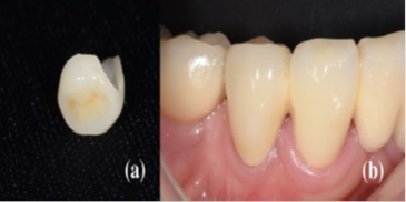
(a) Custom-made press ceramic shell (occlusal view). (b) Buccal view of 3 years after repair
THE FUTURE PROSPECT OF ZIRCONIA RESTORATIONS
Developed from the clinically proven formula for a Cercon base yttria-stabilized zirconia material, Cercon ht (Dentsply Intl., York, PA, USA) represents the new zirconia generation with outstanding translucency for highly esthetic restorations and requires no porcelain build-up. FIG 6
(a) Cercon ht, fully contoured crown, made possible by nanotechnology, before polishing (b) Occlusal view of the Cercon ht, fully contoured crown (second lower left molar)
Zirconia is used exclusively for crowns and FPDs without using veneer ceramics or press ceramics. It has a high flexural strength of over 1200 MPa with excellent veneering characteristics. In dental ceramics, zirconia has proven to be a durable, reliable framework material capable of inhibiting crack growth and preventing catastrophic failure.8,9,10
Clinical studies have shown that zirconia is abrasive to the opposing dentition and it causes excessive wear of the tooth structure. Other in vivo studies are in progress and have demonstrated that polished zirconia yielded high wear resistance and lower antagonistic wear compared to porcelains. On the other hand, new zirconia generation materials leave the surfaces of the antagonists smooth, precisely like natural enamel. There is still much to learn about zirconia and the production of zirconia copings and frameworks. Further studies with larger sample sizes and longer follow-up periods are required to investigate the possible influencing factors of technical failures.
CONCLUSION
Application of zirconia in various filed of dentistry has been reviewed. This review also focuses on the development and current status of the zirconia that was based on recent reviews. Methods for the improvement and development of properties of zirconia were based on data reported in the literature and on other studies by the author.Because of the rapid development of both materials andprocessing technologies, application of zirconia- based FPDs seemed promising. However, dentists and dental technicians must collaborate and perform the proper clinical procedures even if the CAD/CAM can neglect some parts of the conventional manual work. We still need longer clinical evaluations to prove the usefulness of zirconia-based FDPs especially with new options.
Recent progress in the improving in biological and mechanical properties of zirconia is reviewed. Although there was major improvement in the mechanical properties of zirconia, further studies are recommended to confirm their properties.
REFERENCES
- Piconi C, Maccauro G. Zirconia as a ceramic biomaterial: a review Biomaterials 1999; 20: 1-25.
- Helmer JD, Driskell TD. Research on bioceramics. Symposium on use of ceramics as surgical implants. Clemson University, South Carolina: USA 1969.
- Qualtrough AJ, Piddock V. Ceramics update. J Dent 1997; 25: 91
- Current status of zirconia restoration Takashi Miyazaki (DDS, PhD)a,*, Journal of Prosthodontic Research 57 (2013) 236–261 study. Int J Prosthodont 2001; 14: 58-64.
- Luthardt RG, Sandkuhl O, Reitz B. Zirconia-TZP and alumina-- advanced technologies for the manufacturing of single crowns. Eur J Prosthodont Restor Dent 1999; 7:113-9.
- Tinschert J, Natt G, Mautsch W, et al. Fracture resistance of lithium disilicate-, alumina-, and zirconia-based three-unit fixed partial dentures: a laboratory study. Int J Prosthodont 2001; 14: 231-8.
- An overview of zirconia ceramics: Basic properties and clinical applications Paolo Francesco Manicone, Pierfrancesco Rossi Iommetti *, Luca Raffaelli.
- Stawarczyk B, O¨ zcan M, Roos M, Trottmann A, Ha¨mmerle CH. Fracture loadandfailureanalysisof zirconia single crownsveneeredwithpressedand layered ceramics after chewing simulation. Dent Mater J 2011;30:554–62.
- Lughi V, Sergo V. Low temperature degradation-aging-of zirconia: a critical review of the relevant aspects in dentistry. Dent Mater 2010;26: 807–20.
- Preis V, Behr M, Handel G, Schneider-Feyrer S, Hahnel S, Rosentritt M. Wear performance of dental ceramics after grinding and polishing treatments. J Mech Behav Biomed Mater 2012;10:13–22
Disclaimer from Guident
The views and opinions expressed in articles published in Guident are solely those of the authors and do not necessarily reflect the views of the editors, the editorial board or the publisher, Ivory India. Guident does not endorse any product, technique or treatment described. Clinical content is intended for qualified dental and medical professionals and is not a substitute for individual clinical judgement. Guident, its editors and the publisher accept no liability for any consequence arising from the use of information published in the journal.
How to cite this article
Dr. C. Pradeep, Dr. Shivam Gupta, Dr. Siddharth Sisodia. Zirconia in Dentistry- an Overview. Guident. 2020 Sep;13(10). Available from: https://guident.in/articles/prosthodontics/zirconia-in-dentistry-an-overview.html