Caries Removal in Difficult to Reach Areas-a Case Report
Director, Upskill Dental Academy Mumbai, India
INTRODUCTION
Management of dental caries has progressed immensely with advanced methods of initial caries detection and subsequent restoration with advanced esthetic restorative materials.The management of cavitated carious lesions focuses on arresting or controlling including restoring existing lesions through minimal invasive restorative treatments, including repairing rather than replacing old restorations.
For existing carious lesions different lesion stages and activities might require different management, all of which should aim toward
- control of the disease process
- preservation of dental hard tissue
- avoidance of initiating the cycle of restoration
- preservation of the tooth as long as possible
The decision of how to manage with what technique becomes most important.
For example, non cavitated lesions can be managed by removal of biofilms, remineralisation or by sealants for occlusal surfaces.
But for proximal surfaces other methods or sealing or by resin infiltration.
Non cleansable cavitated lesions which are considered active require restorative options
REMOVAL OF CARIOUS TISSUE
- always preserve non demineralised tissue
- place the peripheral margin of the restoration always onto sound dentine and enamel.1
The cavitated lesions in difficult to reach areas like the disto buccal surface of maxillary 2nd and 3rd molars remains a challenge.
Presenting a case of deep disto buccal caries on left maxillary second molar.
CASE REPORT
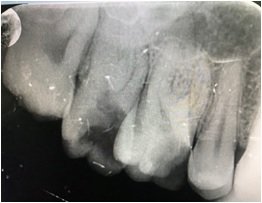
A 43 year old female patient reported to clinic .She complained of sensitivity to cold in maxillary left posterior region. Clinical examination revealed a deep wide carious lesion extending from the buccal to the distal surface found on tooth 27, upon probing. A radiograph was taken to estimate the extent of carious damage & possible periapical changes. The radiograph revealed a wide carious lesion. The tooth was sensitive to cold, but exhibited no lingering pain.Management
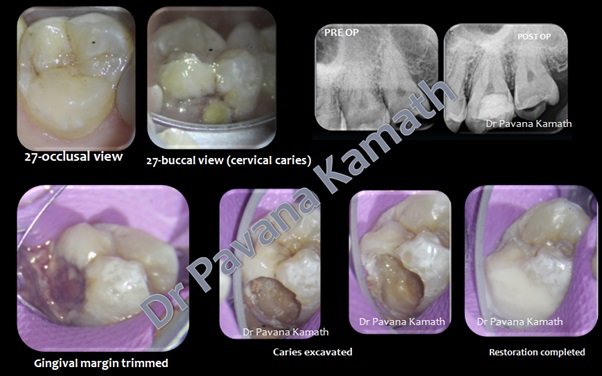
A decision was taken to atraumatically remove caries using chemo mechanical caries removal agent. Refining the margins with a small straight fissure bur to achieve a good marginal seal.
CLINICAL MANAGEMENT
Tooth 27 was anaesthetized; the buccal marginal gingiva was retracted with retraction cord, followed by rubberdam isolation, with a wingless clamp and a non latex rubberdam (hygenic).Under magnification, the initial caries was removed with a large round bur. The deeper caries was removed using a chemomechanical caries removal agent (BRIX3000) for 2 minutes. The caries was removed by using a spoon excavator and checked for remnant caries with a caries detecting agent (find fast, MAARC).
Biodentin (Septodont) was placed in the deeper portion of the cavitated lesion, followed by resin modified glass ionomer. The patient was recalled after 3 months for a follow up.
Considering the depth and width of the carious lesion and its limited operator access, chemomechanical caries removing agent was a great choice which facilitated easy, asymptomatic removal using minimal armamentarium with good patient compliance.
DISCUSSION
Management of dental caries conservatively is a delicate balance achieved with proper use of techniques along with use of magnification to evaluate the carious tooth. Application of chemo mechanical caries removing agent along with the aid of magnification is one of the simplified, effective and accomplished techniques for the same. This method of caries removal exhibits high patient comfort level, precise control, atraumatic and extremely useful in anxious, disabled and also in pediatric patients.REFERENCE
- Chemomechanical Caries removal: A Review & study of an indigenously developed agent(Carie care gel)in children.Journal of International Oral Health.July- August2013;5(4):36-42 Karthik venkatraghavan ,Anil kush.CS Lakshminarayana Lata Diwakar Puja Ravikumar Shankar gouda patil, Sandhya Karthik
Disclaimer from Guident
The views and opinions expressed in articles published in Guident are solely those of the authors and do not necessarily reflect the views of the editors, the editorial board or the publisher, Ivory India. Guident does not endorse any product, technique or treatment described. Clinical content is intended for qualified dental and medical professionals and is not a substitute for individual clinical judgement. Guident, its editors and the publisher accept no liability for any consequence arising from the use of information published in the journal.
How to cite this article
Dr. Pavana Kamath. Caries Removal in Difficult to Reach Areas-a Case Report. Guident. 2020 Sep;13(10). Available from: https://guident.in/articles/endodontics/caries-removal-in-difficult-to-reach-areas-a-case-report.html