Conservative Management of Discolored Teeth by Vital Dental Bleaching: A Case Series
Department of Conservative Dentistry and Endodontics, Seema Dental College And Hospital, Rishikesh
Introduction
The demand for esthetic dentistry has increased continuously and the smile has become an integral part of social attractiveness of a person.1 Since teeth are an integrated part of facial esthetics and are involved in complex social, cultural, and psychological interactions, it is generally perceived that whiter teeth enhance the beauty of a person’s smile. As a result, the demand for whiter and brighter teeth is increasing among today’s patients.2
Today’s dentist has an array of treatment options to harmonize a smile with discoloured vital teeth. The spectrum of treatment ranges from invasive options such as crowns, veneers, and placement of direct restorations to minimally invasive therapies such as macroabrasion, microabrasion, and bleaching to merely prophylaxis. From the number of services listed to enhance the appearance of the discolored teeth, bleaching is an extremely promising option.3
Bleaching is a procedure, which involves lightening the color of a tooth through the application of a chemical agent, to oxidize the organic pigmentation in the tooth. Teeth are whitened by materials such as hydrogen peroxide (HP) and carbamide peroxide (CP), by the initial diffusion into enamel and dentin. These oxidizing agents, after diffusion, break down to produce unstable, free radicals. These free radicals attack organic pigmented molecules, reflect less light, thus creating a “whitening effect.”2 This article throws a light on conservative management of discolored teeth by vital dental bleaching in the following case series.
Mechanism Of Tooth Bleaching
Tooth whitening is any process that lightens the color of the tooth. The causes of discoloration are varied and complex. The color‑producing stains are typically organic compounds that possess extended conjugated chains of alternating single or double bonds and often include heteroatoms, carbonyl and phenyl rings in conjugated system, and are referred to as chromophores.
Bleaching is the chemical degradation of the chromogens. In vital dental bleaching, HP is the active ingredient, which is commonly delivered as HP or CP in commercial agents. CP is a stable complex that breaks down in contact with water to release HP and urea and thus, the chemistry of these agents is that of HP. The basic mechanism of whitening by HP remains unexplained. From the available literature, three distinct phases can be attributed to the changed perception of tooth color.
The first phase is ascribed to the diffusion of HP through the highly permeable interprismatic spaces within enamel and dentinal tubules.
The second phase is based mainly on the interactions of HP with the organic chromophores and is represented as the “Chromophore Theory.” HP, as it diffuses into the tooth, dissociates to produce free oxygen radicals. Depending on the kind of breakage of its chemical bonds, the radical ions formed include hydroxyl radical, hydroperoxyl radical, hydroperoxyl anion, superoxide radical anion, and superoxide radical cation. The discolored teeth appear bleached when the highly reactive oxygen radicals break one or more of the double bonds, clear, or oxidize the chemical moieties in the conjugated chains of the chromophores.
The third phase is associated to perceiving the color change through an altered tooth surface that reflects light differently. An object appears brighter when it reflects light through its rough or light surface. A rough surface postoperatively may result in superior digital color reading, owing to its increased reflective spectra.3
Case Report
CASE 1: A 25 years old female patient reported with the chief complaint of discolouration of teeth. During the examination of the patient, the key clinical parameters that were focused on, are good periodontal health, no or minimal gingival recession and the absence of decay. In the case of this patient, she had no history of any tooth sensitivity. Pre-operative photos were taken. Pola Office was chosen which contains 35% hydrogen perioxide, which facilitates a significant whitening procedure with a start to finish time of less than an hour. The teeth were cleaned with pumice slurry. Teeth were dried, gingival barrier was applied and light cured. With one Pola Office syringe, tip was firmly attached, and carefully plunger was pulled back to release the pressure. Contents of the syringe was carefully extruded into the pot and immediately mixed using a brush applicator until gel is homogeneous. A thick layer of gel was then applied to all teeth undergoing treatment. The gel was left on teeth surfaces for 10 minutes and cured. Three applications were used to complete the in office procedure. After the last application, all gel was suctioned, then washed with water. In this case, a bleaching LED curing light was used for augmenting the in-office procedure. Using standard visual examination and confirmation with VITA Easy shade, a noticeable shade change has occurred. The patient noticed a marked improvement and was very pleased with the final outcome. The patient was asked to return in 10 days to evaluate the results.

PRE-OPERATIVE

APPLICATION OF GINGIVAL BARRIER
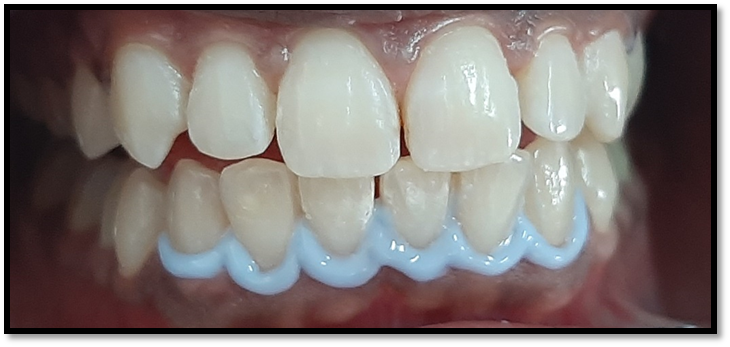
APPLICATION OF GINGIVAL BARRIER
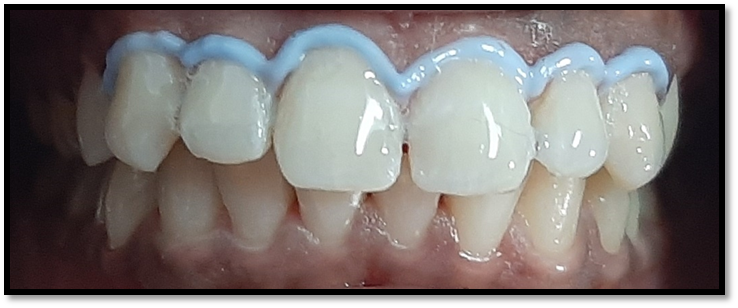
APPLICATION OF BLEACHING AGENT
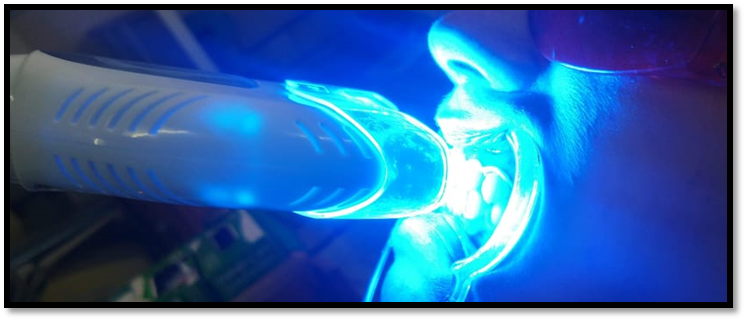
PHOTO-ACTIVATION OF BLEACHING GEL

POST-OPERATIVE

FOLLOW-UP
Case 2: A 22-years-old female was referred to the Department with the chief complaint of yellowish discoloration of teeth. After clinical examination, it was observed that the patient had her teeth only moderately yellowed with the report of high consumption of coffee & tea. In office bleaching procedure was then decided for the patient. First tooth vitality was carried out by using electronic pulp vitality tester for maxillary and mandibular anterior teeth, and all teeth found to be vital. Radiographic examination was also carried out for the same teeth to check the presence of periapical pathologies. After that tooth color shade was verified using a color shade guide (Vita Classical) by visual examination. Oral prophylaxis and polishing were carried out before starting the bleaching procedure. For this patient, Pola Office was chosen. This material contains 35% hydrogen peroxide and potassium nitrate which acts as a desensitizer. All teeth were cleaned using pumice slurry and air dried after that gingival barrier was applied and light cured for 20 seconds. Equal part of bleaching gel and powder was taken and mixed until thick homogeneous mixture was formed and applied over teeth using applicator tip for 8 minutes. Bleaching agent removed using air water syringe and suctioned and final polishing was done. The patient was recalled after 10 for evaluation of result. Patient noticed marked improvement in tooth color with more enhanced smile.

PRE-OPERATIVE

APPLICATION OF GINGIVAL BARRIER

APPLICATION OF GINGIVAL BARRIER

APPLICATION OF BLEACHING AGENT
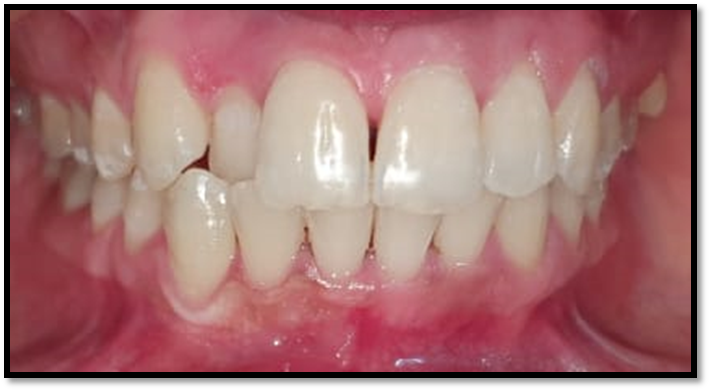
POST-OPERATIVE
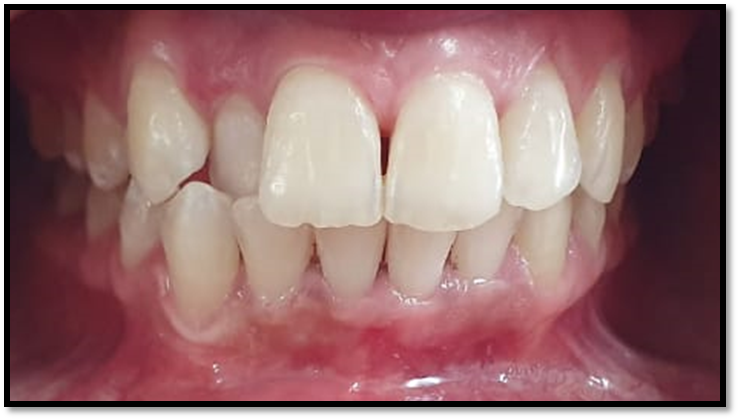
FOLLOW UP
Discussion
Nowadays there are multiple esthetic treatment options are available in the field of dentistry, bleaching is one them. Before starting bleaching procedure, proper clinical evaluation and history taking is very important to understand etiological factor responsible for tooth discoloration and degree of discoloration of teeth. Nonvital and traumatic tooth usually looks discolored hence before bleaching procedure electric pulp testing should be done to avoid misdiagnosis and wrong treatment. Dentists may also wish to consider prescribing NSAIDs prior to treatment since post-treatment sensitivity is unpredictable.4
There are two main types of bleaching procedures - Non-Vital Bleaching which is done on a tooth that is root canal treated and no longer has nerve innervations, Vital Bleaching is performed on teeth that have live nerves. The most common type of vital tooth whitening uses a gel like whitening solution applied directly to the tooth surface like hydrogen peroxide, sodium perborate, carbamide peroxide followed by a heating up of the gel. Vital bleaching is an in-office procedure which uses high concentration of hydrogen peroxide and often referred to as “one hour bleaching.”
There are various brands of bleaching agents with various concentrations are available in the market. Here in this case Pola office bleaching used and it has the most promising outcome. Along 35% hydrogen peroxide Pola office consist of potassium nitrate, so patients post operative sensitivity reduced. Hydrogen peroxide (H2O2) is a chemical substance with high oxidative potential. It is highly unstable and they dissociate into water, oxygen and free radicals when they come in contact with the tissues, the latter accounting for the observed bleaching effect due to their ability to oxidize organic pigments. It is known that the diffusion of H2O2 through the dentin depends on the concentration of the gel, the period of time that the agent is in contact with the tooth and the thickness of dental structure.3 Final outcome of bleaching influenced by patient’s age original shade of the tooth colour, concentration of bleaching agent, time for which the bleaching agent is exposed to the tooth structure.4 Different light sources can be used for inoffice bleaching for heating up the gel to accelerate the dissociation of H2O2 into oxygen radicals such as halogen lamps, light emitting diode, plasma arc lamps and lasers with different wavelengths. In this case series in-office bleaching was performed using 35% H2O2 and light emitting diode as the light source.1
Postoperative Instructions For Vital Bleached Teeth
Avoid acidic drinks, fruits, tea, coffee, and smoking for 48 h postbleach. Avoid disappointment, as shade relapse is to follow. Quicker the drop of shade, more is the rebound. In in‑office bleach, shade regression of about half a shade tends to occur within a week or 10 days postbleaching.3
Adverse Effects Of Tooth Bleaching Common clinical adverse effects of bleaching are hypersensitivity and gingival irritation. Browning et al. observed dentinal hypersensitivity in 77% of participants and 22% of soft tissue sensitivity after bleaching procedures.
- Tooth Sensitivity
Tooth sensitivity, which is one of the most common side effects of bleaching treatment, normally persists for up to 4–7 days after the conclusion of bleaching treatment. Tooth sensitivity during whitening has been associated with microscopic surface defects and subsurface pores in enamel. It has been theorized that these defects allow rapid ingress of the whitening agent toward the pulp, and this results in sensitivity.
- Long Term Stability
Apart from dentinal sensitivity, the long‑term stability of whitening effect is perhaps the most uncertain aspect of the bleaching therapy. The reported recurrence rate of tooth discoloration after 2 years is 10%, after 5 years is 25%, and after 8 years is 49%. For tray bleaching, Haywood reported regression of whitening effect in 26% of cases at 18 months.2
- Effect of Bleaching Agent on Mucosal Tissues
It has been shown that a high concentration of hydrogen peroxide in the range of 30%–35% is destructive to mucus membrane and may lead to burns and bleaching of the gums.
- Effect of Bleaching Agents on Enamel Surface
Many studies have reported morphologic changes of enamel after bleaching with various agents. When enamel surface is exposed to the bleaching agent, it showed some morphologic changes compared to untreated control surfaces.5
Maintenance Of Bleached Teeth Patients are recommended to use a whitening toothpaste and dental floss with a powered toothbrush. Food, beverages, and habits that stain the teeth should be evaded. Women are advised to wear a brighter shade of lipstick to make the teeth appear whiter. A follow up is a must to restore the shade. Depending on the relapse, the follow up is recommended in 6 months or after a year or 2.3
Advantages of In Office bleaching
- Faster bleaching procedure.
- As procedure is under professional, risk factor is eliminated.
- Tooth sensitivity reduced due to use of desensitizers such as potassium nitrate and fluoride.
Disadvantages of In Office bleaching
- In office, bleaching procedure is most expensive than other bleaching procedure.
- Results can be unpredictable and depend on the factors like age, type of stains etc.
Conclusion
The amalgamation of minimal intervention and desire for a flawless smile has widened the scope of whitening vital discolored teeth. In succession, recent years have witnessed a flood of newer products and procedures. Although most teeth bleach promisingly, the predictability depends on multiple factors and is variable. Professionally dispensed bleaching treatment that includes HP‑ and CP‑based bleaching are safe and effective methods when manufacturers’ instructions are followed. A careful monitoring and supervision is critical for achieving a successful and safe tooth whitening outcome. Based on the clinical results reported with professional vital tooth bleaching, it is a viable, esthetic treatment for the discolored dentition its conservative nature and little, if any, risk makes it an important part of an esthetic dentistry treatment plan.
References
- Saha P, Sawhny A, Paul S, Raina A. Report of Two Cases using Vital Tooth Bleaching on Fluorosed. Rama Univ J Dent Sci 2017 Mar;4(1):47-50.
- Athaluri Mounika, Jyothi Mandava, Roopesh B, Girish Karri. Clinical Evaluation of Colo Change and Tooth Sensitivity with In‑office and Home Bleaching Treatments. Indian J Dent Res 2018;29:423-7.
- Joshi SB. An overview of vital teeth bleaching. J Interdiscip Dentistry 2016;6:3-13.
- Dixit H, Bachkaniwala M, khan S, Yadav H,Pandit V, Mandlik J. In Office Teeth Whitening: Case Report. Int J Oral Health Med Res 2016;3(3):70-72.
- AlOtaibi FL. Adverse effects of tooth bleaching: A review. Int J Oral Care Res 2019;7:53-5.
- Niladri Maiti and Utpal Kumar Das. Vital Tooth Bleaching The Journal of Dentist, 2014 Vol. 2, No. 1.
- Dr. Suruchi Sisodia, Dr. Aparna Palekar, Dr.S.Gufran Ali. Vital Teeth Bleaching – Review & Case Report. NJDSR Number 2, Volume 1, January 2014
- Dr. Sana Shaheen1, Dr. Debolina Chowdhury1, Dr. Utpal Kumar Das2. Laser Mediated Vital Teeth Bleaching: A Case Report. International Journal of Innovative Research in Dental Sciences Vol. 2, Issue 5, May 2017.
Disclaimer from Guident
The views and opinions expressed in articles published in Guident are solely those of the authors and do not necessarily reflect the views of the editors, the editorial board or the publisher, Ivory India. Guident does not endorse any product, technique or treatment described. Clinical content is intended for qualified dental and medical professionals and is not a substitute for individual clinical judgement. Guident, its editors and the publisher accept no liability for any consequence arising from the use of information published in the journal.
How to cite this article
Dr. Sneha, Dr. Annil Dhingra. Conservative Management of Discolored Teeth by Vital Dental Bleaching: A Case Series. Guident. 2020 Oct;13(11). Available from: https://guident.in/articles/endodontics/conservative-management-of-discolored-teeth-by-vital-dental-bleaching-a-case-series.html