3D Printing in Prosthodontics
Department of Prosthodontics & Implantology, K.D. Dental College & Hospital, Mathura (U.P) India
ABSTRACT
3D printing is an ingenious technique and is an additive process unlike CAD CAM which is subtractive. It has revolutionized dentistry, proving beneficial in surgical and restorative dentistry; and continues to expand its applications in research and dental education. The key to its success lies in the fact that various materials such as, metal, resin, plastic etc. can be used in this technique; thereby, enabling its usage in prosthodontics.
While there are rapid advances made in technologies, its applications in the field of prosthodontics are not far behind. 3 D printing has revolutionized the way things are manufactured and we may not possibly imagine what future holds for us.
INTRODUCTION
Recent days, 3D printers have been extensively manufactured for prosthodontic use – from commercial printers, scanner to indigenous printers have been developed.
The design, clinical preparation and manufacture Of dental prostheses must be near or at the top of any list of technical processes ranked in terms of complexity and difficulty .When we consider the design, the clinical preparation, the collection of data (impressions), the manufacture and fitting elements, it is perhaps a tribute to the human skills and craftsmanship that we can achieve so much success.
However, on the debit side there is an unattractive hidden archive of adjustments, remakes and failures that add significant economic cost and patient disappointment.
3D printing has grabbed widespread public attention, no doubt helped by sensational news stories focused upon the manufacturing of firearms
The additive 3D printing process brings large cost savings in material when compared with the traditional subtractive milling process of metal or ceramic billets. Another significant advantage of this process is the unlimited design and manufacturing capability previously restricted in conventional CAM activity by tool size and machine axis movement.
3 basic steps in 3D printing
First step – 3D file of the object is designed using a CAD software, with a 3D scanner.
Second step- actual printing process occurs in this step. The material that will be required for printing will be selected according to requirement for example ceramics, plastics, resin and metals. Many materials are still under development.
Third step- this step is the final finishing process it requires specific skills and materials.
SUBTRACTIVE MANUFACTURING TECHNOLOGY
Principles of subtractive manufacturing have been majorly used by both lost wax technique and CAD CAM technology. Subtractive technology is based on power driven machine tools such as saws, lathes and milling machines that are used to mechanically cut a block of material to a desired shape and geometry. This technology enabled reduction of production time and ease of fabricating complex models. However, subtractive manufacturing brings with it disadvantage of increased wastage with removal of excess material and inability of mass production
CAD/CAM systems allow for the production of indirect restorations in a single visit. These systems use an optical camera to take a virtual impression by creating a three dimensional image which is forwarded to a software program. This impression results in a virtual cast on which the restoration is designed. The software then controls a milling process that uses prefabricated blocks of restorative material, either ceramic reinforced composite or all-ceramic material to produce the restoration. The end result is chair side production of the restoration.
ADDITIVE MANUFACTURING TECHNOLOGY
Additive manufacturing on the other hand opens up new avenues for production of dental restorations. Additive manufacturing according to the American Society for Testing and Materials (ASTM) is the process of joining materials to make objects from 3D model data, usually layer upon layer, as opposed to subtractive manufacturing methodologies.
The process of additive manufacturing works on the principle of taking a 3D computer file and creating a series of cross sectional slices. Each slice is printed one on top of the other to create the 3 dimensional object with an advantage of minimal wastage
Additive manufacturing technology has a range of applications such as stereo lithography, laser forming, selective electron beam melting and inkjet printing
MATERIALS USED
According to materials used the printing method is decided. The most commonly used materials with techniques are described below.
- PLASTIC OR ALUMIDE
FUSED DEPOSITION MODELING (FDM)
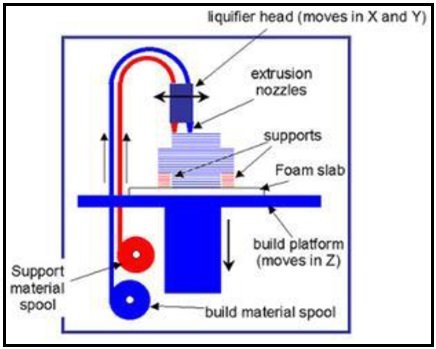
Fused Deposition Modeling developed by Schott Crump used mostly for modeling and prototyping applications. This technology works on the principle of extruding a thermoplastic filament material through a heated nozzle and the material hardens immediately.
SELECTIVE LASER SINTERING (SLS)
It fabricates an object by melting successive layers of powder together, thereby facilitating creation of complex and interlocking forms.
- RESIN OR WAX
The main principle in using resin or wax is photopolymerisation where a photosensitive resin is solidified by a light source. It is used by different 3D printing processes such as
STEREOLITHOGRAPHY (SLA)
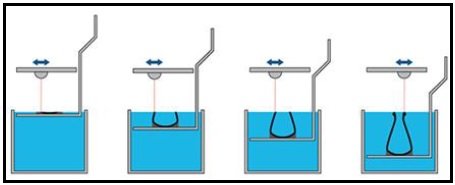
Stereo lithography was introduced in 1980 by Charles Hull. It works on the principle of making solid objects by successively printing thin layers of UV curable photopolymer on top of the each layer.
The ultra violet light draws the object and therefore cures it with the input as digital CAD. SLA can be used for studying pre operatively human models from CT (DICOM) data, for preparation of customised surgical implant guides and also as resin models for lost wax casting.
DIGITAL LIGHT PROCESSING (DLP)
Uses a safe light projector to cure photopolymer resin. The layer is created upside down. After construction of the desired work the residual liquid polymer is drained. DLP along with lost wax casting technique is used to melt the wax and create the object in desired material of choice.
CONTINUOUS LIQUID INTERFACE PRODUCTION
Projects a continuous sequence of UV images, generated by a digital light projector, through an oxygen permeable, UV transparent window below a liquid resin bath.
The dead zone created above the window maintains a liquid interface below the part. Above the dead zone, the curing part is drawn out of the resin bath.
MULTIJET PRINTERS
Are similar to Stereolithography. Polyjet and Multijet 3D Printing use a UV light to crosslink a photopolymer. A printer jet sprays tiny droplets of the photopolymer
in the shape of the first layer. The UV lamp attached to the printer head crosslinks the polymer . The build platform then descends by one layer thickness, and more material
is deposited directly onto the previous layer .
- METAL
DIGITAL LIGHT PROCESSING
DLP combined with the lost-wax casting technique allows objects to be printed in metal of choice.
DIRECT METAL LASER SINTERING (DMLS)
was developed by German company EOS . It is similar to SLS and uses a laser as a power source to sinter metal powder by aiming a laser and tracing a cross section of the object layer by layer. The major difference is the sintering temperature. Polyamide in SLS needs to be sintered at a temperature of 160°C to 200°C, whereas more high-wattage laser is needed for metal as it melts at a temperature between 1510°C and 1600°C; . Various metals, like stainless steel, Titanium, Chrome-Cobalt use this technique in dentistry for fabrication.
ELECTRON BEAM MELTING

Electron beam melting works by melting metal powder layer by layer with an electron beam in high vacuum. Used for making porous dental implants with an advantage of stress shielding & better ingrowth of bone, its roughness may not be suitable for crowns and bridges fabrication.
It produces high density metal parts and retains the material properties.
PROSTHODONTIC INDICATIONS
Stereolithography
- Commonly used to make surgical guides for dental implant insertion with advantages of high mechanical strength and accuracy but one disadvantage is being costly and requiring expensive equipment.
- Computer technology in guided implant surgery uses the DICOM data conversion to CAD CAM technology to produce surgical guides.
- used in the field of maxillo facial prosthodontics as obturators, surgical stents, duplication of prosthesis and burn stents. A soft tissue model is constructed from CT scan into which a silicone is poured for the obturator. The obturator can fit exactly on the patient requiring fewer adjustments compared to the traditional impression techniques.
Selective laser sintering
- Xu et al and Quante found improved and comparable marginal fit of laser sintered chrome cobalt crowns compared to traditional techniques4,5. While Eswaran et al found favourable results with direct metal laser sintered crowns compared to casting technique using 3D printed resin patterns and wax patterns.
- Direct laser sintering can be used to manufacture dental implants with a porous surface, its stiffness close to bone
Electron beam melting
- Mechanical properties, grind ability and corrosion of dental implants manufactured by electron beam melting were found to be comparable to the precious and non-precious metal alloys.
- Fatigue resistance was influenced by electron beam orientation and the crack propagation.
- More wide application in orthopaedics and oral and maxillofacial surgery as customized implants in the form of porous scaffolds.
Direct ink jet printing
- Application of direct ink jet printing for yttria stabilised zirconia ceramic powders for dental restorations was tried. Ceramic ink suspensions were made; characterised and specimens were fabricated and tested for fracture toughness.
- Direct ceramic inkjet printing (DCIJP) uses ceramic powder in a carrier medium which is deposited through a delivery system actuated by a piezoelectric device.
- Successful printing depends on the preparation of suitable ceramic ink which is essentially a well-dispersed suspension of a fine powder. The dispersion must be stable and free from agglomerates.
Fused deposition modeling
- Ear prosthesis have been fabricated using semi-automated technology of CAD modelling and rapid prototyping.
- Subtractive method of combining the mirror image of the contralateral ear with the scan of the defective side is used to print the mold models with fused deposition modelling technique. The molds were finally then made in silicone fetching better accuracy and less time.Integrated manufacturing systems with a laser digitising scanner, rapid prototyping and a vacuum casting machine were used to fabricate a facial prosthesis.
CONCLUSION
Introduction of 3D printing is a breakthrough in the field of prosthodontics although the initial investment is high and requires training for its usage but it also is time saving and provides better quality of life for patients.
Though the experiments are in callow phase, additive manufacturing technology has potential in terms of cost productivity and time.
Further research, mechanical testing and evidence of its efficacy are more needed to explore for dental applications.
REFERENCES
- Chander NG. An overview on 3D printing in prosthodontics. J Indian Prosthodont Soc 2020;20:121-2.
- H Edward, K Nigell. 3D printing in prosthodontics.Fac Dent J.2014;5(4): 153-57.
- Beuer F, Schweiger J, Edelhoff D. Digital dentistry: an overview of recent developments for CAD/CAM generated restorations. Br Dent J. 2008;204(9):505–11.
- G Sivaranjani, S Sarad. 3D printing: the future technology in prosthodontics. Journal of Dental and Orofacial Research.2015;11(1):37-40.
- Cristine Z., et al. “Digital Dentistry - 3D Printing Applications”.Journal of Interdisciplinary Medicine 2.10 (2017): 50-53.
- CAD/CAM Dental Technology: A Perspective on Its Evolution and Status, Edward McLaren, DDS, MDC, Compendium 32.4(2011).
- https://www.sculpteo.com/en/3d-printing/3d-printingtechnologies/
- https://www.dentistrytoday.com/restorative-134/1789--sp-1323704604.
- Xu D, Xiang N, Wei B. The marginal fit of selective laser melting–fabricated metal crowns: An in vitro study. J Prosthet Dent [Internet]. 2014 Dec;112(6):1437–40. Availablfrom:http://linkinghub.elsevier.com/retrieve/pii/S0022391314002637
- Quante K, Ludwig K, Kern M. Marginal and internal fit of metal-ceramic crowns fabricated with a new laser melting technology. Dent Mater. 2008;24(10):1311–5.
- Örtorp A, Jönsson D, Mouhsen A, Vult Von Steyern P. The fit of cobalt-chromium three-unit fixed dental prostheses fabricated with four different techniques: A comparative in vitro study. Dent Mater. 2011;27(4):356–63.
- Kim J-W, Kim J-H, Janal MN, Zhang Y. Damage Maps of Veneered Zirconia under Simulated Mastication. J Dent Res [Internet]. 2008 Dec 1 [cited 2015 Feb 8];87(12):1127 32.Availablefrom:http://jdr.sagepub.com/cgi/doi/10.1177/154405910808701210
- Akova T, Ucar Y, Tukay A, Balkaya MC, Brantley W a. Comparison of the bond strength of laser-sintered and cast base metal dental alloys to porcelain. Dent Mater. 2008;24(10):1400–4.
- Park J, Lee W, Kim H, Kim W, Kim J. Accuracy evaluation of metal copings fabricated by computer-aided milling and direct metal laser sintering systems. 2015; Availablefrom:http://www.ncbi.nlm.nih.gov/pubmed/23680302
- Micheal Cima. Three-dimensional printing techniques US5387380A.Availablefrom:https://www.google.com/patents/US5387380
- Chee Kai C, Siaw Meng C, Sin Ching L, Seng Teik L, Chit Aung S. Facial prosthetic model fabrication using rapid prototyping tools. Integr Manuf Syst [Internet]. 2000 Feb;11(1):4253.Availablefrom:http://www.emeraldinsight.com/doi/abs/10.1108/09576060010303668
Disclaimer from Guident
The views and opinions expressed in articles published in Guident are solely those of the authors and do not necessarily reflect the views of the editors, the editorial board or the publisher, Ivory India. Guident does not endorse any product, technique or treatment described. Clinical content is intended for qualified dental and medical professionals and is not a substitute for individual clinical judgement. Guident, its editors and the publisher accept no liability for any consequence arising from the use of information published in the journal.
How to cite this article
Dr. Shaivy Ambuj, Dr. Siddharth Sisodia. 3D Printing in Prosthodontics. Guident. 2020 Oct;13(11). Available from: https://guident.in/articles/prosthodontics/3d-printing-in-prosthodontics.html