Strategy Against Combination Syndrome by Fabrication of Maxillary Metal Reinforced Complete Denture Opposing Mandibular Cast Partial Denture: A Case Report
Department of Prosthodontics and Crown & Bridge, Subbaiah Institute of Dental Sciences, Karnataka India
ABSTRACT
Combination syndrome is a progressive prosthodontic condition resulting from a complete maxillary denture opposing mandibular anterior natural teeth, leading to compromised oral function and supporting tissues. This report highlights the management of combination syndrome using a metal framework-reinforced maxillary complete denture opposing a mandibular cast partial denture fabricated with the altered cast technique. This conventional approach provides improved rigidity, support, stability, and stress distribution, resulting in favourable functional and esthetic outcomes. It represents a predictable and cost-effective treatment option when implant therapy is not feasible.
Keywords: Combination syndrome; Metal-reinforced complete denture; Cast partial denture; Altered cast technique.
INTRODUCTION
Combination syndrome, first described by Kelly in 1972, refers to a characteristic group of interrelated destructive changes that occur in patients wearing a complete maxillary denture opposing mandibular anterior natural teeth with or without a distal extension removable partial denture (RPD). The classic features include loss of bone from the anterior portion of the maxillary ridge, overgrowth of the maxillary tuberosities, papillary hyperplasia of the hard palate, extrusion of the mandibular anterior teeth, and resorption of the residual ridge beneath the mandibular distal extension bases. Additional signs may include loss of vertical dimension of occlusion, occlusal plane discrepancy, anterior repositioning of the mandible, epulis fissuratum, and periodontal changes.1,2
The pathogenesis is primarily attributed to the biomechanical imbalance created by the presence of mandibular anterior teeth, which transmit excessive occlusal forces to the opposing edentulous maxilla, particularly in the anterior region. This results in anterior maxillary ridge resorption, compensatory tuberosity enlargement, and posterior mandibular ridge. resorption under the distal extension bases.3
Management of combination syndrome is challenging due to progressive ridge resorption, compromised prosthesis support and stability, and the risk of further tissue damage. Although implant-supported mandibular overdentures or fixed prostheses provide the most predictable long-term outcomes by stabilizing posterior support and reducing anterior hyperfunction, many patients require conventional treatment for medical, anatomical, or economic reasons.4
In such cases, a metal-reinforced maxillary complete denture combined with a well-designed mandibular cast partial denture (using altered-cast technique) can distribute forces more evenly, improve stability, and slow further tissue destruction.5
This case report describes the rehabilitation of a patient to prevent combination syndrome using a maxillary metal-reinforced complete denture opposing a mandibular cast partial denture, emphasizing clinical and laboratory considerations that restore function and esthetics while preserving remaining structures.
CASE REPORT
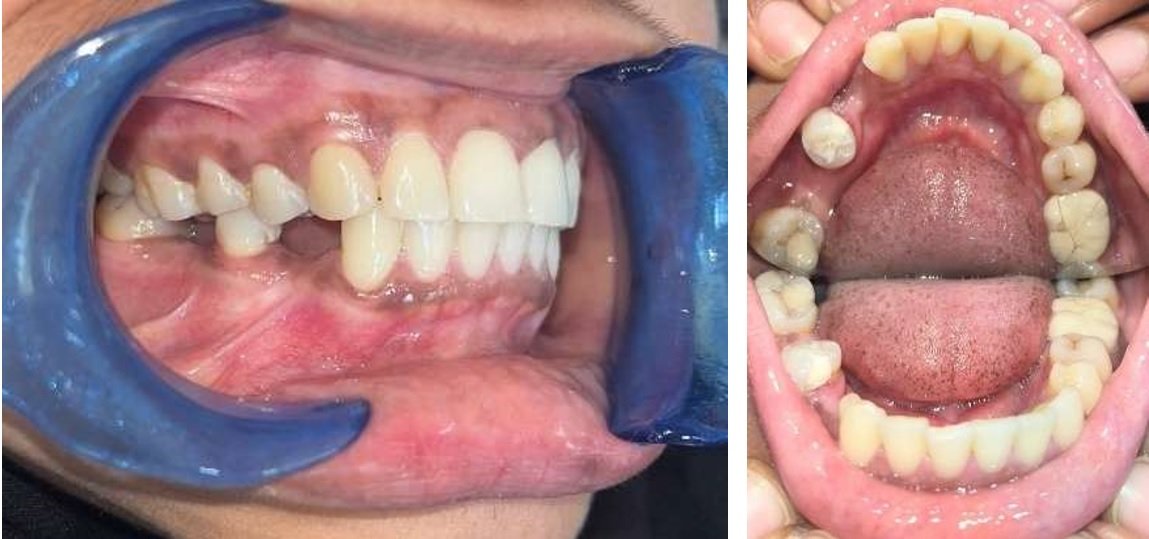
A 65-year-old male presented with difficulty in mastication and poor aesthetics due to missing maxillary teeth and mandibular posterior teeth for two months. He had a 10-year history of controlled hypertension and recent extractions. Extraoral examination revealed a tapering facial form, convex profile, and competent lips, with no facial asymmetry or TMJ abnormalities. Intraorally, the maxilla was completely edentulous (ovoid ridge, Class I residual ridge, Class 2 palatal throat form, Class 1 mucosa). The mandible exhibited Kennedy’s Class II modification 1 (missing 34–37 and 45–46; restored 47) (Fig 1). The diagnosis was completely edentulous maxillary arch and Kennedy’s Class II mod 1 mandibular arch. After discussion of treatment options, the patient was rehabilitated with a metal-reinforced maxillary complete denture and a mandibular cast partial denture to enhance stability and force distribution.
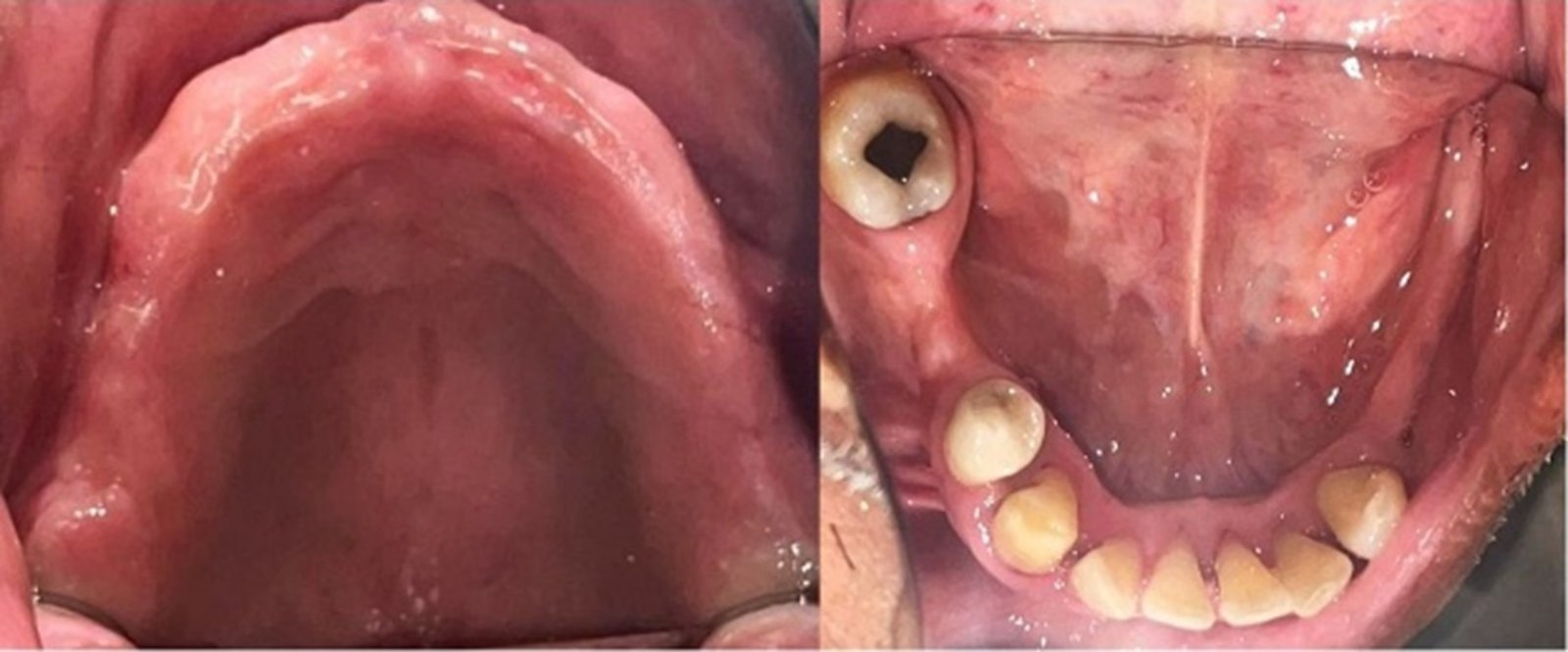
Fig 1: Intraoral View
CLINICAL PROCEDURE
Diagnostic Phase: Primary impressions of maxillary arches was made using impression compound and mandibular impression using alginate, and the resulting cast was poured using type 2 and type 3 dental stone respectively (Fig 2). Tentative jaw relations were recorded, and the diagnostic casts were mounted. Evaluation revealed sufficient inter-arch distance, acceptable occlusal plane, and Class III jaw relation.
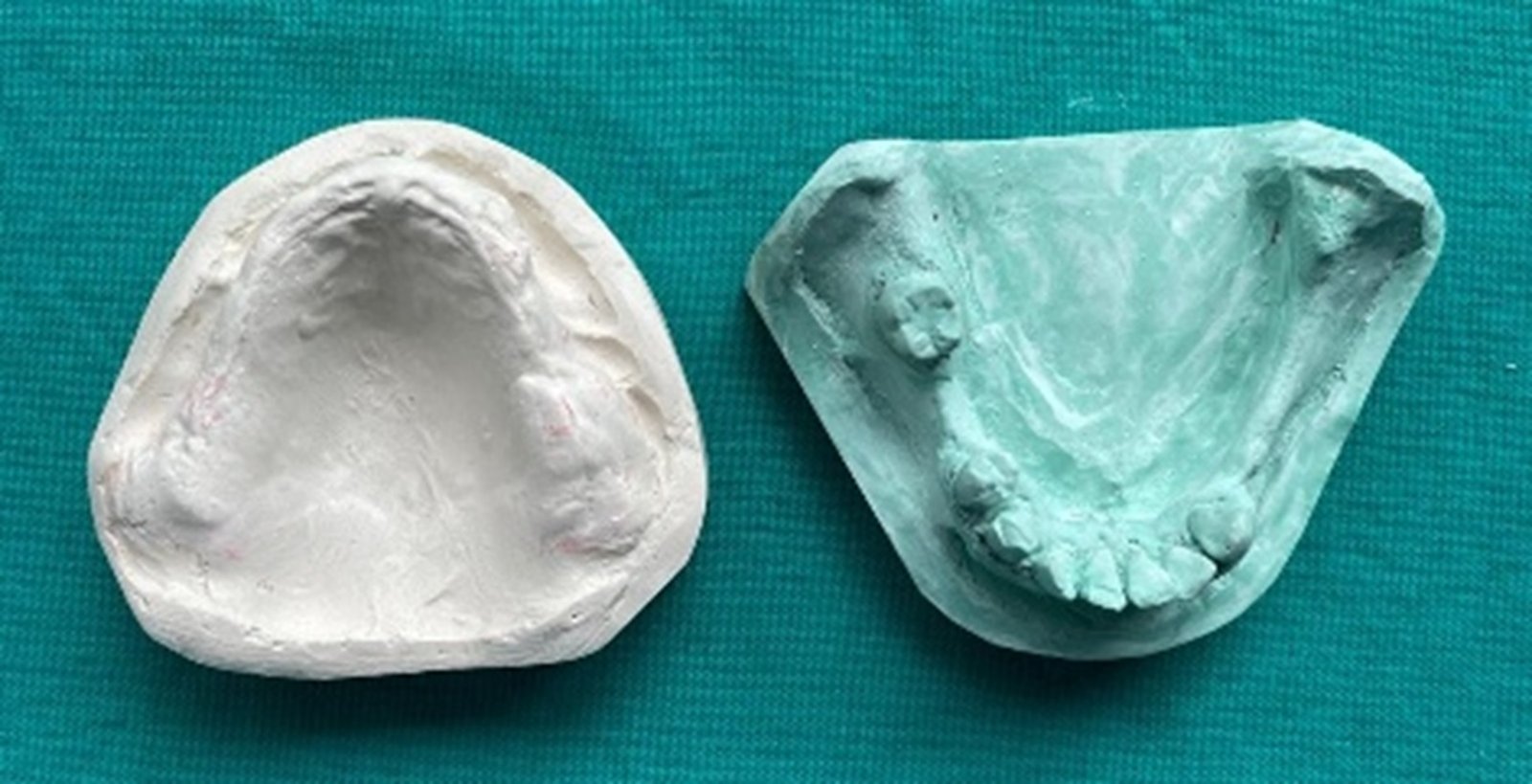
Fig 2 Primary cast
Mandibular Cast Partial Denture Fabrication: The mandibular master cast was surveyed and tripoded. Mouth preparation included mesial occlusal rest seat on 47, distal occlusal rest seat on 44, cingulum rest seat on 33, guiding plane preparation on teeth 33, 44, and 47, and enameloplasty of the lingual cusp of 44. A final impression was made with addition silicone elastomer, and the master cast was poured. The framework design included a lingual bar as the major connector, simple circlet clasps on 44 and 47, and an RPI assembly on 33 (I-bar retainer, proximal plate, and cingulum rest). Blockout was performed with parallel relief (2×2 mm) and arbitrary relief. The refractory cast was obtained after agar duplication. The wax pattern was fabricated, sprued, invested, and cast. The metal framework was tried intraorally for passive fit (Fig 3 and 4).
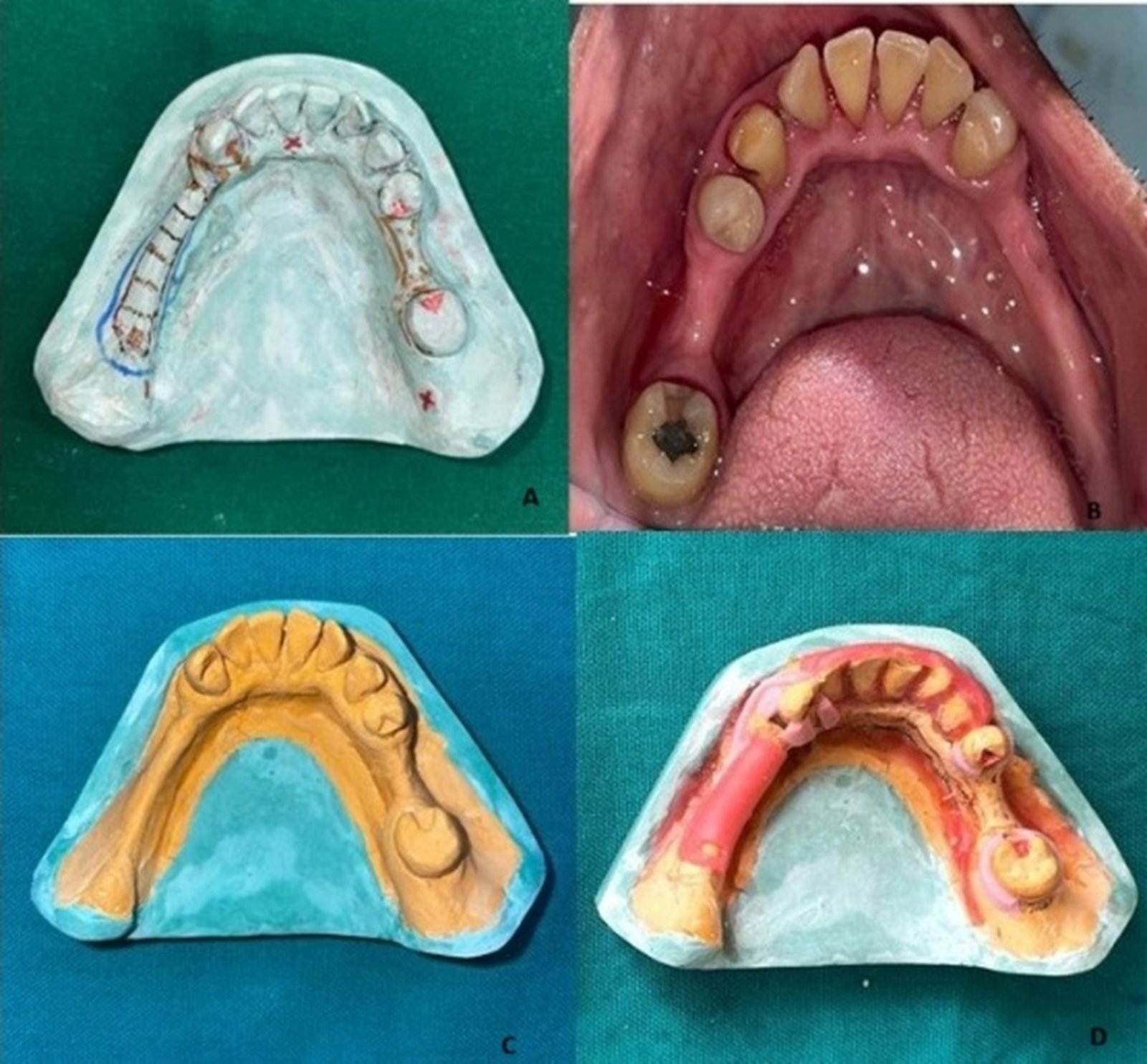
Fig 3: (A) Designing of cast partial denture (B) mouth preparation (C) Master cast (D) Blockout

Fig 4: (A) Agar duplication (B)wax pattern (C) Casted metal framework (D) metal try in
Altered Cast Technique for Mandibular Distal Extension The master cast was sectioned distal to the abutments. Border molding was performed on a custom tray, followed by a secondary impression using addition silicone. Beading and boxing were completed, and the altered cast was poured. The metal framework was verified and adjusted on the altered cast (Fig 5).

Fig 5: Altered cast technique
Maxillary Metal Complete Denture Fabrication Border molding and secondary impression of the edentulous maxillary arch were made using addition silicone. The secondary cast was poured, followed by blockout and fabrication of the refractory cast after agar duplication. A wax pattern incorporating metal mesh was developed, sprued, invested, and cast to produce the metal denture base (Fig 6).

Fig 6: Maxillary metal complete denture (A) Block out (B) Wax pattern (C) Spruing (D) Casted metal framework
Try-in and Laboratory Procedures - Maxillomandibular relations were recorded following facebow transfer. Teeth arrangement was done on the articulator and tried intraorally for aesthetics, phonetics, and occlusion Conventional waxing, investing, dewaxing, processing, finishing, and polishing procedures were then completed to obtain the definitive (Fig 7 and 8).
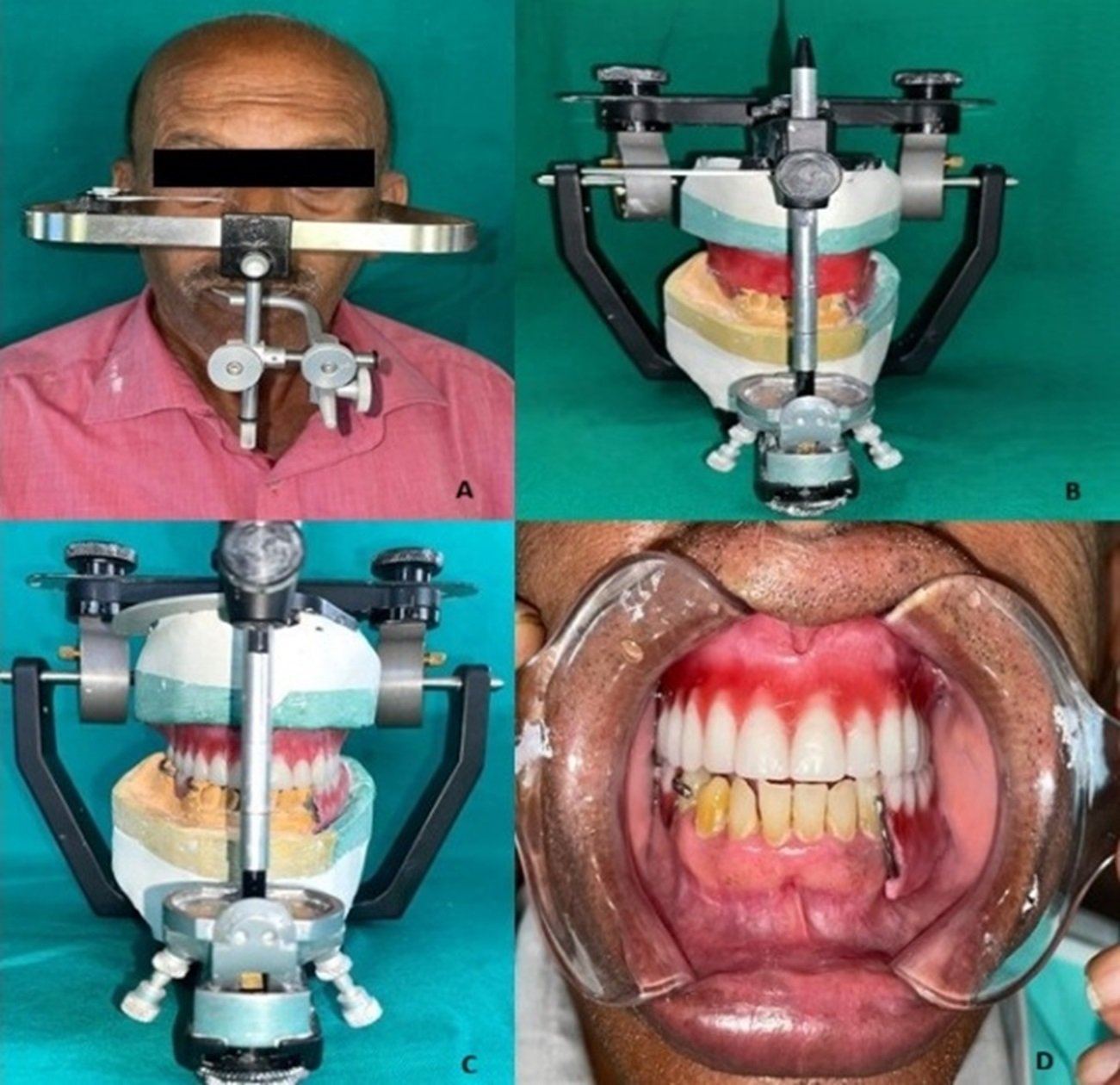
Fig 7: (A) Face bow transfer (B) Mounted (C) Teeth arrangement (D) Try in

Fig 8: Final prothesis
Delivery and Follow-up The metal framework reinforced maxillary complete denture and the mandibular cast partial denture were inserted with necessary occlusal adjustments. Post-insertion instructions were provided. The patient reported significant improvement in mastication, retention, stability, and aesthetics at follow-up.

Fig 9: (A) Pre operative (B) Post operative
DISCUSSION
The management of combination syndrome remains a challenge in prosthodontics, as the presence of mandibular anterior teeth opposing a complete maxillary denture often leads to progressive anterior maxillary ridge resorption, tuberosity enlargement, loss of vertical dimension, and instability of the prosthesis. Various treatment modalities have been proposed in the literature, ranging from conventional removable prostheses to implant-supported restorations. However, considering the patient’s systemic condition, financial constraints, and clinical presentation, a metal framework-reinforced maxillary complete denture opposing a cast partial denture was selected in the present case. This approach aimed to provide rigidity, better force distribution, and long-term stability while minimizing the risk of further tissue damage.1,6
The mandibular cast partial denture was designed with an RPI assembly on tooth 33 and simple circlet clasps on 44 and 47, along with a lingual bar major connector, to achieve optimal retention, stability, and stress distribution.7 The use of the altered cast technique for the distal extension base helped record the residual ridge under functional loading, thereby improving mucosal support and reducing stress on the abutment teeth.8
For the maxillary arch, incorporation of a metal denture base enhanced rigidity, thermal conductivity, reduced bulk, and resistance to fracture compared to conventional acrylic dentures.9 These features are particularly beneficial in opposing natural or partially dentate arches, as they help maintain occlusal stability and prevent anterior hyperfunction.
The successful outcome highlights the value of careful treatment planning, mouth preparation, accurate impressions, and framework design in limiting progression of combination syndrome. Regular follow-up with occlusal adjustments and relining is essential for long-term success. This case demonstrates that a metal-reinforced maxillary complete denture opposing a well-designed mandibular cast partial denture can deliver satisfactory function, aesthetics, and tissue preservation when implant therapy is not feasible.
CONCLUSION
Combination syndrome requires careful treatment planning to prevent further tissue destruction and maintain prosthesis function. A metal framework-reinforced maxillary complete denture combined with a well-designed mandibular cast partial denture fabricated using the altered cast technique provides improved support, stability, and stress distribution. This conventional approach offers a predictable, cost-effective, and clinically effective treatment option for patients in whom implant therapy is not feasible.
REFERENCES
- Kelly E. Changes caused by a mandibular removable partial denture opposing a maxillary complete denture. The Journal of Prosthetic Dentistry. 1972?;27(2):140-50.
- Schmitt SM. Combination syndrome: a treatment approach. The Journal of Prosthetic Dentistry. 1985;54(5):664-71.
- Palmqvist S, Carlsson GE. The combination syndrome: a literature review. The Journal of prosthetic dentistry. 2003;90(3):270-5.
- Langer Y, Laufer BZ, Cardash HS. Modalities of treatment for the combination syndrome. Journal of Prosthodontics. 1995;4(2):76-81.
- Kamble S, Jankar A, Gajare S, Bangar B, Patil S, Somwanshi P. Combination syndrome: a review article. MIDSR Journal of Dental Research 2020; 2:14-9.
- Rajendran S. Combination Syndrome. International Journal of Prosthodontics and Restorative Dentistry. 2012?;2(4):156-60.
- Phoenix RD, Cagna DR, DeFreest CF. Stewart’s clinical removable partial prosthodontics.
- Leupold RJ, Kratochvil FJ. An altered-cast procedure to improve tissue support for removable partial dentures. The Journal of Prosthetic Dentistry. 1965?;15(4):672-8.
- Ohkubo C, Kurtz KS, Suzuki Y, Hanatani S, Abe M, Hosoi T. Comparative study of maxillary complete dentures constructed of metal base and metal structure framework. Journal of oral rehabilitation. 2001;28(2):149-56.
Disclaimer from Guident
The views and opinions expressed in articles published in Guident are solely those of the authors and do not necessarily reflect the views of the editors, the editorial board or the publisher, Ivory India. Guident does not endorse any product, technique or treatment described. Clinical content is intended for qualified dental and medical professionals and is not a substitute for individual clinical judgement. Guident, its editors and the publisher accept no liability for any consequence arising from the use of information published in the journal.
How to cite this article
Dr. Sruthi H Prakash, Dr. Naveen YG, Dr. Iramma Shivani. Strategy Against Combination Syndrome by Fabrication of Maxillary Metal Reinforced Complete Denture Opposing Mandibular Cast Partial Denture: A Case Report. Guident. 2026 Aug;19(9). Available from: https://guident.in/articles/prosthodontics/strategy-against-combination-syndrome-by-fabrication-of-maxillary-metal-reinforced-complete-denture-opposing.html