Restoring Function and Esthetics for Patients with Ectodermal Dysplasia
Department of Prosthodontics, Career Post Graduate Institute of Dental Science and Hospital Lucknow Up, India
ABSTRACT
Ectodermal Dysplasia represents a group of inherited disorder in which two or more ectodermally derived anatomical structures fail to develop. Early dental intervention can improve patient’s appearance and can reduced associated emotional and psychological problem in such type of patients. The course of treatment should be directed to restore esthetics, function, to normalize vertical dimension and provide support to the soft tissues.
KEY WORDS-Hereditary ectodermal Dysplasia, Trichondysplasia, Ectodermal dysplasia, Genetic disorder, Syndrome.
INTRODUCTION
- Congenitally missing teeth is a common developmental anomaly seen in dentistry by dental professionals. More than 120 syndromes are associated with anodontia in which Ectodermal Dysplasia and Downs’s syndrome are most common.
- The Ectodermal Dysplasias represent a heterogenic group of genetic disorders characterized by developmental dystrophies of ectodermal derivatives. It could be inherited as an autosomal dominant, autosomal recessive or as an X- linked genetic disorder.The estimated incidence of Ectodermal Dysplasia is 1% per 100,000 births worldwide.
- One such case of a female patient with characteristic features of Ectodermal DSysplasia including partial anodontia is presented in this case report. She was rehabilitated with a maxillary fixed dental prosthesis and a mandibular overlay denture to restore function and esthetics.
CASE REPORT
- A 22 yrs old female patient reported to the Department of prosthodontics & crown and bridge Career post graduate institute of dental sciences and Hospital Lucknow with the chief complaint of Lack of esthetics, Difficulty in mastication due to congenitally missing teeth. She also complaint of lack of self-confidence and was going through under psychological trauma.There was no similar history in the family. Past medical and treatment history was insignificant.
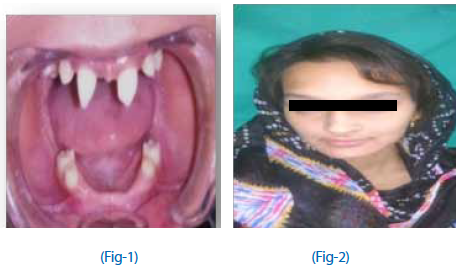
- On general physical examination, patient revealed sparse hair, Frontal bossing, Everted lips, soft, thin and dry skin with decreased lower facial height (Fig-1).
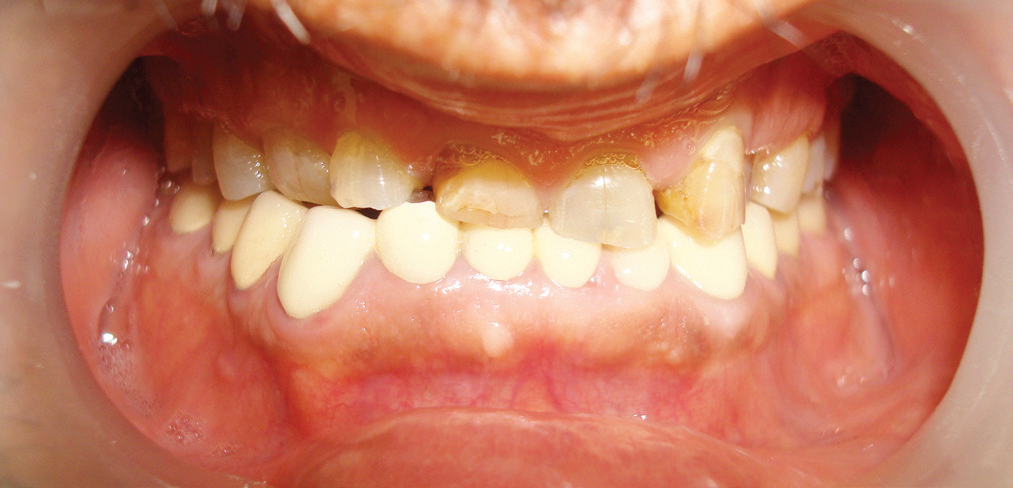
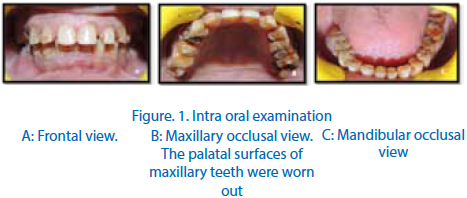
- Intra oral findings of the patient revealed Partial anodontia, hypoplastic peg shaped or conical teeth, generalized spacing and underdeveloped alveolar ridge (Fig-2). OPG showed presence of few teeth i.r.t. 13, 1C, 1E, 23, 2C, 2D, 3D, 3E, 4D & 4E.
- The treatment option preferred was fixed prosthesis to restore maxillary teeth and an overlay mandibular denture to restore lower arch.
- Diagnostic impression was made with irreversible hydrocolloid material (Alginate chromatic jelgrate DENSPLY) and the cast was poured in type III dental stone (Fig-3).

(Fig-3)
articulator and diagnostic wax-up was carried out to ensure esthetic and comfort of the patient (Fig-4). After that intentional root canal treatment was carried out i.r.t, 13 & 23, required preparation was done and final impression was made using elastomeric impression material (FLEXCEED vinyl polysiloxane) (Fig-5).
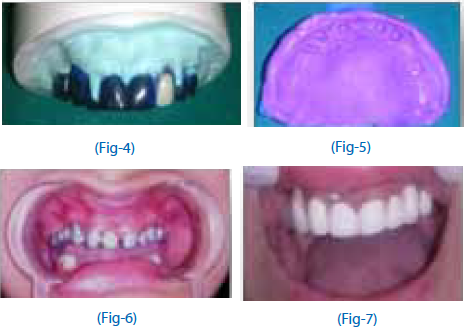
- Cast was poured using type IV dental stone and metal coping trial was carried out to check fit and clearance of the prosthesis and then permanent cementation of the final restoration was done (Fig-6)& (Fig-7).
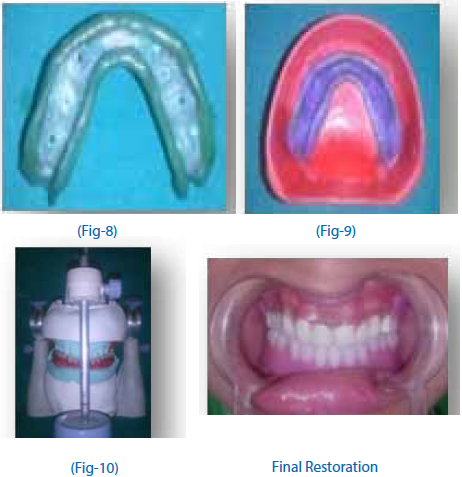
- The Border molding of the mandibular arch was completed and the final impression was made using same elastomeric impression material (FLEXCEED vinyl polysiloxane &light body vinyl polysiloxane impression material) and cast was poured (DENSTONE type III) (Fig-8)(Fig- 9).
- Maxillary impression was made to replace maxillary posterior teeth with a Removable partial denture. After recording Jaw relation, teeth arrangement was done, followed by curing of denture in a conventional manner (Fig-10).
DISCUSSION
Hereditary Ectodermal Dysplasia is a condition, which is associated with the deformation of one or more ectodermal derivatives and typically inherited as a cross linked recessive trait. Hence it generally affects males rather than females.
In the present case report, a case of a female patient with Hereditary Ectodermal Dysplasia is discussed and rehabilitated with fixed maxillary prosthesis and an overlay mandibular denture. Many treatment modalities like implant retained, maxillofacial and removable prosthesis including overlay and over dentures can be used for rehabilitating such type of patients, depending upon age and the number of remaining natural teeth.
In the present case, a fixed prosthesis was opted as a treatment option to restore and rehabilitate the maxilla as sufficient number of teeth were present with optimum crown root ratio and good bony support to be used as abutments and also to fulfill patient expectations as the patient was very keen to have good esthetics. The mandibular arch was restored by giving an overlay denture to preserve the remaining natural teeth as well as remaining alveolar bone.
Option for Implant retained prosthesis was ruled out as bone height was insufficient to place them and as well as because of patient disinterest.
CONCLUSION
Young patients with Ectodermal Dysplasia need to be evaluated early by a dental professional to determine the oral ramifications of the conditions. When indicated, appropriate care needs to be rendered throughout the child’s growth cycle to maintain oral functions as well as to address the aesthetic needs of the patient.
The option for a definitive treatment for young female patient with Ectodermal Dysplasia could be fixed, removable or implant supported prosthesis, singly or in combination depending on number of remaining teeth, age and patients need, as with proper care and prosthodontic treatment, patient can enjoy a relatively normal life.
REFERENCES
- J. Varsha Murthy, Rucha Vaze: Prosthetic Management of an Ectodermal Dysplasia: A Case Report. People’s Journal of Scientific Research, July 2010; 3(2):37-40.
- Jyothi Sharma, GP Mamatha:HEREDITARY ECTODERMAL DYSPLASIA : Diagnostic Dilemmas. Rev Clín Pes Odontol. 2008 jan/abr;4(1):35-40.
- Karla Almeida Viera, Milena Schaaf Teixeira, Cecilia Gatti Guirado, Maria Beatriz Daurte Gaviao:Prosthodontic treatment of hypohidrotic ectodermal dysplasia with complete anodontia:Case Report. Quitessence Int 2007;38:75-80.
- Shigli A, Reddy R.P.V, Hugar S.M,Despande D.Hypohidrotic ectodermal dysplasia: A unique approach to esthetic and prosthetic management : Case Report. J Indian Soc Pedo Prev Dent, 2005:31-35.
- Ellis RK, Danly KJ, Wild TW: Indirect composite resin crowns as an aesthetic approach in treating ectodermal dysplasia – A case report. Quintessence International, 1992; 23:727-729.
- Hickey AJ: Prosthetic treatment for patients with ectodermal dysplasia. Journal of Prosthetic Dentistry, 2001; 86:364-368.
- Pigno MA, Blackman RB, Cronin RJ, Cavazos E. Prosthodontic management of ectodermal dysplasia: A review of literature. J Prosthet Dent1996; 76: 541-5.
- Itthagarun A, King NM. Ectodermal Dysplasia: a review and case report. QuintessenceInt. 1997 Sep;28(9):595-602.
- Nowak AJ, Dental Treatment for patients with ectodermal dysplasia, birth defects 1988;24:243-52.El- Tony MK, Fetelh RM. Hereditary hypohidrotic ectodermal dysplasia with anodontia: a case report. Saudi Dent J. 1994;6 (1):31-34.
- Vikash Ranjan, Rangoli Bhargava, M.K. Sunil, Rahul Bhargava: Ectodermal Dysplasia – A Case Report & Review of Literature. www.journalofdentofacialsciences.com, 2013; 2(1): 27-30.
Disclaimer from Guident
The views and opinions expressed in articles published in Guident are solely those of the authors and do not necessarily reflect the views of the editors, the editorial board or the publisher, Ivory India. Guident does not endorse any product, technique or treatment described. Clinical content is intended for qualified dental and medical professionals and is not a substitute for individual clinical judgement. Guident, its editors and the publisher accept no liability for any consequence arising from the use of information published in the journal.
How to cite this article
Dr.Sayrabh Singh, Dr.PRATIBHA KATIYAR. Restoring Function and Esthetics for Patients with Ectodermal Dysplasia. Guident. 2016 Jun;9(7). Available from: https://guident.in/articles/prosthodontics/restoring-function-and-esthetics-for-patients-with-ectodermal-dysplasia.html