Componeers : A Breakthrough in Veneer Technology
Department of Conservative Dentistry & Endodontics, IMS, BHU, Varanasi
ABSTRACT
Veneering of anterior teeth is a kind of conservative esthetic restoration used for teeth that are malformed, discolored, abraded, eroded or having faulty restorations. Recently introduced Componeer is a direct composite veneer system. These are polymerized prefabricated nanohybrid composite enamel shell that combine advantages of direct composite restoration and advantages of lab made veneer such as improved wear rasistence, excellent esthetic appearance. This case report describe a clinical case step-by step which is used to restore function and esthetics of anterior teeth in one office visit.
Key words: Componeers, Nanohybrid , Esthetic , Resistance
INTRODUCTION
Esthetic dentistry is a specialized art and science that can dramatically improve your smile, appearance and self-esteem. Recent advances in adhesive dentistry and increasing clamor for esthetic dentistry have led to evolution of new materials and various techniques . Veneering of anterior teeth is a minimally invasive esthetic restoration, which was brought to Dentistry by Dr. Pincus as early as 1937.1 One such breakthrough in veneer technology is introduction of componeer system (Coltene, Altstätten, Switzerland). For veneering of anterior teeth, generally two type of materials are in use either ceramic or composite. Ceramic veneers demonstrate high biocompatibility, high color stability and high abrasion resistence. However, these have numerous undesirable characteristics such as fabrication is time consuming, technique sensitive and it is abrasive for opposing natural tooth structure2. Componeer is a direct composite veneer system. These are extremely thin veneer coatings made from nanohybride composite, thickness ranges from 0.3 to 1 mm which allows a high level of conservation of tooth structure during preparation. These composite veneers are very easy to finish and polish, can be modified before luting without compromising either their adhesive potential or their mechanical properties.3
The purpose of this case report is to describe a clinical case, in which the size and shape discrepancy of teeth were restored with prefabricated composite veneer shells.
CASE PRESENTATION
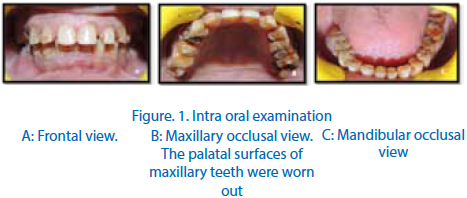
A 25 year old male patient presented in our department with chief complaint of spacing between his front teeth and he was extremely unhappy with his smile. Patient was asthmatic and his dental history was non-contributory. On Clinical examination a size and shape discrepancy in their right and left maxillary lateral incisor was observed (fig.1a,1b,1c). Various treatment options were discussed with patient and the finally decision was made to restore both maxillary lateral incisor with prefabricated composite veneers to correct size and shape discrepancy of teeth and to enhance esthetics of his smile

SHADE AND SIZE SELECTION
Shade is selected with the help of synergy D6 shade guide which contains six dentine cores (A1/B1,A2/B2,A3/B3) and two Enamel shells (Bleach opaque and white opalescent shade) (Fig. 2). At the time of shade selection, Enamel shell suprimeposed over dentin core and then placed adjacent to teeth to determine approximate final colour in presence of day light. In this case dentine shade was A3/B3 while enamel shade was white opalescent for both maxillary right and left lateral incisor. The Patient had darker shade in cervical areas as compared to incisal areas of all other anterior teeth so it was decided to use coloured composites (Paint on color, coltene) (Figure.3). Size selection was done with contour guide which comes with different sizes i.e. S,M,L,XL for upper anterior teeth and in S,M size for lower anterior teeth (Figure.4). Size “L” was selected for both teeth. Often slightly wider and longer shell is preffered as it helps in customizing the veneer with abrasive disk to match the shape of natural teeth .
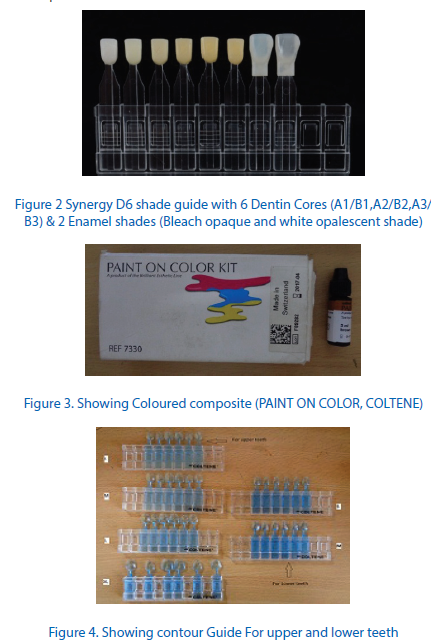
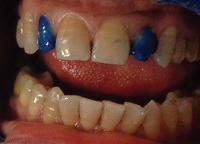
Figure 5. Showing etching of tooth surface with 37% phosphoric acid
PROCEEDURE
Isolation was achieved with cotton rolls. Preparation of tooth should be kept minimal, uniform and restricted entirely to enamel whenever possible. Buccal surface was prepared with round end tapered fissure bur. Cervical margin was defined with round bur no.2. It is important to try composite shell over tooth surface some times to guide the gradual tooth reduction. After making adjustment to composite shells, final tryin was carried out.
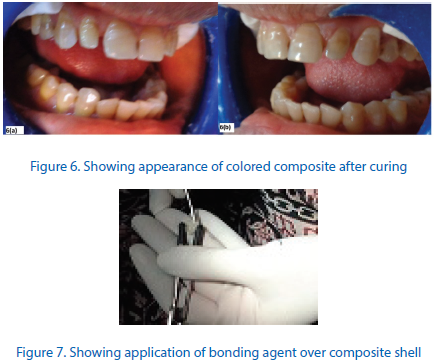
Preparations were etched with 37% phosphoric acid (Fig.6) for 20 seconds followed by rinsing with water for 60 seconds and dried moist. Adhesive (one coat bond , coltene) was applied and light cured for 20 seconds. Then Brown colour composite was applied with help of brush on facial surfaces ( cervical areas of both maxillary lateral incisor ) as it will help in achieving final approximate colour of adjacent teeth and light cured for 20 seconds (fig. 6a,6b). Bonding agent was applied to inner surface of composite shell and left uncured (fig.7). Previously selected dentin shade (A3/B3) was applied on to the tooth surface. Then composite shell was placed over the tooth surface and aligned properly with help of componeer placer.(fig.8). Excess material was removed with the help of componeer modeling instrument and light cured for 40 seconds cervically and then from incisal and palatal aspect respectively. Abrasive strips were used for finishing and polishing of interproximal areas. Silicon rubber points were used to finish margins while flexible aluminium oxide disks( Super-Snap mini kit, SHOFU) were used to adjust the incisal aspect. Post operative view of patient was shown in figure 9.(a), 9.(b), 9.(c).
DISCUSSION
Vennering of anterior teeth can be done with direct (with Composite) or indirect technique (with composite or ceramic veneer). Most commonly used techniques for composite restoration is natural layering technique4. This techniques has various advantages like no impression is recquired, fewer appointment is needed as compared to lab made veneer. However Many studies reported that direct composite restoration often suffers from loss of surface shine, marginal discoloration , wear and tear over the course of time.5 This Prefabricated composite veneer system (componeer , coltene) has advantage of both direct composite as there is no need of impression & lab work , single appointment procedure and of laboratory processed veneer such as improved wear resisitence, excellent esthetics. Veneering composites have a volume percentage of inorganic fillers (approximately 66%) which results in improved mechanical properties with a flexural strength between 120 and 160 MPa and an elastic modulus of 8.5 -12 GPa.6 Most veneering composite applied with a post-curing process that result in better flexural strength compared to ceramic veneer, less polymerization shrinkage, and wear rate comparable to tooth enamel7. As this prefabricated composite veneer system (componeers) have been recently introduced and they are not widely used so the technique mentioned in this paper will help in restoring function and esthetics of anterior teeth in one office visit.
CONCLUSION
Until now the dentist could only choose between a direct composite restoration or elaborate indirect veneer technology. This Direct Composite Veneering System will add a new and interesting dimension to existing treatment options and gives patients new economic perspectives. Prefabricated composite veneers have some advantages of direct composite restorations, as only one session is required without the need to make impressions or laboratory work. Additionally, the restorations can be customized (color and shape) and are more affordable than other indirect restorations, resulting in a very esthetic outcome.
REFERENCES
- Dietschi D, Devigus A. Prefabricated composite veneers: historical perspectives, indications and clinical application. Eur J Esthet Dent. 2011;6(2):178-87.
- Conrad HJ, Seong WJ, Pesun IJ. Current ceramic materials and systems with clinical recommendations: A systematic review. J Prosthet Dent 2007;98:389–404.
- Mangani F, Cerutti A, Putignano A. Clinical approach to anterior adhesive restorations using resin composite veneers. Eur J Esthet Dent 2007;2:188–209.
- Pontons-Melo JC. A direct composite resin stratification technique for restoration of the smile. Quintessence Int 2011;42:205–11.
- Peumans M, Van Meerbeek B, Lambrechts P, Vanherle G. The 5-year clinical performance of direct composite additions to correct tooth form and position. II. Marginal qualities. Clin Oral Investig 1997;1:19–26.
- Borba A, Bona DA, Cecchetti A. Flexural strength and hardness of direct and indirect composites. Braz Oral Res 2009;23:5-10.
- Ferracene JL, Condon JR. Post-cure heat treatment for composite properties and fractographie. Dent Mater 1992;8:290-295.
Disclaimer from Guident
The views and opinions expressed in articles published in Guident are solely those of the authors and do not necessarily reflect the views of the editors, the editorial board or the publisher, Ivory India. Guident does not endorse any product, technique or treatment described. Clinical content is intended for qualified dental and medical professionals and is not a substitute for individual clinical judgement. Guident, its editors and the publisher accept no liability for any consequence arising from the use of information published in the journal.
How to cite this article
Dr. Neelam Mittal, Dr. Pragati Sachan. Componeers : A Breakthrough in Veneer Technology. Guident. 2016 May;9(6). Available from: https://guident.in/articles/prosthodontics/componeers-a-breakthrough-in-veneer-technology.html