Rehabilitation of a Severely Resorbed Mandibular Ridge Using the Neutral Zone Technique: A Case Report
Department of Prosthodontics and Crown & Bridge, K.D. Dental College & Hospital, Mathura, UP, India
ABSTRACT
Severe mandibular ridge resorption significantly compromises denture stability due to reduced support and an increased influence of surrounding musculature. In such cases, conventional complete denture fabrication techniques often fail to provide satisfactory outcomes. The neutral zone technique offers a functional approach by positioning denture teeth and polished surfaces within the zone of muscular equilibrium between the tongue and perioral muscles. This case report describes the prosthodontic rehabilitation of a patient with a severely resorbed mandibular ridge using the neutral zone technique for complete denture fabrication. The use of this approach resulted in improved denture stability, comfort, and patient satisfaction.
Keywords: Neutral zone, severely resorbed ridge, mandibular denture, complete denture, muscle balance
INTRODUCTION
Residual ridge resorption is a chronic, progressive, and irreversible process following tooth loss and is considered a major factor affecting the prognosis of complete dentures.1 The mandible undergoes greater and faster resorption compared to the maxilla, frequently resulting in a flat or narrow ridge with high muscle attachments.2 These anatomical changes significantly compromise denture retention and stability, making prosthodontic rehabilitation challenging. Conventional denture construction relies primarily on ridge anatomy for support. However, in severely resorbed ridges, muscular forces from the tongue, lips, and cheeks often dislodge the denture rather than stabilize it.3 The neutral zone concept is based on positioning denture teeth and contouring polished surfaces within the zone where the forces of the tongue are balanced by those of the lips and cheeks, thereby enhancing denture stability.4
The neutral zone is defined as the potential space between the lips and cheeks on one side and the tongue on the other, that area or position where the forces between the tongue and cheeks or lips are equal.Fish (1931) originally explained how polished surfaces affect stability and retention. Additionally, he explained how complete dentures can be fabricated in the “neutral zone. Bates referred to it as the "Reciprocal zone," "Zone of minimum conflict," by Mathew, "Zone of neutral muscular forces” by Fenn, Heath as the "Denture space," Robert as the "Potential space," and Russell as the "Reciprocal space.5
This case report presents the clinical application of the neutral zone technique in the rehabilitation of a severely resorbed mandibular ridge.
CASE REPORT
A 65-year-old male patient reported to the Department of Prosthodontics, KD Dental College, Mathura, with the chief complaint of poor retention and instability of his mandibular complete denture, resulting in difficulty in mastication and speech. The patient had been edentulous for approximately 10 years and had a history of multiple unsuccessful mandibular dentures. Intraoral examination showed completely edentulous maxillary and mandibular arches. The mandibular ridge was severely resorbed, flat, and narrow with high muscle attachments and a relatively enlarged, active tongue (Figure 1). Based on Atwood’s classification, the ridge corresponded to an advanced stage of residual ridge resorption.1 Considering the unfavorable ridge anatomy and history of denture failure, rehabilitation using the neutral zone technique was planned.
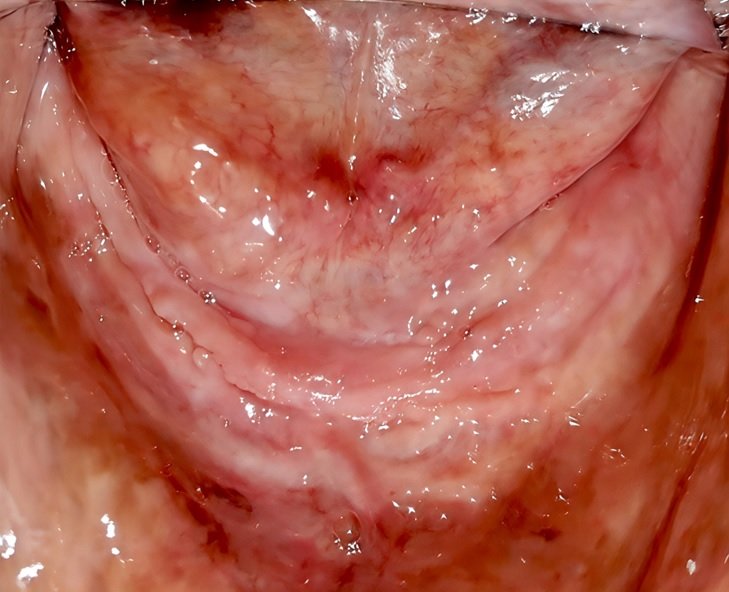
Fig 1
Primary impressions were made using impression compound (Figure 2). Custom trays were fabricated and border molding was carried out. Final impressions were recorded using zinc oxide eugenol impression paste (Figure 3). Master cast was obtained. Acrylic base plates & wax rims were fabricated. Wax rims were adjusted, and Jaw relations were recorded. On the mandibular master cast, another baseplate was fabricated, and a 22-gauge orthodontic wire loop was made. These loops were used to adhere the admixed impression material for neutral zone recording (Figure 4). A mixture ratio of 7 parts impression material and 3 parts green stick material was utilized to capture the neutral zone. Admix material was softened in warm water at 65 °C and loaded onto the record base with loops and placed intraorally. Patient was instructed to do puckering, smiling, wide mouth opening, wetting the upper and lower lips, whistling, and loudly speaking the words ‘A, E, and O’ to record the neutral area (Figure 5). The Addition Silicone putty index was fabricated to preserve the recorded contours (Figure 6), in which melted wax was poured to make the rim, and mandibular teeth were arranged within the neutral zone. After the try-in evaluation (Figure 7), the dentures were processed using heat-cured acrylic resin and delivered to the patient (Figure 8).

Fig 2
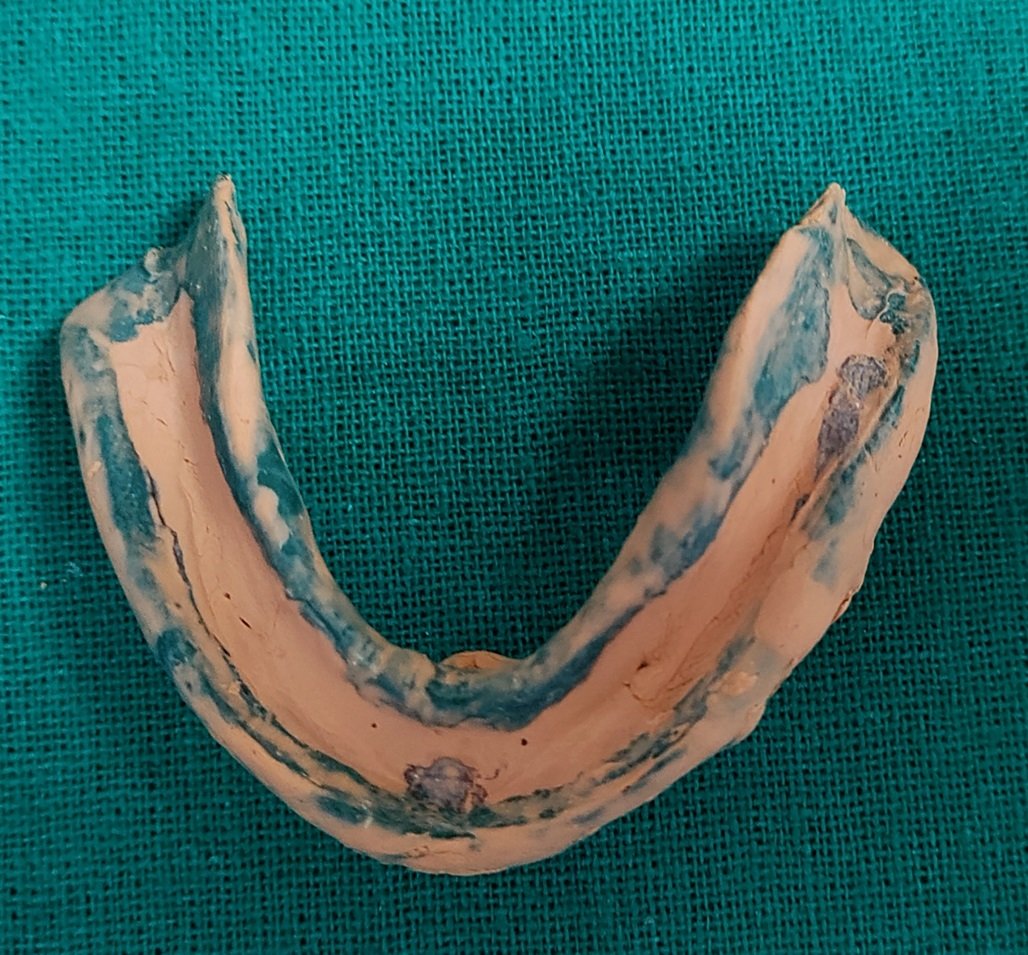
Fig 3

Fig 4

Fig 5
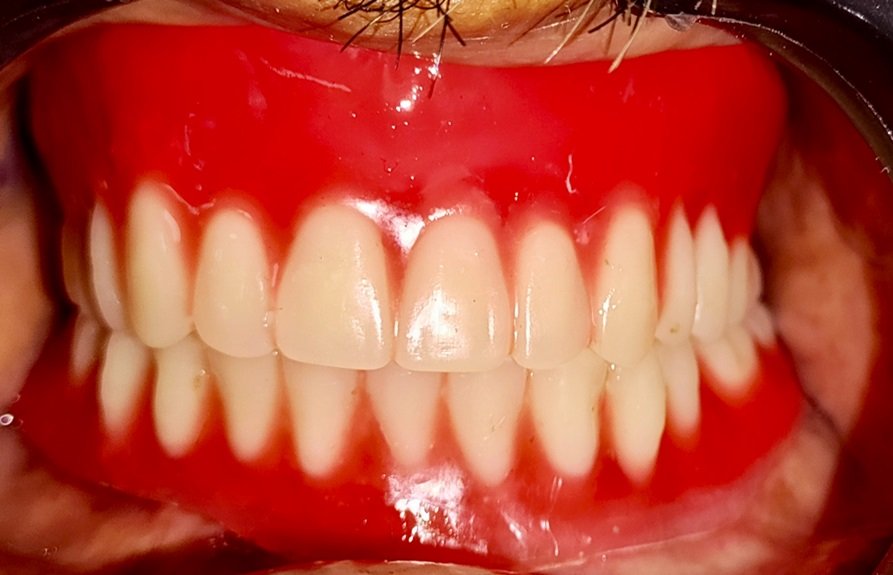
Fig 6
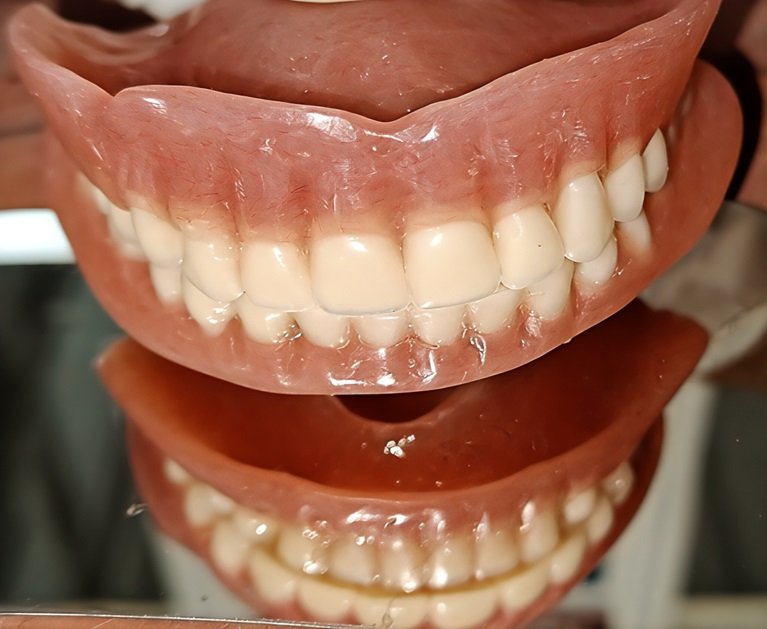
Fig 7
DISCUSSION
Management of severely resorbed mandibular ridges remains one of the most challenging aspects of complete denture prosthodontics due to reduced denture-bearing area and dominant muscular forces.2,7 Conventional techniques often fail to provide adequate stability in such cases. The neutral zone technique utilizes the balance between tongue pressure and perioral musculature to stabilize the denture rather than oppose muscular forces.4 Dentures fabricated using this concept demonstrate improved stability, better tongue space, enhanced phonetics, and increased patient comfort.6,8 Although the technique is time-consuming and technique-sensitive, its advantages outweigh the limitations in selected cases.9,10
CONCLUSION
The neutral zone technique is a biologically sound and effective approach for rehabilitating patients with severely resorbed mandibular ridges. Neutral zone recording is a rapid, accurate, non-invasive, and cost-effective method. Proper recording of the neutral zone and muscle-guided denture construction significantly improves denture stability, comfort, and patient satisfaction.
REFERENCES
- Atwood DA. Reduction of residual ridges: a major oral disease entity. J Prosthet Dent. 1971;26:266–279.
- Carlsson GE. Clinical morbidity and sequelae of treatment with complete dentures. J Prosthet Dent. 1998;79:17–23.
- Zarb GA, Bolender CL. Prosthodontic Treatment for Edentulous Patients. 12th ed. St. Louis: Mosby; 2004.
- Beresin VE, Schiesser FJ. The Neutral Zone in Complete Dentures. St. Louis: Mosby; 1973.
- Fish EW. Principles of full denture prosthesis. Br Dent J. 1931;52:357–368.
- Lott F, Levin B. Flange technique: an anatomic and physiologic approach to complete dentures. J Prosthet Dent. 1966;16:394–413.
- Winkler S. Essentials of Complete Denture Prosthodontics. 2nd ed. New Delhi: AITBS; 2009.
- Jacobson TE, Krol AJ. A contemporary review of the neutral zone. J Prosthet Dent. 1983;49:388–393.
- Heartwell CM, Rahn AO. Syllabus of Complete Dentures. 5th ed. Philadelphia: Lea & Febiger; 1986.
- Anand Kumar R, Prasad KB. Neutral zone impression technique for mandibular compromised ridges. Int J Dent Med Res. 2014;1(4):79–82.
Disclaimer from Guident
The views and opinions expressed in articles published in Guident are solely those of the authors and do not necessarily reflect the views of the editors, the editorial board or the publisher, Ivory India. Guident does not endorse any product, technique or treatment described. Clinical content is intended for qualified dental and medical professionals and is not a substitute for individual clinical judgement. Guident, its editors and the publisher accept no liability for any consequence arising from the use of information published in the journal.
How to cite this article
Dr. Prachi Bansal, Dr. Shubham Chavhan, Dr. Siddharth Sisodiya. Rehabilitation of a Severely Resorbed Mandibular Ridge Using the Neutral Zone Technique: A Case Report. Guident. 2025 Dec;19(1). Available from: https://guident.in/articles/prosthodontics/rehabilitation-of-a-severely-resorbed-mandibular-ridge-using-the-neutral-zone-technique-a-case-report.html