Extended Emax Endocrown: A Novel Approach for Molar Rehabilitation with Radicular Extension – a Three-Year Follow-Up Case Report
MDS, Prosthodontics from GDC Rohtak, MMCDSR, Mullana, Gold Medalist, IDA, IDC Speaker, Zenith Skin Hair And Dental Centre, Rohtak Road, New Delhi, India.
ABSTRACT
Restoring extensively damaged molars, especially those with missing walls, poses a significant challenge in prosthodontics. Conventional crowns and post-core restorations often have limitations in terms of retention, fracture resistance, and long-term success. This case report presents an innovative approach—Extended Emax Endocrowns, where a lithium disilicate (IPS e.max) restoration incorporates a 3 mm radicular extension into the pulp chamber and radicular area, emphasizing saddle anatomy for enhanced stability. A three-year follow-up demonstrated excellent clinical performance, with no signs of failure, reinforcing the reliability of this technique.
INTRODUCTION
Endocrowns have emerged as a reliable alternative to traditional post-and-core restorations, particularly for endodontically treated molars.1 However, when a molar has one or more missing walls, achieving sufficient retention and stability remains a concern. This case introduces the Extended Emax Endocrown, a modification of the conventional endocrown, incorporating a radicular extension that utilizes saddle anatomy and increased surface area for additional reinforcement.
This concept diverges from standard endocrowns by extending the restoration 2-4 mm into the root canal, optimizing load distribution and structural integrity. The lithium disilicate (IPS e.max) material provides superior esthetics and fracture resistance, making it a viable long-term solution.
CASE PRESENTATION
Patient Profile
Age/Gender: 22-year-old female
Chief Complaint: Difficulty in chewing and mild discomfort in the upper left region
Clinical Examination:
Endodontically treated maxillary first molar, palatal, mesial and distal wall missing due to previous fracture. There was satisfactory periapical healing with no signs of infection.
And there was already an adequate occlusal clearance for the crown.
Treatment Plan
Given the structural compromise, a conventional endocrown posed a risk of dislodgment due to inadequate cervical sidewalk.2,3 Instead, an Extended Emax Endocrown was planned, integrating a radicular extension of 3 mm (2-4 mm is recommended in the biggest canals) to enhance stability via saddle anatomy, ensuring a secure fit and better stress distribution.
CLINICAL PROCEDURE
1. Tooth Preparation
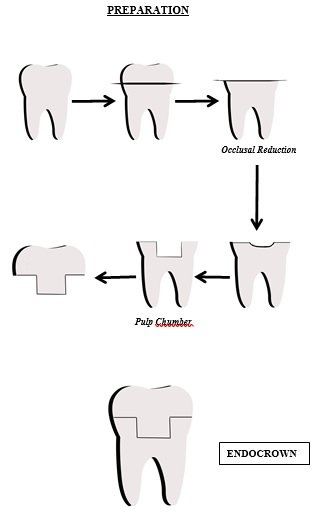
The occlusal surface was flattened, and a butt-joint margin5 was established.
The pulp chamber was carefully extended into the radicular space (2-4 mm) without violating the canal walls, forming a saddle-like adaptation.
2. Impression & Fabrication
A digital impression was taken using an intraoral scanner(nobelbiocare).
The Extended Emax Endocrown was designed with CAD/CAM, ensuring precise adaptation.IPS e.max lithium disilicate was selected for its high strength (400 MPa) and esthetic translucency.
3. Lute
The restoration was bonded using a dual-cure self adhesive (3M Relyx U200) resin cement.
Occlusion was carefully adjusted to prevent excessive stress.

FOLLOW-UP & OUTCOME
1-Year Follow-Up: No microleakage, excellent marginal adaptation, and patient satisfaction.
2-Year Follow-Up: No secondary caries, stable occlusion, and intact restoration.
3-Year Follow-Up: The Extended Emax Endocrown remained functionally intact, demonstrating zero debonding, no fracture, and optimal periodontal health.
DISCUSSION
Key Advantages of Extended Emax Endocrowns:
- Enhanced Stability: The radicular extension reinforces retention, overcoming limitations of standard endocrowns.
- Optimized Load Distribution: Saddle anatomy aids in even stress distribution, reducing the risk of fracture.4,5
- Minimally Invasive: Unlike post-and-core restorations, this technique preserves more dentin, enhancing long-term prognosis.6
- Aesthetic & Functional Superiority: IPS e.max ensures lifelike translucency and durability, making it an ideal choice for molars in comparison with Conventional Restorations
CONCLUSION
The Extended Emax Endocrown represents a significant advancement in the restoration of structurally compromised molars. By incorporating a 2-4 mm radicular extension, this technique enhances stability and longevity, as evidenced by the successful three-year follow-up. This case highlights the potential of lithium disilicate restorations in providing aesthetic, functional, and durable solutions for endodontically treated teeth with compromised walls.
Clinical Significance
This technique can be a game-changer in prosthodontic rehabilitation, particularly for molars with missing walls, eliminating the need for aggressive post-and-core restorations while maintaining structural integrity and longevity.
REFERENCES
- Gupta R, Thakur S, Pandey NK, Roopa B, Fares KT. Endocrown - A Paradigm Shift in Rehabilitation: A Report of Two Cases. Contemp Clin Dent. 2021
- Case Report Post Endodontic Restoration with Novel Endocrown Approach: A Case Series J res adv dent 2018
- Endocrown preparation: Review International Journal of Applied Dental Sciences 2019; 5(1): 253-256
- Houda Dogui, Feriel Abdelmalek, Adel Amor, Nabiha Douki, "Endocrown: An Alternative Approach for Restoring Endodontically Treated Molars with Large Coronal Destruction", Case Reports in Dentistry, vol. 2018
- Fracture Resistance and Failure Mode of Endocrown Restorations with Different Remaining Walls and Finish Lines Sara Koosha the open dentistry journal 2022
- A Thorough Analysis of the Endocrown Restoration: A Literature Review April 2021 The Journal of Contemporary Dental Practice 22(4):422-426
Disclaimer from Guident
The views and opinions expressed in articles published in Guident are solely those of the authors and do not necessarily reflect the views of the editors, the editorial board or the publisher, Ivory India. Guident does not endorse any product, technique or treatment described. Clinical content is intended for qualified dental and medical professionals and is not a substitute for individual clinical judgement. Guident, its editors and the publisher accept no liability for any consequence arising from the use of information published in the journal.
How to cite this article
Dr. Aparna Singhal. Extended Emax Endocrown: A Novel Approach for Molar Rehabilitation with Radicular Extension – a Three-Year Follow-Up Case Report. Guident. 2025 Feb;18(3). Available from: https://guident.in/articles/prosthodontics/extended-emax-endocrown-a-novel-approach-for-molar-rehabilitation-with-radicular-extension-a-three-year.html