Facial Attractiveness and Orthodontics: An Overview
Department of Orthodontics and Dentofacial Orthopedics, SGT Dental College and Hospital, Gurgaon, Haryana, India
INTRODUCTION
The concept of aesthetics is constantly changing, and in the last few decades, it has become increasingly significant in the orthodontics field. In the context of orthodontics, the significance of aesthetics cannot be overstated, but it has frequently been viewed as secondary to reaching a perfect occlusion for an ideal functional occlusion.1
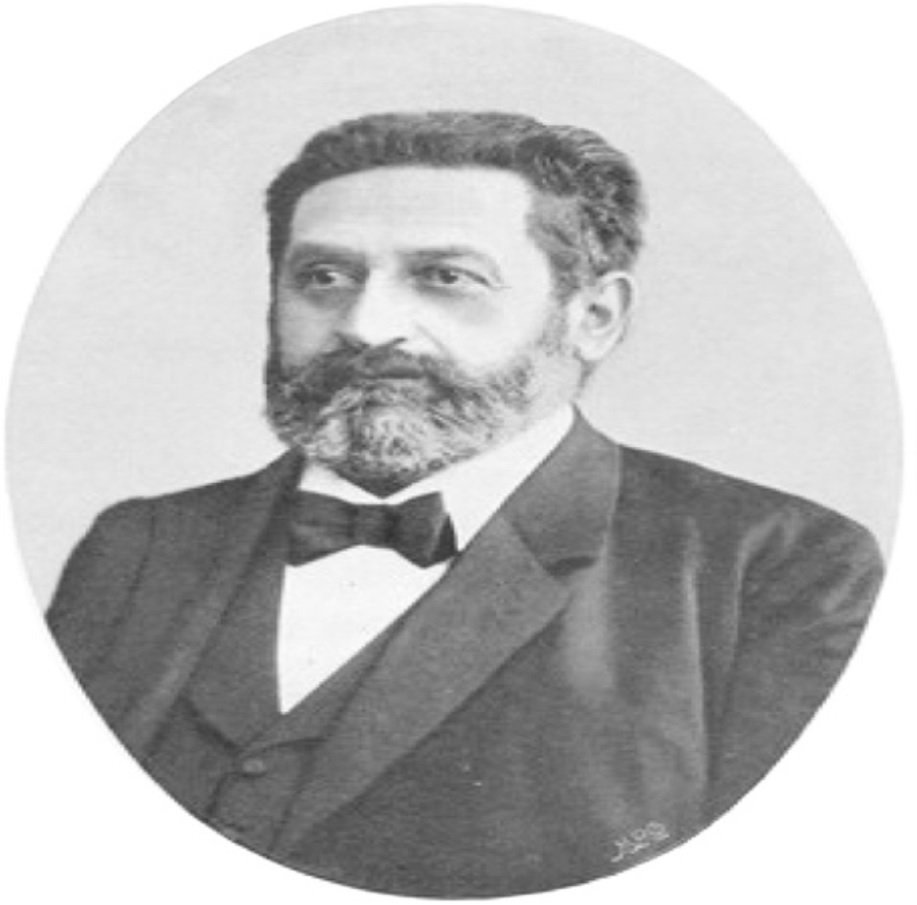
Edward H. Angle2 dedicated chapter II (8 pages) of his textbook's sixth edition, which was released in 1900, to "Facial art—line of harmony." He discussed regarding his "line of harmony," a vertical line that "perfectly harmonizes" with the glabella, subnasale, and pogonion in the profile.3
Lately, aesthetics is a necessary component of the idealized treatment goal and is required to attain a satisfactory result. Prior to treatment, it is important to acknowledge the patient's perception of their face because an orthodontist's and layperson's perspectives on aesthetics differ.4,5 Furthermore, rather than strict adherence to typical average skeletal and dental norms, the treatment goals should aim for a balanced and harmonious facial profile.6
ASSESMENT OF DENTAL ESTHETICS
The three fundamental prerequisites for evaluating dentofacial esthetics are: A dynamic and static three-dimensional assessment of the face during clinical evaluation, an analysis of the relationship between the lips and teeth, and an examination of the anterior teeth's display (both at rest and function)7
The following are the three aesthetic divisions assessed in orthodontic diagnosis:
- Macroesthetics
- Miniesthetics
- Microesthetics
MACROESTHETICS
Frontal and lateral (profile) assessment is done
An ideal proportion of face can be divided transversely into equal fifths. The central and medial fifths should determine the eyes' width and separation. With the nose's width equal to or marginally greater than the central fifth, the chin and nose should be cantered within it. The interpupillary distance and mouth width should ideally match.8 (Fig. 1)
Convex, concave, and straight profile estimations are used as a guide to ascertain the underlying skeletal relationship and whether the jaws are positioned proportionately in the anteroposterior plane.
Evaluating the vertical thirds of the face and the mandibular plane in a lateral view helps identify vertical growth patterns. A steep mandibular plane angle is typically linked to a longer anterior facial height and a tendency toward a skeletal open bite, while a flatter mandibular plane angle is usually associated with a shorter anterior facial height and a deep bite malocclusion.8 (Fig. 2)
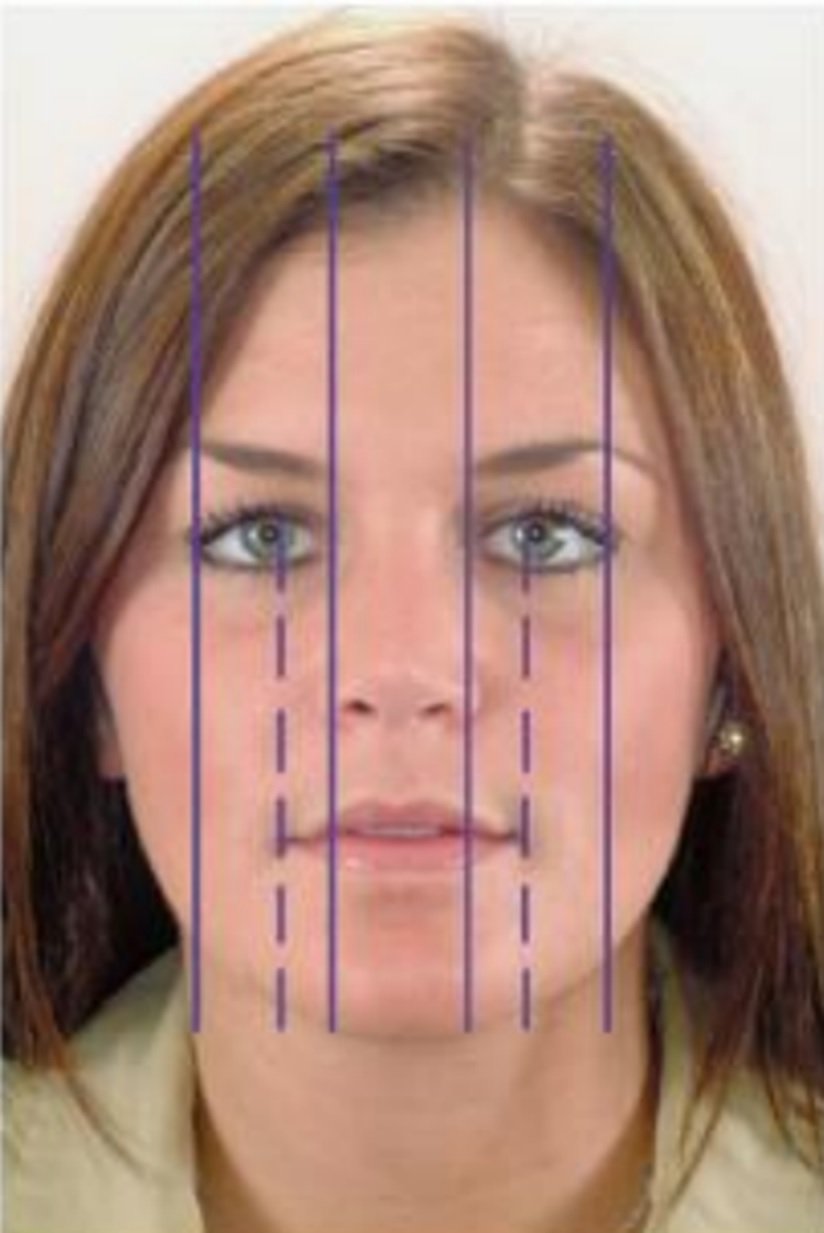
Figure-1: Transverse proportions
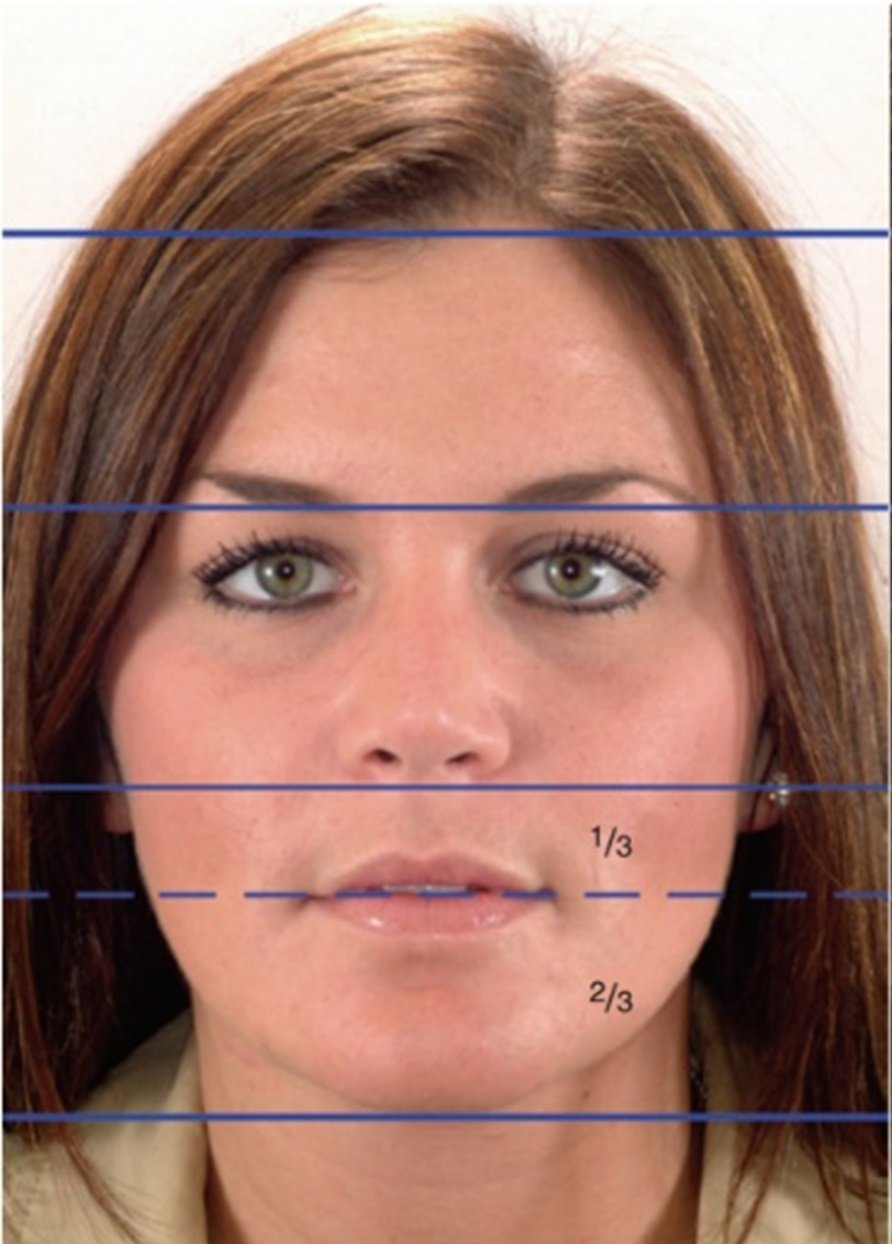
Figure-2: Vertical proportions
MINIESTHETICS
BUCCAL CORRIDOR AND ARCH FORM
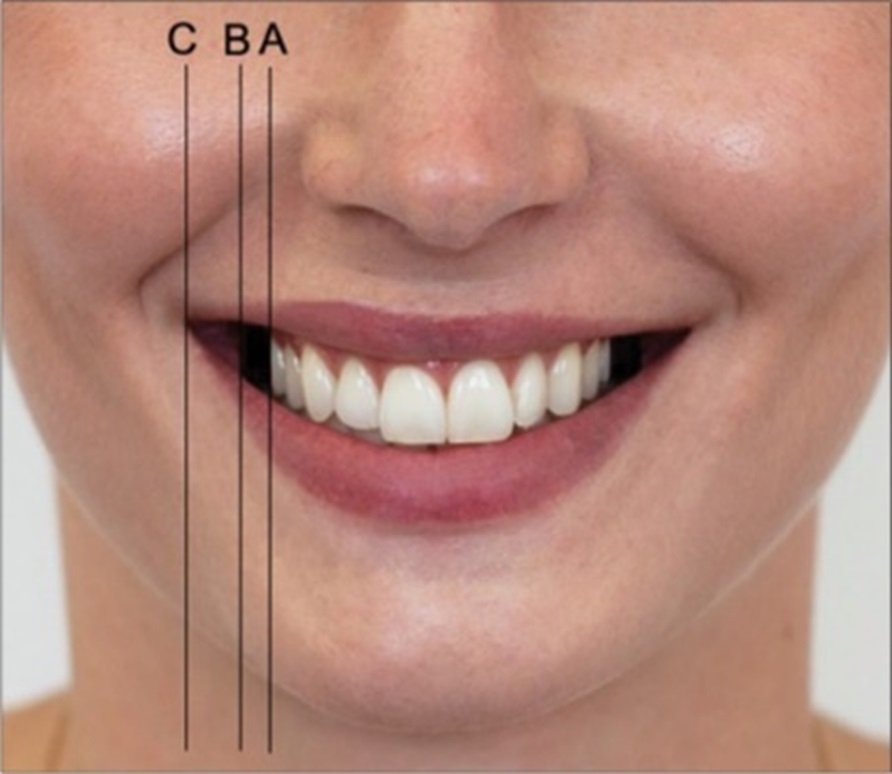
Figure-3: Buccal corridor
It refers to the area between the buccal surface of the posterior teeth and the corner of the lips when a person smiles.9 The existence of buccal corridors is thought to contribute to a more natural-looking smile. However, research has indicated that wider buccal corridors can result in a smile that is perceived as less attractive.10 (Fig. 3)
SMILE ARC

Figure-4: Smile Arcs: (A) Parallel (consonant) smile arc, (B) Straight smile arc, and (C) Reverse smile arc
It refers to the relationship between the curvature of the upper incisors and canines' incisal edges and the curvature of the lower lip when smiling.11 There are three types of smile arcs: parallel (consonant), straight, and reverse. The ideal outcome is to achieve a parallel smile arc.12 (Fig.4)
INCISAL DISPLAY
For a smile to be aesthetically pleasing, at least 75% of the maxillary teeth should be visible, though displaying up to 4 mm of gingiva or having 4 mm of lip coverage over the incisor crown is considered acceptable.13 The most visually appealing smiles have the upper lip aligning with the gingival margin of the upper central incisor. Tjan et al.14 identified three smile types - low, average, and high based on the amount of incisor and gum visibility. (Fig. 5)

Figure-5: Smile Types: (A) Average smile, (B) High smile, and (C) Low smile.
DENTAL MIDLINE

Figure-6: Dental midline
A vertical line drawn from the nasion to the base of the philtrum can serve as a useful reference for identifying the facial midline. During a direct frontal examination, the maxillary midline should ideally be vertical and parallel to the facial midline, or, in the best case, align perfectly with it. (Fig.6)
MICROESTHETICS
TOOTH PROPORTIONS
For a visually balanced smile based on the golden proportion, the apparent width of the lateral incisor should be 62% of the width of the central incisor. Similarly, the apparent width of the canine should be 62% of the lateral incisor, and the apparent width of the first premolar should be 62% of the canine.8 (Fig. 7)
HEIGHT–WIDTH RELATIONSHIPS
The ideal width of a tooth is typically 80% of its height, with Sterrett et al.15 suggesting a range between 0.75 and 0.85. For a central incisor, the width generally falls between 8.1 to 8.6 mm, while the length ranges from 9.5 to 10.2 mm.16 (Fig. 7)
CONNECTORS AND EMBRASURES
The connector area refers to the point of contact between adjacent teeth, while embrasures are the triangular spaces located above this contact, towards the incisal edge.11 (Fig. 7)
GINGIVAL HEIGHT
Generally, the gingival margin of the central incisor and canine are at the same height, whereas the margin of the lateral incisor is positioned 1.5 mm lower. (Fig. 7)
GINGIVAL SHAPE
The gingival shape of the maxillary central incisors and canines is elliptical, with the gingival zenith positioned slightly distal to the tooth’s long axis. In contrast, the gingival shape of the maxillary lateral incisors and mandibular incisors should be symmetrical, resembling a half-oval or half-circle, with the gingival zenith aligning with the tooth’s long axis.17 (Fig. 7)
GINGIVAL CONTOUR
Gingival contouring to remove excess gingival tissue is typically performed through periodontal procedures such as gingivectomy or crown lengthening. On the other hand, gingival recession is commonly addressed with tissue grafts, guided tissue regeneration, or, in certain cases, non-surgical orthodontic extrusion. (Fig. 7)
TOOTH SHADE AND COLOR
The maxillary central incisors are the lightest and most vibrant, with the brightness gradually decreasing in the following teeth. The hue of the maxillary lateral incisors is similar to the centrals, though they are less bright. The canines are the dullest teeth, having the highest chroma (color saturation). The 1st and 2nd premolars, on the other hand, are more similar in color to the laterals and are brighter than the canines. (Fig. 7)

Figure-7: (A) Tooth proportions, (B) Hight width relationship, (C) Connectors and Embrasures, and (D) Gingival Height, Shape, and Contour
CONCLUSION
The revival of the soft tissue paradigm represents a major shift in orthodontics, focusing not only on achieving optimal occlusion but also on improving both dental and facial appearance. This integrated approach takes into account the aesthetic profile of the patient as a crucial element in treatment planning, recognizing that a pleasing facial appearance is as critical, if not more so, than achieving functional dental alignment. By focusing on both functional outcomes and esthetic enhancements, orthodontists can provide patients with results that contribute to both improved health and greater self-confidence.
REFERENCES
- Turley PK. Evolution of esthetic considerations in orthodontics. Am J Orthod Dentofacial Orthop 2015;148(3):374–379.
- Angle EH. Treatment of malocclusion of the teeth and fractures of the maxillae. Angle's system. 1907:21-4.
- Angle EH. Treatment of Malocclusion of the Teeth: Angle's System. Greatly Enl. and Entirely Rewritten, with Six Hundred and Forty-One Illustrations. SS White dental manufacturing Company; 1907.
- Peck H, Peck S. A concept of facial esthetics. Angle Orthod 1970;40(4):284–318
- Peck S, Peck L. Selected aspects of the art and science of facial esthetics. Semin Orthod 1995;1(2):105–126
- Czarnecki ST, Nanda RS, Currier GF. Perceptions of a balanced facial profile. Am J Orthod Dentofacial Orthop 1993;104(2):180–187
- Sarver DM, Ackerman JL. Orthodontics about face: the re-emergence of the esthetic paradigm. Am J Orthod Dentofacial Orthop 2000;117(5):575–576
- Proffit WR, Fields HW, Sarver DM, Contemporary Orthodontics. 5th edition. St. Louis, MO: Elsevier, Mosby; 2012
- Frush JP, Fisher RD. The dynesthetic interpretation of the dentogenic concept. J Prosthet Dent 1958;8(4):558–581
- Janson G, Branco NC, Fernandes TM, Sathler R, Garib D, Lauris JR. Influence of orthodontic treatment, midline position, buccal corridor and smile arc on smile attractiveness. Angle Orthod 2011;81(1):153–161
- Sarver DM. The importance of incisor positioning in the esthetic smile: the smile arc. Am J Orthod Dentofacial Orthop 2001;120(2):98–111
- Zachrisson BU, Esthetics in tooth display and smile design. In Nanda R, ed. Biomechanics and Esthetic Strategies in Clinical Orthodontics. St. Louis, MO: Elsevier Saunders; 2005: 110–130
- Hulsey CM. An esthetic evaluation of lip-teeth relationships present in the smile. Am J Orthod 1970;57(2):132–144
- Tjan AH, Miller GD, The JG. Some esthetic factors in a smile. J Prosthet Dent 1984;51(1):24–28
- Sterrett JD, Oliver T, Robinson F, Fortson W, Knaak B, Russell CM. Width/length ratios of normal clinical crowns of the maxillary anterior dentition in man. J Clin Periodontol 1999;26(3):153–157
- Sharma PK, Sharma P. Dental smile esthetics: the assessment and creation of the ideal smile. Semin Orthod 2012;18(3):193–201
- Gurel G. The Science and Art of Porcelain Laminate Veneers. London: Quintessence Publishing (IL); 2003
Disclaimer from Guident
The views and opinions expressed in articles published in Guident are solely those of the authors and do not necessarily reflect the views of the editors, the editorial board or the publisher, Ivory India. Guident does not endorse any product, technique or treatment described. Clinical content is intended for qualified dental and medical professionals and is not a substitute for individual clinical judgement. Guident, its editors and the publisher accept no liability for any consequence arising from the use of information published in the journal.
How to cite this article
Dr. Ashi Shokeen, Dr. Tarun Kumar, Dr. Geetika Tomar. Facial Attractiveness and Orthodontics: An Overview. Guident. 2025 Feb;18(3). Available from: https://guident.in/articles/orthodontics/facial-attractiveness-and-orthodontics-an-overview.html