Esthetic and Functional Considerations in Preparation Designs for Porcelain Laminate Veneers
Department of Prosthodontics A.B.Shetty Memorial Institute of Dental Sciences, Nitte University, Deralakatte, Mangalore, India
Abstract
Rehabilitation with porcelain laminate veneers is no longer new to esthetic dentistry. The success of such treatment will be always based on selection of treatment planand how to execute that planned treatment in a better way by giving consideration for esthetics and function. This articlediscusses about the various aspects of preparation designs ofporcelain laminate veneers (Buccal, Gingival, Incisal and Palatal) for a successful rehabilitation.
Key words: Porcelain laminate veneers, Aesthetic pre recontouring (APR), Aesthetic pre evaluative temporaries (APT), Preparation designs
INTRODUCTION
In recent years porcelain laminate veneers have become one of the revolutionary treatment option for esthetic smile rehabilitation. Whenever we have an option for such a treatment with porcelain laminate veneers, the major goal of the specialist should be always to preserve the tooth structure to maximum for an improved long term success.
The main factors to be considered when planning the amount of preparation required for a porcelain veneer depends on the goals of the patient, the midline position and cant, lip position and fullness, colour, incisal edge position, desired tooth contours and occlusion; conversely, preparation does not depend on the specific brand of porcelain1.
Earlier the concept of porcelain laminate veneers was mainly based on esthetics, which is currently changed by tooth preparation designs, which aims on long term success, maximum esthetics and improved fracture resistance2, 3, 4.
A study was done on age related changes in tooth enamel, describes the significance of age for porcelain laminate veneers. The results of this study showed significant difference between tooth thickness and chronological age, and the author conclude that a 0.05mm reduction of enamel is not generally available in all group of ages and this will create risk while bonding of porcelain laminate veneers5.
Once dentine exposure occurs in the prepared design, the very next step is to prevent the bonding failure of the porcelain laminate veneers.
Immediate dentine sealing, a new approach showed that, it will improve the bond strength of indirect restorations. The results of this study obtained a significant difference between the immediate dentine sealing and delayed dentine sealing and concluded that, the use of a 3 step etch and rinse dentine bonding agent prior to impression making will improve the micro tensile bond strength of indirect restoration6.
PREPARATION DESIGNS
Preparation designs for porcelain laminate veneers are mainly divided into:
- Buccal or facial preparation
- Gingival preparation
- Proximal preparation
- Incisal preparation and
- Lingual preparation

BUCCAL OR FACIAL PREPARATION
The original standard preparation designs for porcelain laminates were proposed by GalipGurel7, and his technique for buccal reduction is known as Gurel technique. This consist of three steps
-
Aesthetic pre-recontouring (APR)
In this step all the undesired form of tooth material is removed and deficient areas are made using composite mock-up (Fig-1) to the desired positions, at this stage the operator can decide about:
- Position of the teeth
- Incisal edge position
- Midline and
- Facial contours
After composite mock- up, a putty index (Fig-2) is made on top of the mock- up and this index can be used for tooth surface reduction.

Fig 1: Aesthetic pre-recontouring

Fig 2: Putty index
2.Aesthetic pre-evaluative Temporaries (APT)
In this stage composite mock-up is made on the teeth itself with the help of spot etching. (Fig-3) This temporary mock-up is used for the next step, the AMP.
3.Actual material preparation (AMP)
At this stage depth cutters are used over the composite mock-up. By this technique we can do a maximum conservative preparation for a porcelain laminate veneer.
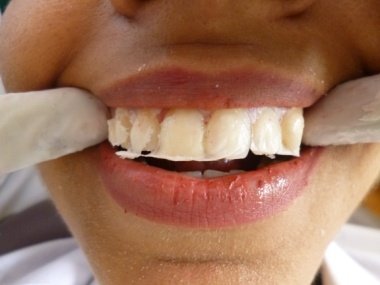

Fig 3: Aesthetic pre-evaluative temporaries
Comparison of three other methods had done, in a study on Geographic distribution of porcelain veneer preparation depth with various clinical techniques. The study compared three clinical techniques namely:
- Dimple, Free hand and Depth grooves techniques and concluded that, when using dimples as depth guides maximum enamel can be conserved in a porcelain laminate veneer treatment8.
Necessary depth – can be classified into 3 types: (Fig4)
- Minimal (0.3mm)
- Medium (0.6mm)
- Deep (0.9mm)
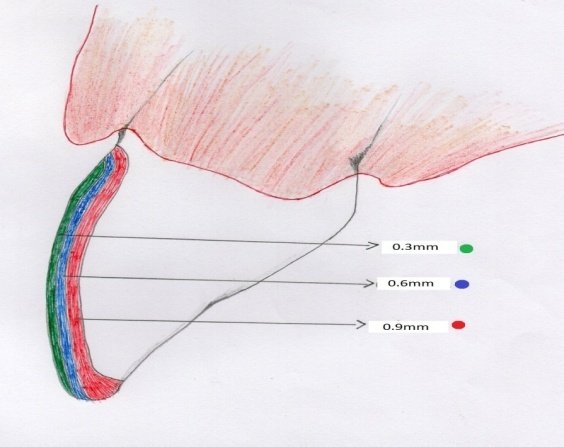
Fig 4 : Buccal preparation
GINGIVAL AND PROXIMAL PREPARATION
Gingival preparation: While preparing the gingival surface, the major goal of the clinician is to achieve a margin that is smooth, fully exposed and readily cleansable. Two types of marginal preparation are preferred:
-
Supragingival margin : Its advantages are :
- Less injury to gingival tissues
- Less chances of dentine exposure
- Easier impressions
- Good isolation at try in and bonding stages
- Easier access for finishing and polishing
- Less chances of impinging on biologic width
- Meticulous hygiene can be maintained
2.Subgingival margin: preparation designs :
- Half the width of crevice depth.
- Marginal defects in restoration can be missed- incomplete seating difficult to detect
- Not preferred until patient demands it even after explanation.
- Wait for 6 -8 weeks after periodontal surgery
- Smooth finishing edge is important
- Use fine grit diamond points
- Gingival displacement can be achieved with braided retraction cord.
- Stronger preparation margin
For both supragingival and subgingival margins a chamfer is the most desirable marginal design. This is because when compared to a shoulder design, chamfer will preserves more enamel in the cervical region which helps in better bonding of porcelain laminate veneers to the tooth structure.
Proximal preparation: The main aim of the specialist while doing a proximal preparation is to place the interproximal margins beyond the visible area and to preserve the contact area. The design can be divided into
Gingivoproximal preparation: Determined by
- Color of tooth
- Visibility from different angles
Depth of chamfer: (Fig-5)
- Shallow
- Medium
- Deep

Fig 5: Gingivoproximal preparation
Interproximal preparation:
- Diamond bur parallel to long axis of tooth and to the midline.
- 0.25 mm facial to actual contact area.
While preparing this surface to prevent scratching of adjacent intact tooth
- Place metal band
- Oscillating instrument
Palatinal extensions of gingivoproximal design:
Can be classified as9:
- Short wrapping
- Medium wrapping (50% interdental area)
- Long wrapping (full interdental area)
Incisal preparation:
There are two basic techniques described by Galip Gurel : (Fig-6)

Fig 6: Incisal preparation designs
- No incisal reduction (Window/intraenamel preparation)
- Incisal edge reduction of 1.0-2.0mm(Incisal overlap)
Studies were conducted to compare fracture load and mode of failure of ceramic veneers with different Incisal preparations, and concluded that, preparation designs with no Incisal reduction and 2mm reduction without palatal chamfer recorded greater fracture loads, when compared to unrestored control group. They also stated that elimination of palatal chamfer will provide stronger restorations and simplified tooth preparation10.
LINGUAL PREPARATION
Lingual preparation is indicated when
- Improvement in anterior guidance is needed
- Create centric interocclusal contacts to prevent the eruption of lingually positioned antagonist lower incisors
Placement of Finish line:
- ¼ th way down the lingual surface
- 1.0 mm from centric contacts (Above or below) (Fig-7)
- Connecting two proximal finish lines
- Not on concavity
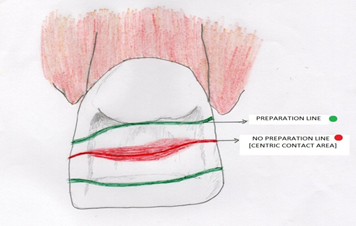
Fig 7: Lingual preparation designs
Design of Finish line:
- Incisopalatine area –A mini chamfer finish line is given and
- Towards cingulum– A long chafer/butt joint
This preparation design is followed, as this will section the enamel rods in that particular area almost in 900, which will in turn helps in improving the bond strength of porcelain laminate veneers.
DISCUSSION
In this review article we discuss about how to select a case for rehabilitation with porcelain laminate veneers and the various preparation designs for porcelain laminate veneers by giving consideration on their esthetic and functional aspects.
Case selection is an inevitable part of any treatment plan. Porcelain laminate veneers can be used in for different kinds of smile correction treatment modalities such as, for mid line diastema closure, tetracycline stained teeth and lingually placed teeth or slightly malalligned teeth. Case selection should be always based on
- High standards of oral hygiene.
- Availability of sound enamel structure. And
- Correction of any surface defects.
Porcelain laminate veneer treatment for different clinical scenario differs from one another.
In case of midline diastema, slight diastema can be confined only to preparation of central incisors. And, if the defect is wide, then we should include lateral incisors and canines. This is done in order to achieve the golden proportion, which is a mathematical theorem concerning the proportion of dentition11.
For tetracycline Staines tooth preparation should follow a preparation depth of 0.9mm in the Incisal and middle third of the tooth and 0.3mm depth on the cervical aspect, this is because enamel bulk in the cervical aspect of the tooth is less as compared to the other areas. On the gingival aspect a subgingival margin is also preferred. These are mainly done in this situation in order to mask the shade of tetracycline stain in the final restoration. Here the careful selection of resin cement will also help in mask the stump shade for some extend.
In cases of lingually placed or slightly malaligned teeth Galip gruel’s technique is the most useful method to preserve maximum enamel possible which will in turn results in better bond strength of porcelain laminate veneers to tooth structure because of intra enamel preparation design.
CONCLUSION
A properly diagnosed and planned porcelain laminate veneer treatment always require a thorough knowledge about the various preparation designs, which are outlined for the needs of different clinical scenarios. Preparation designs are the vital part of any such treatment, hence any negligence in this part of treatment will affect the esthetics , strength and longevity of the planned rehabilitation.
REFERENCES
- Dion Javaheri. Consideration for planning esthetic treatment with veneers involving no or minimal preparation (JADA 2007;138:331-37)
- Calamia JR. Clinical evaluation of etched porcelain veneers. (Am J Dent 1989;2:9-15).
- Garber DA. Porcelain laminate veneers—to prepare or nor to prepare?( Compendium 1991;12:178,180-2).
- Nattress BR, Youngson CC, Patterson CJ, Martin DM, Ralph JP. An in vitro assessment of tooth preparation for porcelain veneer restorations. (J Dent 1995;23:165-70).
- SaadetSaglamAtsu,P. SemaAka,H. CenkerKucukesmen,Mehmet A. Kilicarslan,and CemalAtakan. Age-related changes in tooth enamel as measured by electron microscopy:Implications for porcelain laminate veneers. (J Prosthet Dent 2005;94:336-41.)
- Pascal Magne,Tae Hyung Kim,DomenicoCascioneand Terence E. Donovan. Immediate dentin sealing improves bond strength of indirect restorations. (J Prosthet Dent 2005;94:511 9.)
- The science and art of Porcelain Laminate Veneers: GalipGurel
- G. P. Cherukara, K. G. Seymour, L. Zou, and D. Y. D. Samarawickrama. Geographic distribution of porcelain veneer preparation depth with various clinical techniques (J Prosthet Dent 2003;89:544-50.)
- Magne P, Douglas W.H. Porcelain veneer : Dentine bonding optimization and biomimetic recovery of the crown ( Int J Prosthodent 1999; 12: 111-21)
- Jacopo Castelnuovo, Anthony H. L. Tjan, Keith Phillips, Jack I. Nicholas and John C. Kois. Fracture load and mode of failure of ceramic veneers with different Preparations. (J Prosthet Dent 2000;83:171-80.)
- Levin E L. Dental esthetics and golden proportion. (J Prosthet Dent 1978;40:244-52.)
Disclaimer from Guident
The views and opinions expressed in articles published in Guident are solely those of the authors and do not necessarily reflect the views of the editors, the editorial board or the publisher, Ivory India. Guident does not endorse any product, technique or treatment described. Clinical content is intended for qualified dental and medical professionals and is not a substitute for individual clinical judgement. Guident, its editors and the publisher accept no liability for any consequence arising from the use of information published in the journal.
How to cite this article
Dr.Krishna Prasad D., Dr.Manoj Shetty, Dr.Binoj. K. Chandy. Esthetic and Functional Considerations in Preparation Designs for Porcelain Laminate Veneers. Guident. 2014 Aug;7(9). Available from: https://guident.in/articles/prosthodontics/esthetic-and-functional-considerations-in-preparation-designs-for-porcelain-laminate-veneers.html