Esthetic Rehabilitation of Avulsed Primary Central Incisor in a 4-Year Old Child
Pediatric and Preventive Dentistry, K.M. Shah Dental College and Hospital, Sumandeep Vidhyapeeth Deemed To Be University, Piparia, Waghodia (T), Vadodara (D), Gujarat
ABSTRACT
Dental injury is common among pre-schoolers. Trauma to the primary dentition usually causes pain, loss of function, aesthetic concerns for the child and his/her family. Loss of teeth due to trauma at young age affects the child socially as well as psychologically. Also, it leads to improper speech at young age. Enhancement of facial aesthetics along with development of proper speech, prevention of untoward oral habits and assisting in sound development for the child during the foundation years is the main goal for treatment planning. Replacement of avulsed primary tooth with an anterior fixed appliance is an elective procedure and is based strongly on parental perception and desires for the treatment.
INTRODUCTION
Apart from early childhood caries, traumatic dental injury is one of the main reason for premature loss of primary maxillary anterior teeth in toddlers and pre-schoolers. Trauma to the oral region occurs frequently and comprises 5% of all injuries for which people seek treatment.1 In the age group 0–6 years, oral injuries are ranked as the second most common injury covering 18% of all somatic injuries.1 Demographic evaluations indicate a higher prevalence for trauma in males as compared to females.2 Major reason of dental trauma in children is their weak balance and just having learnt to walk. Common etiological factors are falling, fight, sports, accidents, and hitting items or people at home, school or street. Approximately 30% of all children under the age of seven sustain injuries to one or more of their primary incisors.3 Out of these most of the injuries occur in primary dentition as seen in ages 2–4 years. When the tooth is completely exarticulated from the socket it is termed as ‘Avulsion’. Avulsions make up to 7–13% of all injuries to primary teeth as reported in the literature.3 Nevertheless, various studies have shown that exarticulation (complete avulsion) of primary teeth due to trauma is relatively infrequent. Ravn et al4 and Andearson et al1 reported that right central maxillary incisor is the most frequently avulsed tooth as compared to left central maxillary incisor. The right central maxillary incisor made up 41% of the avulsed teeth. The greatest challenge for rehabilitation is esthetics as well as function to compensate the psycho-social trauma to the patient as well as parent. Various appliances have been designed in order to manage the space due to premature loss of deciduous primary tooth. Appliance can be fixed/removable and functionl/non-functional. For childen, a fixed functional appliance is desirable as it overcomes the desire to wear and easily accepted.
Choice of treatment depends on the factors like chronological age, dental age, segment of dental arch, status of adjacent teeth, missing tooth.5 Parental desire is one of the most decisive factor for selection of appliance. Hence, early intervention results in minimal psychosocial trauma to the child and the parents.
Case
A 4-year-old girl along with her parents reported to Department of Pediatrics and Preventive Dentistry OPD with the chief complaint of missing tooth in upper front tooth region since last 2 years. On recording history of trauma mother gave the history of loss of tooth due to fall while playing. Parents did not report to dentist at the time of trauma. Parents’ major concern was patient being reluctant to open her mouth during smile.
On intraoral examination, tooth 61 was missing along with normal surrounding tissue [Figure 1].

Figure 1: Pre-operative occlusal view
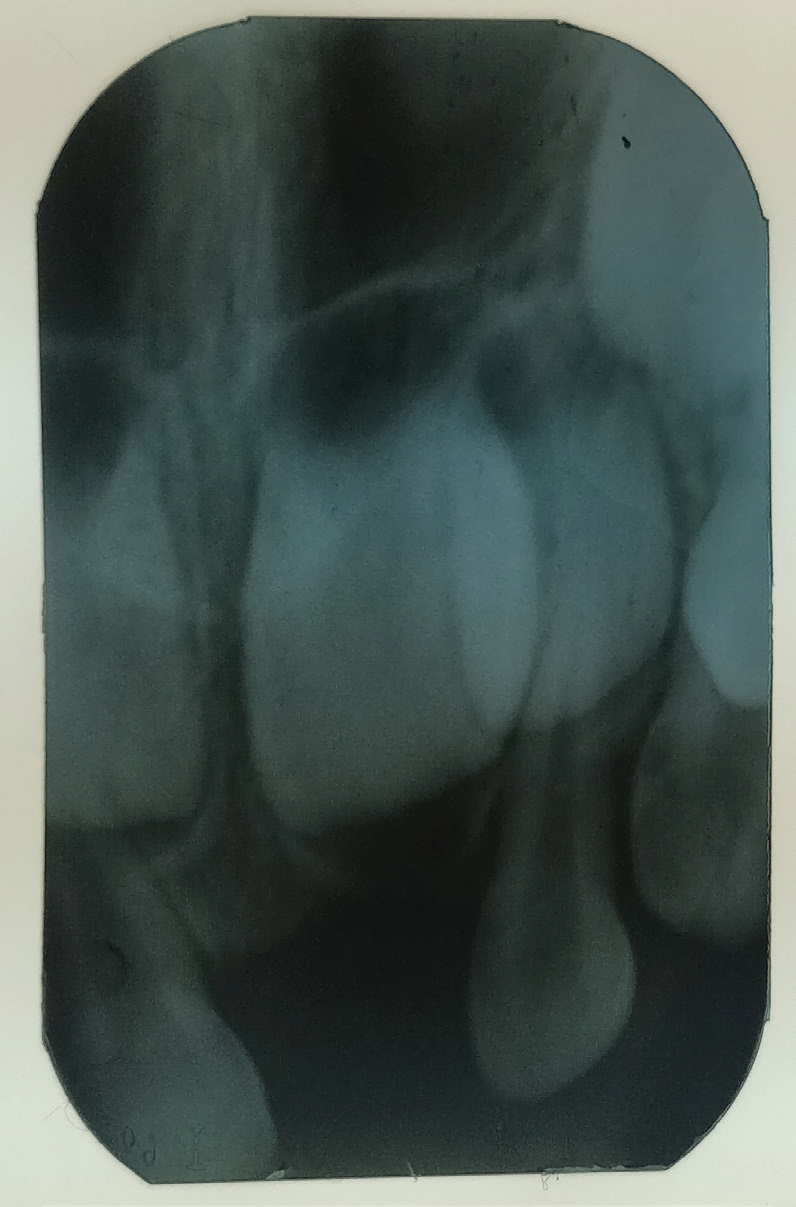
Figure 2: Preoperative intraoral periapical radiograph
After thorough case evaluation, an esthetic fixed functional space maintainer was for planned to alleviate the child and parents’ major concern.
Stepwise procedure for fabrication of appliance:
a) Orthodontic bands (0.005 inch thickness and 0.180 inch width) were adapted on teeth 55 and 65
b) Alginate impression was taken to make the working cast
c) Casts were poured with dental stone
d) A stainless steel wire (0.9 mm) framework with U-loops was spanning from one band to the other was fabricated on the upper cast
e) The free ends of the wire were soldered to the corresponding molar bands
f) An acrylic primary tooth (A2 shade) with similar size of 61 was prepared
g) After cold mold seal application, cold cure acrylic resin was used to attach the tooth to the wire framework.
h) The appliance was then removed from the cast and trimming, finishing, and polishing was done [Figure 3].
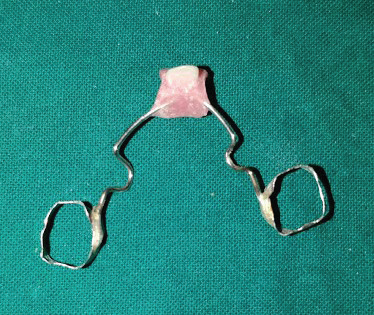
Figure 3: Appliance occlusal view
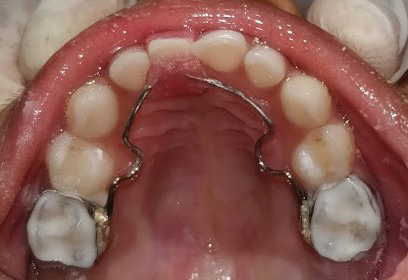
Figure 4: Appliance intraoral occlusal view

Figure 5: Postoperative occlusion
The child and the parent were satisfied by the replacement of lost tooth [Figure 6].
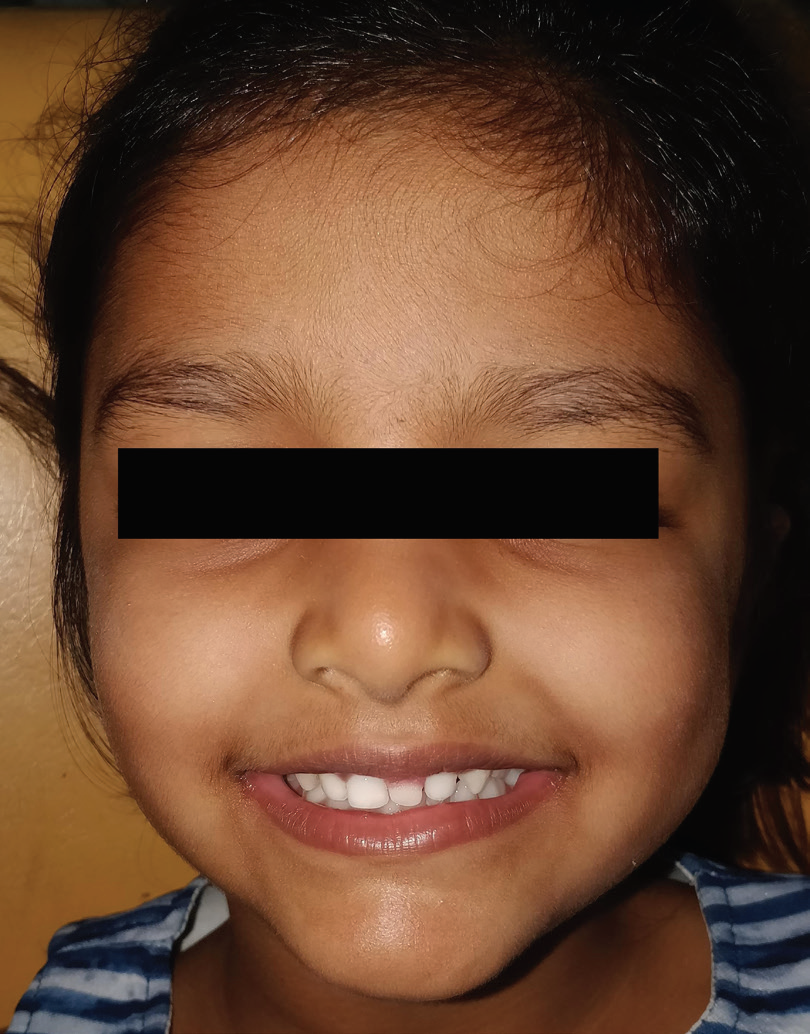
Figure 6: Postoperative extraoral view
DISCUSSION
Trauma to the primary dentition can be caused by various factors like accidents and sports, orotracheal intubation, non-accidental injury (NAI) or physical abuse, increased overjet, protrusion of upper incisors, anterior openbite, hyperactivity, poor motor co-ordination and epilepsy.6 The extent and type of injury is related to the direction and intensity of the impacting traumatic force.
The sequelae of injury to primary dentition and their extent for the permanent dentition are dependent on the age of the patient at the time of trauma, developmental stage of the permanent tooth and type of trauma.
Lingual sides of maxillary anterior teeth are needed by the tongue for certain linguo-dental phonations viz. ‘s’, ‘z’ and ‘th’. Absence of these teeth affects the speech of the child. Hence, the placement of an anterior esthetic space maintainer is an elective procedure which is based on parents’ desire.
Seizure disorders, mental retardation, immunocompromised patients inappropriate and significant deep-bite, over-jet, or anterior crossbite are absolute contraindications for anterior fixed appliances.7 The appliance delivered here is of fixed type and bears none of the disadvantages of the removable type, like need of the patients’ cooperation or chances of breakage.
Intercanine width remains stable even after premature loss of primary maxillary anterior teeth unlike the posterior segment.7 Intercanine growth (less than 0.5mm) is minimal till the age of four years, however after the eruption of permanent first molar the arch width changes.7 During this period the appliance can be removed.
Fixed space maintainers are always acceptable in children over removable appliances. To improve patient acceptance, aesthetic functional fixed appliance is reliable.
Garai D et al5 fabricated Nance palatal button and attached the tooth to the wire hook for replacement of avulsed primary maxillary central incisor and it showed satisfactory result in relation to function and esthetics.
Das PK et al7 replaced the primary maxillary central and lateral incisors with a bonded appliance which had square shaped wire framework in anterior region for reinforcing acrylic resin.
Revathi et al8 incorporated begg brackets to reinforce the acrylic segment with teeth for replacing missing anterior teeth. This appliance may pose the risk of space developing between the teeth and the alveolus, due to an improper anterior fit or reduction of ridge height.
In the present case, minimum amount of palatal was utilized to avoid irritation. Banding of molars was done to reinforce strength. A similar appliance was documented by Jasmine and Groper, in which plastic teeth were attached to metal cleats that were soldered to the palatal wire bar instead of being attached to acrylic.9
One of the most important and valid reasons for replacing missing incisors is to restore a natural and pleasing appearance and thus provide an opportunity for normal psychological development.
CONCLUSION
This case report discusses the simplest technique of anterior esthetic appliance fabrication. Such appliances are considered an elective appliance and are usually dictated by the parents’ desire. This appliance develops a psychological boost for the child. A comprehensive caries prevention programme is mandatory along with a frequent recall schedule.10
REFERENCES
- Andreasen JO, Sundstro¨m B and Ravn JJ. The effect of traumatic injuries to the primary teeth on their permanent successors. I. A clinical and histological study of 117 injured permanent teeth. Scand J Dent Res 1971; 79:219–83.
- Azami-Aghdash S, Ebadifard Azar F, Pournaghi Azar F, Rezapour A, Moradi-Joo M, Moosavi A, Ghertasi Oskouei S. Prevalence, etiology, and types of dental trauma in children and adolescents: systematic review and meta-analysis. Med J Islam Repub Iran 2015 (10 July). Vol. 29:234.
- Christophersen P, Freund M, Harild L. Avulsion of primary teeth and sequelae on permanent successors. Dent Traumatol 2005; 21: 320–323.
- Garai D, Ghosh C, Mandal PK, Kar S. Esthetic anterior fixed functional space maintainer. Int J Pedod Rehabil 2017; 2:90-2.
- Ranka M, Dhaliwal H, Albadri S, Brown C. Trauma to the Primary Dentition and its Sequelae. Dent Update 2013; 40: 534–542
- Ravn JJ. Developmental disturbances in permanent teeth after avulsion of their primary predecessor. Scand J Dent Res 1975;83:131–4.
- Das PK, Datta P, Bora A, Zahir S, Kundu GK. A simple modification of aesthetic fixed appliance for replacement of avulsed maxillary primary incisors. Int J of App Dent Sci: 2015; 1(5): 23-25
- Jasmin JR, Groper JN. Fabrication of a more durable fixed anterior esthetic appliance. Journal of Dentistry for Children 1984;51:124–127.
- Scures CC. Report of the increase in bicanine diameter in 2 to 4-year-old children. Journal of Dentistry for Children 1967;34:332–335.
- Goenka P, Sarawgi A, Marwah N, Gumber P, Dutta S. Simple fixed functional space maintainer. Int J Clin Pediatr Dent. 2014;7(3):225-28.
Disclaimer from Guident
The views and opinions expressed in articles published in Guident are solely those of the authors and do not necessarily reflect the views of the editors, the editorial board or the publisher, Ivory India. Guident does not endorse any product, technique or treatment described. Clinical content is intended for qualified dental and medical professionals and is not a substitute for individual clinical judgement. Guident, its editors and the publisher accept no liability for any consequence arising from the use of information published in the journal.
How to cite this article
Dr. Bhavna Dave, Dr. Paridhi Shah, Dr. Pratik Kariya. Esthetic Rehabilitation of Avulsed Primary Central Incisor in a 4-Year Old Child. Guident. 2019 Nov;12(12). Available from: https://guident.in/articles/pedodontics/esthetic-rehabilitation-of-avulsed-primary-central-incisor-in-a-4-year-old-child.html