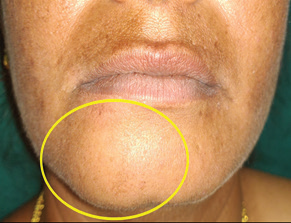
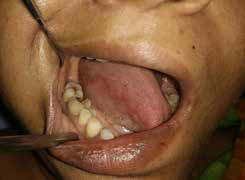
Bird Face Deformity Bilateral Temporomandibular Joint Ankylosis
Department of Oral Medicine and Radiology, A. J. Institute of Dental Science, Mangalore, Karnataka, India
ABSTRACT
Temporomandibular joint ankylosis is a condition in which condylar movement is limited by a mechanical problem in the joint (“ true ankylosis”) or by a mechanical cause not related to joint components (“false ankylosis”). True ankylosis may be bony or fibrous. In bony ankylosis, the condyle or ramus is attached to the temporal or zygomatic bone by an osseous bridge. In false ankylosis, the joint cavity appears normal. It could be because of muscle spasm, coronoid hyperplasia. The most common cause for both unilateral and bilateral ankylosis is trauma. It can occur due to various factors like local or systemic infections. Trauma due to forceps delivery causing bilateral TMJ ankylosis is rare.
Here we report a case of TMJ ankylosis in a 16 year-old female patient showing most of the characteristic features of bilateral TMJ ankylosis.
KeywordsTMJ ankylosis, bilateral Temporomandibular joint ankylosis Bird face deformity.
INTRODUCTION
The American Academy of Orofacial Pain (AAOP) defines ankylosis of the TMJ as “a restriction of movements caused by intracapsular fibrous adhesions, fibrous changes in capsular ligament (fibrous-ankylosis), and osseous mass formation resulting in the fusion of the articular components (osseous ankylosis).1
TMJ ankylosis is a disorder that leads to a restriction of the mouth opening from partial reduction to complete immobility of the jaw. It is the most commonly associated with trauma (13-100%), local or systemic infection (0-53%), or systemic diseases, such as ankylosing spondylitis, rheumatoid arthritis, or psoriasis.2,3 Rarely, it is congenital4,5
It is a disabling condition that causes problem with mastication, digestion, speech, appearance, and oral hygiene.2 Ankylosis of TMJ can be proper(true) or pseudo (false).6 In the first type the damage is caused intra-articularly by adhesion of the mandibular condyle to the glenoid fossa. In the second type, hypomobility of the joints results from extra-articular causes that could follow hyperplasia of the coronoid process; untreated fracture of the zygomatic arch or operation; radiation induced fibrosis of the temporal muscle, or neurological or psychological disorders.7
CASE REPORT
A 16 year old female patient reported to the department of Oral Medicine and Radiology with the chief complaint of difficulty in opening her mouth with a history of trauma 10 years ago. There was no history of a forceps delivery.
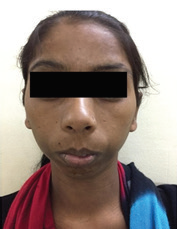
Figure 1: Frontal view of the patient in our case. On clinical examination, mandible was hypoplastic on the both sides.

Figure 2: Profile view showing hypoplastic mandible on both the sides and Bird face deformity, which is characterstic feature of bilteral TMJ ankylosis.

Figure 3: Inadequate mouth opening seen.
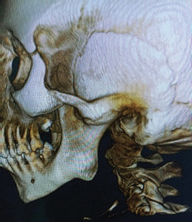
Figure 4: CBCT shows left TMJ with Fused Joints.
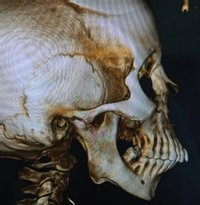
Figure 5: CBCT shows right TMJ with Fused Joints.
DISCUSSION
Trauma to the chin is the most common cause of TMJ ankylosis along the other causes including infections and inflammatory destruction of the synovial joint of the joint. Inflammation of the joint may be primary resulting from infection of the joint itself or may result from extension of neighbouring infections such as otitis media, mastoiditis, osteomyelitis of mandible, blood borne, infection from several sources, rheumatoid arthritis, ankylosis spondylitis, Reiter’s syndrome, and hemarthrosis.8 TMJ ankylosis can be true or false. True ankylosis is further divided into bony where the condyle or ramus is attached to the temporal bone by an osseous bridge, and fibrous where soft tissue union of the joint components occurs with normal bony components. False ankylosis may result from conditions that inhibit condylar movements such as muscle spasm, myositis ossificans, or coronoid process hyperplasia. The clinical features of ankylosis are limited mouth opening, with no pain and joint sounds9 which were evident in our case too.
Cases of bilateral intracapsular bony ankylosis presents with mandibular retrognathism described as “birdface” deformity10 which was also seen in our case.
REFERENCES
- Cunha CO, Pinto LM, de Mendonça LM, Saldanha AD, Conti AC, Conti PC. Bilateral asymptomatic fibrous-ankylosis of the temporomandibular joint associated with rheumatoid arthritis: a case report. Braz Dent J. 2012;23:779-82.
- do Egito Vasconcelos BC, Bessa-Nogueira RV, Cypriano RV. Treatment of temporomandibular joint ankylosis by gap arthroplasty. Med Oral Patol Oral Cir Bucal. 2006;11:E66-9.
- Rishiraj B, McFadden LR. Treatment of temporomandibular joint ankylosis: a case report. Journal-Canadian Dental Association. 2001;67(11):659-63.
- Ajike SO, Chom ND, Amanyeiwe UE, Adebayo ET, Ononiwu CN, Anyiam JO, Ogala WN. Non-syndromal, true congenital ankylosis of the temporomandibular joint: a case report. West indian medical journal. 2006 Jan;55(6):444-6.
- Nwoku AL, Kekere-Ekun TA. Congenital ankylosis of the mandible: report of a case noted at birth. Journal of maxillofacial surgery. 1986 Jan 1;14:150-2.
- Spijkervet FK, de Bont LG, Boering G. Management of pseudoankylosis of the temporomandibular joint: report of cases. Journal of oral and maxillofacial surgery. 1994 Nov 1;52(11):1211-7.
- Valentini V, Vetrano S, Agrillo A, Torroni A, Fabiani F, Iannetti G. Surgical treatment of TMJ ankylosis: our experience (60 cases). Journal of Craniofacial Surgery. 2002 Jan 1;13(1):59-67.
- Worth HM. Principles & Practice of Oral Radiologic Interpertation. The Temporomandibular Joint. Chicago: Year Book Medical Publishers; 1963. p. 663-5.
- Cunha CO, Pinto LM, Mendonça LM, Saldanha AD, Conti AC, Conti PC. Bilateral asymptomatic fibrous-ankylosis of the temporomandibular joint associated with rheumatoid arthritis: a case report. Brazilian dental journal. 2012;23(6):779-82.
- Bello SA, Olokun BA, Olaitan AA, Ajike SO. Aetiology and presentation of ankylosis of the temporomandibular joint: report of 23 cases from Abuja, Nigeria. British Journal of Oral and Maxillofacial Surgery. 2012 Jan 1;50(1):80-4.
Disclaimer from Guident
The views and opinions expressed in articles published in Guident are solely those of the authors and do not necessarily reflect the views of the editors, the editorial board or the publisher, Ivory India. Guident does not endorse any product, technique or treatment described. Clinical content is intended for qualified dental and medical professionals and is not a substitute for individual clinical judgement. Guident, its editors and the publisher accept no liability for any consequence arising from the use of information published in the journal.
How to cite this article
Dr. Abhishek R Dental, Dr. Taniya Thomas, Dr. Raghavendra Kini. Bird Face Deformity Bilateral Temporomandibular Joint Ankylosis. Guident. 2019 Nov;12(12). Available from: https://guident.in/articles/oral-medicine/bird-face-deformity-bilateral-temporomandibular-joint-ankylosis.html