
Maxillary Mollar Distalization with Three Different Custom Made Appliances: 3 Cases
Govt. Dental College and Hospital, Ahmedabad, India
Abstract
Extraction Vs non-extraction philosophy is being a part of orthodontic debate since years. There are many methods of space gaining like extraction, expansion, derotation, proximal stripping, uprighting and distalization.There are ‘n’ numbers of appliances and methods of distalization introduced by several authors in the field of orthodontic. Each method has its own merits and demerits. 3 cases with severe crowding in upper arch and straight soft tissue profile were chosen after proper diagnosis and treated with pendulum, distal jet and distal propeller appliance for distalization. With pendulum appliance there was 7 mm distalization with 130 1st molar tip and 60 anterior anchor loss observed. With distal jet appliance there was 5 mm distalization with 140 1st molar tip and 40 anterior anchor loss observed. Whereas with distal propeller there was 5 mm distalization with only 10 distal tipping of first molar without any anterior anchor loss observed. This cephalometric reading suggesting that all these custom made appliances efficient for molar distalization with varying degree of molar tipping and anterior anchor loss but distal propeller showing minimal 1st molar tipping and anterior anchor loss.
INTRODUCTION
There are several methods of gaining space like extraction, expansion, derotation, proximal stripping, uprighting and distalization. An estimated 25-30% of all orthodontic patients can be benefited from maxillary expansion, and 95% of class II cases can be improved by molar rotation, distalization & expansion1. Initially distalization was introduced by Norman Kingsley in year1892 and with the help of headgear he successfully achieved class I molar relation. But with the headgear, patient’s compliance is major hurdle. So research towards non-compliance methods of distalization became topic of interest for number of innovators. There are ‘n’ numbers of appliances and methods of distalization introduced by several authors in the field of orthodontic. Each method has its own advantages and disadvantages.
With the recent trend towards more non-extraction treatment, several appliances have been advocated to distalize molars in the upper arch. Certain principles, as outlined by Burstone2must be borne in mind when designing, such a magnitude of forces, magnitude of moments, Moment-to-force ratio Constancy of forces and moments, Bracket friction (frictionless appliances are preferable), Ease of use.
Here, in this article 3 cases with acceptable criteria for distalization were chosen and distalization was done using pendulum, custom made distal jet and distal propeller.
CASE REPORTS
All three cases were reported at Department of Orthodontics, Government Dental College and Hospital, Ahmedabad with the chief complain of unevenly placed upper front teeth. They having normal gait and posture, competent lips, straight soft tissue profile with skeletal class 1 imposed over class II molars. All of them having upper 2nd erupted in the arch. Both upper 3rd molar buds were extracted before the initiation of distalization in all three cases.
CASE A
Pendulum appliance was introduced by James J. Hilgers3in 1992. In presented case A, banding of both upper 1st premolars and upper 1st molars were done. Anchorage was taken from upper 1st premolars and anterior hard palate using Nance button. Both active arms were made for 0.022’’ TMA wire. TMA wire was used because it has half of rigidity and double of the resistance for permanent deformation when force is applied then stainless steel wire. After 8 months from appliance delivery, 7 mm of distalization each side was achieved (Fig. 1-5, Table 1).
CASE B
Distal jet was designed by Aldo Carano&TestaMauro4 in 1996. All first and second premolars were banded and acrylic coverage given to anterior hard palate taking support from these premolars. 0.036’’ Begg’s buccal tubes were embedded in this acrylic portion at paramedian region exactly at long axis of roots of lateral incisiors. 1st molars were banded with lingual sheath. 0.7 mm stainless steel wire was used for making bayonets and open coil Niti spring was used for force generation. Anchorage was taken from upper bicuspids and anterior hard palate using Nance button. With this assembly super class I molars were achieved in 7 months. During this period new bayonets had to be made twice as molars moved distally. After 7 months of active force application 5 mm of distalization was achieved each side (Fig. 1-5, Table 1).
CASE C
Nazan Kucukkeles5 in 2006 was first to introduced method of distalization using Hyrex screw. In 2009 Ashok Jena6 has introduced distal propeller appliance. Both upper 1st premolars and 1st molars were banded. Here the Hyrex screw is placed 900 rotated from its usual direction when it’s used for expansion, so when we open screw it opens in sagittal direction. Modification in activation pin is also done by bending it at 1200 and little shorten then regular pin. Anchorage was taken from anterior hard palate and 1st premolars. Screw activation schedule was twice a week. After 3 months of activation 5 mm of distalization was achieved each side (Fig. 1-5, Table 1).
Pre-treatment and post distalization records made and compared for evaluation. Lateral cephalograms were traced and various cephalometric analysis was done and mention in Table 1.
DISCUSSION
All three appliance used here were custom made as well as cost effective. All of them work on palatal surface and non- compliance philosophy. Three different mechanisms were used like, Pendulum works on spring action by TMA wire, Distal Jet uses open coil Niti spring for force application whereas distal propeller uses force of opening of Hyrex screw for distalization.As seen in table 1 7 mm, 5 mm and 5 mm distalization was achieved by Pendulum, Distal Jet and Distal propeller appliance respectively (Table 1). Various degrees of molar tipping and anterior anchor loss were observed with all three appliances.Hilgers (1992)3 reports that when the appliance is placed before the eruption of the second molars, two-thirds of the tooth movement is molar distalization, one-third is experienced as forward shift of the anchor bicuspids and opposite occurred if 2 nd molars erupted. Eruption Status of 2nd

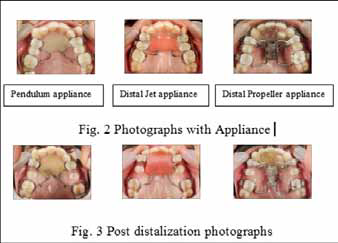
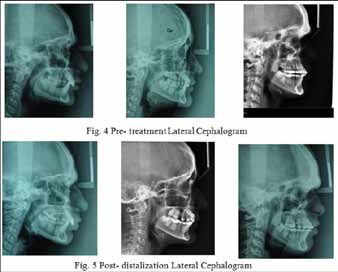
Table 1 Cephalometric analysis

molar plays significant role in terms of efficiency of distalizationappliance and anterior anchor loss.Worms et al. (1973)7 noted that erupted second molars contact with first molars created a resistance to distal movement. This, in effect altered the position of centre of resistance of the first molar. Armstrong (1971) suggests that this movement be complete before the eruption of second permanent molar. In presented case we achieved 7 mm distalization with pendulum and 5 mm with distal jet and distal propeller appliance. As seen in table 1 there was 60 anterior anchor loss (incisor flaring) observed with pendulum and 40 with distal jet appliance whereas there wasn’t any anchor loss in distal propeller appliance. Ghosh and Nanda (1996) also found that the pendulum appliance is a reliable method for distalizing maxillary molars at the expense of moderate anchorage loss. There were 130 tipping of upper first molar is seen with pendulum appliance, 140 with distal jet appliance whereas only 10 tipping is observed with the use of distal propeller appliance. This might be due to rigidity of the distal propeller appliance which prevents molars from distal as well as buccal tipping.
CONCLUSION
There are various types of appliance available in market for distalization either working on buccal or palatal side. Like in our cases custom made appliance are also efficient in distalization with different amount of anterior and posterior tipping. Distal propeller appliance had shown least amount of upper molar tipping as compared to distal jet and pendulum appliance. However further study with lager sample size is required to strengthen above fact.
REFERENCES
- Corbett M.C. (1997): “Slow and continuous maxillary expansion, molar rotation and molar distalization “. J. Clin.; Orthod.; 31: 253-263
- Kalra V. (1995): “An effective unilateral face bow”. J. Clin. Orthod; 26: 60-61
- Hilgers J. J. (1992): “The pendulum appliance for class II non-comliance therapy”. J. Clin. Orthod.: 26 : 706-714.
- Arano A. and Test am. (1996): “The distal jet for upper molar distalization”. J. ClinOrthod.; 30: 374-380.
- Kucukklees, Cakirer, Mowafi:Cephalometric evaluation of molar distalization by hyrax screw used in conjunction with a lip bumper: World J Orthod: 2006 Fall;7(3):261-8.
- Ashok Jena: “Distal Propeller”: An Appliance with New Concepts in the Innovation of Molar Distalization Appliance Design: Orthodontic cyber journal: June 2009
- Worms F.W., Isaacson R.J. and Speidel T.M. (1873): “A concept and classification of centers of rotation and extraoral force systems”. Angle Orthod.; 43: 384-401
Disclaimer from Guident
The views and opinions expressed in articles published in Guident are solely those of the authors and do not necessarily reflect the views of the editors, the editorial board or the publisher, Ivory India. Guident does not endorse any product, technique or treatment described. Clinical content is intended for qualified dental and medical professionals and is not a substitute for individual clinical judgement. Guident, its editors and the publisher accept no liability for any consequence arising from the use of information published in the journal.
How to cite this article
Dr. falguni Mehta Dr. Vaibhav Gandhi Department of Orthodontics. Maxillary Mollar Distalization with Three Different Custom Made Appliances: 3 Cases. Guident. 2015 Jan;8(2). Available from: https://guident.in/articles/orthodontics/maxillary-mollar-distalization-with-three-different-custom-made-appliances-3-cases.html


