Full Mouth Rehabilitation by Hybrid Prosthesis
(Consultant), SIPS Hospital Lucknow, India
Abstract
Aesthetics and function in implantology result from the correct execution of many rehabilitation phases like presurgical planning, surgical and prosthetic phases, and case management. In the presurgical phase, preexisting anatomical conditions and prosthetic evaluations influence the choice of regenerative techniques. Correct presurgical planning is the most important phase to obtain an aesthetic result. Only a successful anatomical correction of hard and soft tissue is able to assure a satisfying therapeutic achievement involving many operative steps and rigorous observance of recovery timing.
This article addresses the design of a hybrid prosthesis that incorporates a metal frame over implants on which the denture rests. Using a flapless surgical approach 5 implants are placed and an implant verification jig is produced. With the help of this implant verification jig a metal framework is CAD CAM milled and casted on the implants to which the screw retained denture is tightened.
Key words-hybrid, screw retained denture, osseointegration, implant verification jig
INTRODUCTION
Dentists and patients have been seeking the optimum treatment outcome following the replacement of missing teeth. Dentists have worked to achieve this target using different treatment protocols, including conventional removable prostheses , overdentures, and fixed prostheses. Accordingly patients have provided their dentists with feedback regarding their perception of the type of supplied treatment.
The new era of dental implants have become an important therapeutic modality in the last decade, mainly after the works developed by Branemark (1985),in which the direct contact between the bone functional tissues and biomaterial titanium is termed osseointegration. Traditional implant placement ,originally described by Branemark(1960s) , involved 2 stage procedure of implant placement followed by abutment connection after a 3 - 6 month healing period.
In early 1990s immediate loading 1 stage protocol in which abutment connection occurred the same day began.
More recently, with the use of computed tomography(CT) ,OPG and CAD/CAM it was possible for us to construct a surgical guide that allowed us to predetermine implant locations virtually and surgically place them without reflecting a tissue flap. We incorporated the placement of hybrid prostheses on a set of implants supported on a metal frame substructure
A cross between a regular denture and a fixed bridge is known as a hybrid. Resorbed ridges and patients choice for a fixed prostheses popularizes this new treatment modality.
Also known as fixed detachable dentures are more natural looking , stable and cost effective.4-6 dental implants are required.
CASE REPORT
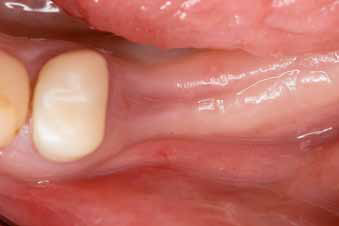
A 56 year old presented to the dental department SIPS hospital Lucknow with the chief complaint of mobility and pain in the recent implants, inability to chew food, compromised speech and hence required replacement

Patient underwent implant surgery at another hospital that eventually failed leading him into a painful condition and a mobile 10 unit bridge. On examination and investigation maxillary arch was found with 7 implants out of which 2 were mobile. Mandibular dentition had periodontally hopeless teeth. Patient did not want a removable prosthesis, therefore we selected a hybrid prosthesis with denture teeth on an acrylic design with a milled framework.
Patients vertical occlusion was recorded. A mark was made on the patients nose and chin and this distance was noted.
MATERIAL
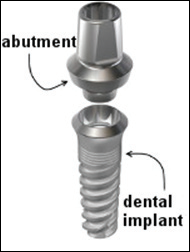
After proper treatment planning Alpha Bio implants (Israel) are placed with the following measurements, 3.75/13,4.2/11.5,4.6/10.5,4.2/13 and 3.75/11.5
They were planned with OPG(orthopantomogram) and study models


METHOD
1.The mobile implants were embedded in the bone and hence made non functional along with removal of the bridge
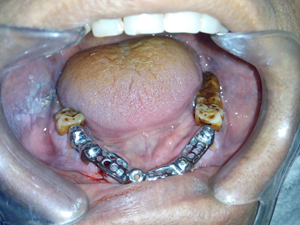
2. All teeth in the mandibular arch were extracted leaving 36 37 38 and 47 followed by bone contouring
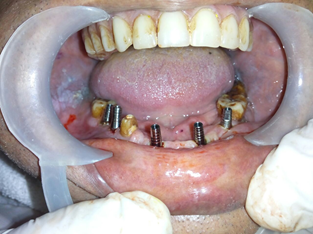
3.5 implants were placed in the lower arch in the next sitting along with bone grafting. Implants were placed at positions 31,33,35,45 and 46 of the previously mentioned predetermined dimensions. Titanium healing caps placed on the implants.
4.Alginate impression of the lower and upper arch recorded for the fabrication of dentures.
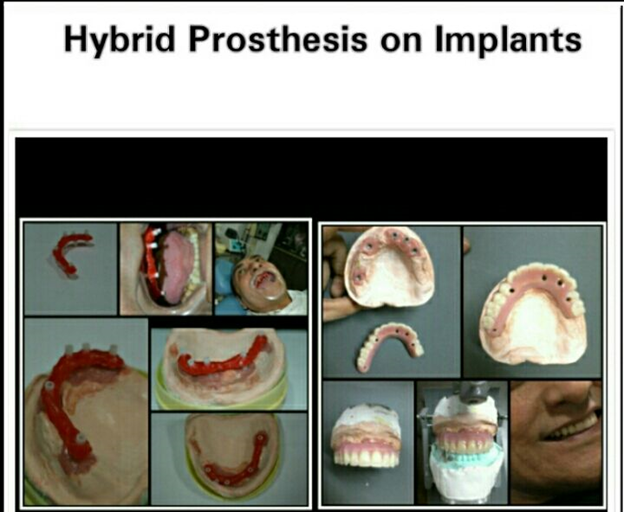
5.After 3 months the patient was recalled. Healing caps are removed and abutments placed respectively. Abutments are loosened and open tray impressions were recorded with putty. Abutments are transferred onto the impression,analogues are placed and tightened onto the abutments. Cast is poured.
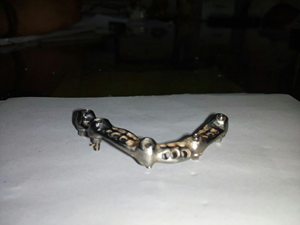
6.Castable abutments are placed on the analogues and a try in jig is fabricated.try in and verification of the jig is done to confirm the accuracy. This is essential prior to the CAD CAM milling of the metal frame
7. After the fit is confirmed open tray impression recorded, jig transferred onto the impression and sent to the lab for fabrication of the metal frame.
8.Following the esthetic try in of the metal frame, final impressions are taken and sent to the lab. Metal frame is casted into the acrylic denture. Thus a try in hybrid denture is fabricated.
9. Try in of the hybrid denture is done. Following its confirmation its sent to the lab for acrylisation. Final prosthesis returned from the lab is checked for fit, occlusion and patient acceptance. A final radiograph is taken. Patient is given oral hygiene instructions and screw access holes were covered with cotton and provisional filling material. At one week evaluation visit, a definitive material is placed to close the screw access holes. This treatment is done over a period of six months.
RESULTS
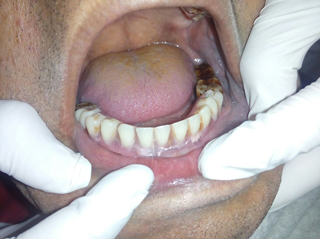
The result was excellent. Patient was very satisfied with the amazing aesthetic and functional ability of the prosthesis

CONCLUSION
Every patient has unique treatment needs. Proper diagnosis and treatment plan are important but cannot be all-inclusive. A comprehensive examination, including a thorough medical and dental history, orofacial and dental clinical examination, dental radiographs, impressions, and jaw relation records for mounting casts are important steps leading to a successful oral rehabilitation. Careful integration and sequencing of the different areas of treatment needed, enhances the final result. Dentists must consider the advantages and disadvantages the available implant prosthetic options and match them to patient's expectations. This article reports on the fabrication of a maxillary and mandibular hybrid prosthesis which proved to b highly satisfactory and comforting to the patient.patient restored his speech and chewing ability very soon.
REFERENCES
- Branemark P-I,Zarb GA,Albrektson T,eds.Tissue Integrated Prosthesis.Osseointegration In Clinical Dentistry.Chicago IL; Quintessence Publishing Co.; 1985:211-232
- Binon P. imnplants and components;Entering the new millennium.Int J Oral Maxilofac Implants.2000; 15:76-94
- Binon P.Evaluation of machining accuracy and consistency of selected implants,standard abutments and laboratory analogues.Int J Prosthodont.1996
- Branemark PL,Hansen BO,Adell R,et al.Osseointegrated implants in the treatment of edentulous jaw.Experience from a 10 year period.Scand J Plast Reconstr Surg.1977;10:1-132
- Adell R,Leckholm U,Rockler B,et al.A 15 year study of osseointegrated implants in the treatment of edentulous jaw.Int J Oral Surg.1981;10:387-416
- Linkow LI.The blade-vent-A new dimension in endosseous implants in humans.Dent Concepts.1998;11:3-6
- Cranin AN,Rockin MF, Garfinkel L, A stastical evaluation of 952 endosteal implants in humans.J Am Dent Assoc.1977;94:315-318
- Misch CE,Non functional immediate teeth in partially edentulous patients.a pilot study of 10 consecutive cases.Compendium.1998;19:25-36
- Schnitman PA,Wohrle PS,Rubenstein JE,et al.Branemark implants immediately loadedwith fixed prosthesis at implant placement.Int J Maxillofacial Implants.1997;12:495-503
- Salama H,Rose LF,Salama M,et al.immediate loading of bilaterally splitedtotanium root form implant in fixed prosthodontics.Int J Periodontics Restorative Dent.1995;15:344-361
- Kapur KK,Veterans Administration, co-operative dental implant study comparison between fixed and removable partial dentures.J Prosthet Dent.1987;59:499-512
- Chipasaco M Gatti C.Implant retained mandibular overdentures with immediate loading:a 3-8 year prospective study on 328 implants.Clin Implant Dent Relat Res.2003;5:29-38
Disclaimer from Guident
The views and opinions expressed in articles published in Guident are solely those of the authors and do not necessarily reflect the views of the editors, the editorial board or the publisher, Ivory India. Guident does not endorse any product, technique or treatment described. Clinical content is intended for qualified dental and medical professionals and is not a substitute for individual clinical judgement. Guident, its editors and the publisher accept no liability for any consequence arising from the use of information published in the journal.
How to cite this article
Dr. Vikram Ahuja, Dr. Ankita Srivastava, Dr. Hina Singh. Full Mouth Rehabilitation by Hybrid Prosthesis. Guident. 2016 Sep;9(10). Available from: https://guident.in/articles/implantology/full-mouth-rehabilitation-by-hybrid-prosthesis.html