
Botulinum Toxin in Cosmetic Dentistry
32 Pearls Multispecially Dental Clinic, Lucknow, India
INTRODUCTION
Botulinum toxin (BTX), a neurotoxic protein produced by the bacterium Clostridium botulinum has been produced commercially for medical, cosmetic, and research use. This toxin is produced by the Gram negative anaerobic bacteria Clostriduim botulinum. There are seven main serotypes - A, B, C(1 and 2), D, E, F, G. All seven neurotoxins are structurally similar but immunologically distinct in their potency, duration of action, and cellular target sites.1
The main action of this toxin is based on the property of inhibition of acetylcholine release at the pre-synaptic level thereby causing muscle paralysis.2
And, this muscle paralysis plays an important role in the management of many cosmetic, dental and medical conditions. This drug gains its appeal as a cosmetic drug because it does not require general anesthesia or surgery.2
There are two main commercial types: botulinum toxin type A and botulinum toxin type B. Throughout the 20th century, achieving a near ideal occlusion was the prime objective of an orthodontic treatment, with esthetics playing only a secondary role. In the present era, where dentistry is on a paradigm shift, we cannot ignore the soft tissue appearance. Moreover, with the dramatic rise in the number of non-invasive cosmetic procedures, botulinum toxin ( BTX) is gaining more popularity in the cosmetic world and dentistry is no exception.3,4
The cosmetic indications include its use for the management of hyperfunctional facial lines, most commonly in the regions of the glabella, periorbial (lateral canthal lines) crow’s feet, and horizontal forehead lines.2 More experienced clinicians may include treatment of the deep wrinkles of the upper lip, nasal scrunching and flaring, deep marionette lines, necklines and platysmal bands along with currently available dermal fillers like collagen, hyaluronic acids, poly-L- Lactic acid, silicone and calcium hydroxyapetite to yield the best results .5-9
Although Botox® (Allergan Inc, USA) and Dysport® (Ipsen Limited, UK) are the most clinically substantiated and published commercial preprations of the BTX- A , other BTX- A preprations like Xeomin (NT-201; Merz Pharmaceuticals GmBH, Germany) , Prosigne (Lanzhou Biological Products Institute, China) and PurTox (Mentor Corp, Santa Barbara,CA, USA) as well as BTX- B preprations like Myobloc (Solstice Pharmaceuticals, South San Francisco, CA, USA) marketed as Neurobloc (Elan Pharmaceuticals, Shannon, County Clare, Ireland) are also in the process of becoming commercially available in some parts of the world.10-12 For cosmetic uses, the vial contents are typically diluted in 1 - 2 ml of sterile saline solution and the resulting solution is advised to be used within several hours of preparation.13
Now the question arises whether there is a place for the use of botulinum toxin in the dental speciality and should a dentists be providing facial cosmetic procedures? Why not? As dentists we are extensively trained in the anatomy of head and neck and are better trained in delievering painless injections .14
The main purpose of this article is to discuss the use of botulinum toxin as an adjunt to aesthetic (mainly implant) dentistry and how their use will have a definite impact on various branches of dentistry including oral surgery, orthodontics (gummy smiles, orthognathic surgery) , implant dentistry, restorative dentistry ( full mouth reconstructions) and many more.
Some of the most common use of botulinum toxins in cosmetic dentistry (especially in the glabellar region and lower facial region) are discussed as under:
USE OF BTX  IN FACIAL WRINKLES
A rhytide, or wrinkle, may be divided into dynamic and static conditions. Dynamic wrinkles occur during the contraction of muscles and are most prominent in the forehead and periorbital regions of the face. They are the product of the repeated and habitual contraction of the underlying muscles of facial expression. When these repeated and habitual contractions become chronic and accompanied by a lack of elasticity of the skin, a wrinkle is produced. Static wrinkles occur as a result of aging, photodamage, trauma, or scarring. Tissue laxity occurs as a function of age, especially in the nasolabial fold areas.15-17
Botulinum toxin is the foundation of minimally invasive aesthetic facial treatments, beginning with their use to smooth glabellar to frown lines to other facial areas as well (Figure 1).
In 1982, Carruthers JC first brought the concept and the application of botulinum toxin (BTX) for clinical use in ophthalmology. This submission was approved and experimental use for misaligned eyes began in 1983.12
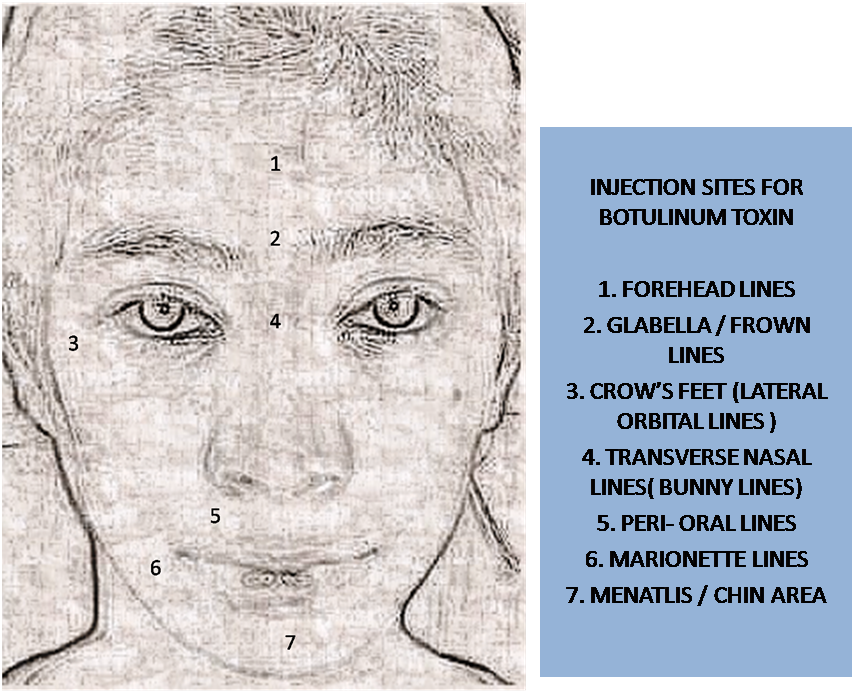
FIGURE 1-INJECTION SITES FOR BOTULINUM TOXIN ON FACE
The subsequent use for benign essential blepharospasm led to its cosmetic use, which was developed in 1987 and in the year 1992, the first study on BTX-A for the treatment of glabellar frown lines was published.11,18
Usually static wrinkles are not amenable to treatment with botulinum toxin as they are not caused by hyperfunctional muscles however BTX along with dermal fillers or various non resorbable materials to an extent can improve the esthetic and functional outcome of the muscles.5-9
While BTX - A is used “ off label” (that is for applications not specifically approved by the FDA) in many practices , including for treatment of facial rhytids around the eyes or from the frontalis muscle , the only approved cosmetic indication for either Botox® or Dysport® is the treatment of glabellar rhytids .19,20
BOTULINUM TOXIN IN THE GLABELLAR REGION
Mastery of the anatomy of the glabellar complex is paramount of the treatment of glabellar rhytids. The complex comprises of the bilateral corrugator supercilli muscles. Activity of these muscles results in the formation of vertical rhytids along the brow. These often resemble a number “11” between the heads of the eyebrows (Figure 2). Additionally, the procerus muscle is active in the area. Firing of the procerus results in horizontal rhytids across the radix of the nose. The botox® dosing for the treatment of glabellar rhytids have been reported anywhere between 20-50 units over several injection sites.21,22
Preoperatively, all makeup should be removed from the patient’s face. The general injection area should then be cleaned with isopropyl alcohol. It is beneficial to use electromyography (EMG) before injections to accurately identify the muscles underlying the wrinkles. Botox injections are accomplished via a single-point or a skewered method. In the latter technique the needle is inserted or “skewered” parallel to the plane of the muscle, and the injection is performed while the needle is carefully withdrawn.23
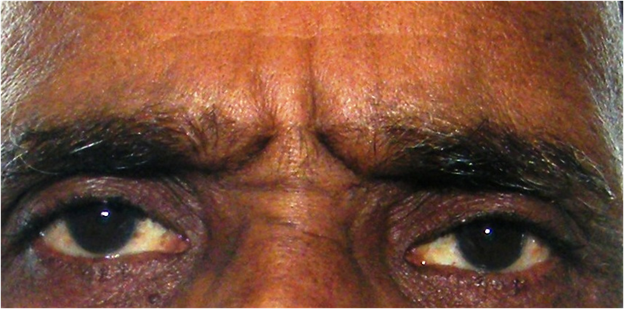
FIGURE 2- VERTICAL RHYTIDS IN GLABELLAR REGION
Usually 5 sites, using 4-6 units each are injected taking care to space the injections about 1- 2 cm apart to avoid injecting into muscles where paralysis is not desired. One site on each side is used to inject the corrugator, second site on each side is used to inject the orbicularis oculi and depressor supercilii, third site is used to inject the procerus in the mid line. The patient is asked to frown or scowl to palpate the targated muscles.18,20,24 A glabellar "spread test" (spreading the glabellar wrinkles apart with the thumb and index fingers) performed prior to the injection allows an estimate of the expected benefit from the injection. In 1998, a dose/response study by Hankins et al of 46 women receiving BOTOX® for glabellar wrinkles found an effective starting dose from 2.5-4 units per injection site.24
Topical anesthetic or ice may also be used to reduce pain during injection. Pressure with gauze immediately after injection is advisable to prevent bleeding and bruising. Patients are advised to excercise the treated muscle (frown or squint) after treatment for 1.5 hours and to avoid sun exposure (as sun exposure can prolong bruising or cause the development of hyperpigmentations in the treatment area), strenuous physical activity ( for 1.5 hours after treatment) , massaging the area after injection, lying down or going to sleep (for 4 hours post-injection) to avoid unwanted diffusion of the toxin into adjacent muscles.
Patients will notice a notable improvement within 1 to 3 days after injection. Maximum improvement is noted at 1 to 2 weeks or sometimes 3 weeks and the effects last approximately 8-12 weeks.18,20
The most common reported adverse effect reported is brow ptosis (injection too close to lateral eyebrow leads to lateral eyebrow ptosis), eyelid ptosis (caused by effects of the toxin on the upper eyelid levator) and muscle loss of expression. It occurs only if the toxin is directly injected into the muscle or close enough for toxin to diffuse to the levator muscle. Minor complications like brusing , pain, temporary eyelid droop, erythema , oedma, headache, flu- like syndrome, and nausea usually resolve within minutes to few days.25
BOTULINUM TOXIN IN THE LOWER  FACE
Treatment of lower face requires more advanced knowledge of injection technique as well as the relevant anatomy. The perioral muscles consists of elevators of the upper lip, elevators and depressors of the corner of mouth and depressors of the lower lip.26
The orbicularis oris is a sphincter like muscle surrounding the mouth. It is responsible for pursing the lips resulting in perioral rhytids. Women usually complaints of lipsticks ‘bleeding’ into thin lines and their treatment is highly desired for esthetic purpose. Botulinum toxin not only softens vertical lip lines but also provides the ‘fuller lips’. It diminishes the hollowing appearance within the vertical musculature bands, thereby offering ‘pseudoaugmentation’.
Patients are adviced to rub ice in the perioral area prior to injection as lips usually hurt more than other sites. Maintainence of symmetry to preserve philtrum midline is of utmost importance.
In the upper lip , two injection points are used-
- Along the vermillion border on each side of the upper lip spaced about 1.5 cm apart,
- More superior injection site between them 1 cm above the vermillion border
For the lower lip, inject only along the vermillion border using two sites on each side of the lip, also spaced 1.5 cm apart.
The mentalis muscle lies at the most inferior portion of the face and is responsible for the appearance of lines in chin area that are variously described as ‘pebble / scrotal chin’. While speaking or chewing, these lines usually become prominent.
Injection of BTX into the point of the chin relaxes mentalis muscle and leads to a significant improvement of appearance of the chin.27,28
4-8 units of Botox® injected each mentalis muscle adjacent to the midline of the chin approximately 1 cm apart.11
Care should be taken as the injections can diffuse to the depressor labii inferioris, resulting in slurred speech.27,28
DOWNTURNED SMILE
The marrionate lines are the lines that turndown the corners of the mouth. These lines are produced as a result of aging due to loss of dermal collagen in the lower lips and chin area. Downturned smile can misrepresent emotions, imparting sad/ concerned appearance.29,30 It can be corrected by injecting a small amount of botulinum toxin at the right spot of the depressor anguli oris muscle (DAO) which will effectively weaken these muscles. The DAO can be identified by instructing the patient to voluntarily and forcibly pull down the corners of the mouth and the muscle can then be felt by pulling inferiorly at a point approximately 1 cm lateral and 8 mm inferior to the commissure.30
The total dose to be administered depends upon the clinical assessment (patient’s muscle tone, activity and facial mimicry) and sex of the individual . An average dose of 3-5 units per side of Botox® will usually suffice for a single DAO muscle. Typical doses for a female can range between 2 -3 Units and for a male between 3 - 5 Units for one side of the mouth. Injections made into the posterior aspect of DAO permits the zygomaticus muscle to act unopposed and elevate the corners of the mouth to a horizontal, more esthetically looking position.29-31
Care should be taken as a medial injection can diffuse to the depressor septi muscles thereby causing slurred speech, a flat upper lip, a droopy upper lip, asymmetric smile, asymmetrical lips to name some otherwise patients can perform their daily activities just a few hours after the treatment.11,12,27,30,31
Contraindications for the use of BTX are known in the art and include children under 12, pregnant and lactating women, patients with history of neuromuscular disease and known sensitivity to BTX , human albumin or those taking aminoglycosides. The use of BTX is also not recommended for patients who are singers, musicians and other individuals who use their perioral muscles with intensity. However, treatment according to this invention will normally not affect normal speech (especially words like ‘p’, ‘b’, ‘j’ and ‘ g’), whistling or mastication particularly in cases where the orbicularis oris is not treated.29,31,32
GUMMY SMILE
The discipline of esthetics in orthodontics can be broken down into four parts: microesthetics (elements that make teeth look like teeth), macroesthetics (principles that apply when groupings of individual teeth are considered), gingival esthetics and facial esthetics.
The display of excessive gingival tissue in the maxilla upon smiling has been called “gummy smile”, a condition some consider esthetically displeasing. The muscular capacity to raise the upper lip higher than average (hyperfunctional muscle) can cause excessive gingival display. Several surgical procedures have been reported in the literature for correction of hyperfunctional upper lip elevator muscles, such as the Rubinstein and Kostianovsky,33 Miskinyar,34 and Rees and LaTrenta,35 techniques, they are not routinely used to treat gummy smile.36 In late 1990, a non surgical alternative for reducing gingival display caused by muscle hyperfunction using Botox became popular. This can be treated targeting the levator labii superioris aleque nasi muscle. This muscle can be identified by asking the patient to move his/ her nose tip. Injection of 1-3 units of Botox® between each superior medial nasolabial fold relaxes the muscle.
In a small open-label trial, five patients with excessive gingival display resulting from hyperfunctional upper-lip elevator muscles were treated with Botox injections under electromyographic guidance.36 The patients were in the age range of 16-23 years. Patients received one 0.25 U per muscle bilaterally into the levator labii superioris, levator labii superioris alaeque nasi, and at the overlap areas of the levator labii superioris and zygomaticus minor muscles. All of the patients were pleased with the results.36 The duration of effect ranged from 3 to 6 months, and no adverse effects were reported.
Complications seen in this area may include asymmetry of the lips and depression of corners of the mouth.
Vertical Neck Bands And Horizontal Necklace Lines
After weight loss, chin or neck liposuction or general age changes, the patient usually complains of prominent vertical bands in their neck. Botulinum toxin can be used to relax these bands. A total dose of 15 to 21 Units per band or 2 to 3 Units per injection is given in the area from 1 to 3 cm from the jaw line to the lower neck.11,37
It has also been noted that injection of BTX into the platysma produces an uplift of the mouth.38
BTX IN MASSETRIC HYPERTROPHY
The craniofacial morphology is influenced by genetic and environmental factors. Moss and Rankow39 noted that muscle function is one of the most important epigenetic factors involved in guiding facial bone growth, as well as bone shape and size. According to Collins’ “hard chewing hypothesis,” the distinctive shape of the Inuit skull is related to vigorous chewing.
Patients who are chronic jaw clenchers frequently present with masseter hypertrophy.40,41 Medical options such as muscle relaxants and occlusal splints have been used to treat benign masseteric hypertrophy since the 1880s. The increased size of these muscles is evident in the patient’s facial appearance which is often substantially altered (eg, the jaw can appear swollen and misshapen). Surgical masseter reduction via an external angle approach was first described in 1947. An intraoral approach evolved to excise the internal layer of the masseter and thickened bone at an angle that preserves the esthetics and protects the facial nerve.42 Many inherent risks were described in the literature when patients are treated with surgery, such as asymmetry, condylar fracture, inferior alveolar nerve injury, hematoma, facial nerve injury, postoperative trismus, and infection.43
Recently, the use of botulinum neurotoxin type A (BTX-A) was expanded as a noninvasive treatment for treating masseteric hypertrophy. An injection of BTX into the masseter muscles leads to temporary partial denervation. By using BTX, we can develop a model of individual muscle paralysis without altering the daily life or the biomechanical environment.44-46
Dosages used for treating the masseter muscle are generally 25 to 30 U of BTX-A.40,47
Kim et al48 reported that the masseter muscle can be reduced by inducing atrophy with a BTX-A injection in the case of masseter hypertrophy,and other authors43 reported the effect of BTX-A in reducing the masseter muscle, which was documented by ultrasonography and computed tomography. Side effects of a BTX-A injection for masseteric hypertrophy, such as a change in the bite force, muscle pain, and facial asymmetry, were reported.40 However, the side effects gradually disappeared by 12 weeks.49
Table 1 shows the target muscles along with the approximate number of injection sites (as there number could increase or decrease according to the requirement of each case) and the starting dose for each treatment.
BTX AS AN ADJUNCT WITH DENTAL IMPLANT THERAPY
More often, patients are demanding not only optimal function and esthetics from their dentition but also enhancement of their macroesthetic appearance. Dental implants have emerged as a predictable long-term option for treating partial edentulism.50-54 Coupled with enhancing the intraoral esthetics via dental implants, treating dynamic wrinkles with botulinum toxin can provide patients with a highly esthetic final result. The ability to use botulinum toxin as an adjunctive treatment with dental implant therapy to enhance facial esthetics offers exciting treatment options for dentists and patients in the years to come.
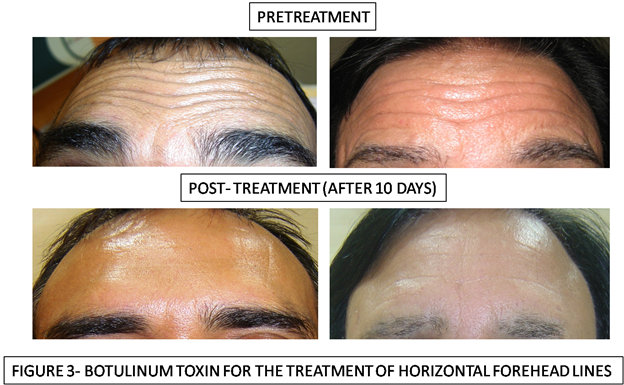
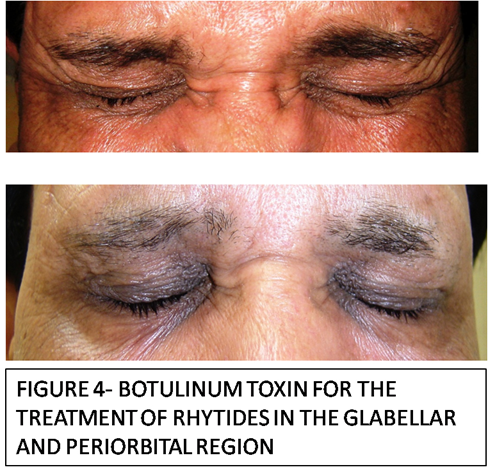
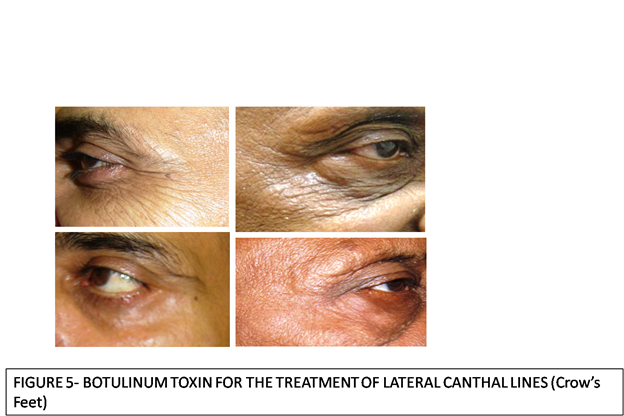
Figures 3, 4 and 5 shows the pre treatment and post treatment photographs of the use of botulinum toxin in treating various cosmetic conditions like horizontal forehead lines, glabellar rhytides and crow’s feet.
CONCLUSION
As there is growing interest in the facial esthetics by everyone, cosmetic dentistry has evolved as a backbone in every dental practice. Patients who are interested in enhancing their appearance and the function of their teeth would definitely want to improve their overall facial appearance. The introduction of botulinum toxin in combination with the dermal fillers can yield wonderful results in dentistry .Proper knowledge of the anatomy of the area of injection along with the correct dosage is essential before starting up any case. Dentists should educate themselves through various courses, conferences, CDEs and seminars being held on these topics and make the best use of this toxin.
REFERENCES
- Schantz, E. J. and Sugiyama, H. Toxic proteins produced by Clostridium botulinum. J Agric Food Chem 1974; 22(1): 26-30.
- Flynn TC. Update on botulinum toxin. Semin Cutan Med Surg 2006; 25: 115–121.
- Early Communication about an Ongoing Safety Review of Botox and Botox Cosmetic (Botulinum toxin Type A) and Myobloc (Botulinum toxin Type B). 2009-01-27.
- Follow-up to the February 8, 2008, Early Communication about an Ongoing Safety Review of Botox and Botox Cosmetic (Botulinum toxin Type A) and Myobloc (Botulinum toxin Type B). Food and Drug Administration (United States), 2009-04-30.
- Cohen SR, Holmes RE. Artecoll: a long lasting injectable wrinkle filler material . Report of a controlled, randomized, multicenter clinical trial of 251 subjects. Plas Reconstr Surg. 2004; 114: 964-977.
- Stegman SJ. Zyderm collagen. Clinical efficacy and tolerance. Rev Laryngol Otol Rhinol( Bord). 1987;108:23-2
- Duranti F, Salti G, Bovani B, Calandra M, Rosati ML. Injectable hyaluronic acid gel for soft tissue augmentation. A clinical and histological study. Dermatol Surg. 1998; 24: 1317- 1325.
- Wetmore SJ. Injection of fat for soft tissue augmentation. Laryngoscope. 1989;99:50-57.
- Naoum c, Dasiou D. Dermalfiller materials and botulin toxin: Review. Int J Dermatol 2001; 40:609-21.
- Carruthers A, Carruthers J. Botulinum toxin products overview. Skin Therapy Lett 2008;13:1-4.
- Carruthers A, Kiene K, Carruthers J. Botulinum A exotoxin use in clinical dermatology [review]. Am Acad Dermatol.1996; 34:788 –797
- Carruthers J, Carruthers A. The evolution of botulinum neurotoxin type A for cosmetic applications. J Cosmet laser Ther. 2007 Sept; (3): 186-92.
- Freeman SR, Cohen JL. New Neurotoxins on the Horizon. Aesthetic Surg J 2008; 28: 325–330.
- Ihde S. Utilisation of prophylactique de la toxine botulique en implantologie dentaire. Implantodontie 2005; 14:51-55 ( In French).
- Smith L. Histopathologic characteristics and ultrastructure of aging skin.Cutis. 1984;43: 414-424.
- Fenske NA, Lober CW. Structural and functional changes of normal aging skin. J Am Acad Dermatol.1986;15:571-585.
- Uittto J. Connective tissue biochemistry of aging dermis. Age related alterations in collagen and elastin. Dermatol Clin. 1986;4:433-446.
- Carruthers JD, Carruthers JA. "Treatment of Glabellar Frown Lines with C. Botulinum -A Exotoxin". J Dermatol surg and oncology . 1992 Jan; 18(1): 17–21
- Niamtu J. Aesthetic uses of botulinum toxin A. J Oral Maxillofac Surg 1999: 57: 1228–1233
- Niamtu J. Cosmetic facial surgery. Oral Maxillofac Surg Clin North Am 2000: 12: 595.
- Carruthers A, Carruthers J, Said S. Dose-ranging study of botulinum toxin type A in the treatment of glabellar rhytids in females. Derm Surg 2005; 31:414-422.
- Carruthers A, Carruthers J, Said S. Dose-ranging study of botulinum toxin type A in the treatment of glabellar rhytids in males. Dermatol Surg.2005; 31: 1297-1303.
- Dastoor S.F, Misch E, Wang L. Botulinum Toxin (Botox) to enhance facial macroesthetics: A Literature review. Jour of Oral Implantology 2007; 33(3):164-171
- Hankins CL, Strimling R, Rogers GS. Botulinum A toxin for glabellar wrinkles. Dose and response. Dermatol Surg. Nov 1998;24(11):1181-3.
- Cote TR, Mohan AK, Polder JA, Walton MK, Braun MM. “Botulinum toxin type A injections: adverse events reported to the US Food and Drug Administration in therapeutic and cosmetic cases”. J. Am. Acad. Dermatol. 53(3):407-15.
- Hoefflin (1998). “Anatomy of the Platysma and Lip Depressor Muscles” Dermatol. Surg., vol. 24: 1225-1231.
- A. Carruthers and J. Carruthers; "Cosmetic Uses of Botulinum A Exotoxin"; In: James, W. D. et al Eds. Advances in Dermatology (1997) Mosby-Yearbook, Chicago: at pages 325-48.
- Kenneth Beer, M.D.1, Joel L. Cohen, M.D.2 and Alastair Carruthers. 3 Clinical Uses of Botulinum Toxins, eds. Anthony B. Ward and Michael P. Barnes. Published by Cambridge University Press. Cambridge University Press 2007. Pages 328-348
- Carruthers et al. “Clinical Indications and Injection Technique for the Cosmetic Use of Botulinum A Exotoxin” Dermatol. Surg 1998; 24: 1189-1194.
- Carruthers J, Carruthers A. Botox treatment for expressive facial lines and wrinkles. Curr Opin Otolaryngol 2000;8:357-61.
- Goldman A, Wollina U. Elevation of the corner of the mouth using Botulinum toxin type A. J Cutan Aesthet Surg 2010;3:145-50.
- Wollina U, Rowland Payne C. Aging well: The role of minimally invasive aesthetic dermatological procedures in women over 65. J Cosmet Dermatol 2010;9:50-8
- Rubenstein A, Kostianovsky A. Cosmetic surgery for the malformation of the laugh: original technique. Prensa Med Argent. 1973; 60:952.
- Miskinyar SA. A new method for correcting a gummy smile. Plast Reconstr Surg. 1983; 72:397-400.
- Rees T, LaTrenta G. The long face syndrome and rhinoplasty. Persp Plast Surg. 1989; 3:116.
- Polo M. Botulinum toxin type A in the treatment of excessive gingival display. Am J Orthod Dentofacial Orthop. 2005;127(2):214-218.
- Carruthers J, Carruthers A. Botox use in the mid and lower face and neck. Semin Cutan Surg 2001;20:85-92.
- F. S. Brandt and B. Bellman. Cosmetic Use of Botulinum A Exotoxin for the Aging Neck; Dermatol. Surg.1998; 24: 1232-1234.
- Moss ML, Rankow RM: The role of the functional matrix in mandibular growth. Angle Orthod 1968;38:95
- Kim HJ, Yum KW, Lee SS, et al. Effects of botulinum toxin type A on bilateral masseteric hypertrophy evaluated with computed tomographic measurement. Dermatol Surg. 2003;29(5):484-489.
- Al-Ahmad HT, Al-Qudah MA. The treatment of masseter hypertrophy with botulinum toxin type A. Saudi Med J. 2006;27(3):397-400.
- Ahn J, Horn C, Blitzer A: Botulinum toxin for masseter reduction in Asian patients. Arch Facial Plast Surg 6:188, 2004.
- To EW, Ahuja AT, Ho WS, et al: A prospective study of the effect of botulinum toxin A on masseteric muscle hypertrophy with ultrasonographic and electromyographic measurement. Br J Plast Surg 2001;54:197
- Aoki KR: A comparison of the safety margins of botulinum neurotoxin serotypes A, B, and F in mice. Toxicon 2001;39:1815
- Brin MF: Botulinum toxin: Chemistry, pharmacology, toxicity, and immunology. Muscle Nerve Suppl 6:S146, 1997.
- Dressler D, Saberi FA, Barbosa ER: Botulinum toxin: Mechanisms of action. Arq Neuro Psiquiatr 2005; 63:180
- Von Lindern JJ, Niederhagen B, Appel T, et al: Type A botulinum toxin for the treatment of hypertrophy of the masseter and temporal muscles: An alternative treatment. Plast Reconstr Surg 2001;107:327
- Kim NH, Chung JH, Park RH, et al: The use of botulinum toxin type A in aesthetic mandibular contouring. Plast Reconstr Surg2005; 115:919
- Park MY, Ahn KY, Jung DS. Botulinum toxin type A treatment for contouring of the lower face. Dermatol Surg 2003;29:477.
- Adell R, Eriksson B, Lekholm U, Branemark PI, Jemt T. Longterm follow-up study of osseointegrated implants in the treatment of totally edentulous jaws. Int J Oral Maxillofac Implants. 1990;5:347– 359.
- Adell R, Lekholm U, Rockler B, Branemark PI. A 15-year study of osseointegrated implants in the treatment of the edentulous jaw. Int J Oral Surg. 1981;10:387–416.
- Buser D, Weber HP, Bragger U, Balsiger C. Tissue integration of one-stage ITI implants: 3-year results of a longitudinal study with hollow-cylinder and hollow-screw implants. Int J Oral Maxillofac Implants. 1991;6:405–412.
- Nevins M, Langer B. The successful application of osseointegrated implants to the posterior jaw: a long-term retrospective study. Int J Oral Maxillofac Implants. 1993;8:428–432.
- Van Steenberghe D, Lekholm U, Bolender C, et al. Applicability of osseointegrated oral implants in the rehabilitation of partial edentulism: a prospective multicenter study on 558 fixtures. Int J Oral Maxillofac Implants. 1990;5:272–281.
Disclaimer from Guident
The views and opinions expressed in articles published in Guident are solely those of the authors and do not necessarily reflect the views of the editors, the editorial board or the publisher, Ivory India. Guident does not endorse any product, technique or treatment described. Clinical content is intended for qualified dental and medical professionals and is not a substitute for individual clinical judgement. Guident, its editors and the publisher accept no liability for any consequence arising from the use of information published in the journal.
How to cite this article
Dr Shally Mahajan, Dr. Srivastava Vipul, Dr.Aakanksha Srivastava. Botulinum Toxin in Cosmetic Dentistry. Guident. 2016 Sep;9(10). Available from: https://guident.in/articles/aesthetic-dentistry/botulinum-toxin-in-cosmetic-dentistry.html


