Fixed Implant Reahbilitation of Maxilla
Jaipur, India
ABSTRACT
Functional, esthetic and psychological issues arising from edentulism have led to oral rehabilitation with implant-supported prostheses. Due to the anatomy of this region, this type of rehabilitation requires detailed planning, especially when treating edentulous maxilla with implant-supported prostheses. In this case report it describes the rehabilitation of an edentulous maxilla from complete denture to implant- supported complete denture. Firstly patient was given complete denture but was not satisfied because of some reasons, then over denture on 3 implants were given so to keep the procedure minimally invasive but still the patient was having problems with hygiene. Finally 3 more implants were placed in such a manner that full mouth rehabilitation was done.
Keywords: Complete denture, Dental implants, Maxilla.
INTRODUCTION
The main concerns of the practitioners nowadays is to obtain the most natural-looking smiles with successful osseointegration of dental implants.1
Elderly patients visit the dental clinics seeking for a good smile which was lost due to the loss of the teeth, supporting alveolar bone, and muscles. To restore these units, complete edentulous patients must be treated by dental implants.2 Treatment options varies from removable to fixed implant supported restorations, but it depends on the patient’s anatomical limitations and personal preferences and also whether to accept extensive surgical procedures to restore the bone and/or soft tissue.1
In comparison to the traditional fixed prosthesis, implant supported overdentures and hybrid prosthesis provide support for the soft tissues of the face. Soft tissue loss can be easily replaced and even pink interdental papilla can be artificially created with the computer-aided designs and developing prosthetic materials.3
Normally if number of implants is more in an arch, a traditional fixed bridge is the prosthetic modality of choice. But in case of maxilla, due to combined vertical and horizontal resorption of bone and tilted positions of the implants a traditional fixed bridge would not meet the patient’s requirements for hygiene maintenance, esthetics, phonetics, and comfort. With a more drawback i.e., pink porcelain is less natural-looking and it usually requires more baking cycles that increase the risk of porcelain fracture.2
Hence fabricating hybrid prosthesis is the solution. It can easily replace the soft tissue, can reduce the mechanical and biological problems (shock absorbing properties ) such as component fracture, screw loosening, and bone resorption.4
Framework leading up to marginal bone around dental implants is due to rapid wear of acrylic denture teeth and stress generated by porcelain teeth present in it. Hence use of veneer materials has been widely accepted in implant dentistry because of their stress absorption and less wear characteristics.5, 6
In this case report it describes the rehabilitation of an edentulous maxilla from complete denture to implant-supported complete denture. Firstly patient was given complete denture but was not satisfied because of some reasons, then over denture on 3 implants were given so to make procedure minimally invasive but still patient was having problems with hygiene. Finally 3 more implants were placed in such a manner that full mouth rehabilitation was done.
CASE REPORT
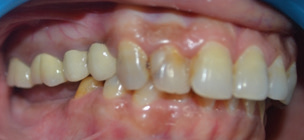
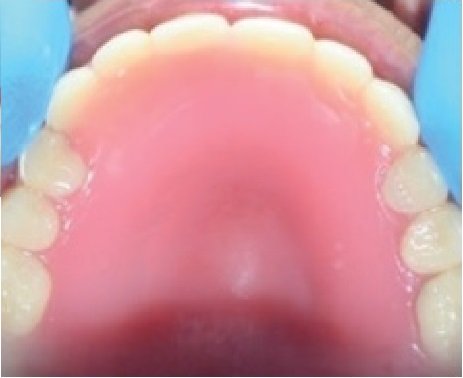
A 57 year old lady came with the chief complain of ill fitting upper denture. The patient has no past relevant medical history. Her dental history included extraction of the periodontally involved teeth and their replacement with removable denture. These dentures were relined on several occasions still patient was not satisfied because of less retention making her unable to chew and speak properly. (Figure. 1 a, b).

(a)
(b)
Figure. 1: a, b Pre-operative image of patient
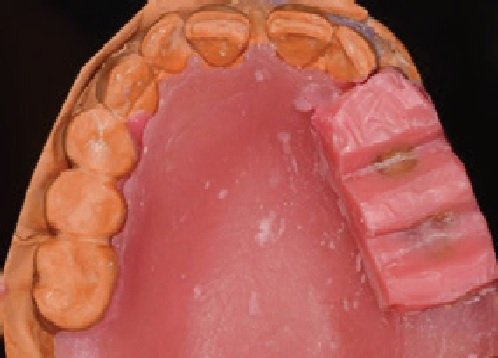
OPG was advised and report revealed resorption of maxillary alveolar ridge. A treatment plan was prepared after a standard protocol. It included fabrication of a 3- free standing Roxolid SLActive implant-supported overdenture for the maxillary arch. (Figure. 2).
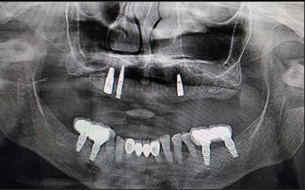
Figure. 2: Immediately after Roxolid SLActive implant placement
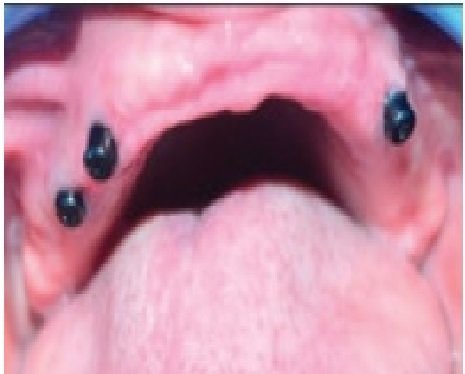
Three Roxolid SLActive implant were placed. Adequate amount of bone formation on the buccal and lingual aspect of the defect resulted in good primary stability of the implant. (Figure. 3 a, b).
(a)

(b)
Figure. 3: a, b - Placement of implant
As recommended by the newer and more efficient biology of implant surface, after 45 days of implant placement, ISQ test was done, which showed excellent biological stability with readings measuring in b/w 73 to 76, thereby showing excellent biologic stability or osseointegration. (Figure. 4).
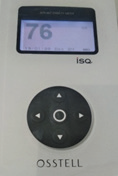
Figure. 4: ISQ reading
The problem of retention was solved. Also the palatal extension was removed from the existing denture but still patient had problems with hygiene and wanted a complete fixed solution. So 3 more implants were strategically placed keeping in plan so that a complete set of fixed teeth can be delivered with minimum extension of cantilevers.(Figure. 5).

Final Fixed prosthesis
Again ISQ of all implants were checked which came out to be satisfactorily and now immediate crowns were given.(Figure. 6 a, b, c).

(Figure. 6: a, b, c - ISQ of all implants)
Patient was satisfied with the result.(Figure. 7 a, b).

Figure. 7: a, b Post operative image of patient and OPG
DISCUSSION
Rehabilitation of edentulous patients should be performed uniquely and avoid generalization of techniques, especially when faced with a wide range of alternatives and different anatomic conditions, as it is the case of the maxilla.7 Hence, judicious planning, including dental casts mounted in an articulator, diagnostic waxing and clinical as well as radiographic examinations, proves imperative. Detailed treatment planning should be conducted taking the following into account: anatomy of the maxilla, bone resorption pattern, quality of bone available for implant placement, emergence profile development, maxillary function at speaking, and esthetics.7-9
In addition, access to hygiene, easy prosthesis repair and patient’s economic resources should also be considered.10 In cases of fixed rehabilitation, the number and position of implants determine which type of prosthesis will be used. Likewise, the prosthesis model of choice guides the number and position of implants in the arch. Both requirements are based on the anatomic and morphological conditions of the maxilla and are directly associated with maxillary prosthesis clinical success, as demonstrated by studies with 1 to 15-year follow-ups.11
In patients with excessive interocclusal space, fabrication of hybrid dentures provides several advantages for the esthetic appearance i.e., decreases the bulkiness of metal substructure and height of crowns. In addition it act as shock absorbent and force distributer. Enhances oral hygiene by food being swiped away as a self-cleansing enhancement.
To decrease stress upon the hybrid prosthesis components correct arrangement of implants, elimination of cantilevers, fine occlusal adjustment, fabrication of a stiff framework, and use of stress absorbing materials are the various components that should be taken into consideration.3, 12 Due to the generation of high stresses certain mechanical and biological complications are faced which result in screw loosening and component fracture, biological bone resorption, and detachment of veneering material from its framework.2, 3 These complications can be decrease if multiple materials are used to fabricate implant supported prosthesis, as they work as a force distributer and absorber.13
CONCLUSION
Implant supported fixed restorations can serve as an excellent treatment modality for edentulous patients. With understanding patient expectations and limitations, prosthetic therapeutic can be successful if detailed pre-surgical analysis is done i.e., prosthetically driven implant position, selection of prosthetic materials, prosthesis design and proper maintenance.
REFERENCES
- M. Steigmann, “Aesthetic flap design for correction of buccal fenestration defects,” Practical Procedures & Aesthetic Dentistry: PPAD, vol. 20, no. 8, pp. 487–494, 2008. View at Google Scholar • View at Scopus.
- J. Montero, C. M. de Paula, and A. Albaladejo, “The ‘Toronto prosthesis’, an appealing method for restoring patients candidates for hybrid overdentures: a case report,” Journal of Clinical and Experimental Dentistry, vol. 4, no. 5, pp. e309–e312, 2012. View at Publisher • View at Google Scholar • View at Scopus.
- J. Gonzalez, “The evolution of dental materials for hybrid prosthesis,” Open Dentistry Journal, vol. 8, no. 1, pp. 85–94, 2014. View at Publisher • View at Google Scholar • View at Scopus.
- T. Kwon, P. A. Bain, and L. Levin, “Systematic review of short- (5–10 years) and long-term (10 years or more) survival and success of full-arch fixed dental hybrid prostheses and supporting implants,” Journal of Dentistry, vol. 42, no. 10, pp. 1228–1241, 2014. View at Publisher • View at Google Scholar • View at Scopus.
- S. D. Heintze, G. Zellweger, I. Grunert, C. A. Muñoz-Viveros, and K. Hagenbuch, “Laboratory methods for evaluating the wear of denture teeth and their correlation with clinical results,” Dental Materials, vol. 28, no. 3, pp. 261–272, 2012. View at Publisher • View at Google Scholar • View at Scopus.
- A. Radhi, A. S. Juszczyk, R. V. Curtis, M. Sherriff, D. R. Radford, and R. K. F. Clark, “Effect of GC METALPRIMER II on bond strength of heat-cured acrylic resin to titanium alloy (Ti-6Al-4V) with two different surface treatments,” The European Journal of Prosthodontics and Restorative Dentistry, vol. 16, no. 3, pp. 132–137, 2008. View at Google Scholar • View at Scopus.
- Brida AS, Agar JR. A classiication system of patients for esthetic ixed implant- supported prosthesis in the edentulous maxilla. Compend Conin Educ Dent. 2010;31(5):366-79.
- Sadowsky SJ. The implant-supported prosthesis for the edentulous arch: design considerations. J Prosthet Dent. 1997;78(1):28-33.
- Brida AS. Three dimensional esthetic analysis in the treatment planning for implant supported ixed prosthesis in the edentulous maxilla: review of the esthetics literature. J Esthet Restor Dent. 2011;23(4):219-36.
- Mericske-Stern RD, Taylor TD, Belser U. Management of the edentulous patient. Clin Oral Implants Res. 2000;11(suppl):108-25.
- Lambert FE, Weber H-P, Susarla SM, Belser UC, Galluci GO. Descriptive analysis of implant prosthodontics survival rates with ixed implant-supported rehabilitations in the edentulous maxilla. J Periodontol. 2009;80(8):1220-30.
- S. Hahnel, M. Behr, G. Handel, and M. Rosentritt, “Two-body wear of artificial acrylic and composite resin teeth in relation to antagonist material,” Journal of Prosthetic Dentistry, vol. 101, no. 4, pp. 269–278, 2009. View at Publisher • View at Google Scholar • View at Scopus
- G. C. Silva, T. M. Cornacchia, C. S. De Magalhães, A. C. Bueno, and A. N. Moreira, “Biomechanical evaluation of screw- and cement-retained implant- supported prostheses: a nonlinear finite element analysis,” Journal of Prosthetic Dentistry, vol. 112, no. 6, pp. 1479–1488, 2014. View at Publisher • View at Google Scholar • View at Scopus
Disclaimer from Guident
The views and opinions expressed in articles published in Guident are solely those of the authors and do not necessarily reflect the views of the editors, the editorial board or the publisher, Ivory India. Guident does not endorse any product, technique or treatment described. Clinical content is intended for qualified dental and medical professionals and is not a substitute for individual clinical judgement. Guident, its editors and the publisher accept no liability for any consequence arising from the use of information published in the journal.
How to cite this article
Dr. Gaurav Gupta, Dr. D. K. Gupta, Dr. Neelja Gupta Wisdom Dental Clinics. Fixed Implant Reahbilitation of Maxilla. Guident. 2019 Aug;12(9). Available from: https://guident.in/articles/implantology/fixed-implant-reahbilitation-of-maxilla.html