Aesthetic Rehabilitation of Adult Skeletal Open Bite Using a Non-Orthodontic, Non-Surgical Approach: A Case Report
Srinagar, J&K
ABSTRACT
Anterior open bite in adult patients presents a significant functional and aesthetic challenge, often requiring orthodontic or surgical intervention. However, patient-related constraints such as time limitations and refusal of surgery necessitate alternative approaches. This case report describes the successful aesthetic rehabilitation of a 24-year-old female patient with a pronounced anterior open bite using a non-orthodontic, non-surgical prosthodontic approach. Through careful planning, diagnostic evaluation, and controlled modification of labial angulation using full-coverage restorations, a satisfactory aesthetic outcome was achieved within a limited timeframe.
Keywords: Anterior open bite, aesthetic rehabilitation, prosthodontics, non-surgical treatment, smile design, adult orthodontic alternatives
INTRODUCTION
Anterior open bite is a complex malocclusion characterized by the lack of vertical overlap between anterior teeth. Management typically involves orthodontic treatment, orthognathic surgery, or a combination of both. However, in adult patients with time constraints or unwillingness to undergo surgical procedures, alternative treatment modalities must be considered.
Advancements in aesthetic dentistry have enabled clinicians to address such challenges through restorative means, focusing on smile design principles and occlusal harmony. This case highlights a pragmatic and patient-centered approach in managing a severe anterior open bite through prosthodontic rehabilitation.
CASE PRESENTATION
A 24-year-old female patient presented with the chief complaint of spacing in her upper and lower anterior teeth, primarily concerned about her smile aesthetics.
Clinical examination revealed a pronounced anterior open bite with significant lack of overjet and overbite. The patient exhibited normal periodontal health and no significant temporomandibular joint issues.
Radiographic investigations, including a lateral cephalogram and orthopantomogram (OPG), were performed to assess skeletal and dental relationships.
An orthodontic consultation was sought. However, due to the severity of the open bite, the patient’s age, and the extended duration required for orthodontic correction, the prognosis for timely completion was unfavorable. Orthognathic surgery was suggested as a definitive solution, but the patient unequivocally declined any surgical intervention.
Additionally, the patient had an urgent time constraint, as she was scheduled to relocate abroad for higher studies.
TREATMENT PLANNING
Considering the patient’s preferences and limitations, a non-orthodontic, non-surgical prosthodontic approach was planned.
The treatment objectives were:
- Closure of anterior spacing
- Improvement of overjet and overbite to the maximum possible extent
- Enhancement of smile aesthetics
- Completion within a limited timeframe
The proposed treatment involved full-coverage crown preparation of upper and lower anterior teeth with modification of labial angulation to achieve improved incisal contact and visual closure of the open bite.
Preoperative diagnostic impressions were made to fabricate study models. These models were used in a detailed consultation session with the patient to explain the existing condition and expected treatment outcomes. A step-by-step visual and mathematical explanation of tooth positioning, angulation changes, and final aesthetics was provided to ensure informed consent.

CLINICAL PROCEDURE
Following patient approval:
- Tooth Preparation:
Controlled preparation of maxillary and mandibular anterior teeth was carried out, ensuring preservation of tooth structure while allowing adequate space for restorative material. - Provisionalization:
Provisional restorations were fabricated to simulate the intended changes in tooth angulation and incisal relationship. This phase allowed evaluation of aesthetics, phonetics, and patient comfort. - Final Restoration:
Based on successful provisional assessment, definitive crowns were fabricated with precise control over labial inclination and incisal edge positioning to achieve optimal aesthetic and functional results. - Cementation:
Final restorations were cemented following standard adhesive protocols.


RESULTS
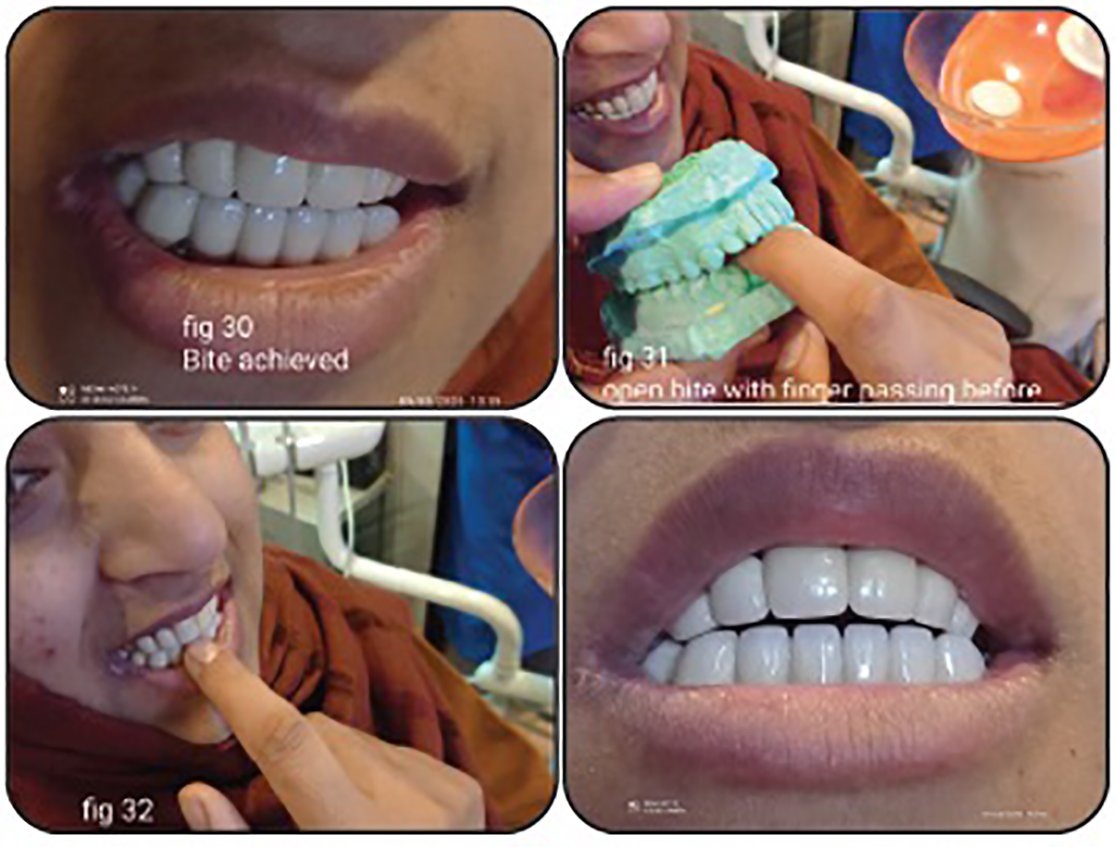
The treatment resulted in a significant improvement in smile aesthetics, with effective closure of anterior spacing and a visually acceptable correction of open bite.
Although complete skeletal correction was not achievable through this approach, the prosthodontic rehabilitation successfully fulfilled the patient’s primary concerns within the given time constraints.
The patient expressed high satisfaction with the final outcome, particularly with the enhanced smile appearance and immediate results.
DISCUSSION
Management of anterior open bite in adults is often challenging, especially when conventional orthodontic or surgical approaches are not feasible.
This case demonstrates that, with careful planning and adherence to aesthetic and occlusal principles, prosthodontic intervention can serve as a viable alternative. Modification of labial angulation and incisal positioning plays a critical role in achieving the illusion of bite closure.
However, such approaches require:
- Thorough case selection
- Detailed patient counseling
- Precise execution
- Understanding of functional limitations
While this method does not address underlying skeletal discrepancies, it provides a practical solution for patients prioritizing time and aesthetics over ideal occlusal correction.
CONCLUSION
In situations where conventional orthodontic and surgical treatments are contraindicated or declined, a non-orthodontic, non-surgical prosthodontic approach can offer a predictable and effective alternative for aesthetic rehabilitation of anterior open bite cases.
This case emphasizes the importance of individualized treatment planning and the clinician’s ability to think beyond traditional protocols while maintaining scientific and aesthetic principles.
Disclaimer from Guident
The views and opinions expressed in articles published in Guident are solely those of the authors and do not necessarily reflect the views of the editors, the editorial board or the publisher, Ivory India. Guident does not endorse any product, technique or treatment described. Clinical content is intended for qualified dental and medical professionals and is not a substitute for individual clinical judgement. Guident, its editors and the publisher accept no liability for any consequence arising from the use of information published in the journal.
How to cite this article
Dr. Muhammad Shafie, Dr. Mateen ShafieDentonic Oral Surgery Implant Centre Rajbagh. Aesthetic Rehabilitation of Adult Skeletal Open Bite Using a Non-Orthodontic, Non-Surgical Approach: A Case Report. Guident. 2026 Mar;19(4). Available from: https://guident.in/articles/implantology/aesthetic-rehabilitation-of-adult-skeletal-open-bite-using-a-non-orthodontic-non-surgical-approach-a-case.html