Non-Vital Bleaching: A Conservative Approach for Discolored Endodontically Treated Teeth: A Report of Two Cases
Department of Conservative Dentistry and Endodontics, Seema Dental College And Hospital, Rishikesh
ABSTRACT
Discoloration of non-vital teeth is a common esthetic concern following trauma or endodontic therapy, especially in the anterior region. Non-vital bleaching provides a conservative, minimally invasive, and cost-effective alternative to prosthetic rehabilitation. This article presents two clinical cases of discolored, endodontically treated anterior teeth treated successfully using the walking bleach technique. The clinical protocol, biological considerations, and potential complications are discussed in detail. Both cases showed excellent esthetic outcomes without any adverse effects, highlighting the predictability and effectiveness of the technique.
Keywords: Non-vital bleaching, walking bleach technique, endodontically treated teeth, tooth discoloration, sodium perborate
INTRODUCTION
Tooth discoloration is a significant esthetic concern that can negatively impact a patient’s smile and psychological well-being. Discoloration of non-vital teeth commonly occurs following trauma, pulpal hemorrhage, necrosis, or as a consequence of endodontic treatment. The breakdown of hemoglobin releases iron, which combines with sulfides to form iron sulfide, resulting in a dark discoloration of the tooth structure. Additionally, remnants of pulp tissue, medicaments, and obturation materials can contribute to intrinsic staining.
Traditionally, such discoloration has been managed using prosthetic approaches such as veneers or crowns. However, these treatment modalities involve removal of sound tooth structure and are therefore considered invasive. In contrast, non-vital bleaching represents a conservative and biologically acceptable approach that preserves tooth integrity while achieving satisfactory esthetic results.
The walking bleach technique, first introduced by Spasser, is widely used due to its simplicity and effectiveness. It involves placement of a bleaching agent ???? the pulp chamber, which is left in situ for a few days and replaced periodically until the desired shade is achieved. Sodium perborate, either alone or mixed with hydrogen peroxide, is the most commonly used bleaching agent due to its safety and controlled release of oxygen.
This article presents two cases of discolored non-vital anterior teeth managed successfully with the walking bleach technique and discusses the clinical considerations and outcomes associated with this procedure.
CASE REPORTS
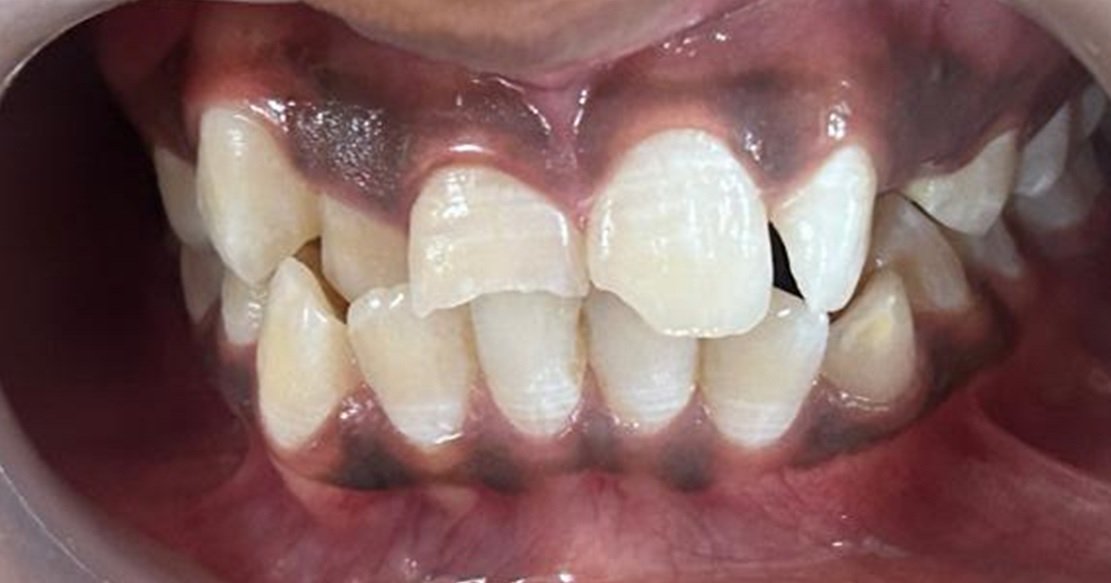
Two patients reported with discolored maxillary anterior teeth following previous endodontic treatment. Both cases were asymptomatic, with satisfactory root canal obturation and no periapical pathology. The discoloration ranged from grey to yellowish-brown, affecting esthetics significantly.
CLINICAL PROCEDURE
The walking bleach technique was employed in both cases following a standardized protocol:
- Preoperative Assessment: Clinical and radiographic evaluation was carried out to confirm the quality of root canal treatment and absence of periapical pathology. Preoperative shade was recorded using a shade guide.
- Isolation: The tooth was isolated using a rubber dam to prevent contamination and protect surrounding tissues.
- Access Opening: The existing restoration was removed, and access to the pulp chamber was achieved.
- Removal of Gutta-Percha: Approximately 2–3 mm of gutta-percha was removed below the cemento-enamel junction (CEJ).
- Cervical Barrier Placement: A cervical barrier of glass ionomer cement was placed to seal the root canal filling and prevent leakage of bleaching agent into the periodontal tissues.
- Preparation of Bleaching Agent: Sodium perborate was mixed with hydrogen peroxide to form a paste.
- Placement of Bleaching Material: The prepared paste was placed ???? the pulp chamber without applying excessive pressure.
- Temporary Restoration: The access cavity was sealed with a temporary restorative material.
- Follow-up: The patient was recalled after 5–7 days. The bleaching agent was replaced if required until the desired shade was achieved.
- Final Restoration: After achieving satisfactory results, the bleaching material was removed, and the cavity was restored permanently with composite resin.
CASE REPORT 1
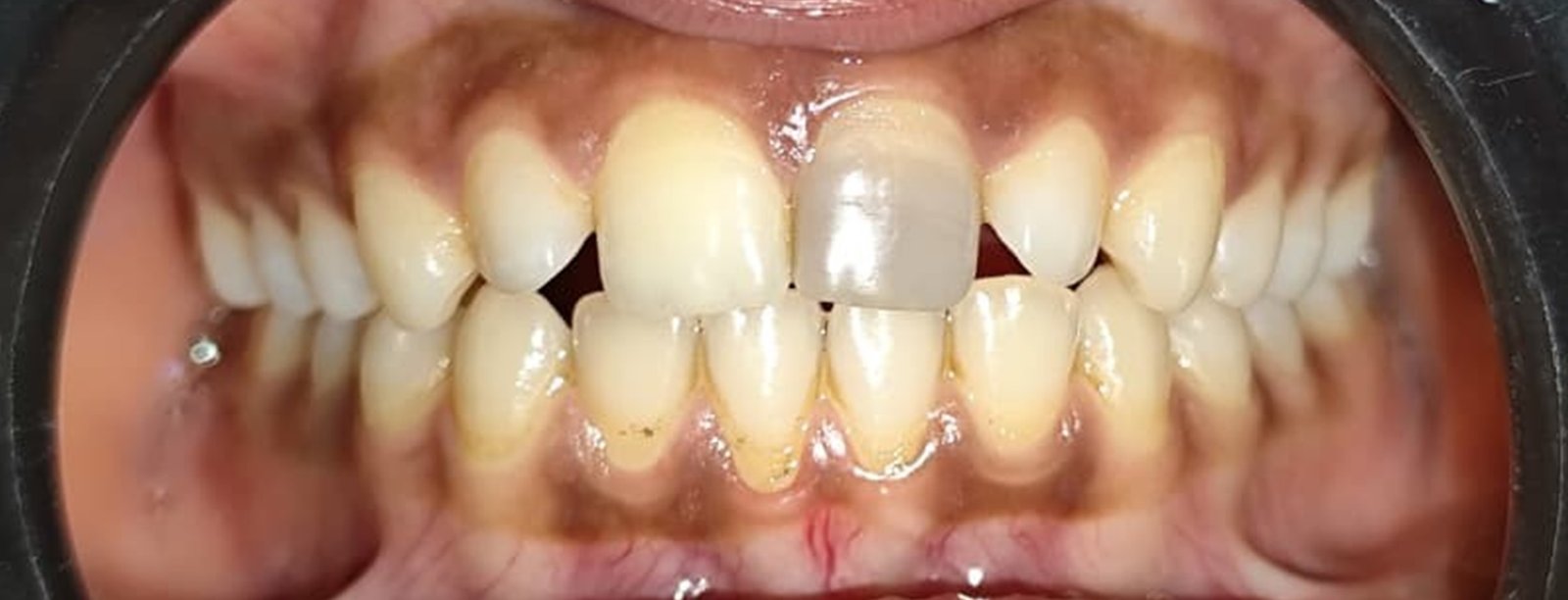
FIG 1: PRE-OPERATIVE

FIG 2: PRE-OPERATIVE
CASE REPORT 2

RESULTS
Both cases showed significant improvement in tooth shade, closely matching adjacent teeth. No postoperative sensitivity, cervical resorption, or other complications were observed during follow-up.
DISCUSSION
Non-vital bleaching is based on the principle of oxidation, wherein free radicals released from bleaching agents break down complex chromogenic molecules into simpler, lighter-colored compounds. Sodium perborate is considered a safer option due to its gradual release of oxygen and reduced risk of external cervical resorption compared to high concentrations of hydrogen peroxide.
The walking bleach technique is widely preferred due to its simplicity, minimal chairside time, and effectiveness. However, proper case selection is crucial. Teeth with defective restorations, cracks, or inadequate root canal treatment should be managed appropriately before bleaching.
A critical step in the procedure is the placement of an adequate cervical barrier. Failure to do so may allow bleaching agents to penetrate the periodontal ligament, potentially leading to external cervical resorption. Studies have shown that the use of sodium perborate mixed with water instead of hydrogen peroxide further reduces this risk.
Although the results of non-vital bleaching are generally stable, some degree of relapse may occur over time. This can be managed by repeat bleaching procedures if necessary. Compared to prosthetic options, non-vital bleaching preserves tooth structure and can be repeated without significant biological cost.
In both cases presented, the walking bleach technique provided excellent esthetic results with no complications, reinforcing its role as a first-line treatment modality for discolored non-vital teeth.
CONCLUSION
Non-vital bleaching is a predictable, conservative, and effective treatment for discolored endodontically treated teeth. When performed with proper technique and precautions, it provides excellent esthetic outcomes while preserving natural tooth structure. It should be considered as the treatment of choice before opting for invasive restorative procedures.
REFERENCES
- Spasser HF. A simple bleaching technique using sodium perborate. J Endod. 1961.
- Nutting EB, Poe GS. Chemical bleaching of discolored endodontically treated teeth. Dent Clin North Am. 1967.
- Rotstein I. Tooth discoloration and bleaching. Endod Topics. 2002.
- Howell RA. Bleaching discolored root-filled teeth. Br Dent J. 1981.
- Plotino G, et al. Non-vital bleaching: A review. J Endod. 2008.
- Attin T, et al. Review of bleaching techniques. Clin Oral Investig. 2003.
- Baratieri LN. Esthetics: Tooth bleaching techniques. Quintessence. 1998.
- Friedman S. Internal bleaching. Dent Clin North Am. 1984.
- Holmstrup G, et al. Walking bleach technique. Endod Dent Traumatol. 1988.
- Heithersay GS. External cervical resorption. Aust Dent J. 1999.
- Dahl JE. Tooth bleaching – review. J Dent. 2003.
- Carrasco LD. Bleaching agents and mechanisms. J Esthet Restor Dent. 2004.
- Joiner A. Review of tooth bleaching. J Dent. 2006.
- Watts A, Addy M. Tooth discoloration and bleaching. Br Dent J. 2001.
Disclaimer from Guident
The views and opinions expressed in articles published in Guident are solely those of the authors and do not necessarily reflect the views of the editors, the editorial board or the publisher, Ivory India. Guident does not endorse any product, technique or treatment described. Clinical content is intended for qualified dental and medical professionals and is not a substitute for individual clinical judgement. Guident, its editors and the publisher accept no liability for any consequence arising from the use of information published in the journal.
How to cite this article
Dr. Aashi Mittal, Dr. Deepti Kushwaha, Dr. Pulkit Gupta. Non-Vital Bleaching: A Conservative Approach for Discolored Endodontically Treated Teeth: A Report of Two Cases. Guident. 2026 Mar;19(4). Available from: https://guident.in/articles/endodontics/non-vital-bleaching-a-conservative-approach-for-discolored-endodontically-treated-teeth-a-report-of-two-cases.html