Rubber Dam Clamps
Director, Upskill Dental Academy, Mumbai, India
THE RUBBER DAM RETAINER/CLAMP
The rubber dam clamp is a part of the kit which is used to anchor the dam to the tooth in order to isolate the field. The rubber dam clamp needs to engage the tooth at certain critical contact points. The clamp is meant primarily for retention of the rubber dam, which it does through its spring action below the height of contour of a tooth. It may also help to slightly retract the gingiva. Currently, the following rubber clamp types are universally recognized:
- Wingless clamp
- Winged clamp
- Distal clamp
- Anterior tooth, premolar, and molar clamps
- Cervical or labial clamps
- Retention clamps (for retention of the rubber dam sheet)
- Retraction clamps (for gingival retraction, e.g., Brinker tissue retractor, Schultz clamps).
An exception is clamp size 212, which provides both retention and retraction.
PARTS OF THE RUBBER DAM CLAMP (PIC 1)

Pic 1
- 1A central arm-helps to engage the rubber dam sheet & 1B anterior arm-helps to engage the rubber dam sheet
- Bow-Placed distally
- Beaks-grip the tooth
- Contact Points-the point of contact of the clamp with the tooth –circumferential, four point contact.
- Notch
- Clamp Holes-help in positioning the clamp over the tooth with the help of forceps.1
WINGLESS CLAMPS (PIC 2)

Pic 2
Their jaws are rounded, short. The dental floss is looped distally around the clamp. The clamp is placed on the tooth and the rubber dam is stretched over it. The frame is finally fit over it.
They do not have the central arm and the anterior arm to hold the sheet on them for direct placement.
WINGED CLAMPS (PIC 3)

Pic 3
Their jaws have wings. These wings are pulled through the hole in the rubber dam sheet and both are placed on the tooth together.
DOUBLE BOW CLAMPS (PIC 4)
The double bow clamps are suited for single rooted teeth.

Pic 4
ACTIVE AND PASSIVE CLAMPS (PIC 5)
Clamps can be active, which slide down the tooth to give a firmer grip, or passive which stay where placed but tend to dislodge more easily. If a local anaesthetic has not been used then the passive clamp may be kinder, although once the initial pressure has been accepted the discomfort rapidly disappears. A little topical anaesthetic may be helpful during application. A good length of dental floss should always be passed through the holes in the clamp as security in case it is dropped in the mouth or the bow fractures.

Passive clamp Pic 5 Active clamp
SPECIALISED CLAMPS
Non Metallic clamps made of polycarbonate plastic. They are specifically designed to produce less trauma to the gingiva. The efficacy of a dental rubber dam clamp depends on its ability to grip the tooth firmly, thereby preventing the clamp or dam slipping. A mismatch of contact between the clamp’s gripping edge and the tooth surface can concentrate the gripping force on a single contact point, causing depressions in the tooth’s surface.

Pic 6
Soft clamp (Pic 6)
SoftClamp’s unique design distributes the applied force evenly, reducing the pressure on the contact area. The grip-tight coating of the clamps’ jaws allows SoftClamp to engage the tooth surface gently but firmly, minimising the risk of slippage and eliminating the cause of patient discomfort and iatrogenic damage to the teeth.
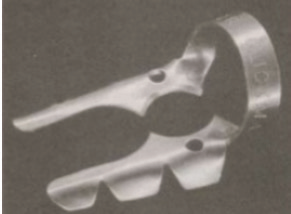
Offset clamps (Pic 7)
The bow of the clamp is placed to one side (right/left) this provides better access and does not interfere with the normal anatomic structures, provides space for matrix and retainers.
Pic 7
Long guard extension clamp (Pic 8)

Pic 8
The clamp retracts the tongue and protects the soft tissue.
Tiger clamp (Pic 9)

Pic 9
This clamp provides additional retention with their serrated jaws, especially helpful in case of broken down teeth.
Gingival retractor clamps (Pic 10)
Provides maximum retraction without laceration of gingival tissues.
Pic 10
PLACEMENT OF THE CLAMP
Select the clamp, place it at the cervical region of the tooth, which is the narrowest part of the tooth.
The jaws of the clamp should not exceed beyond the mesial and distal line angles of the tooth because
- Complete seal around the anchor tooth is difficult to achieve
- Gingival trauma more likely to occur
- Interfere with matrix and wedge placement
- Jaws should not extend beyond mesial and distal line angles of tooth
In order to choose the clamp one needs to know the type of tooth, shape of tooth and dimensions.
CLAMPS ARE NUMBERED AND CORRESPOND TO SPECIFIC TOOTH
Preparation of the selected clamp
Tie an 18 inch floss around the bow of the wing style clamp, before placing it on the anchor tooth.
In case of winged clamp place the hole punched in the sheet over the wings and carry the sheet and the clamp onto the tooth to be isolated.
In case of wingless clamps, place the clamp over the tooth followed by the sheet over it.
CLAMP SELECTION AND PLACEMENT ON THE TOOTH


HEAT TREATMENT OF CLAMPS
Heat treatment improves the strength, hardness, ductility and corrosion resistance.
Tempering of clamps (steel) has effects of toughening, by lessening brittleness and reducing internal stresses.
REFERENCES
- https://pocketdentistry.com/rubberdam
- https://ap.coltene.com/pim/DOC/TM/doctmdam-it-it-s-easy-finalsenaindv1.pdf
- https://www.researchgate.net/publication/281442356_HEAT_TREATMENT
Disclaimer from Guident
The views and opinions expressed in articles published in Guident are solely those of the authors and do not necessarily reflect the views of the editors, the editorial board or the publisher, Ivory India. Guident does not endorse any product, technique or treatment described. Clinical content is intended for qualified dental and medical professionals and is not a substitute for individual clinical judgement. Guident, its editors and the publisher accept no liability for any consequence arising from the use of information published in the journal.
How to cite this article
Dr. Pavana Kamath. Rubber Dam Clamps. Guident. 2019 Jul;12(8). Available from: https://guident.in/articles/endodontics/rubber-dam-clamps.html