
Management of Complicated Tooth Fracture with Interdisciplinary Approach Followed by Fiber Post and Lithium Disilicate Crown
ABSTRACT
Traumatic dental injuries are prevalent but management with functional and esthetic rehabilitation is a prime concern. Various treatment modalities including fiber post have been explained which has raised the life of the tooth along with its strength. This paper highlights the importance of interdisciplinary approach for rehabilitation of complicated fractured anterior tooth. Key words: complicated fracture, fiber post, osteoplasty, lithium disilicate.
INTRODUCTION
During any traumatic injury to facial region, the incidence of maxillary anterior being injured, is 37% as they are most facially placed in the arch. This is followed by maxillary lateral incisors (16%) and mandibular central incisor. The incidence of complicated crown fracture ranges from 2 – 13% of all dental injuries.1
Although traumatic dental injuries are prevalent and their management is a challenge to the clinician, but treatment modalities have raised the life of the tooth.2 The treatment for coronal tooth fracture depends upon various factors such as extent of fracture (biological width violation, endodontic involvement and alveolar bone fracture), pattern of fracture and restorability, soft tissue status, condition of fractured tooth fragment and remaining tooth fracture, occlusion, esthetics, economical status and prognosis.3
Moreover gingivectomy, osteotomy/osteoplasty, flap surgery or combination may be needed if required.4
The objective of this paper was to present a case of complicated crown fracture requiring endodontic treatment, crown lengthening with the use of glass reinforced fiber composite followed by all ceramic prosthesis.
CASE REPORT
A 21 years old male patient reported to department with a chief complaint of pain and fractured tooth in left upper anterior teeth region. Patient had given history of trauma 18 days back. Intraoral examination revealed complicated crown root fracture irt 22; Ellie’s class 2 fracture irt 21 (figure 1 and 2). On palpation, no dento - alveolar fracture was noticed. The treatment was planned in six phases. (1) Emergency phase included the surgical removal of fractured segment followed by access opening irt 22. 2) In systemic phase: Antibiotics and analgesics were prescribed. (3) Preventive phase: oral prophylaxis and oral hygiene with diet instructions. (4) Preparatory phase: root canal treatment irt 22 and tooth build up with direct composite resinirt 21 with putty index method.5 Corrective phase: crown root lengthening involving osteoplasty, fiber post and all ceramic prosthesis irt 22 and composite tooth buildup irt 216 Maintenance phase: recall after 1 week for follow-up and regularly after 3 months. Patient was asymptomatic. Access opening was done irt 22, working length was established and obturation was done with AH Plus sealer (Dentsply, Maillefer, and North America). (figure 3). Crown lengthening procedure was performed which included gingivectomy along with osteoplasty (figure 4 and 5). Post space preparation was done with Peeso Reamer no 3 (Mani, Japan). Fiber post placement with resin cement (RelyX™ U200)and core build up was done (Luxa Core Z-Dual)(figure 6 and 7). Tooth build up was done irt 21 with putty index method (figure 8). Tooth preparation was done for all ceramic prosthesis irt 22 (figure 9).Putty impression was taken (Dentsply siorna, USA) (figure 10) followed by E max. (Lithium disilicate) prosthesis was given irt 21 (Figure 11).
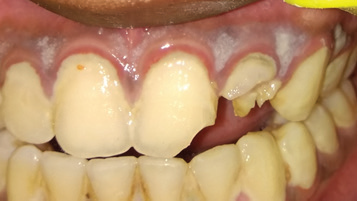
Figure 1

Figure 2
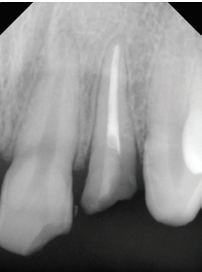
Figure 3

Figure 4
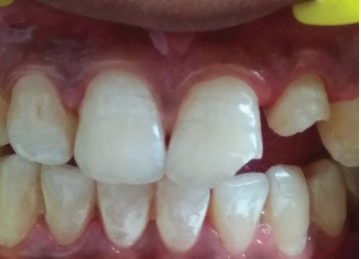
Figure 5
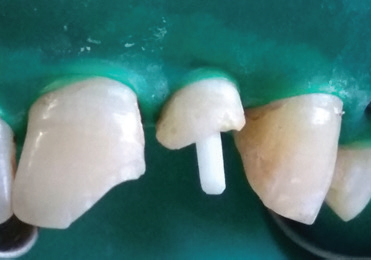
Figure 6
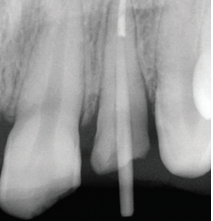
Figure 7
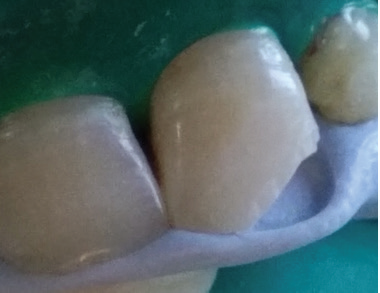
Figure 8
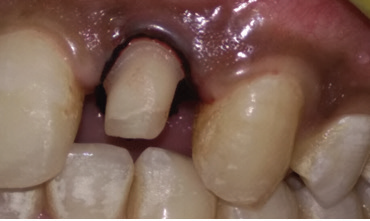
Figure 9
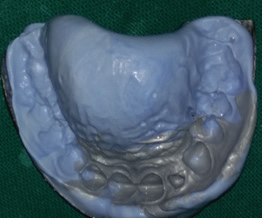
Figure 10
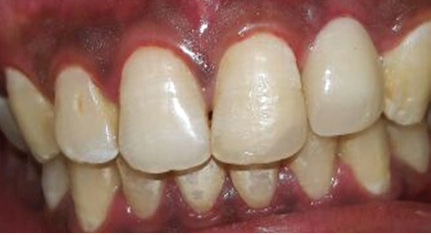
Figure 11
DISCUSSION
Trauma with accompanying fracture of anterior teeth is a tragic experience and requires immediate attention. It’s not only because of damage to the dentition but also psychological effect of the trauma to the child and his/her parents.5 Various treatment modalities have been proposed for crown root fractures: If the fracture line is supragingival, the procedure for reattachment will be straight forward. Second option is to convert subgingival fracture to supragingival fracture with the help of crown lengthening procedures which can include gingivectomy, surgical extrusion or orthodontic intervention. This results in favorable gingival and periodontal health without compromising the integrity of alveolar bone or periodontal support along with excellent esthetics.6,7
Reattachment procedure using acid-etch technique was first reported by Tennery. Subsequently, Starkey and Simonsen had also documented such cases. With the current concepts of dentine hybridization, reattachment procedures have better prognosis with promising long-term results.8
In this present case report, after taking informed consent from the patient, the mobile coronal fragments was extracted atraumatically followed by gingivectomy and osteotomy procedure was performed in order to get clean margins for restoration. This was followed by endodontic therapy, placement of prefabricated fibre post, composite core build and followed by all ceramic crown restoration. Orthodontic extrusion was also ruled out because of the time constraint on the part of patient.7
The lack of adequate tooth structure necessitates it to be supported with an anchorage system. For better esthetics, tooth-colored glass-fiber composite posts can be utilized as they have light transmission properties and are capable of resisting occlusal loads. In the present case, an adhesive, dual-cure-luting composite system and a glass-fiber-reinforced composite post were used.9,10
Tooth-colored fiber posts have several advantages. Their main proposed advantage is monobloc effect, good aesthetics and flexibility as compared to metal posts and have approximately the same modulus of elasticity as dentin. Tooth during function should result in better stress distribution and fewer fractures.11,12
Junge and colleagues reported that posts cemented with resin cements were more resistant to cyclic loading than were those cemented with zinc phosphate or resin-modified glass-ionomer cement.13
In Maxillary right central incisor, patient had Ellis class II fracture for which the vitality tests were normal and so it was decided to be treated with direct composite restoration. Well supporting putty index matrix will be required when restoring proximal defects which are greater in dimensions to satisfactorily re-establish adequate contour and contact form Advantages with putty index matrix are that exact palatal contour and form can be obtained, since it is a rigid matrix exact contour can be obtained even in large defects and also can be used predictably to restore multiple defects; disadvantages are that a mock buildup of the defect has to be made, may require second appointment, composite build up can adhere to the adjacent tooth especially if the adjacent tooth is not isolated.
In this case, fragment reattachment was ruled out due to trauma since fragments were broken into small pieces & hence it does not meet the criteria for reattachment procedures.
CONCLUSION
The goal of conservative dentistry is to conserve as much tooth structure as possible. Moreover fracture of an anterior tooth is a traumatic incident but preservation of the remaining natural and healthy tooth structure will have a positive psychological impact on the patient. Coordinated multidisciplinary approach with careful consideration of patients expectations & request are critical for successful outcome & patient satisfaction.REFERENCES
- Kang Y, Franco CS. A story of dental injury and orthodontics. Oral Health Dent Manag 2014; 13: 243-53.
- Anand S, Hegde DY, Yeluri R, Masih U, Yadav P, Kumar S. Comprehensive management of complicated crown fracture in 10 year old child. Int J Pedod Rehabil 2017; 2: 46-50.
- Macedo GV, Diaz PI, De O Fernandes CA, Ritter AV. Reattachment of anterior teeth fragments: A conservative approach. J Esthet Restor Dent 2008; 20: 5-18.
- Olsburgh S, Jacoby T, Krejci I. Crown fractures in the permanent dentition: Pulpal and restorative considerations. Dent Traumatol 2002; 18: 103–15.
- Hegde RJ. Tooth fragment reattachment – An esthetic alternative: Report of a case. J Indian Soc Pedod Prev Dent 2003; 21: 117-9.
- Andreasen JO, Andreasen FM, Andreasson L. In: Textbook and Colour Atlas of Traumatic Injuries to the Teeth. 4th ed. Copenhagen- Denmark: BlackwellMunksgaard Publishers; 2007.
- Kulkarni et al. Clinical management of a complicated crown root fracture using autogenous tooth fragment: A biological restorative approach. Contemp Clinical Dent. Jan- Mar 2013; vol.4 (1): 84-87.
- Starkey PE. Reattachment of a fractured fragment to a tooth. J Indiana Dent Assoc 1979; 58: 37-8.
- Freedman GA. Esthetic post-and-core treatment. Dent Clin North Am 2001; 45: 103-16.
- Koutayas SO, Kern M. All-ceramic posts and cores: The state of the art. Quintessence Int 1999; 30: 383-92.
- Schwartz RS, Robbins JW.Post placement and restoration of endodontically treated teeth: a literature review. J Endod 2004; 30(5): 289-301.
- Ferrari M, Vichi A, García-Godoy F. Clinical evaluation of fiber reinforced epoxy resin posts and cast post and cores. Am J Dent2000; 13 (spec iss):15B-18B.
- Junge T, Nicholls JI, Phillips KM, Libman WJ. Load fatigue of compromised teeth: a comparison of three luting cements. Int J Prosthodont 1998; 11(6): 558-564.
Disclaimer from Guident
The views and opinions expressed in articles published in Guident are solely those of the authors and do not necessarily reflect the views of the editors, the editorial board or the publisher, Ivory India. Guident does not endorse any product, technique or treatment described. Clinical content is intended for qualified dental and medical professionals and is not a substitute for individual clinical judgement. Guident, its editors and the publisher accept no liability for any consequence arising from the use of information published in the journal.
How to cite this article
Dr. Tanvi Paliwal, Dr. Ajay Nagpal, Department Of Conservative Dentistry & Endodontics, K. D. Dental College & Hospital, Mathura. Management of Complicated Tooth Fracture with Interdisciplinary Approach Followed by Fiber Post and Lithium Disilicate Crown. Guident. 2019 Jul;12(8). Available from: https://guident.in/articles/endodontics/management-of-complicated-tooth-fracture-with-interdisciplinary-approach-followed-by-fiber-post-and-lithium.html


