Preserving Tooth Structure with Composite Inlays: A Case Analysis
Department of Conservative Dentistry and Endodontics, Seema Dental College And Hospital, Rishikesh
ABSTRACT
A composite inlay is a dental restoration used to repair damaged or decayed teeth, typically in cases where a filling would be insufficient, but a crown is unnecessary. It is made from composite resin, a tooth-colored material that provides a natural appearance and blends seamlessly with the surrounding tooth structure. Composite inlays are custom-fabricated in a dental lab or created chairside using modern CAD/CAM technology. They are bonded securely to the tooth, offering durability and resistance to wear, while preserving more of the natural tooth. This minimally invasive solution ensures both functionality and aesthetic appeal.
INTRODUCTION
Direct composite restorations are often associated with challenges such as polymerization shrinkage and reduced fracture toughness.1 In order to allow a higher degree of conversion of indirect resin composites, different polymerization techniques combining light, heat, vacuum or pressure were utilized.6 All these measures led to enhancement of the properties of indirect resin composites. To address these limitations, indirect composite restorations have become a viable alternative. Advancements in adhesive technology and restorative materials have greatly enhanced treatment strategies for restoring posterior teeth. While amalgam and gold restorations have consistently demonstrated clinical success and biocompatibility, tooth-colored restorations are increasingly replacing metal-based options, not only for aesthetic purposes but also due to the ability to perform more conservative tooth preparations.5
Ceramic and resin composite materials are commonly used in restorative dentistry for their natural aesthetics and functionality. Ceramics offer strong mechanical properties and a long-term success rate of about 90% over 10 years but may require extensive tooth preparation.2 Resin composites are more conservative and can achieve good aesthetics, yet they face challenges like polymerization shrinkage, microleakage, and color instability. Indirect techniques with resin composites help address some of these issues by allowing complete curing outside the oral environment, reducing shrinkage, and improving proximal contours. This approach is particularly beneficial for large cavities in posterior teeth where direct composites may not provide sufficient strength. Despite the popularity of resin composites, there’s limited evidence on their long-term clinical performance compared to ceramics. However, indirect composite restorations can provide better occlusion and tooth form in extensive restorations.
CASE REPORT 1
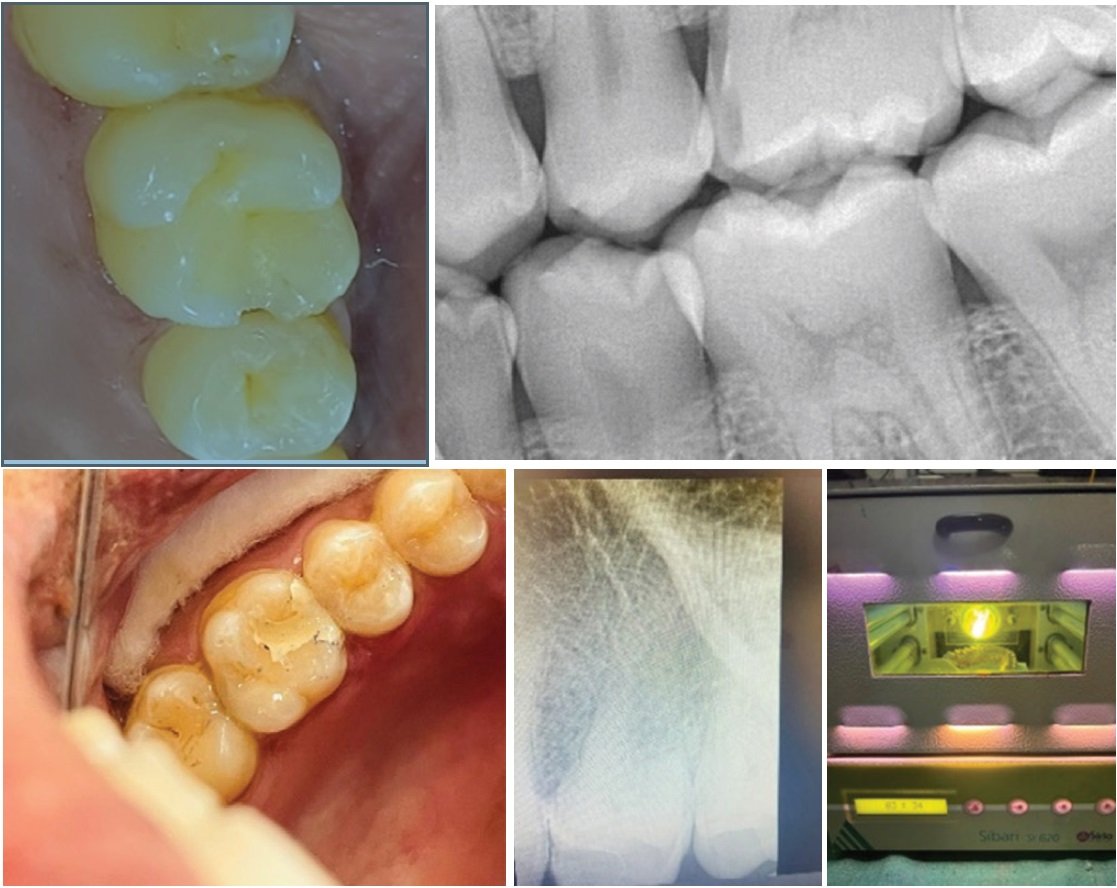
A 32-year-old patient presented to the Department of Conservative Dentistry and Endodontics with a chief complaint of decay in the upper left molar region, along with food lodgment in the area. Based on clinical and radiographic examination, an indirect composite inlay was recommended as the treatment plan.
CASE REPORT 2
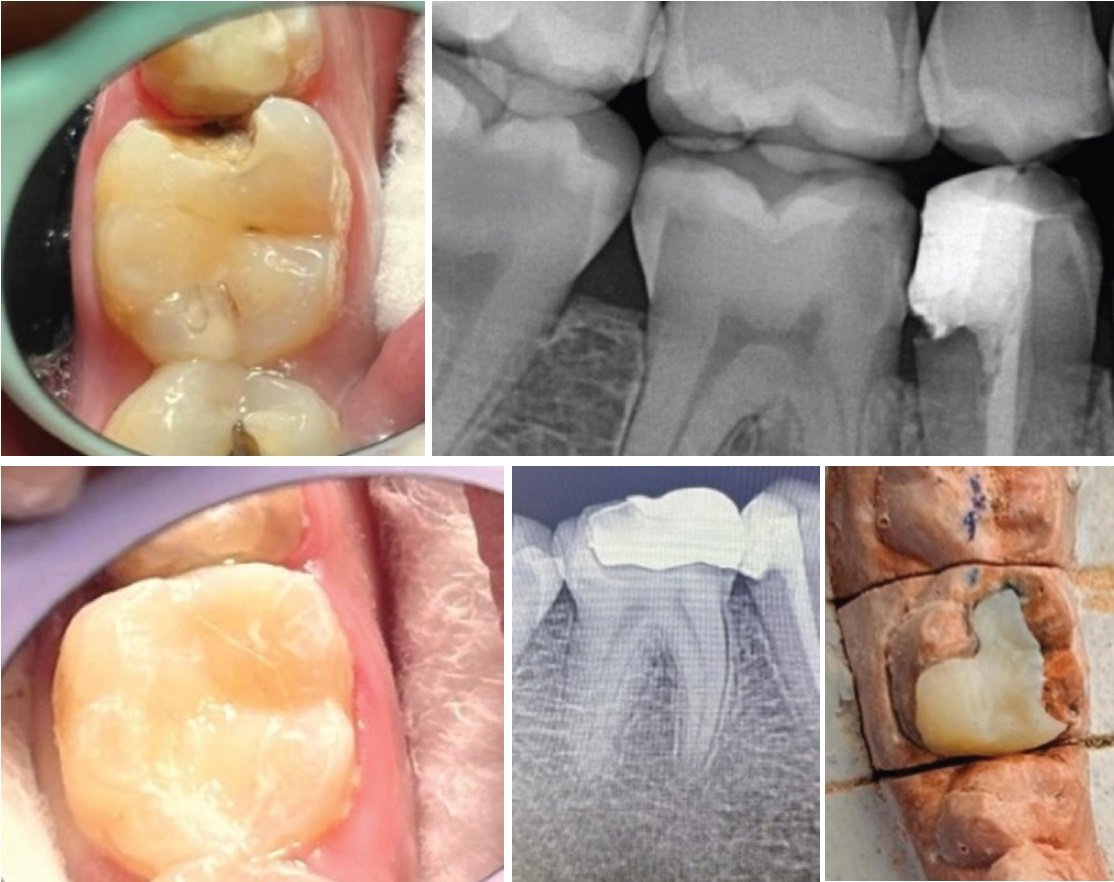
A 23-year-old patient visited the Department of Conservative Dentistry and Endodontics, reporting issues of decay and food accumulation in the lower right molar area. Following clinical and radiographic evaluation, an indirect composite inlay was advised as the appropriate treatment.
DISCUSSION
Indirect resin composites are increasingly favored over metal-ceramic restorations, especially for bruxing patients. They offer easier intraoral repairs, reducing the need for full replacements, which can be costly and time-consuming. Their wide range of shades allows for better aesthetic outcomes, blending seamlessly with natural teeth and gingiva. Additionally, these composites distribute occlusal forces more effectively than ceramics, lowering the risk of fractures. Overall, they provide a durable and cost-effective solution, with high clinical success rates.
CONCLUSION:
Indirect resin composites offer a practical solution for patients needing extensive restorations,4, especially those with bruxism or other parafunctional habits. They provide a blend of aesthetic flexibility, durability, reparability, and cost savings, making them a valuable alternative to conventional metal-ceramic options.3 Indirect resin composites seem to be an excellent alternative for restorations in selected clinical cases where ceramic restoration is not possible
REFERENCES
- Neelam Mittal , Nidhi Singh, Chi Koy Wan Indirect Composite Inlays Restoration: A Case Report Indian Journal of Dental Education, Volume 13 Number 1, January – March 2020
- Galiatsatos A, Galiatsatos P, Bergou D. Clinical Longevity of Indirect Composite Resin Inlays and Onlays: An Up to 9-Year Prospective Study. Eur J Dent. 2022 Feb;16(1):202-208. doi: 10.1055/s-0041-1735420. Epub 2021 Nov 8. PMID: 34749421; PMCID: PMC8890907.
- Mandikos MN, McGivney GP, Davis E, et al. A comparison of the wear resistance and hardness of indirect composite resins. J Prosthet Dent 2001 Apr;85(4):386–95
- Soares CJ, Martins LR, Pfeifer JM, et al. Fracture resistance of teeth restored with indirect-composite and ceramic inlay systems. Quintessence Int 2004 Apr;35(4):281–86
- M Veneziani Posterior indirect adhesive restorations: updated indications and the Morphology Driven Preparation TechniqueInt J Esthet Dent201712220430
- Keith H S Chan Review: Resin Composite FillingMaterials 20103212284310.3390/ma 3021228
Disclaimer from Guident
The views and opinions expressed in articles published in Guident are solely those of the authors and do not necessarily reflect the views of the editors, the editorial board or the publisher, Ivory India. Guident does not endorse any product, technique or treatment described. Clinical content is intended for qualified dental and medical professionals and is not a substitute for individual clinical judgement. Guident, its editors and the publisher accept no liability for any consequence arising from the use of information published in the journal.
How to cite this article
Dr. Kancha Shalvini, Dr. Eva Mishra, Dr. Anil Dhingra. Preserving Tooth Structure with Composite Inlays: A Case Analysis. Guident. 2024 Dec;18(1). Available from: https://guident.in/articles/endodontics/preserving-tooth-structure-with-composite-inlays-a-case-analysis.html